Industrial Mixers
PerMix News & Updates
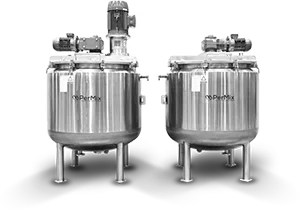
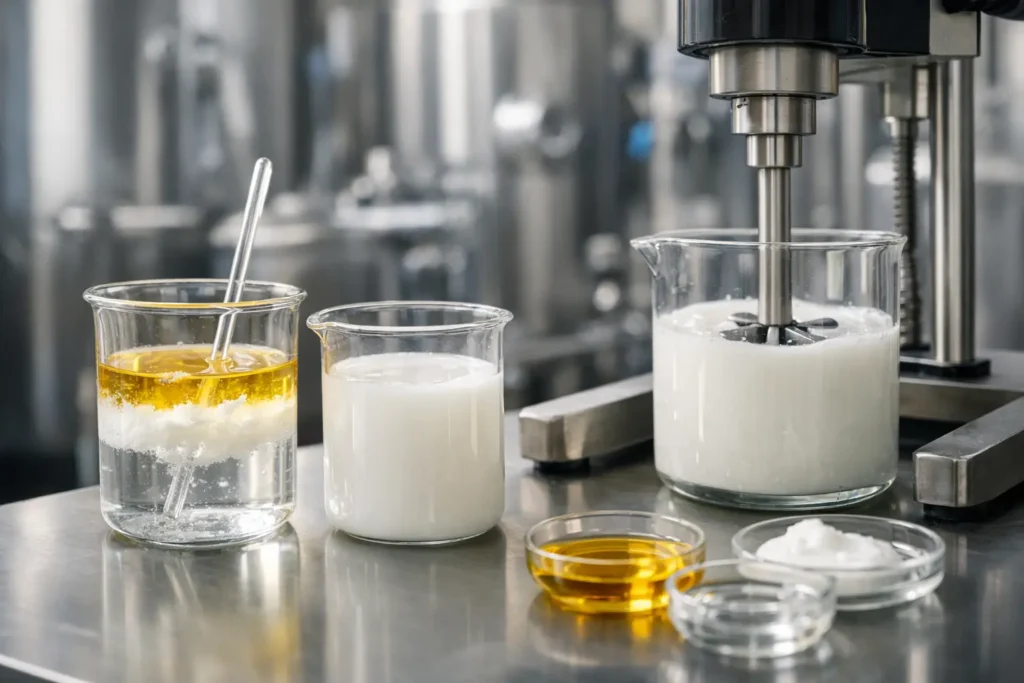
A stable emulsion is rarely achieved by selecting a machine from a catalog. Oil phase ratio, viscosity, temperature, droplet-size target, batch volume, sanitation requirements, and downstream handling all determine whether an emulsification process will perform reliably. Knowing how to select an emulsifier begins by separating two connected decisions: selecting the chemical emulsifying agent and selecting the industrial emulsification equipment that supplies the required energy and process control.
For manufacturers, the second decision is often where product quality is won or lost. A formulation may be chemically sound in the laboratory yet separate, aerate, overheat, or vary from batch to batch when moved into production. The correct emulsifier system must create the intended droplet structure while fitting the complete manufacturing process.
An emulsion consists of one liquid phase dispersed as droplets within another immiscible liquid phase. Most industrial applications are oil-in-water emulsions, such as beverages, sauces, creams, coatings, and certain pharmaceutical or chemical products. Water-in-oil systems are also common in spreads, specialty cosmetics, and protective coatings. The emulsion type establishes the starting point for both surfactant selection and equipment design.
First, define what the finished product must do. A lotion may require a fine droplet size for texture and shelf stability. A food dressing may need a controlled particle distribution that delivers the intended mouthfeel without making the product excessively viscous. A polymer or chemical emulsion may be specified around reaction performance, conductivity, or coating behavior. These requirements are more useful than a general request for “high shear.”
The chemical emulsifier must be compatible with the two phases, process temperature, pH range, salts, active ingredients, and regulatory requirements. Hydrophilic-lipophilic balance, interfacial tension reduction, and dosage matter, but they are not independent of the mechanical process. A surfactant that performs in a small beaker may need a different addition sequence, temperature profile, or shear exposure at production scale.
Product viscosity is equally influential. Low-viscosity liquid emulsions can often circulate efficiently through an inline rotor-stator homogenizer. High-viscosity creams, pastes, and concentrated emulsions may not flow through an external loop without excessive pressure, poor turnover, or localized heating. These products typically benefit from a vacuum emulsifying mixer or a multi-motion vessel system that combines bulk agitation, wall sweeping, and high-shear dispersion within the same processing vessel.
Rotational speed is not a universal measure of emulsification capability. Tip speed, rotor-stator geometry, gap size, product residence time in the high-shear zone, recirculation rate, and viscosity all affect the actual energy delivered to the dispersed phase.
A high-shear rotor-stator emulsifier works by drawing material into a rotor-stator head, accelerating it, and forcing it through precisely controlled openings. The resulting hydraulic and mechanical forces break droplets and distribute the dispersed phase. However, more shear is not automatically better. Excessive energy can introduce heat, damage shear-sensitive ingredients, change rheology, destabilize protein systems, or create unnecessarily fine droplets that alter the product’s intended performance.
Set a measurable droplet-size objective whenever possible. This may be a maximum droplet diameter, a distribution range, a visual stability requirement, or a validated performance specification. Then evaluate whether the equipment can consistently achieve that result at the target batch size and cycle time.
Laboratory trials should also account for the difference between a single pass and a full production process. A bench homogenizer may expose a small sample to repeated high-shear passes very quickly. A production vessel must process every portion of a much larger batch with comparable consistency. Scale-up therefore requires more than increasing motor horsepower. It requires analysis of vessel geometry, circulation patterns, recirculation volume, and the location where each phase enters the process.
Industrial emulsification systems are available in several configurations, each with clear application advantages. The right choice depends on the product and operating method, not on which equipment category has the highest published speed.
A vacuum emulsifying mixer is often the preferred solution for viscous creams, ointments, sauces, gels, and personal care products. It combines an anchor or scraper agitator for bulk movement with a high-shear emulsifier for droplet reduction. Vacuum capability supports deaeration, improves powder wetting, limits oxidation for sensitive products, and helps produce a smoother finished appearance.
This configuration is especially valuable when heating, cooling, powder induction, phase transfer, and vacuum deaeration must occur in a controlled batch sequence. The trade-off is that batch processing requires disciplined cycle control and may be less suitable than an inline system for very high-volume continuous production.
Inline emulsifiers are well suited to lower-viscosity products, continuous processing, and applications requiring efficient recirculation through a high-shear zone. They can be installed in a single-pass arrangement or used with a process vessel and recirculation loop. Multiple passes may improve droplet-size reduction, but the loop must be designed for the product’s viscosity, temperature, pressure limitations, and required production rate.
An inline unit is not a substitute for adequate tank agitation. If the vessel does not maintain uniform bulk circulation, some material may receive insufficient shear while other material passes through the homogenizer repeatedly. The result can be batch variation despite a capable inline machine.
Bottom-entry emulsifiers place the high-shear head directly in the vessel, making them practical where compact layout, sanitary design, and direct processing are priorities. They can be paired with an anchor agitator, scraper, or other low-speed mixing element to manage the entire volume. This approach can reduce external piping and product hold-up while providing strong localized shear.
The critical engineering question is whether the high-shear zone and bulk flow pattern reach all material effectively. Dead zones near the wall, liquid surface, or vessel bottom can compromise repeatability, particularly with viscous products or formulations that thicken during cooling.
Many production problems attributed to the emulsifier begin upstream or downstream. Poor powder wetting can form agglomerates that remain visible after high shear. Inconsistent oil addition can overload the emulsifying agent locally and create unstable droplets. Inadequate heating may leave waxes or fats partially melted. Cooling too slowly or too quickly can shift viscosity, crystallization behavior, or product structure.
For this reason, equipment selection should include ingredient addition strategy. Liquid injection points, powder induction systems, phase premixing, transfer pumps, and recirculation piping all affect final quality. If powders are difficult to wet, a vacuum powder induction system may provide more value than simply increasing emulsifier speed. If the product traps air, vacuum deaeration should be evaluated as part of the process rather than treated as a separate correction step.
Thermal management also deserves early attention. High shear generates heat, and many emulsions require a controlled temperature window during phase combination and cooling. Specify jacket area, heating and cooling media, temperature measurement locations, and control logic based on the actual batch cycle. A system that reaches the required temperature but cannot remove heat at the required rate may become the production bottleneck.
In food, beverage, pharmaceutical, cosmetic, and specialty chemical facilities, cleanability is a performance requirement. Product-contact materials, surface finish, seals, elastomers, drainability, clean-in-place coverage, and access for inspection should be evaluated before equipment is approved. An emulsifier that produces excellent quality but requires excessive manual cleaning can reduce available production time and introduce avoidable contamination risk.
Automation should match the criticality of the process. At minimum, manufacturers often need repeatable control of agitator speed, emulsifier speed, temperature, vacuum level, phase addition timing, and batch duration. Higher-value systems may include recipe management, load cells, flow measurement, data recording, alarms, and integration with plant control platforms. These controls are not optional extras when batch repeatability and validation matter.
Material compatibility must also be verified against the formulation and cleaning chemistry. Stainless steel grade, seal design, bearing arrangement, and elastomer selection affect reliability in acidic, solvent-based, abrasive, or high-temperature service. The lowest initial equipment price can become the highest lifecycle cost if wear parts fail early or cleaning requirements were underestimated.
The most reliable selection process uses representative product trials. Test the real ingredients at the intended concentration, temperature, and processing sequence. Record viscosity, droplet size, visual appearance, density, air content, batch time, and stability after storage. Where possible, run trials at more than one shear level and addition rate to identify the operating window rather than a single acceptable condition.
A capable equipment partner should ask detailed questions about your formulation, production target, cleaning standard, utilities, and plant constraints before proposing a configuration. PerMix applies this process-first approach because the best emulsifier is not simply the machine with the most power. It is the system that produces the required product consistently, fits the operating environment, and supports measurable production performance.
Select the emulsifier around the process your plant must run every day: the real formulation, real batch size, real cleaning cycle, and real quality standard. That is where stable emulsions become dependable manufacturing results.
Stay Connected