Industrial Mixers
PerMix News & Updates
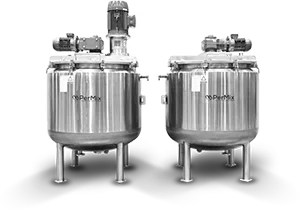
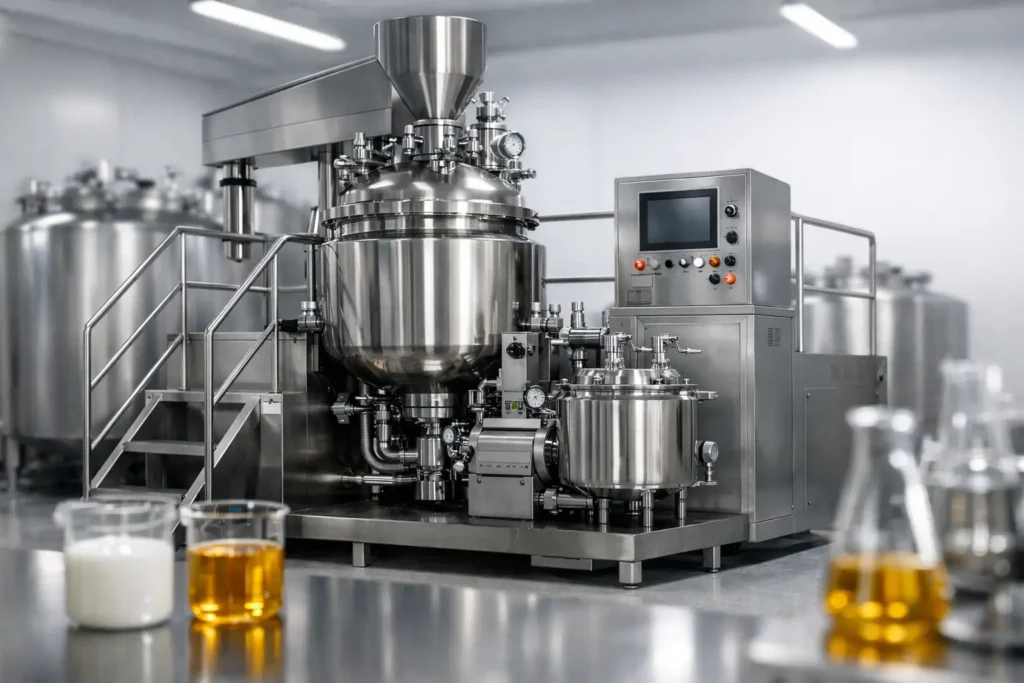
A cream that looks smooth in the pilot lab can fail quickly at production scale. Air remains trapped in the batch, powder fisheyes appear after filling, viscosity shifts from one vessel to the next, or an emulsion separates after temperature cycling. This vacuum emulsifying equipment buying guide focuses on the engineering decisions behind those outcomes, not just a list of vessel sizes and motor ratings.
Vacuum emulsifying systems are used when a formulation requires controlled dispersion, high shear, deaeration, heating or cooling, and repeatable batch conditions in one integrated process. They are common in cosmetics, personal care, pharmaceuticals, foods, chemicals, adhesives, coatings, and specialty materials. The right system can improve product quality and cycle time. The wrong one can create a permanent production constraint that no control adjustment will fully correct.
A vacuum emulsifier should be specified around the material and the process sequence. Before evaluating equipment, define what happens from raw-material charging through discharge. Identify the phases being combined, the order of addition, the temperature profile, the target particle or droplet size, the finished viscosity, and the acceptable batch cycle time.
The most useful question is not, “What capacity mixer do we need?” It is, “What must happen to this material at each point in the batch?” A low-viscosity lotion, a wax-containing cream, a polymer gel, and a highly aerated paste may all be called emulsions, but they place very different demands on agitation, homogenization, vacuum capability, heat transfer, and discharge.
Material behavior deserves particular attention. Document viscosity at minimum and maximum process temperatures, not only at room temperature. Determine whether the formulation is shear-thinning, yield-stress sensitive, heat sensitive, abrasive, foaming, or prone to agglomeration. A system that handles the final product may still struggle during the intermediate stage where viscosity peaks or powders are introduced.
Vacuum emulsifying equipment normally combines an anchor-style agitator with a high-shear homogenizer. The anchor moves bulk material through the vessel, sweeps the heat-transfer surface, and supports uniform temperature and ingredient distribution. The homogenizer supplies localized mechanical energy to reduce droplet size, disperse solids, and break agglomerates.
Neither component should be selected in isolation. High rotor speed alone does not guarantee a stable emulsion. The relevant factors include rotor-stator geometry, tip speed, power input, recirculation through the shear zone, batch viscosity, residence time, and the formulation’s response to shear. Some products need intense short-duration homogenization; others require lower shear to avoid damaging sensitive structures or incorporating excess heat.
For high-viscosity creams, ointments, gels, and pastes, an anchor agitator with wall scrapers is often essential. Scrapers improve heat transfer and reduce the risk of material baking onto the vessel wall. Their design and pressure against the wall should suit the product and cleaning method. A system intended for sticky, high-value formulations also needs to leave minimal residual material after discharge.
Homogenizer location matters. Bottom-entry homogenizers are frequently effective for high-shear processing and can promote circulation through the vessel. In-tank and external recirculation configurations may be better suited to certain batch sizes, sanitary requirements, or process sequences. The correct arrangement depends on whether every portion of the batch reliably passes through the high-shear zone.
Vacuum does more than remove visible bubbles. It can improve density consistency, appearance, filling accuracy, oxidation control, and emulsion stability. It also supports powder induction and can lower boiling points when processing under controlled temperature conditions.
The required vacuum level depends on the product, batch temperature, vapor load, vessel volume, and desired deaeration time. A deeper vacuum is not automatically better. Excessive vacuum can cause volatile loss, uncontrolled expansion, or foaming, especially when surfactants are present. The system must be designed to manage foam and condensable vapors without allowing product carryover into the vacuum line.
Evaluate the entire vacuum circuit, including the pump type, condenser or condensate receiver, filters, piping diameter, valves, and instrumentation. A vacuum pump sized without considering vapor generation may pull down an empty vessel quickly but perform poorly during an actual heated batch. For pharmaceutical, food, or personal care production, hygienic design and cleanability of the vacuum path are as important as pump capacity.
Many emulsions depend on precise thermal control. Waxes must melt fully, emulsifiers must activate at the intended temperature, powders may hydrate within a defined range, and the batch may need rapid cooling to establish final texture. A jacketed vessel is standard, but jacket area alone does not determine performance.
Confirm the available heating and cooling utilities, including steam, hot water, thermal fluid, chilled water, and glycol. Then evaluate the required heat-up and cool-down rates using the actual batch mass, specific heat, vessel geometry, agitation performance, and viscosity profile. As viscosity rises, heat transfer becomes more dependent on effective wall sweeping and bulk circulation.
Temperature probes should represent the batch, not merely the jacket or a stagnant zone. For critical products, consider whether multiple temperature measurements, recipe-driven ramp rates, and automated utility control are needed to protect quality and reduce operator variation.
Nominal vessel volume is rarely the right purchasing metric. Vacuum emulsifiers need headspace for agitation, foam control, ingredient additions, and safe vacuum operation. A vessel with a 1,000-gallon total capacity may have a significantly lower effective working volume depending on product behavior and process requirements.
Define minimum and maximum batch sizes. Operating too far below the intended working range can reduce agitator effectiveness, leave the homogenizer inadequately immersed, or compromise temperature control. Operating too close to the vessel’s upper limit can create foaming and charging problems. If the plant expects a broad product portfolio, a flexible working range may be more valuable than selecting equipment around one current formula.
Throughput should include the full cycle: charging, heating, mixing, homogenization, vacuum deaeration, cooling, sampling, discharge, and cleaning. A vessel that produces a batch in four hours is not necessarily a four-hour production system if cleaning and changeover add two more hours. This distinction affects the number of vessels required, labor planning, and return on capital.
Many emulsification failures begin during charging. Adding powders through an open manway may be acceptable for simple, low-volume formulations. It is rarely the best answer for dusty powders, difficult-to-wet ingredients, or processes where operator consistency matters.
A powder induction system can pull powders directly into the liquid stream under vacuum or through a controlled high-shear zone. This can reduce dust, shorten wet-out time, and minimize agglomerates. However, powder induction equipment must be matched to bulk density, flowability, particle size, feed rate, and the liquid phase’s ability to wet the powder. Bridging in a hopper or overfeeding the induction point can stop a process just as effectively as an undersized homogenizer.
Also consider liquid metering, load cells, transfer pumps, and the number of addition ports. When a formula includes multiple oils, active ingredients, fragrances, or heat-sensitive components, the addition architecture should support the recipe rather than force operators into improvised steps.
Cleaning requirements should influence vessel geometry, surface finish, agitator design, seals, valves, and piping from the outset. For frequent product changes or regulated production, a clean-in-place system may be justified. For highly viscous products, confirm that cleaning coverage reaches the underside of agitator components, homogenizer areas, discharge valves, and all recirculation lines.
Specify wetted materials and elastomers for chemical compatibility, corrosion resistance, cleaning chemicals, and temperature exposure. Stainless steel grade, surface finish, gasket selection, mechanical seal design, and drainability all affect long-term reliability. If the application requires sanitary, pharmaceutical, explosion-proof, or validation-oriented construction, establish those standards before the mechanical design is finalized.
Controls determine whether the equipment can produce the same result after the commissioning team leaves. At a minimum, operators need clear control of agitator speed, homogenizer speed, temperature, vacuum level, utility valves, and process time. The appropriate automation level depends on product risk, batch frequency, staffing, and documentation requirements.
Recipe management can improve repeatability where formulations require controlled addition order, thermal ramps, timed homogenization, and vacuum stages. Load cells and flow measurement may improve accuracy for critical ingredients. Data recording may be required for regulated applications and is often valuable for diagnosing quality variation in any manufacturing environment.
Do not automate a poorly defined process. First establish the operating window: acceptable temperatures, mixing speeds, vacuum range, addition rates, and endpoint criteria. Automation should enforce a proven process, not conceal uncertainty in the formulation or equipment design.
A meaningful equipment proposal should explain why the vessel configuration, agitator, homogenizer, vacuum system, thermal design, and controls fit the application. Be cautious of proposals that rely only on a capacity number and a generic power rating.
Ask suppliers to address representative viscosity, batch range, utility conditions, ingredient addition sequence, cleaning approach, discharge method, and expected cycle time. If possible, conduct product trials or review data from a comparable application. Trials are particularly valuable when the formula is highly viscous, foam-prone, temperature sensitive, or difficult to disperse.
PerMix approaches vacuum emulsification as an integrated process problem. The most productive specification discussion includes the product, production target, facility constraints, operator workflow, and long-term maintenance plan. Equipment performance is strongest when those factors are engineered together.
The best purchasing decision is the one that gives your operators a controlled, repeatable process instead of a machine that requires constant intervention. Bring real formulation data, realistic production targets, and the difficult parts of the batch into the specification meeting. Those details are where a vacuum emulsifying system earns its value.
Stay Connected