Industrial Mixers
PerMix News & Updates
A protein powder batch can look uniform at discharge and still fail where it matters: at the scoop. When high-intensity sweeteners, flavors, vitamin premixes, gums, and mineral ingredients are not distributed correctly, every downstream function inherits the problem. This protein powder blending case study examines a representative manufacturing challenge and the engineering decisions that moved the process from inconsistent batches to controlled, repeatable production.
The objective was not simply to replace an existing blender. The manufacturer needed to protect label claims, increase usable production capacity, reduce cleaning downtime, and maintain the flexibility to run whey, plant-based, and blended protein formulations on the same line.
The operation produced flavored nutritional powders in batch sizes ranging from 1,000 to 2,000 pounds. Major ingredients included whey protein concentrate, whey protein isolate, milk powder, cocoa, and carbohydrate carriers. Minor additions included salt, sweeteners, flavors, vitamin-mineral premixes, lecithin, gums, and flow agents.
Its legacy ribbon blender could combine the major powder fraction reasonably well, but performance declined as formulations became more demanding. Low-dose ingredients were introduced directly into the main batch. Fine powders formed agglomerates around localized liquid additions. Some finished lots showed variation in flavor intensity and nutritional assay results, while the cleaning cycle between allergen-containing and non-allergen products limited available run time.
The original equipment was not necessarily unsuitable for every protein powder. The issue was that the process had changed around it. Formulations contained wider differences in particle size, bulk density, and flow behavior than the blender and ingredient-addition method were designed to manage.
For a protein powder manufacturer, this distinction matters. A mixer is not selected only by vessel volume or horsepower. It must be evaluated against blend segregation risk, minor-ingredient dispersion, liquid addition requirements, batch frequency, discharge behavior, sanitation targets, and the controls needed to make each batch repeatable.
The engineering review began with material and process data rather than a catalog specification. The team examined bulk density, particle-size distribution, moisture sensitivity, flowability, fat content, cohesiveness, and the inclusion level of each ingredient. This identified several sources of variability that were being treated as one mixing problem.
The whey proteins and carbohydrate carriers had different particle-size distributions and densities. The vitamin-mineral premix was added at a very low percentage of the total batch, making direct addition vulnerable to localized concentration. Lecithin was being sprayed into the blender without sufficient atomization or distribution across the moving powder bed. Meanwhile, high-shear processing was not desirable for the complete formula because it could create excess fines, heat, and dust while providing no benefit to the bulk blend.
The analysis also considered the production schedule. A blender capable of fast mixing but difficult cleaning would not improve overall output. Conversely, a highly sanitary design with a long blend cycle would constrain the plant as demand increased. The correct solution needed to balance mixing intensity with gentle product handling, accessible cleaning, and reliable discharge.
Ribbon mixers are proven equipment for many dry powder applications, particularly free-flowing products with compatible bulk properties and moderate blending requirements. In this case, however, the formulation included low-level actives and a controlled liquid-addition step. The plant also needed faster batch turnover and better consistency across multiple product families.
A ribbon design could potentially have been retained with upstream premixing and revised liquid addition. That path would have reduced capital cost, but it would not have addressed all operational limitations. The manufacturer chose a more flexible configuration because the expected value came from improved total process performance, not from the lowest initial equipment price.
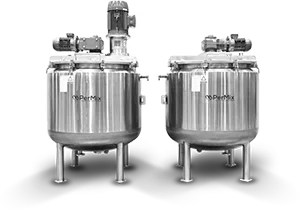
The selected solution was a sanitary paddle mixer with a full-length high-speed chopper, precision liquid-addition assembly, ingredient feeding provisions, and recipe-based automation. The paddle mixer created a fluidized mechanical mixing zone that moved powder throughout the vessel efficiently while remaining gentle enough for the protein base materials.
Paddle geometry and shaft speed were selected to create broad axial and radial movement. This reduced dead zones and shortened the time needed to achieve uniformity. The chopper was not run continuously as a substitute for mixing. It was applied at defined stages to break soft agglomerates and distribute lecithin after spray introduction.
Liquid addition was redesigned as a controlled process step. Lecithin was delivered through an atomizing spray arrangement positioned to contact the active powder zone rather than a stationary surface or vessel wall. Flow rate was synchronized with mixer operation, and the recipe established both spray duration and post-spray blend time. This prevented the localized wetting that had contributed to clumps and inconsistent instant properties.
Minor ingredients were no longer dumped individually into the full batch. The lowest-dose components were first combined with a compatible carrier to create a premix. That premix was then introduced in a controlled sequence after the major powders had established a uniform moving bed. This is a practical example of how process design can be more decisive than mixer type alone.
A consistent protein powder operation requires more than a validated blend time. It requires control over what enters the mixer, when it enters, and how the batch is released.
The automated recipe system managed ingredient sequence, mixer speed, chopper operation, liquid addition, blend duration, and discharge permissions. Load cells verified batch mass. Operator prompts reduced the chance of an ingredient being added at the wrong time, while production records supported investigation and quality review when needed.
This level of control is particularly valuable for manufacturers with frequent flavor changes and multiple formulations. A vanilla whey product, chocolate plant protein, and high-calorie mass gainer may all run through the same equipment, but they should not be treated as the same process. Their bulk behavior, liquid demand, mix time, and cleaning requirements may differ substantially.
Sampling strategy was revised at the same time. Rather than relying on a single sample taken near discharge, the quality team evaluated samples from multiple locations and batches during qualification. Assay testing focused on the ingredients most likely to reveal non-uniformity, including low-dose markers and flavor-related components. Blend time was established from actual performance data, with a defined operating window rather than an arbitrary fixed value.
The new process improved batch repeatability by controlling the conditions that previously changed from run to run. The manufacturer achieved more consistent distribution of minor ingredients, improved powder appearance after lecithin addition, and fewer quality holds associated with sensory variation or blend uniformity concerns.
Production capacity increased not because the mixer was simply larger, but because the complete cycle was engineered more effectively. Faster charging, shorter validated mixing periods, controlled liquid application, efficient discharge, and more practical cleaning reduced the nonproductive time surrounding each batch.
The gains also extended to operations. Operators had clearer batch instructions, maintenance teams had better access to critical components, and quality personnel had more meaningful process records. For the business, this meant higher confidence in release decisions and a production line better able to absorb growth without relying on excessive safety time or rework.
There were trade-offs. The integrated system required a greater initial investment than a basic replacement blender. It also required disciplined recipe development, operator training, and preventive maintenance for the spray and control systems. Those requirements are not drawbacks when they are planned correctly. They are part of building a process that can deliver consistent product at commercial scale.
The central lesson of this protein powder blending case study is that uniformity is created by the entire process, not by a mixer in isolation. Ingredient characteristics, premix strategy, charging order, liquid atomization, blend dynamics, discharge design, sanitation, and automation each influence the final scoop.
For a simple, free-flowing protein formula, a conventional batch blender may be the most economical and effective answer. For formulations containing low-dose actives, oils, lecithin, difficult plant proteins, or frequent product changeovers, the process often demands a more engineered approach. The right answer depends on the material data and the production objective.
PerMix approaches these applications by first defining the operating problem, then engineering the mixing system around the formula, capacity target, and plant realities. That is how equipment selection becomes a measurable production improvement rather than a replacement purchase.
The next productive question is not, “Which blender should we buy?” It is, “What must every finished scoop deliver, and what process conditions are required to make that result repeatable?”
Stay Connected