
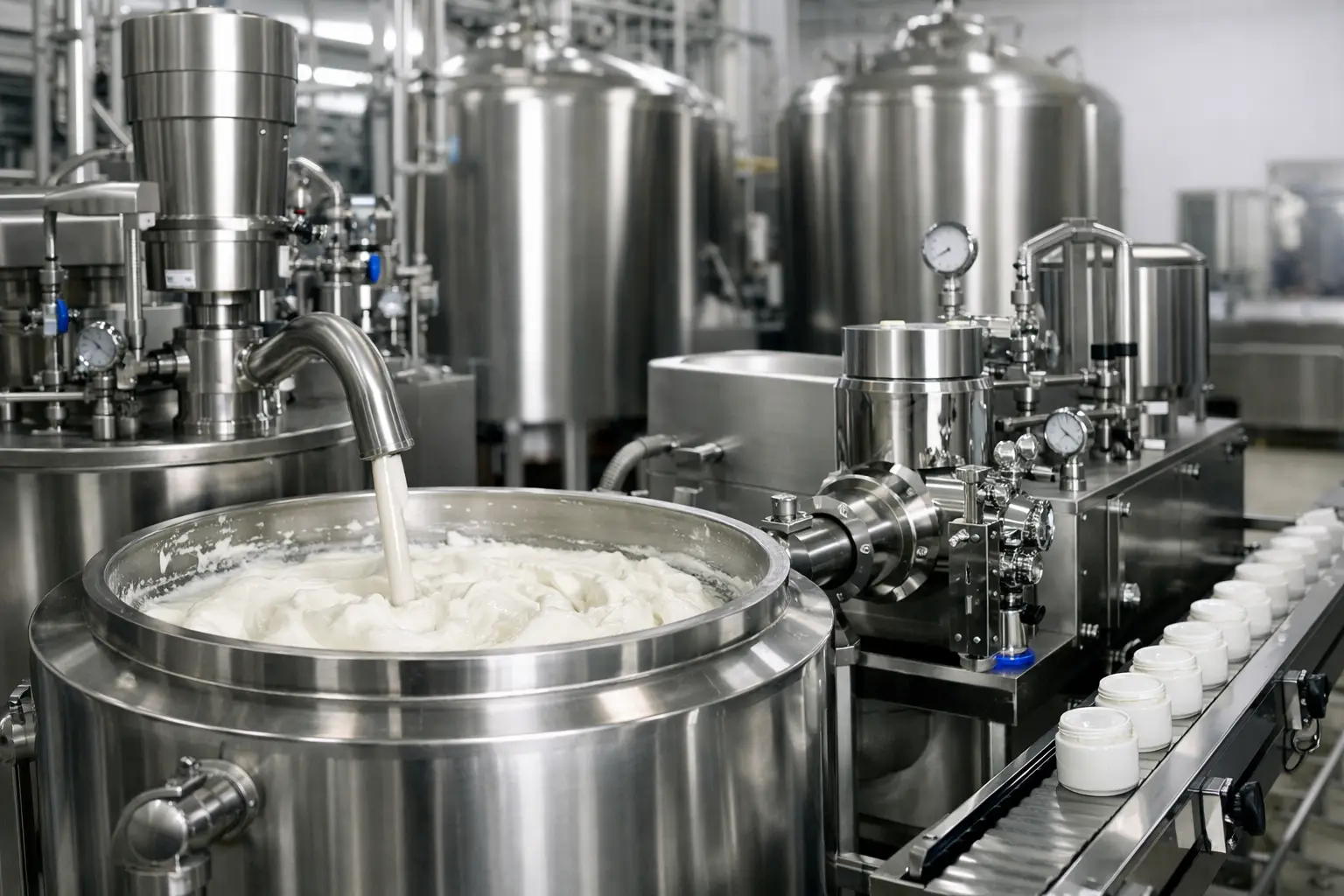
Cream failure is rarely caused by a single mixing step. A batch may look smooth at discharge yet separate after filling, trap air during cooling, develop inconsistent viscosity, or require excessive cleaning time between product runs. Selecting the best equipment for cream manufacturing starts with the actual formulation and process sequence, not a generic mixer specification.
For cosmetic, personal care, pharmaceutical, food, and specialty chemical creams, the core challenge is usually the same: combine phases, disperse powders and functional ingredients, create the required droplet or particle size, manage temperature, remove entrained air, and deliver a repeatable finished texture. The right equipment system must perform each of those functions without damaging shear-sensitive ingredients or creating a bottleneck elsewhere in production.
Selecting the Best Equipment for Cream Manufacturing
There is no single machine that is best for every cream. A light lotion, a high-solids cosmetic butter, a pharmaceutical topical, and a dairy-based cream product can have very different rheology, thermal requirements, sanitary standards, and batch cycle targets. The best selection is based on what the material does at each stage of production.
A process engineer should first establish the viscosity range from startup through final cooling, the oil-to-water ratio, emulsifier system, powder loading, particle-size requirement, temperature profile, batch volume, and allowable air content. These inputs determine whether the operation needs simple agitation, high-shear emulsification, vacuum processing, recirculation, or an integrated combination of all five.
The process also changes as the batch changes. A formulation that is free-flowing at 160°F may become highly viscous during controlled cooling. Equipment sized only for the initial liquid stage can lose circulation when the viscosity rises, leading to poor heat transfer and nonuniform texture. Torque, agitator geometry, motor capacity, and vessel wall sweeping must be evaluated at the highest expected operating viscosity, not only under water-like test conditions.
The Core Equipment in a Cream Processing System
A jacketed process vessel with a properly selected low-speed agitator is the foundation of most batch cream lines. For medium- to high-viscosity products, an anchor or sweep agitator is often the appropriate choice because it moves material across the vessel wall, supports heat transfer, and prevents stagnant zones. Wall scrapers are especially valuable where waxes, fatty alcohols, gums, or thickening polymers can accumulate on heated or cooled surfaces.
The vessel jacket should be designed around the required heating and cooling duty. Steam, hot water, thermal fluid, chilled water, or glycol may be appropriate depending on the product and utility infrastructure. Fast heating is useful for melting waxes and preparing the oil phase, but controlled cooling is often more critical to final quality. If cooling occurs too quickly or unevenly, the product can develop unstable viscosity, poor appearance, or undesirable crystal structure.
A high-shear rotor-stator emulsifier is typically the key device for creating a stable cream emulsion. It draws product into a high-energy mixing zone and subjects it to intense hydraulic and mechanical shear. This action reduces droplet size, distributes emulsifiers, breaks down agglomerates, and improves uniformity throughout the batch.
High shear is not automatically better. Over-processing can introduce excess heat, affect delicate active ingredients, alter a polymer network, or change the sensory profile of a finished cream. The objective is to apply sufficient energy to achieve the specified emulsion and dispersion, then stop. A system with variable speed and defined processing controls gives manufacturers more practical control than a fixed, maximum-shear approach.
For powders that tend to float, clump, or form fish eyes, a powder induction system can substantially improve batch performance. Rather than manually adding powders into an open vessel, the system uses vacuum or liquid flow to draw ingredients into the process stream. This reduces dust exposure, shortens wet-out time, improves operator safety, and helps prevent undispersed material from reaching the finished product.
The most common cream manufacturing equipment configuration includes these coordinated functions:
- A jacketed vessel with anchor or sweep agitation for heating, cooling, and bulk turnover.
- A high-shear emulsifier for droplet-size reduction and dispersion.
- A vacuum system for deaeration and controlled powder addition.
- A recirculation loop or inline homogenizer when additional processing intensity is required.
- Sanitary transfer and filling equipment sized to move the finished cream without excessive hold-up or shear.
Why Vacuum Emulsifying Mixers Are Often the Better Choice
Vacuum emulsifying mixers combine several critical process functions in one enclosed system. They are particularly effective for creams that require a smooth, air-free appearance, controlled density, and strong emulsion stability. Vacuum can remove entrained air generated during mixing, improve powder wetting, and reduce oxidation risks for formulations containing sensitive oils, fragrances, or active ingredients.
A vacuum system also supports cleaner processing in applications where containment and hygiene matter. For personal care and pharmaceutical creams, an enclosed vessel can reduce operator exposure and help control the production environment. For food applications, the hygienic design must align with the specific sanitation, pasteurization, and regulatory requirements of the product.
However, vacuum is not necessary for every formulation. If the product is low viscosity, non-aerated, and readily mixed, a conventional jacketed tank with an inline homogenizer may deliver the required quality at lower capital cost. The decision should be based on measurable needs such as residual air, fill-weight consistency, emulsion stability, batch cycle time, and cleaning requirements.
Inline Homogenizers and Mills: When a Batch Emulsifier Is Not Enough
An inline high-shear homogenizer is useful when the process benefits from continuous recirculation or when a plant needs to process a cream after it leaves the main vessel. It can be installed in a recirculation loop to pass material through a controlled shear zone multiple times. This configuration provides flexibility for difficult emulsions, scale-up work, and formulations that need more uniform particle or droplet distribution.
Colloid mills may also be considered for certain products, particularly where milling, refining, or deagglomeration is required. They can be effective, but their role should not be assumed. Some cream formulations respond better to rotor-stator homogenization than to milling, while highly shear-sensitive products may require gentler processing. Testing the actual formulation is more reliable than selecting equipment based on a familiar process label.
For continuous cream manufacturing, inline systems can reduce batch handling and support higher throughput. They also require disciplined control of feed rates, temperature, residence time, and cleaning procedures. A continuous system is not simply a larger batch process. Its success depends on stable upstream ingredient delivery and a well-defined operating window.
Design Details That Protect Product Quality
The vessel and mixer design must prevent dead zones. Poor geometry around the vessel bottom, outlet valve, baffles, and agitator shaft can leave material unmixed or difficult to clean. This becomes more serious with high-viscosity creams, where the product does not readily flow back into the active mixing zone.
Discharge design deserves equal attention. A cream that takes too long to empty ties up the vessel, increases product loss, and may require operators to use unsafe manual intervention. Bottom-mounted homogenizers, flush discharge valves, positive-displacement pumps, and short transfer paths can improve recovery and reduce cleanup time. The correct transfer pump must match product viscosity and tolerate the required flow rate without separating or aerating the emulsion.
Material construction, surface finish, seals, and clean-in-place capability should be matched to the industry and formula. Sanitary stainless steel construction is common, but the required finish, elastomer compatibility, documentation, and validation support vary significantly between cosmetic, food, and pharmaceutical production. Plants producing multiple SKUs should also evaluate changeover time and cleaning validation early in the project, not after installation.
Automation turns a capable mixer into a repeatable manufacturing process. Recipe control can manage ingredient addition sequence, heating and cooling ramps, agitator speed, homogenizer run time, vacuum level, and discharge conditions. Sensors for temperature, pressure, load, pH, conductivity, and flow provide the process data needed to investigate deviations and maintain consistent batch quality.
Scale-Up Requires More Than a Larger Vessel
A pilot batch that performs well in a small laboratory mixer may fail when moved directly to production scale. The relationship between tank diameter, liquid level, agitator tip speed, power input, recirculation rate, and heat-transfer area changes as volume increases. Simply matching motor horsepower or mixing time does not preserve the same process conditions.
The most effective scale-up program identifies the quality attributes that matter most: viscosity, droplet size, appearance, density, yield, fill performance, and stability over time. Production equipment is then engineered to achieve those results while meeting target batch size and cycle time. PerMix approaches cream systems as an integrated process problem, considering mixing, emulsification, thermal control, vacuum, powder handling, discharge, and automation together.
The productive next step is to evaluate a representative formulation under realistic temperature, viscosity, and batch-cycle conditions. That work converts an equipment purchase from a machine comparison into a defined process solution built for consistent cream quality.