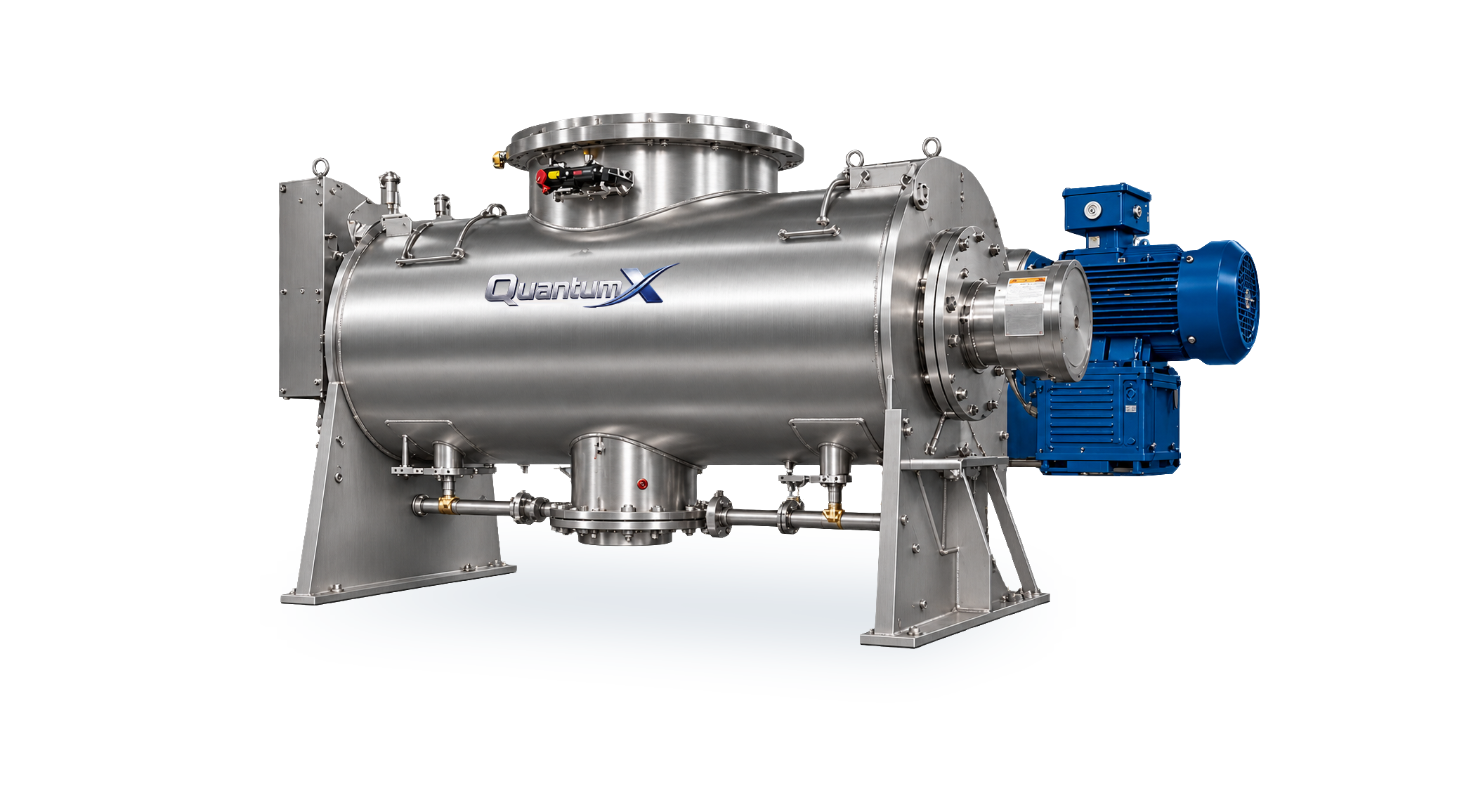
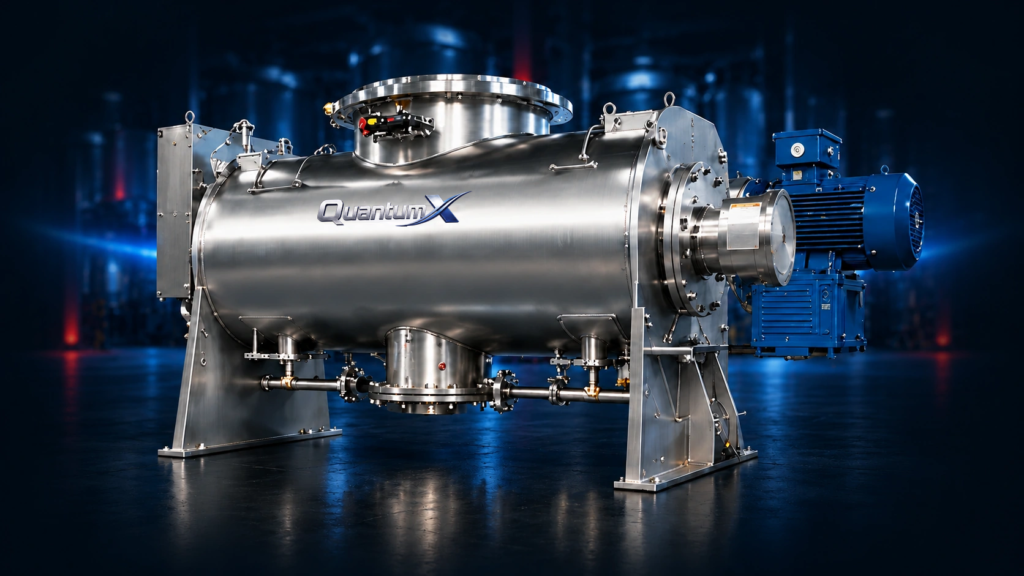
QuantumX stainless steel industrial mixer with blue drive motor

PROCESS ENGINEERING EQUIPMENT INTEGRATION AUTOMATION

QuantumX Custom Process Systems

Not Just a Mixer. A Manufacturing System Engineered Around Your Process.

A successful production line is not created by selecting individual machines and connecting them afterward.

Ingredient receiving, weighing, feeding, mixing, liquid addition, milling, thermal processing, transfer, inspection, packaging, controls and utilities must operate as one coordinated process.

Discuss Your Application with QuantumX

Overview

What Is a Custom Process System?

A custom process system is an engineered combination of equipment, controls, instrumentation, utilities and material-transfer interfaces designed around a defined production process.

It differs from a catalog machine because the equipment package is developed around:

  • The material
  • The formulation
  • The batch or continuous process
  • Production throughput
  • Required product quality
  • Safety
  • Sanitation
  • Containment
  • Plant layout
  • Available utilities
  • Operator workflow
  • Cleaning
  • Documentation
  • Downstream processing

A custom system may contain standard equipment platforms, but their configuration, size, interfaces and operating sequence are engineered for the application.

The custom work may involve:

  • Selecting the correct mixer technology
  • Modifying vessel or agitator geometry
  • Developing a material-handling strategy
  • Integrating multiple unit operations
  • Designing the control sequence
  • Defining safety interlocks
  • Creating a skid or modular package
  • Coordinating multiple manufacturers
  • Establishing acceptance criteria
  • Testing the completed system

Custom does not mean unproven.

The strongest custom system combines proven equipment platforms with application-specific engineering where the process requires it.

  1. Process-first equipment selection
  2. Single-machine to integrated-line scope
  3. Powder, liquid, thermal and high-viscosity systems
  4. Multi-brand Proc-X integration
  5. PLC/HMI and batch-data architecture
  6. FAT, SAT and commissioning support
  7. North American engineering coordination
  8. Project-specific documentation and compliance pathways

Key capabilities

Key Capabilities

QuantumX custom process systems integrate the required unit operations around a defined manufacturing objective.

The scope can range from a single engineered mixing package to a fully integrated production system incorporating:

  1. Raw-material receiving
  2. Bulk and minor-ingredient storage
  3. Weighing and dosing
  4. Mixing
  5. Reaction
  6. Liquid addition
  7. Coating
  8. Granulation
  9. Milling
  10. Screening
  11. Vacuum processing
  12. Heating and cooling
  13. Drying
  14. Contained transfer
  15. Metal detection
  16. Checkweighing
  17. Filling and packaging
  18. PLC/HMI automation
  19. Batch reporting
  20. Documentation
  21. Factory acceptance testing
  22. Commissioning support

When to customize

When Does a Project Require a Custom Process System?

A custom system should be considered when:

  • The mixer cannot operate as a stand-alone machine
  • Multiple ingredients must be weighed and sequenced automatically
  • The process combines powders and liquids
  • The formulation requires milling before or after mixing
  • The batch must remain enclosed
  • Vacuum or pressure is required
  • Product must be heated, cooled or dried
  • ATEX or hazardous-area requirements apply
  • Operator exposure must be controlled
  • Product contamination must be minimized
  • The line must communicate with upstream and downstream equipment
  • Multiple product sizes or recipes must be processed
  • Batch records or data logging are required
  • Production capacity exceeds manual handling
  • Cleaning and changeover must be automated
  • Final packaging must be integrated with the mixer
  • The plant footprint or headroom creates layout constraints
  • Several equipment manufacturers must operate under one controls architecture
  • The process requires a defined performance guarantee
  • The customer needs one coordinated project interface

A custom system is not necessary merely because one nozzle, platform or control panel differs from a standard machine.

It becomes valuable when the relationship between the equipment determines whether the process will succeed.

Scope

From Machine Supply to Integrated Process Line

Define the Scope Level Before the Project Begins

QuantumX projects can be supplied at several levels.

Scope LevelTypical SupplyAppropriate When
Engineered machineMixer, drive, controls and application-specific optionsThe customer already has ingredient handling and downstream equipment
Packaged subsystemMixer with dosing, vacuum, thermal or discharge packageOne process area must operate as a coordinated unit
Skid-mounted systemEquipment, piping, instruments, valves and controls assembled on a skidFactory assembly and reduced site work are priorities
Integrated production lineReceiving, dosing, processing, inspection and packagingMultiple unit operations must operate under one process architecture
Project-specific turnkey scopeEquipment plus specifically defined installation, commissioning and site responsibilitiesThe commercial scope clearly assigns all parties and interfaces

Important Scope Principle

The term turnkey should only be used when the contract defines exactly what is included.

Items such as the following may be included or supplied by others:

  • Building modifications
  • Foundations
  • Structural steel
  • Electrical distribution
  • Plant compressed air
  • Steam generation
  • Chilled water
  • Dust collection
  • Fire protection
  • Permits
  • Installation labor
  • Rigging
  • Process piping outside the skid
  • Site cabling
  • Network integration
  • Waste handling
  • Site validation

A clear scope boundary protects the project from assumptions and unpriced responsibilities.

Design basis

Begin with a Written Design Basis

The Design Basis Becomes the Technical Foundation of the Project

Before selecting equipment, QuantumX should establish a written process and equipment basis.

The design basis may include:

  • Product description
  • Material properties
  • Process flow
  • Batch or continuous operation
  • Production capacity
  • Process sequence
  • Quality targets
  • Utility conditions
  • Compliance requirements
  • Safety requirements
  • Site limitations
  • Customer standards
  • Scope boundary
  • Acceptance criteria

The design basis should be reviewed and approved before detailed engineering.

Changes made after approval may affect:

  • Equipment size
  • Motor power
  • Controls
  • Layout
  • Cost
  • Lead time
  • Documentation
  • Testing
  • Validation

Design-Basis Categories

CategoryInformation Required
MaterialState, bulk density, viscosity, particle size, flowability, cohesion, fragility, abrasion, corrosion and temperature sensitivity
FormulaIngredient list, percentages, addition sequence, minor ingredients, liquids and expected variation
ProductionBatch mass, batch volume, batches per hour, hourly throughput, shifts and annual production
ProcessMixing, coating, granulation, reaction, drying, cooling, milling, screening or packaging requirements
QualityUniformity, particle size, moisture, temperature, residual solvent, viscosity, density and product integrity
EnvironmentSanitary area, washdown, dry room, cleanroom, hazardous area, containment or outdoor installation
UtilitiesElectrical supply, compressed air, steam, hot water, cooling water, glycol, thermal oil, nitrogen and vacuum
FacilityAvailable footprint, headroom, access doors, floor loading, platform requirements and maintenance clearances
ControlsPLC platform, HMI, recipes, batch reports, historian, network and electronic-record requirements
ComplianceASME, PED, ATEX, CE, sanitary, cGMP-support, containment or customer corporate standards
ExecutionRequired drawings, FAT, SAT, installation, commissioning, training, spares and documentation

Material characterization

Material Characterization

Equipment Selection Begins with How the Material Behaves

A product name alone is not a sufficient engineering description.

Two materials with the same chemical identity may behave differently because of:

  • Particle size
  • Particle shape
  • Moisture
  • Temperature
  • Manufacturing history
  • Storage time
  • Compaction
  • Surface treatment
  • Bulk density
  • Electrostatic behavior

The material review should include:

  • Loose bulk density
  • Packed bulk density
  • Operating bulk density
  • Specific gravity
  • Particle-size distribution
  • Particle shape
  • Flowability
  • Cohesiveness
  • Angle of repose
  • Compressibility
  • Agglomerate strength
  • Fragility
  • Abrasion
  • Corrosion
  • Hygroscopicity
  • Moisture
  • Oil or fat content
  • Electrostatic behavior
  • Dustiness
  • Thermal sensitivity
  • Oxygen sensitivity
  • Toxicology or exposure limits
  • Combustible-dust or solvent data

Material properties determine:

  • Mixer technology
  • Feeder type
  • Hopper geometry
  • Conveyor type
  • Drive torque
  • Valve design
  • Dust-control strategy
  • Materials of construction
  • Cleaning method
  • Discharge method

Process Objectives

Define What the System Must Accomplish

The system may be required to perform one or more of the following:

  • 01

    Dry Blending

    Distribute powders or granules uniformly without intentionally changing particle structure.

  • 02

    Minor-Ingredient Distribution

    Distribute low-percentage vitamins, minerals, flavors, active ingredients, catalysts or additives.

  • 03

    Liquid Addition

    Apply oil, binder, water, solvent, flavor, catalyst or functional liquid to a moving powder bed.

  • 04

    Particle Coating

    Create controlled surface coverage while limiting lumps and nonuniform wet zones.

  • 05

    Deagglomeration

    Break soft clusters while preserving the desired primary particles.

  • 06

    Granulation

    Form granules with controlled size, density, porosity, strength and moisture.

  • 07

    Heating or Cooling

    Move product repeatedly across a thermal surface to achieve the required temperature profile.

  • 08

    Reaction

    Control feed sequence, mixing, heat removal, pressure, gas generation and endpoint.

  • 09

    Vacuum Processing

    Remove entrained gas, reduce oxygen, dry product or recover solvent.

  • 10

    Milling

    Reduce particle size or break hard agglomerates before or after mixing.

  • 11

    Classification or Screening

    Remove oversize, control particle distribution or protect downstream equipment.

  • 12

    Contained Processing

    Protect operators, product and the surrounding environment throughout charging, processing and discharge.

  • 13

    Packaging

    Deliver the finished product to bags, drums, totes, containers or an automated filling system.

Equipment pathways

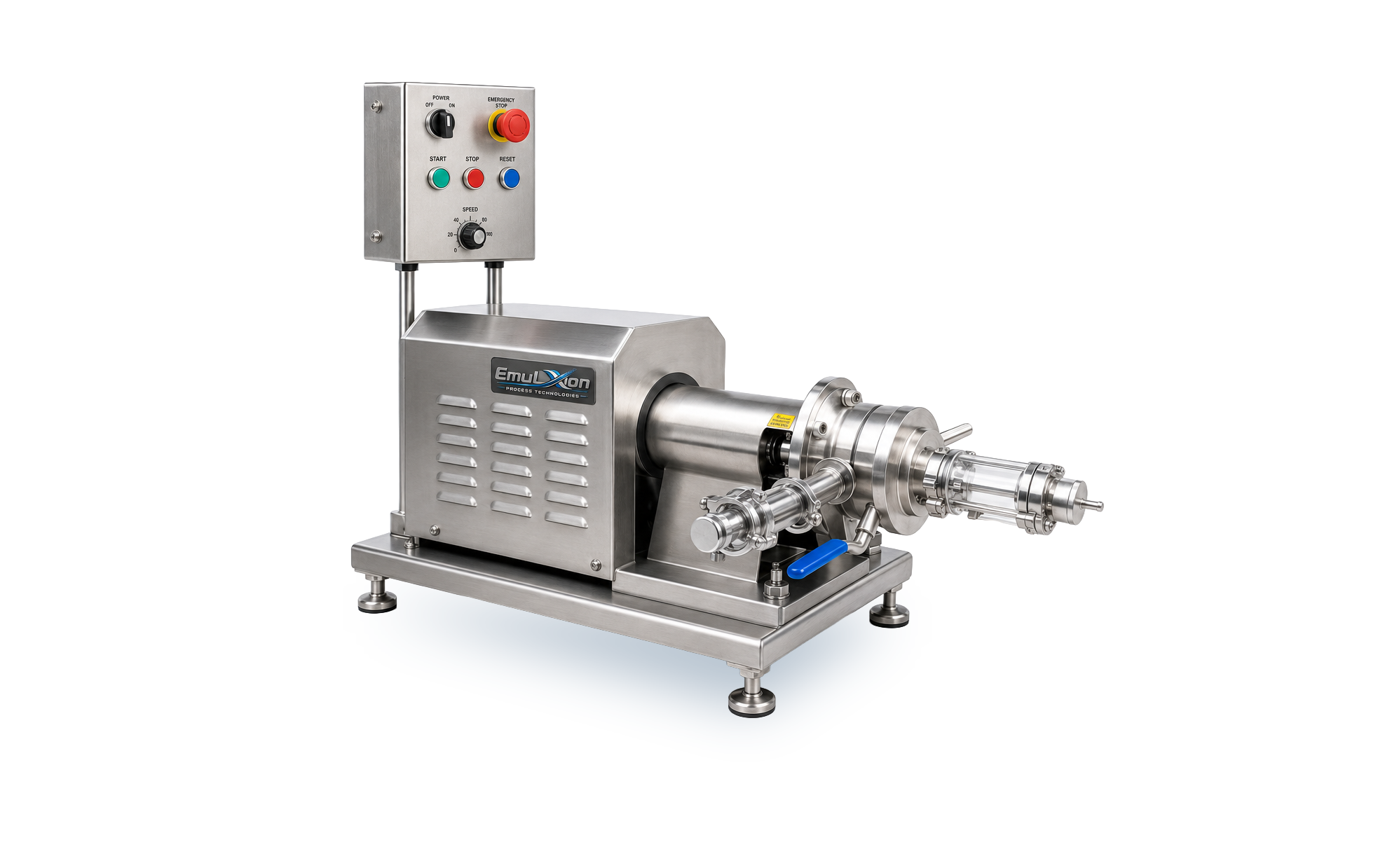
PerMix, QuantumX and EmulXion

Three Defined Equipment Pathways

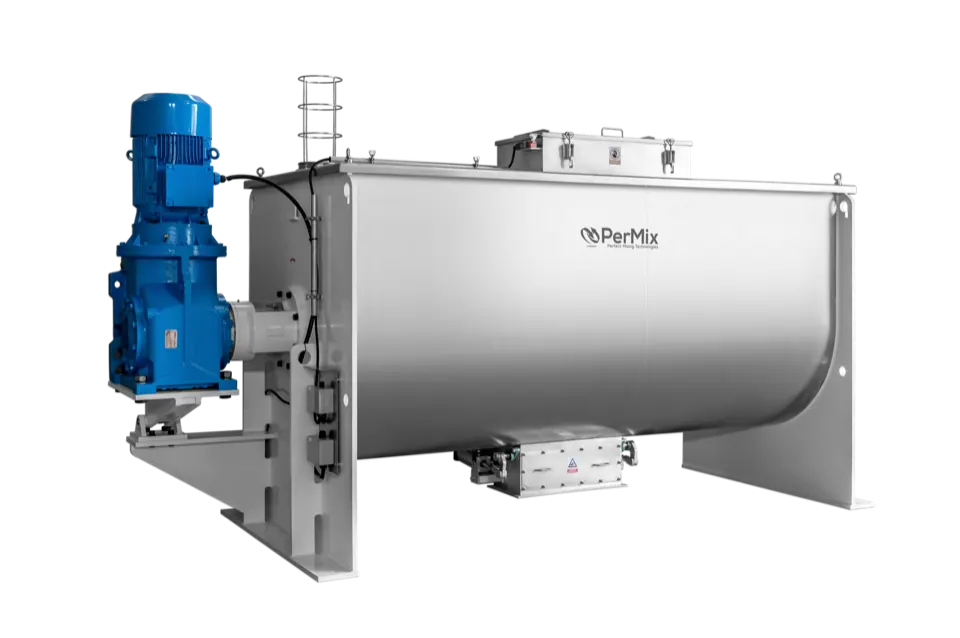
PerMix horizontal ribbon mixer

PerMix Standard Mixers

Use PerMix standard models for atmospheric processing of powders and granules where a ribbon, paddle, plough or double cone mixer can perform the required duty.

Process architecture

01Stage

The Mixer Is the Center of the Process—but Not the Entire Process

A custom mixing system can include the following production stages.

Material ReceivingStorageWeighing & DosingChargingMixing / Reaction / DryingMilling or ScreeningInspectionSurge StorageFilling & Packaging

The actual sequence may include recycle loops, bypasses, parallel lines or staged batch processing.

Each interface should be engineered around:

FlowPressureProduct stateDustSegregationCleaningContainmentControl logicMaintenance

02Stage

Material Receiving and Storage

Potential receiving systems include:

Bag-dump stationsDrum dumpersIBC unloadersBulk-bag unloadersTruck unloadingRail unloadingPneumatic transferVacuum transferManual ingredient stations

Potential storage systems include:

SilosDay binsHoppersIntermediate bulk containersDrumsMobile totesSanitary vesselsInerted storage vessels

Storage design should consider:

Product flowabilityHopper angleArchingRat-holingCompactionAerationDustStaticMoistureTemperatureCross-contaminationInventory tracking

03Stage

Weighing, Feeding and Dosing

Batch Accuracy Begins Before the Mixer

Potential feeding systems include:

Screw feedersVibratory feedersBelt feedersRotary airlocksLoss-in-weight feedersGain-in-weight systemsGravimetric liquid dosingVolumetric liquid dosingMicroingredient feedersManual weigh stationsAutomated dispensing systems

The dosing strategy should address:

Major ingredientsMinor ingredientsMicroingredientsLiquidsReworkOperator-added componentsIngredient verification

Potential controls include:

Load cellsFeeder feedbackBarcode scanningLot verificationTolerance checksAutomatic correctionOverfeed alarmsBatch reconciliationIngredient traceability

A precise mixer cannot correct an incorrectly weighed formulation.

04Stage

Charging the Mixer

Potential charging methods include:

Gravity feedScrew conveyorVacuum conveyorPneumatic conveyingLoss-in-weight feederGain-in-weight hopperDrum tipperBag-dump stationIBC dockingSplit-butterfly valveGlovebox connectionLiquid transfer line

The charging sequence affects:

Blend timeMinor-ingredient distributionDustSegregationAgglomerationProduct damageMixer torqueLiquid distribution

QuantumX can automate:

Ingredient orderIngredient verificationFeeder start and stopMixer permissivesValve sequencingDust extractionVacuum transferLiquid addition

05Stage

Mixing and Processing Technologies

A custom QuantumX system may incorporate:

Ribbon mixersPaddle mixersPloughshare mixersDouble cone mixersFluidized-zone mixersHigh-speed granulator mixersConical screw mixersVacuum mixersVacuum mixer-dryersPressure-rated mixersASME mixers and reactorsDouble planetary mixersMulti-shaft mixersSigma mixers and MixtrudersCustom reactors

The selection should be based on:

Product movementRequired shearParticle integrityLiquid additionThermal dutyVacuum or pressureWorking rangeCleaningDischarge

06Stage

Liquid Addition and Dosing Systems

Liquid-addition systems may include:

Storage tankDay tankHeated tankAgitatorMetering pumpMass-flow meterLoad-cell weighingPressure regulatorHeated hoseSpray lanceAtomizing nozzlesHydraulic nozzlesMultiple spray zonesRecirculation loopLine-clearing sequenceCIP connections

The liquid system should be engineered around:

ViscosityTemperatureAddition percentageAddition timeDroplet sizeSpray patternPowder absorptionWetting behaviorAgglomerationCleaningHazard classification

The nozzle and the mixer cannot be selected independently.

07Stage

Milling, Delumping and Classification

Milling may occur:

Before mixingDuring a recirculation processImmediately after dischargeBefore packagingAs part of rework handling

Potential purposes include:

Breaking hard agglomeratesControlling feed sizeReducing final particle sizeNarrowing particle distributionImproving downstream dissolutionPreparing a uniform dryer feedConditioning recycled material

A custom system may integrate:

DelumperCone millHammer millPin millUniversal millAir-classifying millJet millKnife granulatorSifterClassifier

The mill should be selected around:

Feed particle sizeTarget particle sizeCapacityHeat sensitivityAbrasionContainmentATEXProduct purityCleaning

A mixer should not be expected to perform hard particle-size reduction.

08Stage

Screening and Sifting

Screening can:

Remove oversizeProtect equipmentControl final particle sizeRemove foreign materialBreak soft lumpsVerify product condition before packaging

Potential equipment includes:

Vibratory screenerCentrifugal sifterInline sieveSecurity screenMulti-deck screenerPressure or vacuum-rated screening systemContained screener

The screen should be sized around:

ThroughputMesh sizeProduct flowMoistureBlindingFragilityDustCleaningChangeover

09Stage

Thermal Processing

A custom QuantumX system can incorporate:

HeatingCoolingVacuum dryingSolvent recoveryCondensationCrystallization supportReaction temperature controlThermal conditioningProduct cooling before packaging

Potential thermal equipment includes:

Jacketed mixerHeated agitatorThermal-fluid skidSteam systemHot-water unitChillerGlycol systemCondenserReceiverVacuum pumpBelt dryerCooler

Thermal performance should be based on a mass and energy balance rather than jacket area alone.

10Stage

Transfer Between Unit Operations

Potential transfer methods include:

GravityScrew conveyingBelt conveyingVacuum conveyingDilute-phase pneumatic conveyingDense-phase conveyingPump transferPressure-assisted transferMobile IBCDrum transferEnclosed chuteContained split-valve transfer

The transfer method can affect:

SegregationParticle damageDustTemperatureMoisture pickupOxygen exposureContainmentProduct lossCycle time

A uniform product can segregate after leaving the mixer.

The complete transfer path must be reviewed.

11Stage

Inspection and Product Protection

Potential inspection steps include:

MagnetsMetal detectionX-ray inspectionCheckweighingVision inspectionSeal inspectionBarcode verificationLot verification

Inspection equipment should be positioned according to:

Product formPackage typeCritical control pointContaminant riskFlow rateTemperatureProduct effectCleaningReject method

The control system can record:

Inspection statusReject eventsAlarm historyDevice verificationBatch association

12Stage

Filling and Packaging

Potential downstream systems include:

Valve-bag fillerOpen-mouth baggerAuger fillerNet-weigh fillerDrum fillerTote fillerCup fillerContainer fillerPouch fillerBulk-bag fillerCheckweigherSealerCoderLabelerPalletizer

Packaging integration should account for:

Product flowabilityBulk densityDustTarget weightBag or container sizeProduction rateAccuracyProduct aerationSegregationMetal detectionOperator handling

Proc-X integration

One Group. Multiple Integrated Technologies.

QuantumX custom systems can coordinate multiple Proc-X technologies within one process architecture.

Potential integrations include:

AIS Bulk Material Handling

Bulk-bag unloadersBag-dump stationsSilosHoppersFeedersConveyorsVacuum transferPneumatic conveyingWeighing systems

DP Pulverizers

Cone millsPin millsHammer millsAir-classifying millsJet millsCryogenic millingDelumpingClassification

EmulXion

Powder-induction systemsHigh-shear mixersInline emulsifiersShear pumpsHomogenizersVacuum emulsifying systemsDeaerators

Fuxion

ExtrusionCompoundingFormingContinuous downstream processing

ThermoFlow

Belt dryingCoolingThermal processing

InspeX

Metal detectionX-ray inspectionCheckweighingProduct inspection

PreciXion

FillingBaggingSealingCodingPackaging

AirloX

Rotary airlocksDiverter valvesBulk-solids flow control

Controls and automation

Controls and Automation

Controls and Automation

One Control Architecture Should Coordinate the Process

A custom QuantumX control system can integrate:

  • PLC
  • HMI
  • Variable-frequency drives
  • Motor starters
  • Remote I/O
  • Safety PLC
  • Recipe management
  • Ingredient sequencing
  • Load-cell weighing
  • Feeder control
  • Liquid dosing
  • Mixer operation
  • Temperature control
  • Vacuum control
  • Pressure control
  • Inerting
  • Milling
  • Screening
  • Inspection
  • Packaging
  • Batch reporting
  • Alarm history
  • Data logging
  • Remote support

Potential platforms include:

  • Siemens
  • Allen-Bradley
  • Customer-specified industrial control platforms
Recipe Management

A recipe can define:

  • Ingredient list
  • Ingredient order
  • Target weights
  • Tolerances
  • Mixer speed
  • Mixing time
  • Liquid-addition rate
  • Temperature profile
  • Vacuum profile
  • Pressure profile
  • Chopper operation
  • Discharge sequence
  • Cleaning cycle

Recipe access can be controlled by user level.

Potential user roles include:

  • Operator
  • Supervisor
  • Maintenance
  • Quality
  • Engineering
  • Administrator
Batch Data and Traceability

Potential batch records can include:

  • Batch number
  • Formula
  • Product code
  • Ingredient lots
  • Actual weights
  • Operator
  • Start and finish time
  • Mixer speeds
  • Mixing times
  • Product temperature
  • Vacuum
  • Pressure
  • Liquid addition
  • Alarms
  • Deviations
  • Inspection results
  • Final batch status

Where electronic records or signatures are used within the scope of FDA-regulated record requirements, 21 CFR Part 11 may apply. FDA describes Part 11 as covering electronic records and electronic signatures used under applicable predicate rules. Final applicability and system validation remain the regulated manufacturer’s responsibility.

Part 11-compatible control features are available where required. Final applicability, validation, procedures and compliance remain the responsibility of the regulated manufacturer.

Network and Data Integration

Potential system interfaces include:

  • ERP
  • MES
  • SCADA
  • Plant historian
  • Laboratory information system
  • Warehouse management
  • Barcode system
  • Production scheduling
  • Maintenance management
  • Cloud reporting
  • Remote service gateway

The project should define:

  • Communication protocol
  • Data ownership
  • Tag list
  • Cybersecurity requirements
  • User access
  • Backup
  • Time synchronization
  • Remote-access policy
  • Data retention
  • Customer IT responsibility

Potential industrial protocols include:

  • EtherNet/IP
  • PROFINET
  • Modbus TCP
  • OPC UA
  • Application-specific interfaces
Instrumentation

Potential instrumentation can include:

  • Load cells
  • Level switches
  • Continuous level measurement
  • Pressure transmitter
  • Vacuum transmitter
  • Temperature sensor
  • Flow meter
  • Mass-flow meter
  • Oxygen analyzer
  • Dew-point analyzer
  • Moisture sensor
  • Torque monitoring
  • Motor-current monitoring
  • Vibration monitoring
  • Bearing-temperature sensor
  • Seal-pressure sensor
  • Filter differential pressure
  • Conductivity
  • pH
  • Product density
  • Valve-position feedback
  • Speed feedback

Each instrument should have a defined process or safety function.

Instrumentation should not be added merely to make the system appear sophisticated.

Control Narratives and Interlocks

A control narrative defines:

  • Operating modes
  • Start permissions
  • Process sequence
  • Setpoints
  • Alarms
  • Trips
  • Recovery steps
  • Manual operations
  • Cleaning sequence
  • Emergency behavior

Potential interlocks can include:

  • Mixer cannot start with access door open
  • Feeder cannot operate unless the receiving valve is open
  • Liquid cannot be added until the mixer reaches the required speed
  • Vacuum cannot start until closures are confirmed
  • Pressure operation requires pressure-rated closure confirmation
  • Discharge cannot open while the mixer is operating
  • Packaging cannot start without inspection equipment ready
  • Heater cannot operate without product circulation
  • Nitrogen process cannot start without oxygen analyzer availability
  • High torque stops ingredient addition
  • High temperature stops heating
  • High pressure isolates feeds

Safety and compliance

Safety, Compliance and System Design

Safety and Risk Engineering

Equipment Risk and Process Risk Are Related—but Not Identical

QuantumX can support project-specific:

  • Equipment risk assessment
  • Guarding review
  • Control-system risk review
  • Interlock matrix
  • Cause-and-effect matrix
  • Hazardous-area review
  • Mechanical ignition-risk review
  • Pressure-boundary review
  • Cleaning-risk review
  • Maintenance-access review

The customer and its process-safety team remain responsible for the complete facility and process-hazard basis unless additional services are specifically included.

For covered highly hazardous chemical processes, OSHA’s Process Safety Management standard requires employers to identify, evaluate and control process hazards through elements including process-safety information, process hazard analysis, operating procedures, mechanical integrity and management of change.

Potential project risk activities may include:

  • HAZOP
  • What-if analysis
  • FMEA
  • LOPA
  • Dust-hazard analysis
  • Relief review
  • Ergonomic review
  • Sanitation risk review
  • Containment assessment

The scope and leadership of each activity should be defined contractually.

Compliance Pathways

ASME

Pressure-vessel projects may require ASME Section VIII construction and an applicable certification route. ASME’s current BPVC edition is 2025, including Section VIII pressure-vessel rules.

PED

Applicable European pressure equipment may require conformity under Pressure Equipment Directive 2014/68/EU.

ATEX

Equipment intended for use in applicable potentially explosive atmospheres may require engineering and conformity assessment under ATEX Directive 2014/34/EU.

Sanitary and cGMP-Supporting Design

Equipment can be engineered with materials, finishes, access, cleaning systems, documentation and control features to support the customer’s sanitation or cGMP strategy.

The equipment alone does not establish facility or process compliance.

Customer Standards

Projects may also require:

  • Corporate engineering standards
  • Approved component lists
  • Electrical standards
  • Cybersecurity requirements
  • Hygienic-design standards
  • Validation procedures
  • Documentation templates
  • Country-specific certification
Sanitary and Cleanable System Design

A sanitary system requires more than stainless steel.

The design should consider:

  • Product-contact materials
  • Welds
  • Surface finish
  • Internal geometry
  • Drainability
  • Dead legs
  • Shaft seals
  • Valves
  • Gaskets
  • Spray coverage
  • Cleaning chemistry
  • Access
  • Inspection
  • Waste handling

Potential sanitary features include:

  • 304 or 316L stainless steel
  • Defined product-contact finish
  • Ground and polished welds
  • Electropolishing
  • Passivation
  • Sanitary connections
  • Flush valves
  • Reduced product traps
  • Drainable piping
  • CIP spray devices
  • Wash-in-place systems
  • Stainless-steel cladding
  • Washdown-compatible enclosures
Cleaning Strategy

The cleaning method should be defined before detailed engineering.

Potential strategies include:

  • Dry manual cleaning
  • Vacuum cleaning
  • Wipe-down cleaning
  • Manual wet washing
  • Wash-in-place
  • Clean-in-place
  • Automated spray cleaning
  • Solvent cleaning
  • Campaign cleaning
  • Product-dedicated equipment

Cleaning design should include:

  • Mixer
  • Feeders
  • Conveyors
  • Transfer lines
  • Valves
  • Filters
  • Mills
  • Screeners
  • Surge hoppers
  • Packaging equipment
  • Waste system

A mixer may be cleanable while the connected process line is not.

Skid-Mounted Systems

A skid-mounted package can include:

  • Mixer
  • Pumps
  • Piping
  • Valves
  • Instruments
  • Vacuum equipment
  • Thermal equipment
  • Electrical panel
  • Controls
  • Structural frame
  • Access platform

Potential advantages include:

  • Factory assembly
  • Reduced field piping
  • Factory wiring
  • Controlled quality
  • Integrated FAT
  • Faster installation
  • Fewer site interfaces
  • Defined battery limits

Potential limitations include:

  • Shipping dimensions
  • Shipping weight
  • Building access
  • Rigging
  • Maintenance access
  • Utility flexibility
  • Future expansion
Modular and Field-Integrated Systems

A modular or field-integrated system may be preferred when:

  • Equipment is too large to ship as one skid
  • Existing plant equipment must be reused
  • Multiple floors are involved
  • Long conveyors are required
  • Silos or platforms are field erected
  • Future expansion is planned
  • Several production areas must be connected

Modules may be organized by function:

  • Ingredient receiving module
  • Dosing module
  • Mixing module
  • Vacuum or thermal module
  • Inspection module
  • Packaging module
  • Controls module

Each module requires clearly defined mechanical, electrical and control interfaces.

Responsibility

System Scope and Responsibility Matrix

Define Who Owns Every Interface

Project ElementQuantumX ScopeCustomer ScopeThird-Party Scope
Process design basisCollaborativeApproves and supplies product dataSpecialist input where required
Equipment selectionPrimaryReviews and approves—
General arrangementPrimarySupplies building constraintsStructural review where required
Process pipingAs specifiedPlant tie-ins unless includedInstaller may execute
Electrical panelAs specifiedIncoming power and distributionElectrical contractor
Field wiringAs specifiedSite cabling unless includedElectrical contractor
UtilitiesConnection pointsUtility generation and deliveryUtility contractor
FoundationsLoads and interface dataFinal design and constructionCivil engineer
InstallationOptionalUnless includedRigging and mechanical contractor
Process safetyEquipment supportFacility and process ownerQualified safety specialists
Relief sizingInterfaces as specifiedProcess basis and approvalRelief specialist
FATQuantumX coordinatesWitnesses and approvesSuppliers participate
SATSupport as contractedSite readiness and operationInstaller and customer
ValidationDocumentation supportFinal validation responsibilityValidation consultant
PermitsSupport dataFinal responsibilityLocal engineer or authority

This matrix should be customized for every project.

Project execution

01Step

Application Discovery

QuantumX reviews:

ProductFormulaCapacityProcess objectiveCurrent problemsFacilityUtilitiesCompliance requirementsProject schedule

02Step

Process Design Basis

The team defines:

Material dataProcess sequenceUnit operationsPerformance targetsScope boundaryAcceptance criteria

03Step

Concept Development

Concept engineering may include:

Preliminary process-flow diagramEquipment selectionCapacity calculationPreliminary layoutUtility estimateControls conceptBudgetary scope

04Step

Testing and Process Validation

Testing may be used to determine:

Mixer technologyCycle timeLiquid additionParticle damageDrying curveMilling resultDischargeCleaningScale-up basis

05Step

Commercial and Technical Proposal

The proposal should define:

Equipment scopePerformance basisExclusionsOptionsPriceTermsLead timeDocumentationTestingWarrantyDelivery basis

06Step

Front-End Engineering

Front-end engineering can include:

Approved process flowGeneral arrangementP&IDUtility scheduleInstrument listControl narrativeScope matrixHazard inputs

07Step

Detailed Engineering

Detailed engineering can include:

Fabrication drawingsEquipment calculationsPipingValvesInstrumentsElectrical designControlsSafety interlocksPlatformsInstallation interfaces

08Step

Manufacturing and Procurement

QuantumX coordinates:

FabricationPurchased componentsSupplier documentsQuality inspectionsAssemblyControls programmingDocumentation

09Step

Factory Acceptance Testing

The system is tested against an approved FAT protocol.

10Step

Delivery and Installation Support

Support can include:

Shipping coordinationRigging guidanceInstallation drawingsUtility connectionsRemote or field support

11Step

Commissioning and SAT

Commissioning verifies:

InstallationRotationControlsInstrumentsInterlocksUtilitiesOperating sequence

12Step

Performance Testing and Training

Where included, the system is operated using the agreed product or substitute material and acceptance protocol.

13Step

Lifecycle Support

Support can include:

Spare partsPreventive maintenanceTroubleshootingControls supportRetrofitsCapacity upgradesAdditional recipesOperator training

Testing and acceptance

Testing, Acceptance and Documentation

Process Testing

Testing should be considered when:

  • Material behavior is uncertain
  • Scale-up risk is significant
  • The process includes liquid addition
  • Particle damage is critical
  • Drying is required
  • Granulation is required
  • High viscosity is involved
  • A performance guarantee is requested
  • Multiple technologies could be suitable

A test protocol should define:

  • Material quantity
  • Material identity
  • Ingredient sequence
  • Equipment
  • Operating conditions
  • Sampling plan
  • Analytical method
  • Acceptance criteria
  • Discharge method
  • Cleaning method
Performance Guarantees

Define Success Before the Order

A performance commitment should clearly identify:

  • Customer product
  • Customer-supplied material condition
  • Batch quantity
  • Ingredient formulation
  • Utilities
  • Operating procedure
  • Test method
  • Sampling locations
  • Analytical method
  • Acceptance criteria
  • Maximum cycle time
  • Product-temperature limit
  • Discharge criteria
  • Customer obligations

Avoid vague requirements such as:

  • “Mix completely”
  • “No lumps”
  • “Uniform product”
  • “Fast cycle”
  • “Easy cleaning”

Replace them with measurable criteria.

Examples include:

  • Defined coefficient of variation
  • Defined particle-size distribution
  • Defined final moisture
  • Defined residual solvent
  • Defined liquid-distribution target
  • Defined batch cycle
  • Defined discharge residual
  • Defined particle-damage limit
Factory Acceptance Testing

Potential FAT activities include:

  • Visual and dimensional inspection
  • Scope verification
  • Documentation review
  • Motor rotation
  • Speed ranges
  • Feeder operation
  • Load-cell verification
  • Liquid-dosing verification
  • Valve sequencing
  • Instrument checks
  • PLC/HMI operation
  • Recipe testing
  • Alarm simulation
  • Safety-interlock testing
  • Vacuum testing
  • Pressure testing
  • Thermal-function testing
  • Inspection-equipment testing
  • Packaging interfaces
  • Data logging
  • Batch-report generation
  • Product test where agreed

The FAT protocol should be approved before testing begins.

Site Acceptance and Commissioning

SAT and commissioning can include:

  • Installation inspection
  • Utility verification
  • Field-I/O testing
  • Instrument calibration review
  • Rotation checks
  • Valve operation
  • Safety circuits
  • Network connections
  • Dry-cycle operation
  • Water testing where appropriate
  • Product commissioning
  • Operator training
  • Maintenance training
  • Performance verification

SAT scope should distinguish between:

  • Equipment installation verification
  • Controls commissioning
  • Product commissioning
  • Performance testing
  • Regulatory validation
Documentation Package

Depending on scope, QuantumX documentation can include:

  • Design Basis Memorandum
  • User Requirements review
  • Process-flow diagram
  • General arrangement
  • P&ID
  • Equipment list
  • Instrument list
  • Valve list
  • Utility schedule
  • Nozzle schedule
  • Electrical load list
  • I/O list
  • Control narrative
  • Functional specification
  • Alarm and interlock matrix
  • Cause-and-effect matrix
  • Network architecture
  • Foundation loads
  • Material certificates
  • Welding documentation
  • Surface-finish documentation
  • Pressure-test records
  • Vacuum-test records
  • Calibration certificates
  • Motor and gearbox data
  • Instrument data sheets
  • Electrical drawings
  • Panel drawings
  • PLC and HMI backups
  • FAT protocol
  • FAT report
  • SAT protocol
  • Operating manual
  • Maintenance manual
  • Spare-parts list
  • Preventive-maintenance schedule
  • IQ/OQ support documents
  • Training records

The exact documentation package should be defined commercially before order placement.

Example systems

Example Custom System Architectures

Automated Dry Powder Mixing Line

Bulk-Bag UnloaderLoss-in-Weight FeedersMinor-Ingredient StationMixerSecurity ScreenerMetal DetectorSurge HopperBagging System

Powder Coating and Packaging Line

Powder ReceivingGravimetric DosingPlough or Fluidized-Zone MixerHeated Liquid DosingCoolingScreeningCheckweighingPackaging

Vacuum Mixer-Dryer System

Contained ChargingVacuum Mixer-DryerProduct-Retention FilterCondenserReceiverVacuum PumpContained Discharge

High-Containment Pharmaceutical System

Isolator ChargingSplit-Butterfly ValveContained Mixer or GranulatorContained Wet MillClosed Dryer TransferContained IBC

Battery-Material Processing Line

Dry-Room Ingredient HandlingLoss-in-Weight DosingInerted MixerMilling or DeagglomerationScreeningContained TransferPackaging

High-Viscosity Process System

Liquid ChargingPowder FeedingMulti-Shaft or Planetary MixerVacuum DeaerationThermal ConditioningPress-Out or Pump TransferFilling

Industries and applications

Industries and Applications

Why QuantumX

Why Manufacturers Choose QuantumX Custom Process Systems

  • 01

    Process-First Engineering

    The system is selected around the manufacturing objective rather than a preferred machine.

  • 02

    Broad Technology Portfolio

    Powder, liquid, vacuum, pressure, thermal, milling, inspection and packaging technologies can be coordinated within one project.

  • 03

    Defined Scope and Interfaces

    Equipment boundaries, utilities, installation responsibilities and acceptance criteria are established before execution.

  • 04

    One Controls Architecture

    Feeders, mixers, mills, valves, inspection and packaging equipment can operate under one coordinated system.

  • 05

    Testing and Scale-Up

    Material testing and process development can reduce risk before production equipment is finalized.

  • 06

    Compliance Pathways

    ASME, PED, ATEX, containment, sanitary and regulated-process requirements can be incorporated when defined.

  • 07

    Complete Documentation

    Drawings, P&IDs, control narratives, test protocols and operating documentation can be included according to scope.

  • 08

    North American Project Coordination

    Customers receive a defined commercial and technical interface for the project.

  • 09

    Lifecycle Support

    The system can be supported through spare parts, troubleshooting, controls upgrades, capacity expansion and future process changes.

PROCESS-SYSTEM APPLICATION REVIEW

Custom Process-System Design Information

Tell Us What Must Enter the System, What Must Happen and What Must Leave It

Provide:

  1. Industry
  2. Product or formulation
  3. Process description
  4. Current process
  5. Current production problem
  6. Desired final product
  7. Raw-material list
  8. Ingredient percentages
  9. Batch mass
  10. Minimum batch
  11. Maximum batch
  12. Required hourly throughput
  13. Required annual production
  14. Number of recipes
  15. Loose bulk density
  16. Operating bulk density
  17. Specific gravity
  18. Particle size
  19. Particle shape
  20. Flowability
  21. Cohesiveness
  22. Fragility
  23. Abrasion
  24. Corrosion
  25. Moisture
  26. Solvent content
  27. Viscosity or rheology
  28. Minor-ingredient percentages
  29. Liquid additions
  30. Required blend uniformity
  31. Required particle size
  32. Required final moisture
  33. Required product temperature
  34. Required cycle time
  35. Receiving method
  36. Storage method
  37. Weighing method
  38. Ingredient-charging sequence
  39. Mixing requirement
  40. Milling requirement
  41. Screening requirement
  42. Heating requirement
  43. Cooling requirement
  44. Vacuum requirement
  45. Pressure requirement
  46. Drying requirement
  47. Inerting requirement
  48. Oxygen or dew-point target
  49. Containment target
  50. ATEX or hazardous-area classification
  51. ASME or PED requirement
  52. Sanitary requirement
  53. Cleaning method
  54. Changeover requirement
  55. Inspection requirement
  56. Packaging format
  57. Package sizes
  58. Packaging rate
  59. Upstream equipment
  60. Downstream equipment
  61. Existing equipment to be reused
  62. Available footprint
  63. Available headroom
  64. Floor loading
  65. Building-access limitations
  66. Electrical supply
  67. Compressed air
  68. Steam
  69. Hot water
  70. Cooling water
  71. Glycol
  72. Thermal fluid
  73. Nitrogen
  74. Plant vacuum
  75. Dust collection
  76. Preferred PLC platform
  77. MES or ERP requirements
  78. Batch-report requirements
  79. Electronic-record requirements
  80. Documentation requirements
  81. FAT requirements
  82. SAT requirements
  83. Installation scope
  84. Commissioning scope
  85. Training requirements
  86. Delivery location
  87. Required delivery date
  88. Project stage
  89. Budgetary or firm proposal
  90. Drawings and files available

Upload process-flow diagrams, formulations, material and safety data sheets, batch requirements, P&IDs, existing equipment information, facility layouts, utility data and customer specifications. Confirm an approved confidential communication channel before submitting proprietary formulations or sensitive process information.

Frequently asked questions

Frequently Asked Questions

Got more questions?Ask an engineer
What is a QuantumX custom process system?

A QuantumX custom process system is an engineered combination of equipment, controls, instrumentation and material-transfer interfaces developed around a defined manufacturing process.

What makes a system custom?

The equipment, controls, interfaces and operating sequence are engineered around the customer’s materials, process goals, plant constraints and required performance rather than selected as a fixed catalog package.

Is every custom system completely new?

No. The strongest custom systems use proven equipment platforms and customize only the areas required by the process.

Can QuantumX provide only the mixer?

Yes. Scope can range from an engineered mixer to a complete integrated line.

Can QuantumX provide a skid-mounted system?

Yes. Mixers, pumps, piping, valves, instruments, controls, thermal equipment and vacuum equipment can be assembled as a skid where shipping and process conditions permit.

Can QuantumX supply a turnkey system?

A turnkey scope can be provided when the contract clearly defines installation, utilities, site work, controls, commissioning and all other responsibilities. The term should not be used without a detailed scope matrix.

Can QuantumX integrate other Proc-X brands?

Yes. Systems can integrate mixing with material handling, feeding, milling, extrusion, liquid processing, inspection, thermal processing and packaging.

Can the system integrate equipment from another manufacturer?

Yes, when the interfaces, communications, responsibilities and technical information are clearly defined.

Who is responsible for the complete process design?

Responsibility depends on the agreed scope. QuantumX can engineer the equipment package and specified process interfaces. The customer remains responsible for product formulation, complete facility safety and any excluded process-engineering scope.

What information is needed for a budgetary proposal?

Provide the process description, material data, batch or throughput, utilities, compliance requirements, layout constraints, equipment scope and required project boundary.

Can QuantumX develop a process-flow diagram?

Yes. A preliminary or detailed process-flow diagram can be included according to the engineering scope.

Can QuantumX provide a P&ID?

Yes. P&IDs can be developed for the supplied process system and defined utility interfaces.

Can QuantumX size silos, hoppers and feeders?

Yes. Sizing can be evaluated from capacity, material properties, refill frequency, feeding accuracy and plant layout.

Can the system use loss-in-weight feeders?

Yes. Loss-in-weight feeding can be integrated for controlled continuous or batch ingredient addition.

Can liquid dosing be automated?

Yes. Pumps, flow meters, load cells, valves, heated lines and spray systems can be controlled through the batch recipe.

Can the system include milling?

Yes. Cone, pin, hammer, ACM, jet and other milling technologies can be incorporated where appropriate.

Can the system include screening?

Yes. Vibratory, centrifugal and other screening technologies can be integrated.

Can QuantumX integrate metal detection or X-ray inspection?

Yes. Inspection systems can be integrated before or after packaging according to the product and critical-control-point strategy.

Can the system include filling and packaging?

Yes. Bagging, drum filling, container filling, sealing, coding, checkweighing and related packaging operations can be integrated.

Can the system include vacuum drying?

Yes. QuantumX vacuum mixer-dryers can be integrated with condensers, receivers, vacuum pumps, inerting and contained discharge.

Can the system operate under pressure?

Selected systems can be engineered for positive pressure, vacuum-and-pressure cycles, ASME or PED requirements.

Can the system be ATEX compliant?

Project-specific ATEX systems can be engineered when the zone, material-hazard data, equipment category and required conformity basis are provided.

Can the system provide high containment?

Yes. Closed charging, isolators, split valves, high-integrity seals, safe-change filtration, contained sampling and discharge can be incorporated.

Can the system be sanitary?

Yes. Sanitary materials, finishes, connections, drainage, WIP and CIP can be engineered according to the product and cleaning basis.

Can the system be cleaned in place?

CIP can be integrated where the geometry, spray coverage, chemistry, drainage and cleaning requirements permit.

Can QuantumX provide Part 11 controls?

Part 11-compatible control features can be incorporated where applicable. Final applicability and system validation remain the responsibility of the regulated manufacturer.

Which PLC platforms are available?

Siemens, Allen-Bradley and other customer-approved industrial platforms can be evaluated.

Can the system connect to our MES or ERP?

Yes, provided the required communication protocol, data structure, cybersecurity rules and responsibility boundaries are defined.

Can QuantumX provide batch reports?

Yes. Reports can include ingredients, lot numbers, actual weights, process conditions, alarms, times and final batch status.

Can QuantumX reuse existing equipment?

Possibly. Existing equipment must be reviewed for capacity, condition, controls, safety, compliance and interface compatibility.

Can the system be expanded later?

Modular systems can be designed with future equipment, recipe, capacity or packaging expansion in mind.

Can QuantumX perform product testing?

Testing can be evaluated when material quantity, safety, confidentiality, procedure and acceptance criteria are agreed.

Can a process guarantee be provided?

A project-specific performance commitment may be possible when the feed material, process conditions, utilities, testing method and acceptance criteria are clearly defined.

What is included in FAT?

FAT scope can include mechanical inspection, dry operation, controls, interlocks, instruments, dosing, vacuum, thermal functions and product testing where agreed.

What is the difference between FAT and SAT?

FAT occurs before shipment at the manufacturing or assembly location. SAT occurs after installation and confirms the system in its final site configuration.

Does SAT include production performance testing?

Only when included in the agreed commercial scope and supported by the required product, utilities, operators and analytical methods.

Can QuantumX provide installation?

Installation support or installation services can be included when the scope, site conditions, labor responsibilities and local requirements are defined.

Can QuantumX commission the system?

Yes. Remote or on-site commissioning can be included.

Is operator training available?

Yes. Operator and maintenance training can be included during FAT, commissioning or after startup.

What documentation is supplied?

The package can include drawings, P&IDs, equipment lists, utility schedules, control narratives, manuals, FAT records and other project-specific documents.

Can IQ/OQ documents be provided?

IQ/OQ support documentation can be included where specified.

Who is responsible for permits and local approval?

The facility owner normally remains responsible for permits, site approvals and local jurisdictional requirements unless the contract specifically states otherwise.

Who is responsible for process safety?

QuantumX can support equipment risk reviews and supply agreed safety functions. The owner remains responsible for the complete facility process-safety program and hazard analysis unless additional specialist services are specifically included.

What information is needed for a firm quotation?

A firm quotation normally requires approved process data, equipment scope, layout, utilities, compliance requirements, controls, documentation, delivery location and commercial terms.

QuantumX custom process systems

One Process. One Integrated Engineering Basis.

Choose QuantumX custom process systems when the project requires:

  • Multiple coordinated unit operations
  • Automated ingredient handling
  • Gravimetric dosing
  • Powder and liquid integration
  • Mixing and milling
  • Mixing and drying
  • Mixing and packaging
  • Vacuum or pressure
  • ASME or PED
  • ATEX
  • High containment
  • Sanitary design
  • Advanced controls
  • Batch reporting
  • Product inspection
  • Modular skid construction
  • FAT, SAT and commissioning
  • Multi-brand Proc-X integration
  • Defined project accountability

Request engineering support

Let’s talk about your process.

Share your material and batch requirements. A PerMix engineer will review the application and recommend a mixer.

+1 (855) PERMIXUSACall john.paul@procxinc.comEmail