
1. Personnel Protection
Control occupational exposure during routine operation, cleaning, sampling, maintenance and foreseeable process interruptions.
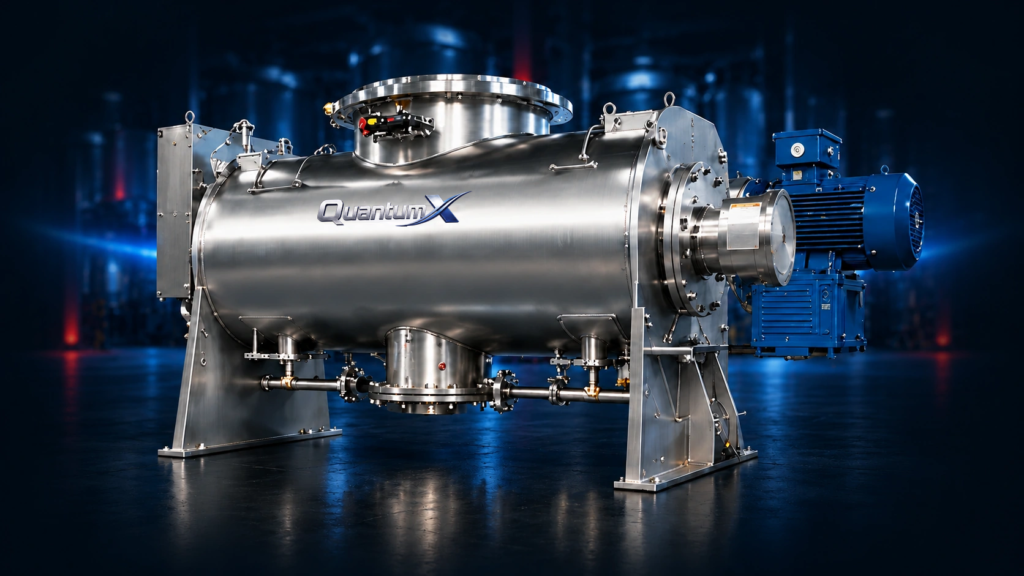
CLOSED CHARGING SEALED PROCESSING CONTAINED SAMPLING & DISCHARGE
Contain the Material at Every Transfer—not Only Inside the Mixer
A high-containment mixer is not simply a sealed vessel.
QuantumX high-containment systems integrate the mixer with closed-transfer interfaces, high-integrity shaft seals, filtered pressure management, contained sampling, controlled discharge, cleaning systems, process automation and project-specific containment-performance testing.
Overview
The System Is Only as Strong as Its Weakest Transfer Point
A mixer vessel may remain sealed during operation while significant exposure occurs during:
For that reason, containment performance cannot be determined from the vessel shell alone.
The engineering review must follow the material through the entire sequence:
Every connection, opening and intervention must be included in the containment strategy.
A sealed mixer with an open charging step is not a high-containment process.
Key capabilities
Protection objectives
Control occupational exposure during routine operation, cleaning, sampling, maintenance and foreseeable process interruptions.
Protect the batch from:
Prevent hazardous or highly active material from reaching:
Maintain:
A system may require personnel containment, product protection or both.
The airflow and pressure strategy must be selected around the actual protection objective. A generic statement that every contained system should operate under either positive or negative pressure is technically incomplete.
A system may require personnel containment, product protection or both.
The airflow and pressure strategy must be selected around the actual protection objective. A generic statement that every contained system should operate under either positive or negative pressure is technically incomplete.
Exposure basis
Define the Target Before Selecting the Equipment
Containment terminology is frequently used inconsistently.
The project should distinguish between:
An occupational exposure limit, or OEL, is a quantitative exposure value established or adopted to protect workers over a defined exposure period.
The project must identify:
OELs can come from authoritative government, professional or company-specific toxicological assessments. OSHA also notes that safety data sheets may include OSHA limits, ACGIH values and other limits used or recommended by the manufacturer or employer.
An occupational exposure band, or OEB, groups a chemical into a hazard band based on toxicological potency and potential health effects.
NIOSH provides an occupational exposure-banding process for chemicals that lack authoritative OELs. The resulting OEB represents an exposure-concentration range intended to guide risk-management decisions; it is not the same as a verified equipment-performance result.
An equipment supplier should not independently assign a customer’s OEB based only on a product name.
The OEB or OEL should be established or approved by the customer’s:
Different companies may use different internal OEB definitions and concentration ranges.
Health-based exposure limits and permitted daily exposure values are generally used to evaluate patient or product cross-contamination risk in shared pharmaceutical facilities.
They are not interchangeable with worker OELs.
The EMA’s health-based exposure-limit guideline focuses on scientifically derived thresholds for assessing cross-contamination risk between medicinal products manufactured in shared facilities.
A project may therefore require separate controls for:
The containment-performance target should define the measurable result expected from the equipment or complete process under an agreed test protocol.
It should identify:
The target should be established before the containment system is finalized.
NIOSH’s hierarchy of controls prioritizes elimination, substitution and engineering controls above administrative controls and personal protective equipment. Well-designed engineering controls place a barrier between the worker and the hazard and are generally less dependent on perfect human behavior.
For a high-containment mixing process, this means the primary strategy should be built around:
Administrative procedures and PPE remain important, but they should not be the only measures protecting the operator from a potent or toxic material.
Define Where the Containment Boundary Begins and Ends
The containment boundary can include:
The project should identify:
A clear containment-boundary drawing should be included in the project design basis.
Containment engineering
01Interface
Charging Is Often the Highest-Exposure Step
Dry powder charging can release material through:
Bag openingContainer connectionDust displacementProduct free fallFlexible-hose disconnectionResidue on container surfacesOperator handlingFilter ventingIncorrect docking
Potential QuantumX charging systems include:
Contained bag-dump stationGlovebox chargingIsolator chargingContinuous-liner bag systemDrum-docking stationIBC dockingSplit-butterfly valveRapid-transfer interfaceVacuum conveyingDense-phase conveyingScrew feedingContained loss-in-weight feedingContained gain-in-weight chargingDisposable transfer linerClosed liquid-addition port
Split-Butterfly Valve Charging
A split-butterfly valve can create a closed connection between:
IBC and mixerDrum and mixerPortable container and mixerIsolator and mixerUpstream process and mixer
The active and passive halves dock before the product path opens.
Engineering considerations include:
Valve sizeProduct flowabilityRequired containment targetDocking forceAlignmentResidual productCleaningValve orientationProduct buildupOperator accessContainer weightAutomationSafe undocking
Vacuum Transfer
Vacuum conveying can reduce manual lifting and open product transfer.
Potential benefits include:
Closed chargingReduced dustAutomated ingredient transferReduced operator handlingControlled batch sequencingIntegration with weighing
Engineering considerations include:
Product degradationSegregationLine velocityFilter loadingReceiver designStaticMoistureCleaningTransfer distanceBatch accuracyVacuum sourceContained filter servicing
A closed vacuum line does not automatically provide high containment if the receiver filter or connection must be opened without an engineered safe-change method.
02Interface
Air Displaced During Charging Must Leave the Vessel Safely
When powder enters the mixer, displaced gas must escape or be controlled.
Potential venting systems include:
High-efficiency filterCartridge filterBag filterFiltered vacuum connectionSafe-change filter housingBag-in/bag-out housingPulse-cleaned filterNitrogen-compatible vent systemClosed dust collectorSecondary HEPA filtration
The system should address:
Airflow rateDust loadingParticle sizeProduct toxicityPressure differentialFilter areaFilter cleaningFilter ruptureSafe filter replacementWaste handlingVacuum compatibilitySolvent compatibilityExplosion protection
Filter Change Is a Containment Operation
The clean side of a filter may be safe.
The dirty side may contain concentrated hazardous material.
The replacement procedure should define:
IsolationDecontaminationBaggingSafe removalReplacementIntegrity verificationWaste labelingPersonnel protection
03Interface
Every Rotating Shaft Is a Potential Containment Interface
Shaft seals must be selected around:
Exposure targetProduct finenessProduct toxicityAbrasionVacuumPositive pressureShaft speedShaft diameterTemperatureSolvent compatibilityCleaning methodAllowable leakageMaintenance frequency
Potential seal systems include:
Gas-purged sealsNitrogen-purged sealsMechanical sealsDouble mechanical sealsBarrier-fluid sealsCartridge sealsDry-running sealsContainment-specific seal arrangementsMonitored seal chambers
Seal Monitoring Can Include
Purge-gas pressurePurge-gas flowBarrier-fluid pressureBarrier-fluid temperatureBarrier-fluid levelSeal temperatureLeakage detectionDifferential pressureAlarm and shutdown logic
A seal selected only for dust control may not meet a high-containment exposure target.
04Interface
During mixing, the containment system must control:
Shaft penetrationsAccess doorsProduct inletsLiquid-addition portsChoppersInstrument connectionsVent filtersVacuum connectionsDischarge closuresSampling interfaces
Potential operating features include:
Sealed vesselNegative-pressure operationVacuum operationControlled positive pressureNitrogen blanketingOxygen monitoringDust-tight closuresAutomated ingredient sequencingRemote operationCamera or sight-glass monitoringTorque and current monitoringPressure monitoringFilter differential-pressure monitoringSafe opening interlocks
05Interface
Liquid can be introduced through:
Sealed dosing lancePressure-rated nozzleSpray manifoldMetering pumpMass-flow meterLoad-cell dosingClosed transfer vesselPressurized feed potDisposable liquid connection
The liquid-addition system should control:
BackflowLeakageSpray distributionLine clearingResidual productCleaningConnection and disconnectionPressure differentialSolvent vaporHazardous-area requirements
A liquid line can become a contamination pathway if product migrates upstream or remains trapped after processing.
06Interface
Sampling Should Not Require Opening the Mixer
A representative sample may be required during:
Dry blendingGranulationHeatingCoolingVacuum dryingReactionFinal release
Potential contained sampling systems include:
Closed sample valvePocket samplerRetractable samplerGlovebox samplingIsolator samplingClosed sample bottle connectionPurgeable sampling chamberDouble-valve sample transferDisposable sample sleeve
Sampling design should account for:
Sample representativenessOperator exposureSample quantityVessel pressureVacuumProduct flowabilityCleaningResidual materialCross-contaminationSample-container sealingAnalytical-laboratory transfer
A sample is not representative merely because it was collected safely.
The sampling position must also reflect the mixing and process objective.
07Interface
The System Must Stay Closed Until the Product Reaches the Next Secure Boundary
Potential discharge systems include:
Split-butterfly valveContained IBC dockingDrum-docking stationContinuous linerGlovebox dischargeIsolator dischargeVacuum transferDense-phase conveyingClosed screw conveyorPressure-assisted transferContained rotary valveDouble-valve isolationClosed surge hopperDirect packaging connectionTablet-press or capsule-filler transferContained wet millContained dryer transfer
Discharge design should consider:
Product flowabilityResidual hold-upOutlet sizeBridgingCohesionVessel pressureVacuumDownstream ratingStaticDustOperator interventionConnection residueUndockingCleaningWaste handling
Residual Product at the Connection
The external faces of a connection can become contaminated during undocking.
The transfer interface should address:
WipingWashingVacuum cleaningSurface sealingSplit-valve face containmentDisposable coversBag-outAutomated decontaminationVerified safe disconnection
QuantumX platforms
01
Active Convective Mixing in a Closed Powder System
02
Gentle Processing for Fragile or Variable-Density Materials
03
Intensive Mixing for Cohesive and Difficult Powders
04
Gentle Vertical Processing with Gravity-Assisted Discharge
05
Gentle Tumble Blending with Minimal Internal Tooling
06
Contained Wet Granulation from Charging Through Dryer Transfer
07
QuantumX platforms
01Platform
Active Convective Mixing in a Closed Powder System
QuantumX contained ribbon mixers can be evaluated for:
APIsPharmaceutical excipientsPotent nutraceuticalsToxic chemical powdersFine catalystsBattery materialsCarbon additivesDusty premixesClosed liquid additionVacuum mixingVacuum drying
Engineering considerations include:
Ribbon width and pitchShaft sealsSupport-arm cleanabilityWorking fillContained chargingSamplingFlush dischargeWash-in-placeVacuum and pressureFilter changeResidual hold-up
02Platform
Gentle Processing for Fragile or Variable-Density Materials
QuantumX contained paddle mixers can be evaluated for:
Pharmaceutical granulesCoated particlesFragile active ingredientsCatalyst carriersBattery-material granulesPotent powder blendsControlled liquid addition
Engineering considerations include:
Paddle geometryParticle protectionOpen agitator accessShaft sealsSamplingDischargeCleaningContained maintenance
03Platform
Intensive Mixing for Cohesive and Difficult Powders
QuantumX contained plough mixers can be evaluated for:
Cohesive APIsPotent powdersToxic chemicalsNanomaterialsCarbon blackConductive additivesGranulationCoatingLiquid additionDeagglomeration
Engineering considerations include:
Plough profileChopper sealsProduct temperatureMechanical ignition riskWearContained chargingContained wet millingWIP/CIPSafe maintenance
04Platform
Gentle Vertical Processing with Gravity-Assisted Discharge
QuantumX contained conical screw mixers can be evaluated for:
Potent pharmaceutical powdersFine chemicalsHigh-value catalystsNanomaterialsBattery materialsVacuum dryingSolvent removalLow-shear blendingBroad working ranges
Potential containment advantages can include:
Top-mounted driveBottom contained dischargeClosed vacuum systemIntegrated filterFewer low-level shaft penetrationsGravity-assisted emptyingClosed samplingWash-in-place
05Platform
Gentle Tumble Blending with Minimal Internal Tooling
QuantumX contained double cone mixers can be evaluated for:
Free-flowing potent powdersHigh-value pharmaceutical materialsFragile granulesCrystalsHigh-purity powdersVacuum drying
Engineering considerations include:
Contained chargingRotating pressure boundaryTrunnion sealingDynamic balanceSample collectionContained dischargeVessel positioningGuardingCleaningVacuum connections
06Platform
Contained Wet Granulation from Charging Through Dryer Transfer
QuantumX high-containment granulation systems can integrate:
Isolator chargingSplit-valve transferClosed binder additionSealed granulationContained samplingEnclosed wet millingClosed pneumatic transferFluid-bed dryer integrationWash-in-placeClean-in-placeContained waste removal
Potential applications include:
Potent oral solid-dose productsCytotoxic formulationsSensitizing compoundsHigh-value active ingredientsControlled-release products
07Platform
High-viscosity contained systems can be engineered for:
Potent liquidsHigh-viscosity active formulationsMedical adhesivesToxic pastesBattery slurriesNanomaterial dispersionsReactive productsVacuum deaeration
Potential containment features include:
Closed powder inductionSealed vacuum hoodHigh-integrity multi-shaft sealsGlovebox chargingContained change-can dockingContained samplingPress-out dischargeDisposable transfer interfacesWash-in-place
Pressure regimes
These Terms Should Not Be Used Interchangeably
Used to encourage leakage airflow inward and reduce outward migration of hazardous powder.
Can help maintain inward leakage and support closed transfer.
May be required for:
Process vacuum can create different mechanical, filtration and foaming requirements than ordinary containment pressure control.
May be required for:
Positive pressure can increase the potential driving force for outward leakage.
The seal, closure and containment strategy must therefore account for the worst differential pressure.
The isolator or glovebox pressure regime depends on:
A high-containment system may use different pressure zones across:
Operation and cleaning
An isolator can create a physical barrier between the operator and the product.
Potential mixer integrations include:
Design considerations include:
The mixer should be positioned so routine work can be completed without awkward operator movement or unnecessary breach of containment.
Flexible containment can be used for:
Potential benefits include:
Engineering considerations include:
Flexible containment should be integrated into a defined operating procedure—not treated as an improvised accessory.
The Mixer Should Be Safe Before It Is Opened
High-containment cleaning strategies can include:
The method should be selected around:
Wetting Before Opening
Where compatible with the material, wetting can reduce airborne-powder release during opening and maintenance.
However, adding water or cleaning solution may create:
The decontamination method must be product-specific.
Wash-in-Place and Clean-in-Place
WIP
Wash-in-place may reduce residue and exposure sufficiently to permit safer manual inspection or final cleaning.
CIP
Clean-in-place is a more fully engineered, repeatable cleaning process using defined:
A high-containment CIP system may include:
CIP supports containment and cleanability, but it does not by itself establish cleaning validation.
Highly potent or toxic products manufactured in multiproduct facilities require risk-based cross-contamination controls that can include facility design, segregation, process containment and procedural measures. FDA’s inspection program specifically evaluates the integrity of isolators, pressure differentials, material and personnel flow, cleaning and controls for highly potent or toxic products.
ICH Q7 likewise calls for appropriate containment or dedicated controls for highly sensitizing, highly active, toxic or infectious materials unless validated cleaning or inactivation procedures are established and maintained.
Equipment features that can support a cross-contamination strategy include:
The facility owner remains responsible for the complete cross-contamination risk assessment and quality-system controls.
Maintenance Can Create More Exposure Than Routine Operation
Potential high-risk maintenance tasks include:
The equipment should include a maintenance-containment strategy.
Potential measures include:
The design should identify which components can be maintained without breaching the primary containment boundary.
Performance testing
01Testing
Performance Must Be Measured Under Defined Operating Conditions
Containment performance should be demonstrated through an agreed test protocol—not assumed from equipment appearance.
The current third edition of the ISPE SMEPAC guide was published in December 2024. It provides standardized principles and methodologies for evaluating airborne emissions and surface deposition from pharmaceutical containment systems under defined test conditions, including more complex equipment and processes.
Potential test operations can include:
ChargingMixer operationSamplingDischargeContainer disconnectionFilter handlingCleaningMaintenance intervention
Potential measurements can include:
Operator breathing-zone samplesFixed-location air samplesBackground samplesSurface depositionRoom migrationTransfer-interface contamination
02Testing
A surrogate material may be selected based on:
DetectabilityParticle-size distributionDustinessFlowabilityAnalytical sensitivitySafetySimilarity to the expected process
The test report should clearly identify:
SurrogateBatch quantityEquipment configurationOperating procedureOperatorsRoom conditionsSampling positionsSampling durationAnalytical methodDetection limitsTest repetitionsDeviationsResults
03Testing
A containment test result applies to the specific:
Equipment configurationSurrogateOperating procedureConnectionsOperatorsSampling planRoom conditionsMaintenance condition
It should not be presented as a universal containment guarantee for every material, batch, operator or site.
04Testing
Factory Testing
Containment testing at the manufacturer’s facility can:
Evaluate the baseline equipment configurationVerify transfer interfacesIdentify leakage pointsConfirm operating proceduresTrain personnelSupport design refinementDocument performance before shipment
05Testing
Testing after installation can evaluate:
Actual room conditionsFinal HVACInstalled transfer equipmentActual operator proceduresDownstream connectionsUtility conditionsSite cleaningFacility pressure differentials
06Testing
Retesting may be appropriate after:
Major maintenanceSeal replacementEquipment modificationProcess changeProduct changeTransfer-interface changeSignificant containment deviationExtended serviceUpdated exposure target
Factory testing does not replace site verification.
Technical details
Potential QuantumX containment controls include:
Safe Opening Logic Can Require
Potential QuantumX containment-system materials include:
Selection should account for:
Nonconductive Liners
Ceramic and polymer liners may affect:
Containment, ATEX and wear requirements must be reviewed together.
High Containment and Vacuum
Vacuum can support:
But vacuum can also increase:
High Containment and Positive Pressure
Positive pressure may support:
But it can increase the driving force for outward leakage.
High Containment and ATEX
A high-containment system may also require:
Containment, vacuum, pressure, ASME, PED and ATEX are separate design requirements that must be integrated into one project basis.
Industries and applications

APIs · Highly potent APIs · Cytotoxic materials · Hormonal products · Sensitizing compounds · Controlled substances · Pharmaceutical intermediates · Potent oral solid-dose products · High-containment granulation · Vacuum drying
Explore industry
Toxic powders · Sensitizing chemicals · Reactive intermediates · Fine catalysts · Pigments · Functionalized powders · Solvent-wet materials · Hazardous additives
Explore industry
Conductive carbon · Carbon nanotubes · Carbon nanofibers · Cathode powders · Anode powders · Nanomaterials · Ceramic electrolytes · Metal powders · High-purity materials
Explore industry
Pesticide intermediates · Seed-treatment actives · Veterinary actives · Potent feed additives · Agricultural chemicals
Explore industry
Potent actives · Fine pigments · Sensitizing ingredients · Nanomaterials · High-purity powders
Explore industryClinical materials · Development compounds · Pilot-scale potent processing · High-value specialty powders · Small-batch toxic materials
Explore industryWhy QuantumX
QuantumX evaluates charging, mixing, sampling, discharge, cleaning and maintenance—not only the mixer vessel.
Ribbon, paddle, plough, conical screw, double cone, granulator, planetary and multi-shaft systems can be evaluated according to the product.
The equipment is engineered around customer-approved OEL, OEB, containment target and process conditions.
Systems can integrate split valves, isolators, gloveboxes, vacuum transfer and contained containers.
Shaft seals, closures, filters, valves and sampling systems are engineered as containment boundaries.
WIP, CIP, wet-down, contained cleaning and safe maintenance can be incorporated.
Containment can be coordinated with vacuum, ASME, PED, ATEX, inerting and controlled atmosphere.
Containment-performance testing can be planned around an agreed SMEPAC-based protocol.
Drawings, controls, operating procedures, maintenance instructions, FAT and containment-test documentation can be included according to scope.
EXPOSURE & CONTAINMENT APPLICATION REVIEW
Provide:
Upload approved toxicology or industrial-hygiene information, safety data sheets, OEL/OEB basis, transfer-interface requirements, containment test specification, process data, cleaning strategy, room layout, P&IDs and facility drawings. Confirm an approved confidential communication channel before submitting proprietary formulas, active concentrations or sensitive toxicology data.
Frequently asked questions
A high-containment mixer is part of an engineered closed-processing system designed to control hazardous or highly active material during charging, mixing, sampling, discharge, cleaning and maintenance.
No. Containment performance depends on the complete process, including transfer connections, shaft seals, filters, sampling, discharge, cleaning and operator procedures.
An occupational exposure limit is a quantitative concentration limit used to guide worker-exposure control over a defined time period.
An occupational exposure band groups a chemical into a hazard band based on toxicological potency and potential adverse effects, particularly when a formal OEL is unavailable.
No. Different organizations may use different OEB definitions and ranges. The customer should provide the approved OEL or OEB basis.
The customer’s toxicologist, industrial hygienist or occupational-health team should establish or approve the exposure band and target.
No. OELs address worker exposure. PDE and HBEL values are generally used for patient safety and cross-contamination risk.
No. Performance depends on charging, sampling, discharge, filtration, cleaning, room conditions, operating procedures and downstream connections.
SMEPAC is ISPE’s standardized methodology for evaluating airborne particle emissions and surface deposition from pharmaceutical containment systems under defined test conditions.
SMEPAC is a testing methodology and guidance framework, not a generic certification automatically applied to equipment.
Yes. A test protocol can be developed around the agreed operations, surrogate material, sampling plan, analytical method and acceptance criteria.
Factory testing establishes performance in the tested factory configuration. Site testing may still be required after installation with the final room, HVAC, operators and connected equipment.
A surrogate powder is processed through the equipment while airborne and surface samples are collected to evaluate emissions under defined conditions.
That is project-specific and may introduce additional safety, regulatory and facility requirements. Surrogate materials are often preferred for equipment-performance testing.
Options can include glovebox charging, isolators, continuous liners, vacuum transfer, split-butterfly valves, contained IBCs, drums and closed feeders.
Yes. Split-valve charging or discharge can be integrated where appropriate to the container, flow rate and containment target.
Yes. The transfer system, receiver filter, line cleaning, static and filter-change method must also meet the containment basis.
Yes. Closed sample valves, glovebox sampling and other contained sampling systems can be evaluated.
Potential options include split valves, contained IBC docking, continuous liners, vacuum transfer, closed screw conveying, contained hoppers and direct downstream connections.
Safe-change or bag-in/bag-out filter housings can be integrated so contaminated filter media can be isolated and removed in a controlled manner.
Yes. Wet-down, WIP or CIP can reduce loose powder before inspection or maintenance, subject to material compatibility and cleaning strategy.
CIP can reduce exposure during cleaning, but complete containment depends on the entire system, procedure and validated performance.
Yes. Vacuum, seals, filters, vapor handling and the containment interfaces must be designed together.
Selected systems can operate under pressure, but positive pressure increases the potential driving force for leakage. Pressure-rated construction and containment must be integrated.
Yes. Application-specific pressure-vessel construction can be incorporated where required.
Yes. ATEX and containment requirements can be integrated around customer-supplied zone and material-hazard data.
Yes. Nitrogen purge, evacuation and backfill, oxygen monitoring and process interlocks can be incorporated where required.
Yes, subject to a defined exposure target, process design, cleaning strategy, containment interfaces and performance-testing basis.
Yes, where material compatibility, exposure target, waste handling, cleaning and facility requirements are defined.
Yes. These applications normally require detailed review of dustiness, containment, static, filtration, cleaning and operator exposure.
Potential platforms include ribbon, paddle, plough, conical screw, double cone, high-speed granulator, double planetary and multi-shaft systems.
Some systems can be improved, but a true high-containment upgrade may require major changes to charging, seals, filters, sampling, discharge, cleaning and room interfaces. Retrofit feasibility must be assessed individually.
Not automatically. PPE requirements are determined by the customer’s exposure assessment and complete control strategy.
No responsible equipment supplier should promise absolute zero exposure. Performance should be stated against a measurable target and defined test protocol.
Provide the material hazard, OEL or OEB, batch size, transfer method, sampling, discharge, cleaning, vacuum or pressure, ATEX requirements, containment target and test methodology.
QuantumX high-containment mixers
Request engineering support
Share your material and batch requirements. A PerMix engineer will review the application and recommend a mixer.