
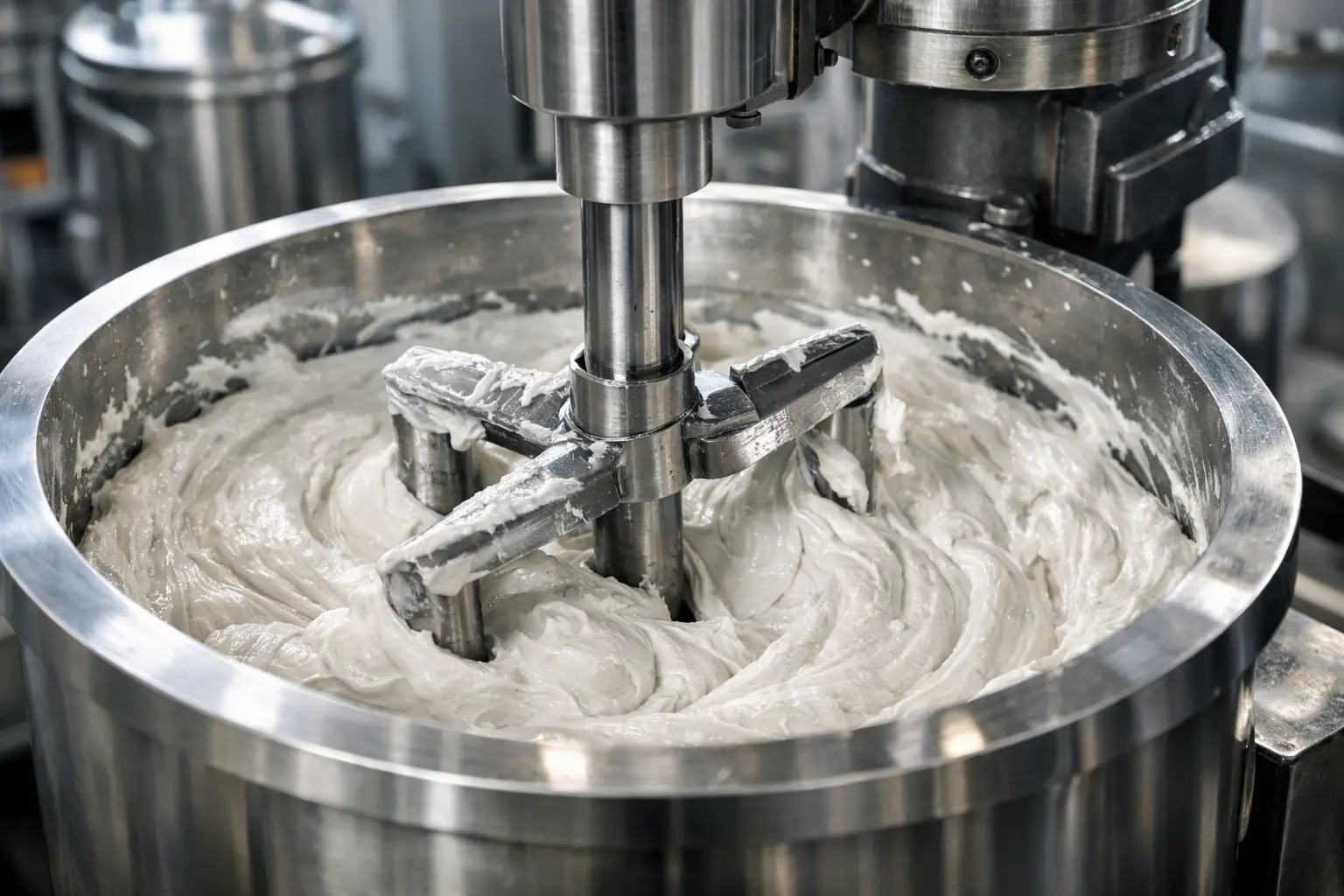
When a paste stops flowing and starts fighting the mixer, equipment selection gets expensive fast. The best mixer for viscous paste is not the one with the biggest motor or the highest RPM. It is the one built around your material’s yield stress, shear sensitivity, solids loading, temperature behavior, and discharge requirements.
That matters because “viscous paste” covers a wide range of products that behave nothing alike in production. Adhesives, putties, battery slurries, dough-like food masses, cosmetic creams, ceramic compounds, wet granulations, sealants, and heavy chemical formulations can all fall into the same broad category. Some need aggressive kneading. Others need controlled shear under vacuum. Some must move heat efficiently. Others must protect fragile ingredients and maintain particle structure.
What the best mixer for viscous paste depends on
In industrial processing, paste viscosity alone is not enough to choose a machine. Two products with similar apparent viscosity can require very different mixing actions. One may need folding and compression to incorporate powders into a sticky base. Another may need rotor-stator shear to reduce droplets or break agglomerates. A third may need a slow, high-torque agitator that keeps the batch moving without overheating it.
The real selection factors are usually rheology, solids concentration, batch size, residence time, cleaning standards, and whether the process needs vacuum, heating, cooling, or pressure. Production teams also need to look at practical constraints such as floor space, discharge height, operator access, automation level, and maintenance tolerance. A mixer that performs well in the lab can still fail commercially if discharge is slow or cleanup takes too long.
The mixer types that handle viscous paste best
Sigma mixers for heavy-duty kneading
For very thick, dense, and resistant materials, sigma mixers are often the strongest choice. Their twin blades generate high torque and intensive kneading action, making them well suited for products such as sealants, gum bases, putties, heavy doughs, carbon pastes, and high-viscosity compounds with substantial solids loading.
This design works especially well when the process calls for compression, folding, smearing, and continuous mass turnover rather than simple circulation. It is often the right answer when a conventional agitator starts channeling around the batch instead of moving through it.
The trade-off is that sigma mixers are not the most versatile option for every formulation. If your product needs fine emulsification, rapid dispersion of micro-additives, or very sanitary washdown between frequent changeovers, another platform may be a better fit.
Planetary mixers for versatility and wall-to-wall coverage
Planetary mixers are a strong candidate when the paste is thick but still benefits from broad vessel coverage and controlled mixing patterns. Because the mixing element rotates on its own axis while orbiting the vessel, the design is effective for viscous materials that tend to cling to walls and resist movement.
Double planetary mixers are commonly selected for adhesives, plastisols, sealants, battery materials, composites, and filled pastes. They can also support vacuum operation, which is a major advantage when air entrainment affects density, appearance, or downstream filling.
If the formulation includes powders, liquids, and viscosity build during the same batch, this style often provides a balanced solution. It combines strong bulk movement with good ingredient incorporation. The limitation is that it may not match the localized shear intensity of a dedicated high-shear mixer unless additional dispersion tools are integrated.
Multi-shaft mixers for complex paste formulations
When a process needs more than one mixing job in the same vessel, a multi-shaft mixer is often the most practical answer. These systems combine low-speed high-torque agitation with one or more high-speed dispersers, saw-tooth blades, or rotor-stator heads. That makes them effective for pastes that require both bulk turnover and targeted shear.
This is a common fit for coatings, inks, adhesives, resins, cosmetic creams, and chemical compounds where powder wet-out, viscosity rise, and dispersion quality all matter. A multi-shaft design gives process engineers more control over each stage of the batch instead of forcing one agitator to do everything.
The main advantage is flexibility. The main trade-off is complexity. More shafts and more functions usually mean more controls, more validation work, and a higher capital cost than a simpler kneader or planetary unit.
High-shear vacuum mixers for smooth, refined pastes
Some viscous pastes are judged less by torque and more by texture, homogeneity, and air-free finish. In those cases, a high-shear vacuum mixer may be the best mixer for viscous paste, especially in cosmetics, pharmaceuticals, food, and specialty chemicals.
These systems are designed for emulsification, dispersion, deaeration, and thermal control in one integrated process. They are well suited for creams, gels, ointments, emulsified pastes, and formulations that need a polished, consistent final structure.
They are not the first choice for extremely stiff masses that behave more like dough or putty. But for products where smoothness, fine particle distribution, and vacuum deaeration are critical, they are often the best-performing option.
Common selection mistakes
The first mistake is choosing based on viscosity number alone. Paste behavior changes with shear rate, temperature, solids level, and time. A material that looks manageable during startup can become much harder to mix after powder addition or solvent loss.
The second mistake is underestimating discharge. Many thick products mix acceptably but become a bottleneck at emptying. If the paste must feed an extruder, filler, mill, or downstream vessel, discharge method should be part of the initial specification, not an afterthought.
The third mistake is ignoring heat. Viscous mixing generates friction, and friction changes product properties. For heat-sensitive formulations, jacket design, mixing speed, and batch cycle profile can be just as important as agitator type.
How to identify the right fit for your plant
Start with the material, not the machine category. You need to define whether the paste is shear-thinning, shear-sensitive, thixotropic, tacky, abrasive, aeration-prone, or heat-sensitive. You also need to know whether ingredients are added all at once or in stages, and whether viscosity rises gradually or sharply during the batch.
Next, look at the required end state. Are you trying to knead, disperse, emulsify, deagglomerate, deaerate, or simply blend to uniformity? The same batch may require more than one of these actions. That is why many difficult paste applications are better served by custom-engineered configurations than by standard one-size-fits-all equipment.
Then evaluate throughput honestly. A mixer that can technically process the product is not automatically production-ready. Batch turnover, loading method, cleaning time, operator intervention, and recipe repeatability all affect true plant capacity.
For regulated industries, validation and sanitary design also matter. In food, pharma, nutraceutical, and personal care applications, surface finish, cleanability, gasket selection, dead-leg reduction, and documentation can influence the decision as much as mixing performance.
Best mixer for viscous paste by application type
If your product behaves like a heavy dough, gum, putty, or dense filled compound, sigma mixing is often the most effective route. If it is a high-value adhesive, sealant, battery paste, or composite material that needs strong movement and vacuum capability, a double planetary mixer is often the stronger option.
If you are processing creams, gels, ointments, or refined emulsified pastes, high-shear vacuum systems usually deliver better product finish and air control. If the formulation includes several competing needs such as powder incorporation, dispersion, viscosity rise, and final adjustment, a multi-shaft mixer is often the smartest investment.
That is why experienced equipment suppliers do not answer this question with a single model number. The best answer comes from matching mixing action to product behavior and production targets. In many cases, the best result is not just choosing a mixer type but specifying the right blade geometry, vessel configuration, drive capacity, jacket design, vacuum level, and discharge system.
At PerMix, this is exactly where engineered selection makes the difference. Industrial buyers do not need generic advice. They need a machine that fits the material, the plant, and the business case.
The right paste mixer should make production more predictable, not more complicated. If the equipment matches the process, operators spend less time fighting the batch and more time making consistent product at the throughput the plant was built to deliver.