
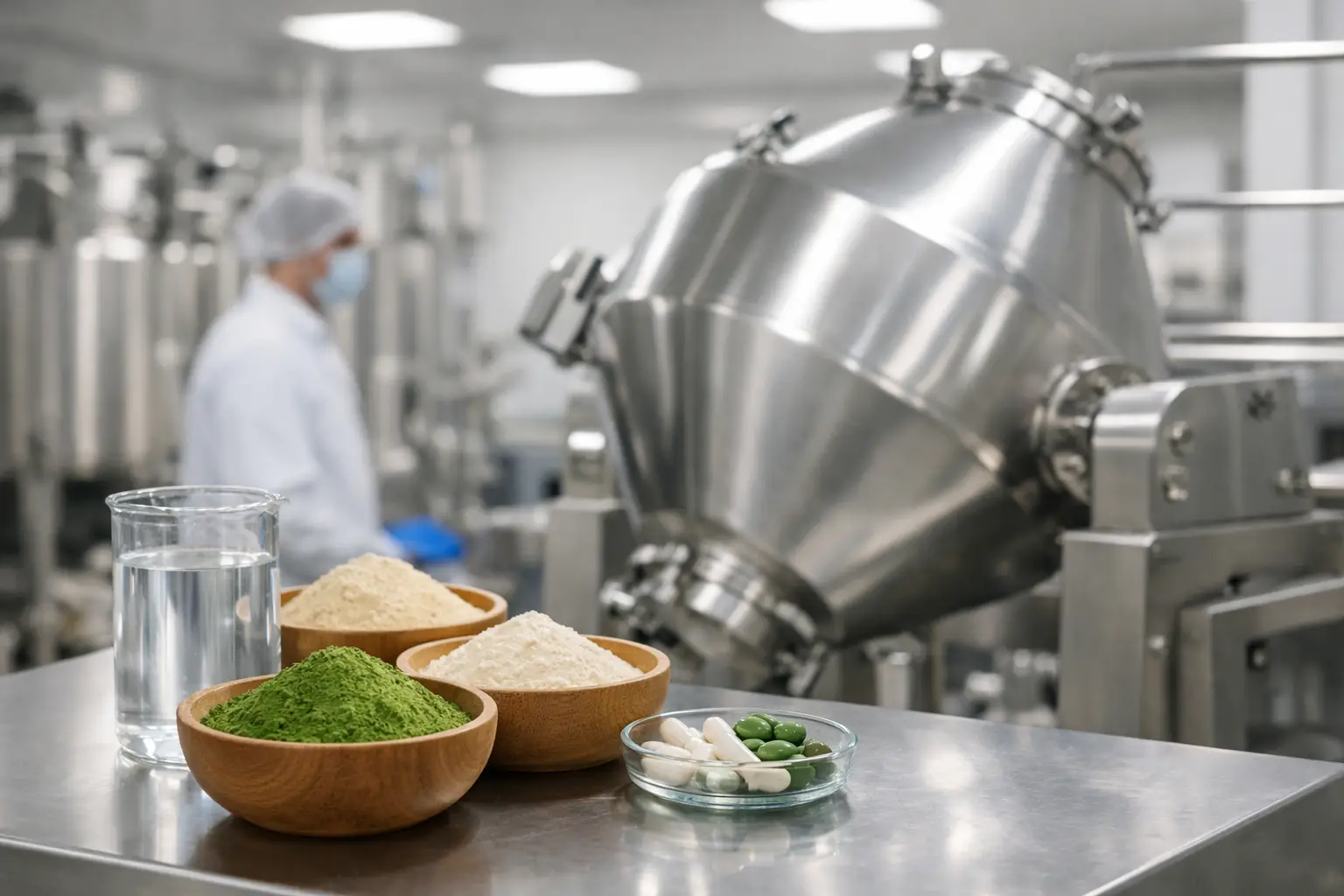
A nutraceutical blend can look uniform and still fail a potency test. When a formula contains low-dose vitamins, minerals, botanical extracts, probiotics, enzymes, sweeteners, and flow agents with very different densities and particle sizes, the mixer becomes a direct control point for product quality. The best mixers for nutraceutical powders are therefore not defined by a single machine type. They are selected around the formula, batch size, segregation risk, cleaning standard, and production targets.
For manufacturers, the right decision protects more than blend uniformity. It affects batch repeatability, active ingredient distribution, production capacity, operator time, cross-contamination risk, and the ability to validate a process with confidence.
What Makes Nutraceutical Powder Mixing Difficult?
Nutraceutical powders frequently combine ingredients that do not naturally behave alike. Fine botanical extracts may be cohesive and prone to agglomeration. Crystalline vitamins and minerals can be free-flowing but differ substantially in particle size and bulk density. Potent actives may be present at fractions of a percent, while flavors, fibers, proteins, or carriers make up the balance of the batch.
This creates several process risks. A low-dose active can form localized concentrations if it is charged directly into the main batch without a proper preblend. Particles can segregate after mixing during transfer, bin filling, or packaging. Excessive shear can damage fragile ingredients, while inadequate movement leaves dead zones and incomplete dispersion.
The best result comes from treating blending as a complete process rather than a vessel selection exercise. Material testing, charge sequence, fill level, mixing time, liquid addition method, discharge design, and downstream handling all need to support the desired finished-product specification.
Best Mixers for Nutraceutical Powders by Application
Ribbon mixers for standard dry blends
Ribbon mixers remain a strong choice for many nutraceutical powders, particularly larger batches of reasonably free-flowing formulations. The inner and outer ribbons move material in opposing directions, creating broad convective circulation throughout the trough. This makes the design practical for protein blends, powdered drink mixes, fiber products, mineral blends, and formulations with moderate amounts of flavors or flow aids.
A ribbon mixer is often cost-effective where the batch is consistent, ingredient additions are straightforward, and the formulation does not require intensive deagglomeration. It can also accommodate limited liquid addition when a spray system is properly designed.
The trade-off is that ribbon mixers are not always the best answer for highly cohesive materials, very small active additions, or formulas that need aggressive dispersion. Shaft seals, discharge geometry, and clearances also deserve close attention when cleanability and cross-contamination control are critical.
Paddle mixers for gentle, repeatable blending
Paddle mixers are well suited to nutraceutical formulas that require gentler particle handling and fast, efficient batch turnover. Their paddles create a fluidized mechanical mixing action that can distribute ingredients effectively with relatively low shear. This is valuable for blends containing fragile granules, coated ingredients, sensitive botanical particles, or materials where particle attrition must be minimized.
For many applications, a paddle mixer offers a favorable balance of blend uniformity, short mixing time, and controlled discharge. The design can be especially effective when paired with a high-performance bomb-bay or full-length discharge valve that reduces residual material and supports faster cleaning between products.
Paddle geometry, rotational speed, and operating fill level must be matched to the powder. A formula that performs well at a 50 percent fill level may behave differently at 70 percent. Production-scale testing should confirm both blend uniformity and discharge consistency before equipment is finalized.
Plough mixers for cohesive powders and liquid additions
Plough mixers are among the best-performing options for more demanding nutraceutical powders. Their plough-shaped elements lift and project material into a mechanically fluidized mixing zone. This intense circulation is effective for cohesive botanical powders, formulas with density differences, agglomerated ingredients, and blends that require uniform liquid addition.
A plough mixer can be fitted with high-speed choppers to break soft agglomerates and improve dispersion. This combination is useful when incorporating flavors, oils, lecithin, natural extracts, or other liquid ingredients into a dry carrier. It can also reduce the need for separate preconditioning steps in certain processes.
Higher mixing intensity is not automatically better. If the formulation includes shear-sensitive probiotics, encapsulated actives, or delicate particles, the plough and chopper system must be evaluated carefully. The objective is sufficient energy to disperse ingredients, not unnecessary energy that changes particle structure or product performance.
Conical mixers for low-shear and high-value formulations
Conical mixers are often selected for specialty nutraceutical products, pilot production, and formulations requiring low-shear blending. Their geometry supports gentle tumbling and controlled movement, making them suitable for fragile powders, high-value active ingredients, and applications where very low residue is a priority.
A conical mixer can offer excellent batch flexibility, particularly when manufacturers run smaller campaigns or several product families. Its compact footprint and efficient discharge can be attractive in facilities where space and cleaning time are constrained.
However, a conical mixer may require longer blend times than an intensive plough or paddle mixer. It is also not the default solution for every difficult powder. Highly cohesive materials or formulations needing liquid incorporation may benefit from a more active mixing mechanism or an integrated intensifier.
Continuous mixers for high-throughput production
Continuous mixing can be the right solution for established nutraceutical products produced at high volume. Instead of processing discrete batches, ingredients are metered continuously into the mixer and discharged as a steady finished blend. When feed systems are accurate and controls are properly engineered, continuous operation can improve throughput, reduce labor, and decrease production footprint.
The key limitation is formulation and feed consistency. Continuous mixers depend on reliable loss-in-weight feeders, stable material flow, and disciplined control of ingredient rates. They are generally best for mature, high-volume products rather than frequent short runs or development-stage formulas that change often.
Selecting a Mixer Starts With the Powder
The same mixer can produce excellent results with one formulation and poor results with another. Before specifying equipment, process engineers should characterize the powder blend and the required operating conditions. Bulk density, particle-size distribution, moisture content, flowability, cohesiveness, electrostatic behavior, and active ingredient concentration all influence mixer selection.
Particle size and density differences are especially important. When one component is fine and light while another is coarse and dense, a uniform blend can separate after discharge. In that case, the solution may involve matching particle sizes, granulating a minor component, changing the addition sequence, reducing transfer distance, or selecting packaging equipment that limits vibration-induced segregation. The mixer alone cannot correct a downstream process that re-segregates the product.
For low-dose actives, premixing is often essential. A geometric dilution approach distributes the active into a compatible carrier before it enters the main mixer. This reduces the chance of isolated high-concentration pockets and supports more defensible validation results.
Cleaning, Validation, and Hygienic Design Matter
Nutraceutical manufacturers may process allergen-containing proteins, botanical extracts, vitamin blends, and products with distinct flavors on the same equipment. Cleaning performance is therefore a production and quality issue, not an afterthought.
Mixer designs should be evaluated for accessible internal surfaces, minimal retention areas, removable components where appropriate, sanitary weld quality, shaft seal design, and discharge valve cleanability. Depending on the product portfolio, dry cleaning may be preferred to avoid moisture exposure and downtime. Other facilities may require wet-cleaning capability, clean-in-place systems, or documented cleaning validation protocols.
Material construction should also match the application. Stainless steel contact surfaces are standard for most nutraceutical production, while surface finish, gasket materials, and seal configurations should be selected for the formulation and sanitation method. Equipment that is difficult to inspect or clean can become the limiting factor in an otherwise capable production line.
Build the Mixing System, Not Just the Mixer
A high-performance nutraceutical blending operation includes more than the mixing chamber. Accurate ingredient feeding, dust collection, sifting, milling, liquid spray systems, vacuum conveying, intermediate storage, and automated controls can all influence final blend quality.
For example, an inline sifter may prevent foreign material or oversize agglomerates from entering the mixer. A mill can normalize the particle size of difficult ingredients before blending. Load cells and recipe controls can verify additions, capture batch data, and reduce operator-dependent variability. A properly designed discharge and conveying arrangement can preserve the uniformity achieved in the mixer.
The practical question is not which mixer has the most features. It is which process configuration consistently delivers the target blend uniformity at the required throughput, with acceptable cleaning time and operating cost. PerMix engineers this decision around real material behavior and measurable manufacturing performance, rather than a catalog specification.
The right nutraceutical powder mixer should make quality easier to repeat from batch to batch. Start with representative material trials, define the critical quality attributes, and evaluate the complete process from ingredient charging through final packaging. That is where a sound equipment decision becomes a reliable production advantage.