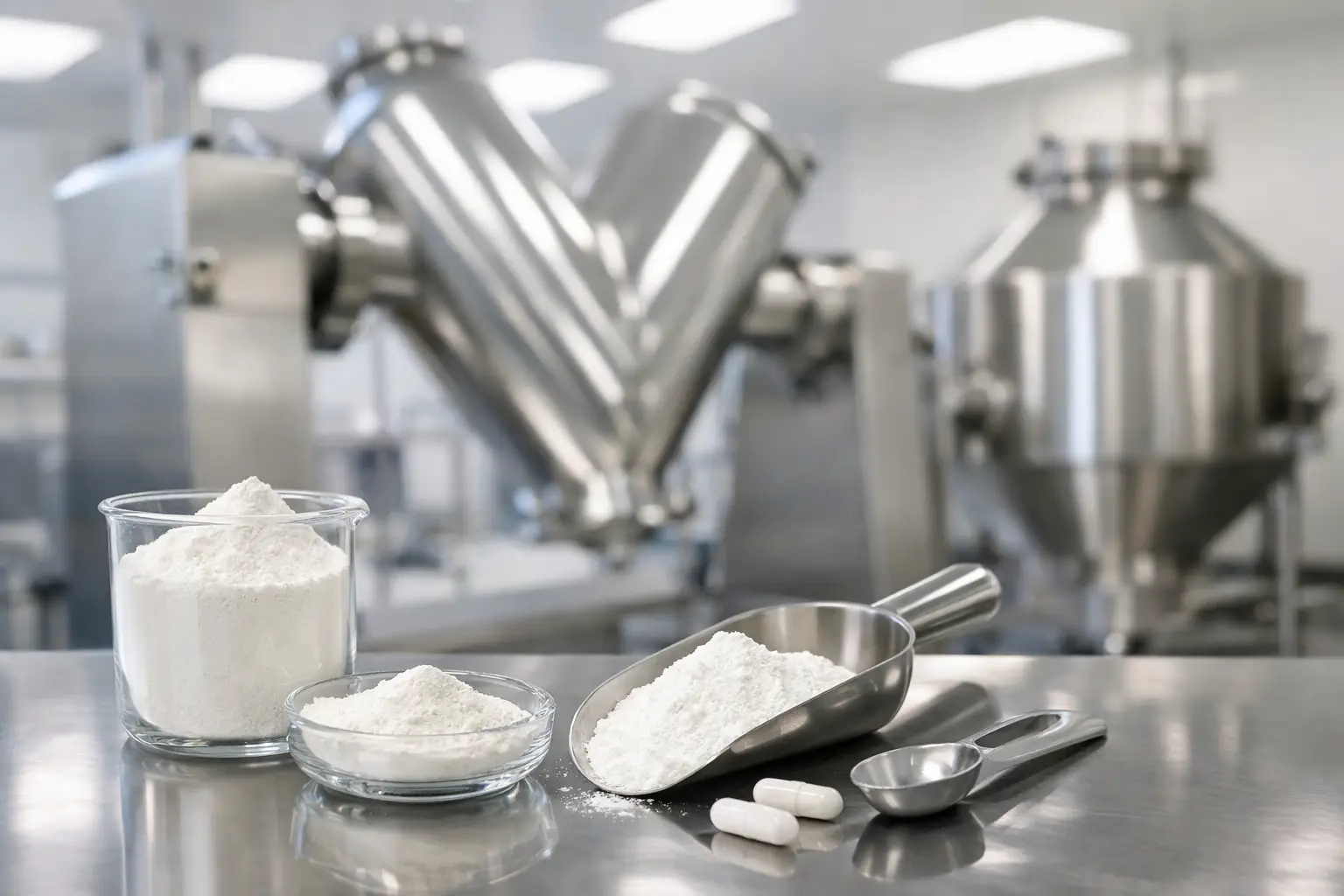
A blend that looks uniform in the bin can still fail content uniformity, segregation control, or cleaning validation once it reaches production. That is why pharmaceutical powder blending equipment cannot be selected on capacity alone. In regulated manufacturing, the mixer has to support repeatable blend quality, controlled handling, sanitary design, and practical scale-up without creating unnecessary downtime or validation burden.
For pharmaceutical manufacturers, the right choice starts with the powder, not the machine brochure. Bulk density, particle size distribution, flow behavior, API concentration, friability, moisture sensitivity, and the need for liquid addition all affect which blending technology will perform well. The best result is rarely the most aggressive mixer or the lowest-cost vessel. It is the equipment that fits the formulation, the batch strategy, and the compliance expectations of the facility.
What pharmaceutical powder blending equipment must deliver
In pharma production, blending is not just about combining ingredients. The process has to achieve a defined level of homogeneity within a validated time window while protecting the powder from overprocessing. Some formulations blend quickly but segregate during discharge. Others need enough mechanical action to break soft agglomerates, yet cannot tolerate excessive shear or heat.
That creates a narrower equipment selection window than many buyers expect. Pharmaceutical powder blending equipment should support consistent residence time, predictable mixing patterns, gentle but effective solids movement, and full cleanability. It also needs to fit the practical realities of the plant, including containment targets, room height, charging methods, discharge requirements, and integration with upstream milling or downstream tablet compression and encapsulation.
A good equipment decision reduces more than blend variation. It can shorten batch cycle time, improve operator safety, simplify cleaning procedures, and make future scale-up more straightforward. A poor choice tends to show up in recurring process deviations, long changeovers, difficult sampling, and production schedules that never quite hold.
Matching the blender to the powder behavior
The first technical question is how the material behaves under motion. Free-flowing excipients and direct-compression blends usually respond well to gentle convective mixing. Cohesive powders, fine APIs, and low-dose formulations often need tighter process control and closer attention to segregation risk.
Ribbon blenders are often chosen for efficient batch blending of powders with similar bulk properties. They provide strong convective movement and good throughput, making them attractive when batches are larger and the formulation is not especially fragile. The trade-off is that not every ribbon design is ideal for highly sensitive blends or for applications where dead spots and cleaning access must be minimized to a very high standard.
Paddle blenders are frequently preferred when a gentler mixing action is needed. They can handle delicate materials more carefully while still producing a thorough blend. For formulations that are prone to particle degradation or where a narrow process window matters, paddle geometry can offer a better balance between blend efficiency and product protection.
Plow mixers come into play when the process calls for more energetic particle movement, rapid blending, or the ability to disperse small liquid additions into a powder bed. In pharmaceutical applications, this can be useful, but only if the formulation can tolerate the higher mechanical intensity. Faster is not always better. If the powder is segregation-prone or heat-sensitive, added intensity can create as many problems as it solves.
Tumble blending also remains relevant in pharma, especially where very gentle movement is needed. The limitation is that tumble systems may require longer blend times and careful control over fill level and loading sequence. They can be effective, but they are not the right answer for every production target.
The real performance metric is repeatability
Buyers often ask how fast a blender can complete a batch. That matters, but it is not the leading metric in pharmaceutical manufacturing. Repeatability matters more. If a mixer can deliver a homogeneous blend in twelve minutes one day and needs twenty the next because of inconsistent loading, poor flow patterns, or scale sensitivity, the process becomes harder to validate and harder to schedule.
Repeatability depends on several design details. Agitator geometry, rotational speed, batch fill level, internal clearances, discharge design, and material-of-construction finish all influence the outcome. Sampling strategy matters too. A mixer should not be judged by a single good trial. It should be evaluated by whether it can consistently reach target uniformity across multiple runs under realistic production conditions.
This is where engineering support has real value. A supplier with broad application experience can help identify whether the issue is truly mixer selection or whether it starts upstream with particle size reduction, ingredient sequencing, or feeder accuracy. In practice, process success is often built on that full-system view.
Sanitary design, containment, and validation cannot be afterthoughts
In pharmaceutical environments, equipment design has to support more than mixing mechanics. Product contact surfaces, weld quality, gasket selection, shaft sealing, access points, and drainability all affect cleanability and inspection. If the blender is difficult to clean, every product changeover becomes slower and every validation cycle becomes more expensive.
Containment is another major factor. Potent compounds, dust control requirements, and operator exposure limits may push the specification toward sealed charging, vacuum conveying interfaces, glovebox integration, or contained discharge. These features are not accessories. In many facilities, they are central to whether the equipment is workable at all.
The same applies to documentation. IQ/OQ support, material traceability, finish documentation, and compliance-oriented design review can materially affect project timelines. Procurement teams may focus on capital cost first, but engineering and quality teams usually pay the price when critical documentation or hygienic details are missing.
Scale-up is where many projects go off track
Lab success does not automatically translate to production success. A blend that performs well in a pilot unit may behave differently at commercial volume because fill level, headspace, ingredient loading sequence, and powder compaction all change with scale. That is why pharmaceutical powder blending equipment should be selected with a clear path from development through commercial production.
The safest approach is to evaluate scale-up based on mixing principle, not just vessel size. Equipment that preserves similar motion patterns and process logic across capacities is easier to justify and easier to validate. If the production machine uses a different mechanical action from the pilot unit, development data may not transfer cleanly.
It also helps to consider future manufacturing plans early. A blender sized only for current demand can become a bottleneck faster than expected. On the other hand, oversizing can create poor mixing performance at low fill volumes. The right capacity decision usually lands in the middle – enough headroom for growth, but still aligned with realistic batch sizes and process windows.
Common buying mistakes
One common mistake is treating all powder blends as if they behave the same. A vitamin premix, a high-dose tablet blend, and a low-dose potent formulation can each require a different mixing approach. Another mistake is assuming the fastest blender delivers the best productivity. If aggressive action creates segregation, attrition, or cleaning difficulty, the apparent time savings disappear elsewhere in the process.
Buyers also run into trouble when they focus too heavily on nominal working volume and not enough on discharge performance. A blend that hangs up in the outlet, leaves excessive heel, or segregates during transfer can compromise the entire process. Good discharge design is part of good mixing design.
The last mistake is buying a standard machine for a nonstandard application. Pharmaceutical production often needs customized features such as spray bars for liquid binders, vacuum capability, CIP considerations, special finishes, high-containment interfaces, or controls tuned to batch records and validation expectations. Standardization can reduce cost, but only up to the point where it starts creating operational workarounds.
What to look for in a supplier
The best supplier is not simply the one with the most equipment models. It is the one that can connect powder behavior, process goals, sanitary requirements, and commercial constraints into a practical recommendation. That means asking detailed questions about formulation characteristics, batch size range, sampling plan, cleaning method, and future expansion.
For many manufacturers, the advantage of working with an experienced partner such as PerMix is access to multiple blending technologies rather than being pushed toward one machine type. That broader equipment range makes it easier to match the application instead of forcing the application to fit the equipment. It also supports customization where standard platforms need to be adapted for containment, cleaning, or integration requirements.
A strong supplier should be able to discuss trade-offs clearly. If a ribbon blender offers better throughput but a paddle blender offers gentler handling, that should be stated directly. If a plow mixer improves dispersion for liquid addition but increases mechanical intensity, that should be part of the recommendation. Serious pharmaceutical buyers do not need vague promises. They need engineered answers tied to production reality.
The right pharmaceutical powder blending equipment does more than mix a batch. It supports quality targets, protects operators, simplifies validation, and gives production teams a process they can trust shift after shift. When the equipment truly matches the formulation and the plant, blending stops being a recurring problem and starts becoming a dependable part of output growth.