
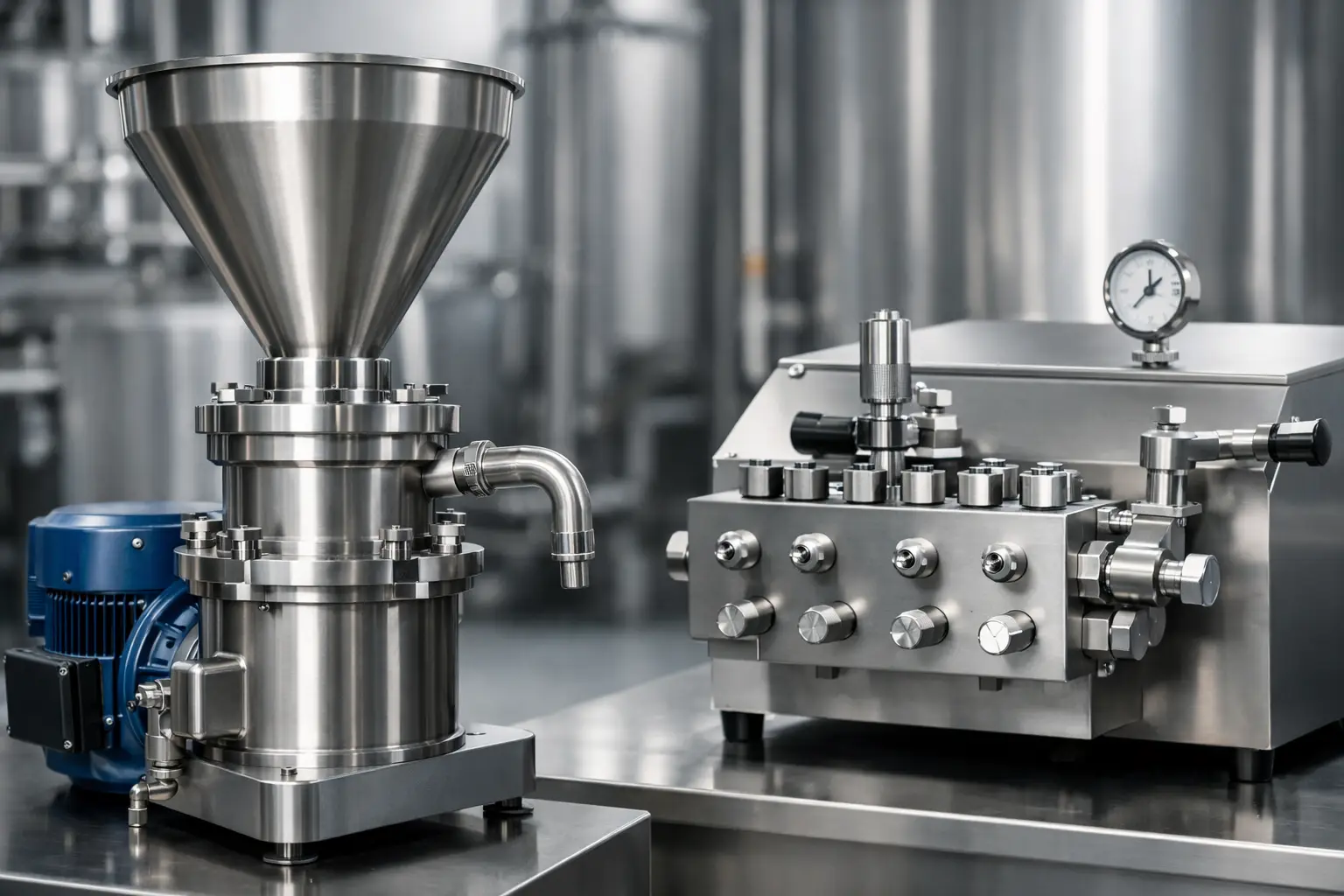
A product that separates after filling, feels gritty on the tongue, or varies from batch to batch rarely has a simple equipment problem. It has a process-energy problem. In the colloid mill vs homogenizer decision, the correct choice depends on the required particle or droplet size, formulation viscosity, solids characteristics, flow rate, temperature limits, and the level of product stability the application demands.
Both technologies apply mechanical energy to disperse, emulsify, and refine materials. They are not interchangeable, however. Selecting one based only on a general claim of “high shear” can lead to unnecessary recirculation, excessive heat input, premature wear, or a product that still fails quality targets.
Colloid Mill vs Homogenizer: The Core Difference
A colloid mill reduces and disperses material by passing it through a controlled gap between a high-speed rotor and a stationary stator. Product is accelerated through the milling zone, where intense hydraulic shear, turbulence, and mechanical forces break down agglomerates and distribute one phase into another. Many colloid mills allow adjustment of the rotor-stator clearance, giving operators practical control over processing intensity.
A homogenizer is a broader equipment category. In industrial applications, the term may describe a rotor-stator homogenizer or a high-pressure homogenizer. This distinction matters. A rotor-stator homogenizer uses a similar shear principle to a colloid mill, while a high-pressure homogenizer forces product through a narrow valve or orifice at elevated pressure. The pressure drop creates extreme turbulence, shear, cavitation, and impact forces.
For that reason, the most useful comparison is often a colloid mill versus a high-pressure homogenizer. The colloid mill is generally a practical choice for continuous processing of viscous emulsions, suspensions, pastes, and slurries. A high-pressure homogenizer is commonly selected when the product requires a finer, more uniform droplet or particle distribution, often at micron or submicron scale.
Where a Colloid Mill Performs Best
A colloid mill is frequently used when the process must combine particle size reduction and dispersion in one compact, continuous unit. Typical applications include sauces, dressings, nut butters, cosmetic creams, ointments, asphalt emulsions, pigment dispersions, chemical slurries, and polymer or resin formulations.
Its advantage is not simply shear. It is the ability to handle process streams that may be too viscous, too solids-laden, or too paste-like for a high-pressure valve homogenizer to operate efficiently. With the right feed conditions, a colloid mill can break down soft particles, disperse powders into liquids, refine a suspension, and improve emulsion uniformity without requiring extreme operating pressure.
The adjustable milling gap can also be valuable during product development. Operators can tune the process for texture, viscosity, and stability rather than treating the equipment as a fixed black box. For products where a narrow particle size distribution is not critical, this flexibility can provide the best balance of performance, throughput, and operating cost.
There are limits. A colloid mill may not achieve the very fine droplet size required for long-term stability in demanding emulsions. It can also generate significant heat, especially when processing viscous materials through a tight gap or making multiple recirculation passes. Heat-sensitive formulations may require jacketed tanks, cooling loops, controlled feed rates, or a different homogenization approach.
When a Homogenizer Is the Better Process Tool
High-pressure homogenizers are designed for applications where particle or droplet size directly determines product performance. In dairy beverages, nutritional emulsions, pharmaceutical suspensions, liposomal systems, specialty chemicals, and fine cosmetic emulsions, a smaller and more consistent distribution can improve physical stability, appearance, mouthfeel, bioavailability, or functional performance.
The process begins with a positive-displacement pump that raises product pressure before forcing it through a homogenizing valve. The product experiences a rapid pressure drop across the valve. This can produce much finer dispersion than a colloid mill, particularly when the formulation is properly pre-blended and the dispersed phase is compatible with the process.
That capability carries a cost. High-pressure homogenization requires a controlled, pumpable feed. Large particles, fibrous ingredients, hard abrasive solids, or oversized agglomerates can create plugging, accelerate valve wear, and reduce reliability. The equipment also requires careful attention to seals, valves, pressure-rated piping, instrumentation, and maintenance practices.
A homogenizer is therefore not automatically the premium choice. It is the correct choice only when the product specification justifies its higher process intensity and capital complexity. If a sauce, paste, or slurry meets stability and texture requirements after colloid milling, adding high pressure may increase cost without improving commercial results.
The Important Middle Ground: Rotor-Stator Homogenizers
Many equipment evaluations become confused because rotor-stator homogenizers are also called high-shear homogenizers. These units use a rapidly rotating rotor to draw material through stator openings, creating intense localized shear. Depending on configuration, they can be installed in a batch vessel, used as an inline unit, or incorporated into a recirculation loop.
A rotor-stator homogenizer can be an effective option for liquid-liquid emulsification, powder wetting, deagglomeration, and dispersion where a high-pressure valve is unnecessary. It may provide more formulation flexibility than a colloid mill for certain low- to medium-viscosity products, particularly when powder induction and rapid incorporation are process priorities.
The best selection is not based on the equipment name. It is based on the energy required to produce the target result. A colloid mill, inline rotor-stator homogenizer, and high-pressure homogenizer can all improve an emulsion, but they apply energy differently and suit different material conditions.
Selection Criteria That Affect Production Performance
The first question is what the process must achieve. If the objective is to eliminate soft agglomerates, improve suspension uniformity, or create a stable but relatively coarse emulsion, a colloid mill may be sufficient. If the objective is to create very fine droplets for maximum stability, opacity, texture control, or functional performance, high-pressure homogenization may be necessary.
Viscosity is equally important. Colloid mills are often well suited to heavier products, but performance depends on feed consistency, flow behavior, rotor-stator gap, and temperature. A product that becomes dramatically more viscous at low temperature may need preheating or a different feed arrangement to maintain consistent milling conditions.
Solids characteristics should be evaluated early. Soft solids and readily dispersible ingredients may process effectively through a colloid mill. Hard minerals, abrasive pigments, crystalline materials, fibrous ingredients, or large particles can produce rapid wear or require upstream size reduction. High-pressure homogenizers generally demand an even more controlled feed because their narrow valves are sensitive to contamination and oversize material.
Throughput should be assessed against required residence time and pass count. A machine sized only for nominal flow may fail to deliver the required particle reduction at production rate. In some applications, one pass through a high-pressure homogenizer meets the specification. In others, a colloid mill with controlled recirculation provides the better production solution. The answer depends on measured product results, not equipment nameplate capacity.
Heat, Cleaning, and Maintenance Are Part of the Decision
Shear processing converts mechanical energy into heat. This can be beneficial when a formulation needs melt assistance or viscosity reduction, but it can damage flavors, volatile compounds, proteins, active ingredients, and heat-sensitive emulsifiers. Process design should account for inlet temperature, outlet temperature, cooling capacity, and the effect of temperature on viscosity and stability.
Cleaning requirements can be just as decisive. Food, pharmaceutical, and personal care operations may require clean-in-place capability, sanitary construction, validated cleaning cycles, and minimal product hold-up. The selected machine must fit the full cleaning system, including piping geometry, valves, pumps, and drainability. A highly capable processor that is difficult to clean can become a production bottleneck.
Maintenance profiles also differ. Colloid mills require inspection of rotor-stator surfaces, seals, and gap condition, particularly with abrasive products. High-pressure homogenizers require disciplined maintenance of valves, seats, seals, plungers, and pressure components. The lowest purchase price is rarely the lowest lifecycle cost if wear parts, downtime, and product losses are ignored.
Start With the Product Specification, Not the Machine
A disciplined equipment evaluation begins with the formulation and measurable quality targets. Define the incoming particle size, required droplet or particle size, viscosity range, solids loading, batch size, production rate, allowable temperature rise, sanitation standard, and acceptable process time. Then evaluate representative product under production-like conditions.
Pilot testing is especially valuable when stability, texture, or particle size is commercially critical. It reveals whether one-pass processing is realistic, whether recirculation is required, how much heat the product absorbs, and whether the equipment causes foaming, viscosity changes, or formulation damage. It also prevents an expensive mistake: specifying a machine that produces an impressive laboratory result but cannot maintain that result at plant scale.
PerMix approaches this decision as a process-engineering question, considering upstream feeding, pre-mixing, thermal control, equipment configuration, and downstream packaging requirements alongside the shear device itself.
The right system is the one that repeatedly delivers the required product at production rate, with manageable cleaning, maintenance, and energy use. When the specification is clear, the choice between a colloid mill and a homogenizer becomes far less about equipment labels and far more about manufacturing performance.