
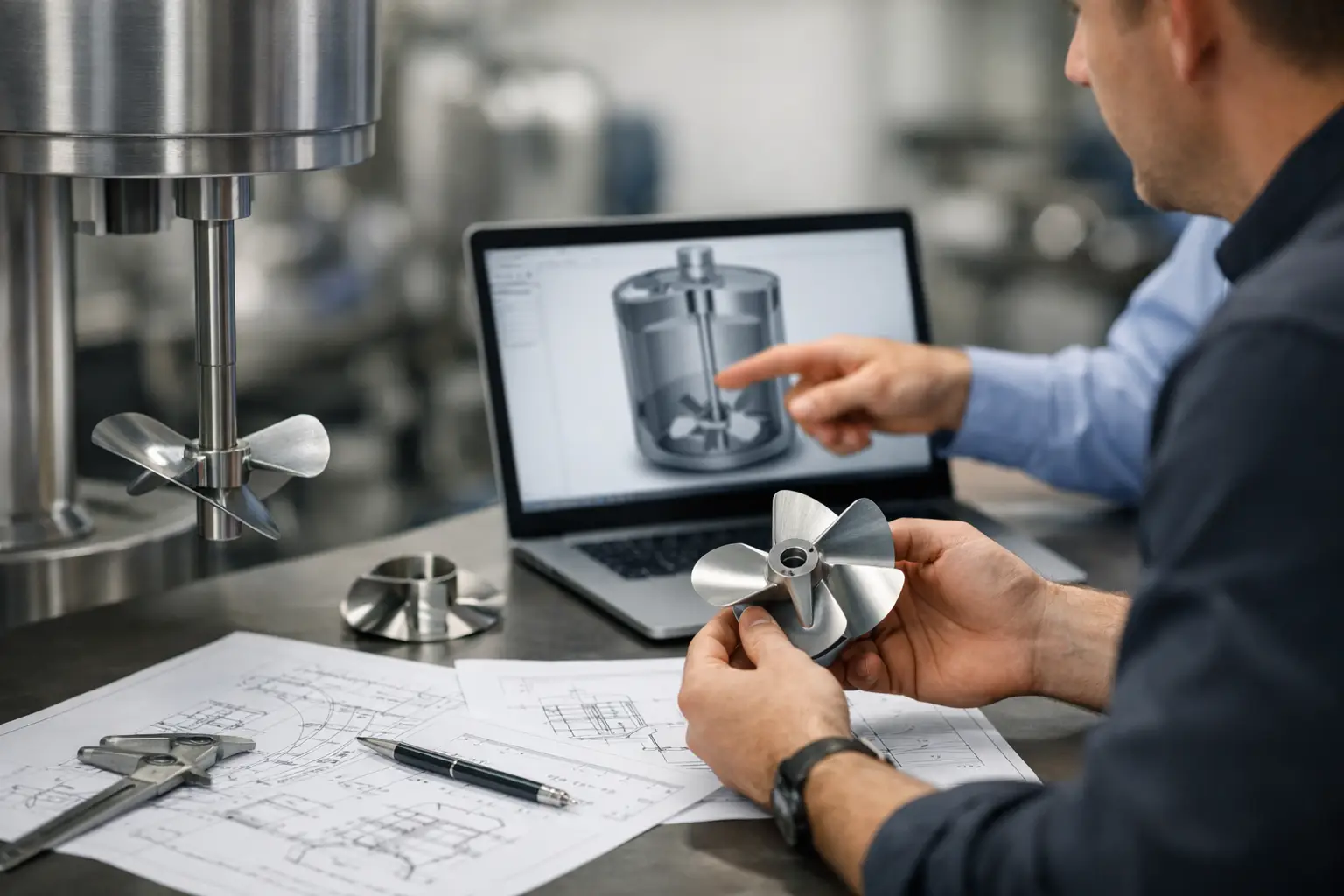
A mixer can produce an acceptable batch in a demonstration and still fail the production line. The difference is usually not motor power or vessel volume. It is whether the custom mixer design process began with the actual material behavior, operating conditions, and production objectives that define success at plant scale.
For industrial manufacturers, a custom mixer is not simply a standard machine with modified dimensions. It is an engineered process solution that accounts for formulation variability, feed methods, batch size, viscosity changes, liquid addition, temperature, cleaning, discharge, controls, and the operating realities of the facility. The goal is measurable performance: uniform product, repeatable batches, efficient cycle times, and dependable operation over the equipment’s service life.
Start With the Process, Not the Mixer Type
The first question should not be, “Which mixer should we buy?” It should be, “What must the process achieve?” A ribbon mixer, paddle mixer, plough mixer, double planetary mixer, high shear mixer, or multi-shaft system can all be correct for a particular application. Each can also be the wrong choice when selected from a limited set of product specifications.
The engineering discussion begins by defining the product and the process window. For powders, this includes bulk density, particle size distribution, particle shape, moisture level, flowability, segregation tendency, abrasiveness, and sensitivity to shear. For liquids, slurries, pastes, and high-viscosity products, viscosity at different temperatures and shear rates matters, along with yield stress, thixotropy, solids loading, and entrained air.
Material behavior often changes during processing. A dry powder may become cohesive after a minor liquid addition. A paste may become substantially more viscous as fillers are incorporated. An emulsion may require controlled shear input to reach droplet-size targets without damaging a heat-sensitive ingredient. These changes determine the mixing mechanism, agitator geometry, drive torque, vessel configuration, and batch sequence.
Production objectives must be equally specific. Required throughput, batch size range, acceptable cycle time, target blend uniformity, allowable residual product, and cleaning frequency all affect the final design. A system optimized for maximum capacity may not be optimal for frequent formula changes. A mixer designed for high intensity may create excessive heat or particle attrition in a fragile product. The right answer depends on the application and the cost of compromise.
Define Inputs That Influence Mixer Design
A disciplined custom mixer design process converts production knowledge into engineering inputs. Material samples and existing batch records are valuable, but they are only part of the picture. Engineers also need to understand how ingredients arrive, how they are metered, and what happens before and after mixing.
For example, a powder blend may require milling or screening before it reaches the mixer. A liquid binder may need to be preheated, accurately metered, and sprayed across the moving powder bed. A viscous adhesive may require vacuum deaeration before discharge. If these upstream and downstream requirements are ignored, even a well-designed mixer can become a bottleneck.
Critical inputs commonly include the following:
- Minimum, normal, and maximum batch volumes
- Ingredient addition sequence and feed rates
- Required mixing time and allowable total cycle time
- Product temperature limits and heating or cooling needs
- Sanitary, clean-in-place, or dry-cleaning requirements
- Hazardous-area classification and dust containment needs
- Discharge destination, elevation, and transfer method
- Available utilities, controls architecture, and installation constraints
These details establish the true design basis. They also identify where a stand-alone mixer is insufficient and where an integrated process system will provide better control, less manual handling, and more predictable results.
Select the Mixing Mechanism for the Material
Mixer selection is a function of how energy should be applied to the product. The objective is not to use the most aggressive mixing action. It is to apply sufficient convective, shear, and dispersive energy to meet the product specification with minimal waste, damage, or cycle-time penalty.
Ribbon mixers are effective for many free-flowing powders, dry blends, and moderate liquid additions. Their low-to-medium intensity action provides broad circulation and efficient blending when the material does not require aggressive deagglomeration. Paddle mixers offer a gentler mixing profile and can be particularly useful for fragile particles, granules, and applications where product integrity is a priority.
Plough mixers create a mechanically fluidized mixing zone and are well suited to cohesive powders, rapid blending, larger liquid additions, and applications that benefit from choppers for deagglomeration. High shear mixers and emulsifiers are designed for processes where dispersion, particle reduction, emulsification, or controlled shear is central to product quality.
For highly viscous pastes, polymers, sealants, battery materials, and filled compounds, double planetary, sigma, and multi-shaft mixers may be required. These systems deliver high torque and reach material near the vessel wall and bottom where conventional agitators can leave stagnant zones. Vacuum capability may be added when entrapped air affects density, appearance, filling accuracy, or downstream performance.
No mixer type is universally better. A high-intensity design can shorten blend time but increase energy consumption, heat generation, and wear. A gentler design can protect particles but may require longer cycles or tighter control of ingredient addition. The design should make those trade-offs visible before equipment is released for fabrication.
Engineer the Vessel, Drive, and Discharge as One System
The agitator is only one part of mixing performance. Vessel shape, working volume, clearances, shaft sealing, drive capacity, and discharge design directly affect batch uniformity and operating reliability.
A properly sized drive must accommodate more than normal running conditions. Starting torque, product buildup, cold-start viscosity, process upsets, and future formulation changes need to be considered. Undersized drives may operate adequately during initial trials but create nuisance trips, slow ramp-up, or premature mechanical wear in full production.
Discharge deserves the same engineering attention as mixing. A mixer that produces a uniform batch but leaves excessive heel material can create cross-contamination, yield loss, and cleaning delays. The discharge valve must match the product’s flow characteristics and the receiving process. Sticky materials may require a larger outlet, specialized valve geometry, or assisted discharge. Powders may require dust-tight transfer and controlled flow into packaging, conveying, or downstream processing equipment.
Thermal control is another frequent design requirement. Jacketed vessels, insulated surfaces, heated covers, or temperature-controlled circulation systems may be necessary when viscosity, reaction rate, crystallization, or product stability changes with temperature. For vacuum processing, the vessel and sealing system must be designed for the required pressure level and operating temperature, not treated as an afterthought.
Validate Performance Before Finalizing the Design
For demanding applications, engineering judgment should be supported by testing. Laboratory trials, pilot-scale runs, and process development evaluations provide evidence that a proposed configuration can meet product and production requirements.
Testing can establish mixing time, blend uniformity, liquid distribution, temperature rise, torque demand, vacuum deaeration performance, and discharge behavior. It also reveals practical issues that specifications may miss, such as powder dusting during charging, agglomerates that require choppers, or material buildup around seals and access covers.
Scale-up requires care. Similar-looking mixers at different sizes do not always produce identical results because fill level, tip speed, power input, and flow patterns change. A qualified engineering partner evaluates which process conditions must be maintained from trial scale to production scale and which parameters need adjustment.
Acceptance criteria should be defined early. These may include coefficient of variation targets, particle-size results, viscosity range, moisture content, batch time, residual material limits, or documented control functions. Clear criteria prevent subjective approval decisions and align equipment performance with quality requirements.
Build Controls Around Repeatability and Flexibility
A custom mixer becomes more valuable when the controls system protects the process from variation. Recipe management can control ingredient sequence, mixing speed, mixing time, vacuum level, temperature, and liquid dosing. Load cells, flowmeters, temperature sensors, torque monitoring, and vacuum instrumentation provide the feedback needed to maintain a repeatable batch.
The appropriate automation level depends on the operation. A development plant may prioritize flexibility and operator visibility. A high-volume production line may require automated charging, controlled dosing, interlocks, batch records, and integration with plant supervisory systems. Both benefit from controls designed around the actual operating sequence rather than generic start-stop logic.
Safety and maintainability should be designed into the system at the same stage. This includes guarding, access interlocks, dust control, safe access for cleaning, seal replacement procedures, gearbox serviceability, and availability of wear components. Equipment that is difficult to clean or maintain will eventually reduce usable capacity, regardless of its nominal output.
The Best Design Improves the Whole Line
The strongest custom mixer design does not stop at the vessel boundary. It considers material receiving, feeding, mixing, discharge, transfer, cleaning, and operator interaction as connected process steps. That is where manufacturers find the most meaningful gains in consistency, throughput, labor efficiency, and product yield.
PerMix approaches custom equipment as a production-performance decision, not a catalog selection exercise. When material data, process testing, mechanical design, and controls engineering are aligned early, the result is equipment built for the batches a plant must run every day – including the difficult ones, not only the ideal ones.
Before approving a mixer specification, ask whether it has been designed around your real formulation range, your actual operating sequence, and your definition of acceptable output. That conversation is often where a capable machine becomes a reliable manufacturing solution.