
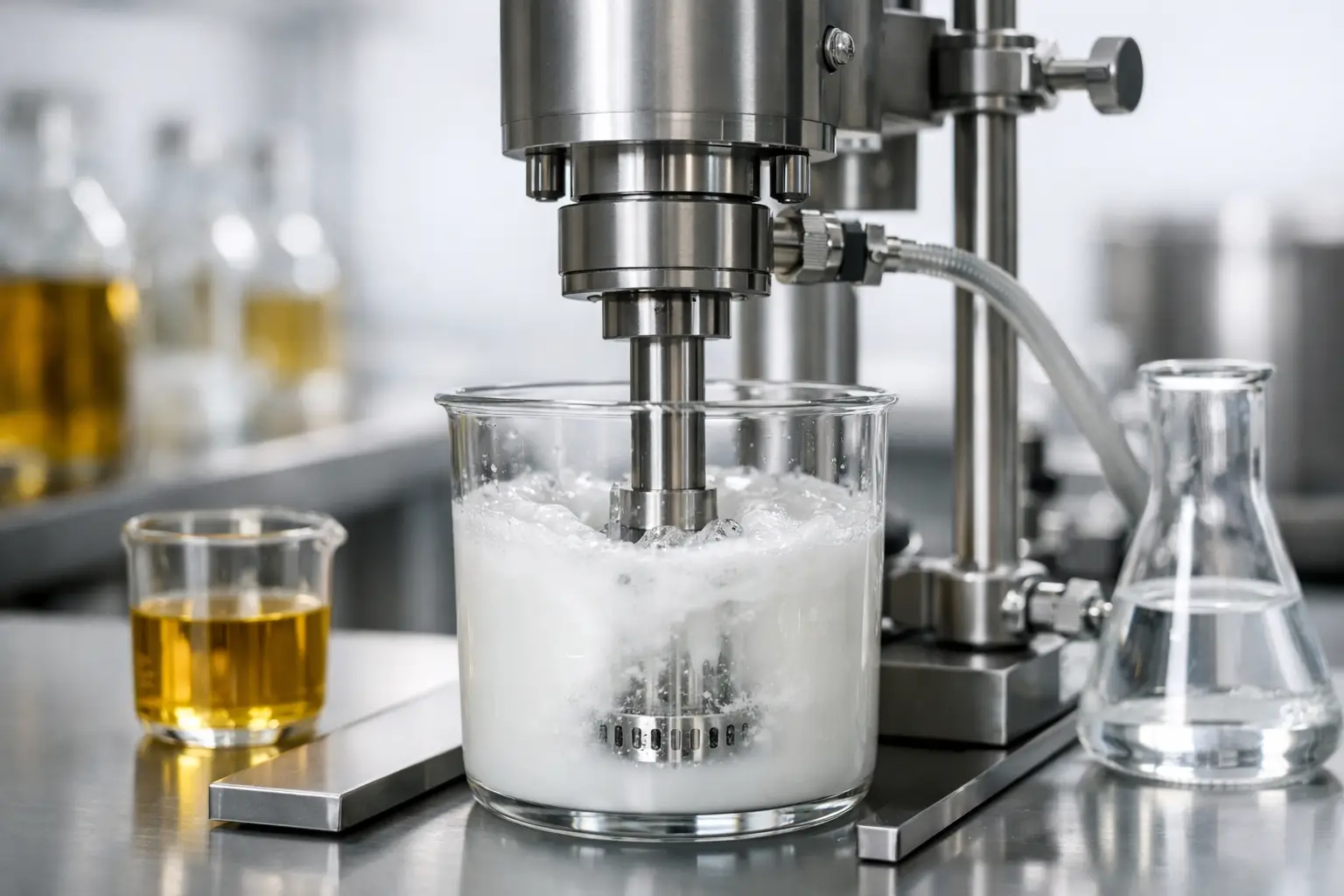
A batch that looks fine in the tank can still fail on the line. The cream separates after filling, the beverage rings out in storage, or the lotion texture shifts from one run to the next. In many of these cases, the issue is not the formula. It is the way energy is applied. A high shear homogenizer for emulsions is designed to solve that exact problem by reducing droplet size, improving dispersion, and producing a more stable, repeatable product.
For production teams, this is not a small detail. Emulsion quality affects shelf life, appearance, mouthfeel, absorption, viscosity, and overall process consistency. If the wrong mixing technology is used, operators often compensate with longer batch times, extra ingredients, or repeated rework. That increases cost without addressing the root cause.
What a high shear homogenizer for emulsions actually does
An emulsion is a system where one immiscible liquid is dispersed into another, typically oil in water or water in oil. Because those phases naturally want to separate, the process equipment must create enough mechanical force to break one phase into very fine droplets and distribute them evenly through the continuous phase.
This is where high shear mixing matters. A high shear homogenizer uses intense mechanical action, usually through a rotor-stator assembly or similar workhead design, to generate strong shear forces, turbulence, and localized pressure changes. As material passes through the high-energy zone, larger droplets are broken down into smaller ones. Smaller, more uniform droplets generally lead to better stability and more consistent product performance.
That sounds straightforward, but the real value is in control. In industrial production, you are not simply trying to mix ingredients together. You are trying to hit a target particle or droplet distribution, keep cycle time in range, avoid overheating, protect sensitive ingredients when needed, and repeat the same result at scale.
Why emulsions fail without enough shear
Many plants start with general-purpose agitators because they are already installed or because the product appears easy to mix at small scale. The problem shows up later. Standard agitation is often effective for bulk movement, heat transfer, and simple blending, but not for aggressive droplet size reduction.
When shear is too low, oil droplets remain large and inconsistent. That usually means weaker stability, more separation risk, and broader variation between batches. Operators may see floating oil, creaming, sedimentation, or texture drift. In cosmetic and personal care applications, the product may feel greasy or uneven. In food processing, the emulsion may lose the intended mouthfeel. In chemical systems, poor dispersion can affect downstream reaction behavior or final application performance.
Too much shear can also be a problem, depending on the formula. Some products are heat-sensitive. Others may foam, degrade, or lose the desired rheology if processed too aggressively. The right answer is not maximum energy. It is application-specific energy delivered in a controlled way.
Where high shear homogenizers perform best
A high shear homogenizer for emulsions is commonly used where product quality depends on fine droplet size and strong phase stability. Food manufacturers use this type of equipment for dressings, sauces, dairy blends, beverage emulsions, flavor systems, and nutritional products. Personal care and cosmetics producers use it for creams, lotions, gels, serums, and sunscreens. Pharmaceutical and nutraceutical operations rely on it for suspensions, topical products, and liquid formulations that demand tight consistency.
Chemical and specialty product manufacturers also benefit when they need to combine immiscible liquids, wet out difficult powders, or speed up dispersion of additives, surfactants, and functional ingredients. In each case, the process goal is slightly different, but the equipment requirement is similar: fast and repeatable energy transfer.
Batch, inline, or vacuum – the choice depends on the process
Not every homogenizer is the same, and this is where many equipment decisions become more technical. Batch high shear homogenizers are often a strong fit for flexible production, product development, and operations running multiple SKUs. They allow close control over time, ingredient addition, and recirculation within a single vessel.
Inline systems are often preferred when throughput, continuous processing, or rapid turnover is the priority. They can provide very efficient droplet reduction as material passes through the shear zone, and they are especially useful in larger production environments where process standardization matters.
Vacuum-capable systems are often selected for products that trap air easily, such as creams, ointments, and high-viscosity emulsions. Removing entrained air improves appearance, density, and filling performance. It can also reduce oxidation and improve shelf stability in certain formulas.
There is no universal best option. The best configuration depends on viscosity range, batch size, sanitation requirements, ingredient sensitivity, production schedule, and whether the process needs to scale later.
Key factors when selecting a high shear homogenizer for emulsions
The first question is usually product behavior. What are the oil and water phase properties? What viscosity range do you expect before, during, and after emulsification? Does the formula contain powders that need fast wet-out or ingredients that tend to agglomerate? These details determine the workhead design, motor power, rotor speed, and vessel geometry required.
The second factor is production target. A pilot batch and a full manufacturing run can behave very differently even with the same formula. Scale-up is not just about using a larger tank. Shear exposure, residence time, and circulation pattern all change with equipment size and system layout. That is why engineering support matters. Buyers need equipment sized for actual production conditions, not just a lab result.
Material compatibility and sanitary design are also critical. Food, pharmaceutical, and personal care operations may require polished contact surfaces, clean-in-place capability, specific elastomers, and compliance with sanitary or regulated production standards. Chemical processors may prioritize corrosion resistance, sealing options, and the ability to handle abrasive or reactive materials.
Finally, think about plant economics. The lowest purchase price is rarely the lowest operating cost. If a machine extends cycle time, creates cleanup challenges, or produces inconsistent emulsions that require rework, it becomes expensive very quickly. Good equipment should improve throughput, reduce waste, and support predictable output.
Process benefits beyond droplet size
Droplet reduction gets most of the attention, but plant managers usually care just as much about production performance. A well-matched homogenizer can shorten batch cycles because emulsification happens faster and more reliably. It can improve first-pass quality, which reduces operator intervention. It can also simplify formulation by allowing better use of stabilizers and functional ingredients.
In many applications, better homogenization translates directly into stronger commercial results. Products look better, pour better, spread better, and hold up better in storage. That matters whether you are producing a premium cosmetic cream, a shelf-stable sauce, or a specialty chemical emulsion.
There is also a maintenance and uptime angle. Industrial buyers want equipment that can run day after day without becoming a service burden. Strong mechanical design, correct seal selection, and proper motor sizing make a real difference over the life of the system.
Why engineering fit matters more than generic specs
It is easy to compare RPM, horsepower, or tank volume on a quotation sheet. Those numbers matter, but they do not tell the full story. Emulsion performance depends on how the entire system works together – rotor-stator geometry, flow path, vessel design, baffles, heating or cooling integration, vacuum level, and ingredient addition sequence.
That is why experienced manufacturers focus on application fit rather than selling a standard machine into every process. A mayonnaise-style emulsion, a low-viscosity beverage concentrate, and a pharmaceutical cream may all require high shear, but they do not require the same system. One may need stronger recirculation. Another may need tighter temperature control. Another may need a sanitary vacuum vessel with precise powder induction.
For industrial buyers, this is the difference between buying equipment and buying a working process solution. PerMix approaches these projects with that reality in mind, combining broad equipment options with application-driven engineering so customers can match the machine to the product, not force the product to fit the machine.
Getting better emulsion results starts with the right questions
If your current process depends on extended mixing time, operator adjustments, or formulation workarounds to stay stable, the issue may not be the recipe. It may be inadequate shear, poor circulation, or a system that was never designed for emulsification in the first place.
The right high shear homogenizer should help you produce finer, more stable emulsions with less guesswork and stronger batch-to-batch control. That is good for quality, good for throughput, and good for cost control. The best place to start is with your actual material behavior, production targets, and plant constraints, because the right machine is the one that performs under your conditions every day.