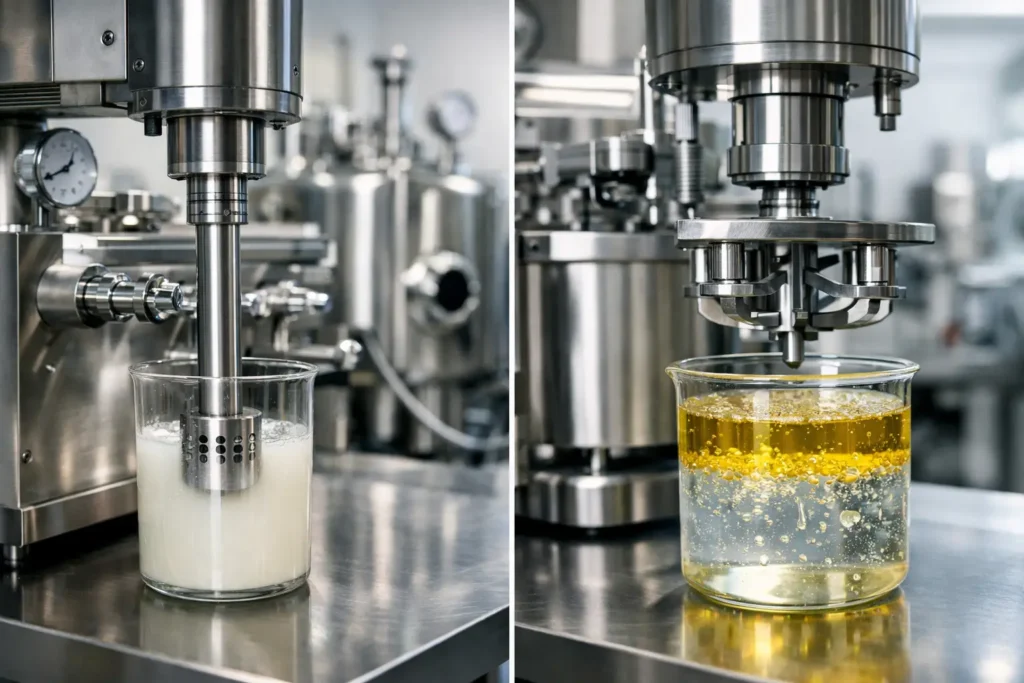
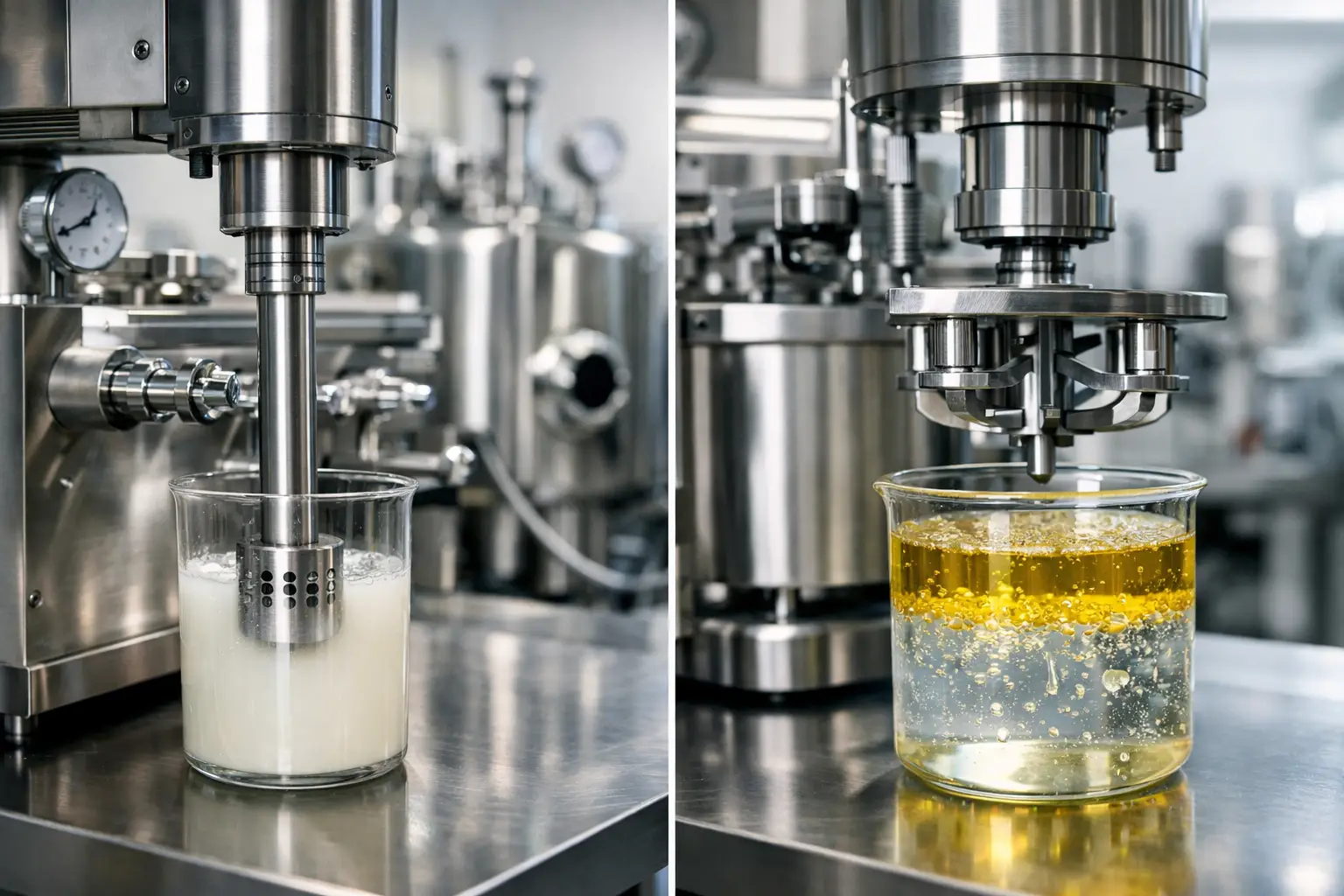
A sauce that separates on the shelf, a cream that feels gritty, or a chemical blend that drifts batch to batch usually points to one issue – the wrong processing method. When buyers compare homogenizer vs emulsifier differences, they are not splitting hairs. They are making a process decision that affects texture, stability, throughput, sanitation, energy use, and long-term production cost.
In many plants, the terms get used interchangeably. That is where selection mistakes start. A homogenizer and an emulsifier can both improve dispersion and product uniformity, but they do not work the same way, and they are not always solving the same problem. If your goal is reliable scale-up and repeatable product performance, the distinction matters.
What are the real homogenizer vs emulsifier differences?
The simplest way to separate them is by primary function. A homogenizer is designed to reduce particle or droplet size and create a more uniform distribution, often at very fine scale. An emulsifier is designed to mix immiscible phases, usually oil and water, and create or support a stable emulsion.
That sounds close because in real production they often overlap. Many emulsification processes involve droplet size reduction, and many homogenizing processes improve emulsion stability. Still, the equipment focus is different. Homogenization is usually about intensity and size reduction. Emulsification is usually about combining phases efficiently and building the right structure in the product.
For a plant manager or process engineer, that difference shows up in practical terms. If you need tighter particle size distribution, smoother mouthfeel, or improved suspension quality, homogenization is often the key requirement. If you need to create a stable oil-in-water or water-in-oil system without separation, emulsification is the starting point.
How each machine works in production
Homogenizers use high energy to reduce size
Industrial homogenizers apply intense mechanical force to break droplets or particles into smaller, more consistent sizes. Depending on design, that can happen through high pressure, rotor-stator action, or other high-shear mechanisms. The common result is finer dispersion, narrower size distribution, and a more uniform final product.
This matters in products where texture, appearance, or stability depend on very small particles or droplets. Dairy, beverages, pharmaceutical suspensions, cosmetics, and specialty chemicals often require this level of refinement. A coarse pre-mix may look acceptable in the tank, but without true homogenization it may not hold performance through filling, storage, or transport.
Emulsifiers focus on combining phases effectively
An emulsifier, in equipment terms, usually refers to a machine built to blend two non-compatible liquids into an emulsion. Many industrial emulsifiers use high shear, especially rotor-stator designs, to pull one phase into another and distribute it quickly. In vacuum processing, they may also remove entrapped air while improving consistency.
This is especially useful in creams, lotions, ointments, sauces, dressings, and other products where phase incorporation is the central challenge. The machine is not just breaking droplets. It is building the emulsion under the right process conditions, often with heating, cooling, vacuum, and controlled ingredient addition.
The biggest selection mistake
A common mistake is choosing equipment based on a broad product label instead of the actual process target. Saying you produce mayonnaise, hand cream, or pesticide concentrate does not automatically tell you whether a homogenizer or an emulsifier should lead the process. What matters is what problem you are trying to solve.
If the issue is phase separation during storage, your process may need better emulsification. If the issue is rough texture, poor color development, inconsistent viscosity, or unstable particle distribution, you may need stronger homogenization. In some applications, you need both, either in one integrated system or in separate stages.
That is why application review matters more than terminology. The right answer depends on formulation, viscosity, solids content, batch size, temperature sensitivity, sanitary requirements, and the level of finish the product must reach.
Homogenizer vs emulsifier differences in performance
Droplet and particle size
Homogenizers are generally selected when very fine size reduction is the performance driver. They are better suited for applications where final smoothness, suspension quality, or optical uniformity depends on smaller and more consistent particles or droplets.
Emulsifiers can also reduce droplet size, but that is not always their only or primary strength. Their value often lies in rapid phase incorporation and emulsion formation across a practical production range.
Product stability
Both can improve stability, but in different ways. A homogenizer improves stability by reducing particle or droplet size and making the system more uniform. An emulsifier improves stability by properly distributing one phase into another and creating the conditions for a stable emulsion structure.
Neither machine alone guarantees shelf stability. Formula design, emulsifier chemistry, viscosity profile, and thermal process all matter. Equipment selection supports the result, but it does not replace formulation science.
Viscosity handling
Many emulsifier systems are designed to process medium to high viscosity products, especially in batch vessels with anchor agitation, wall scraping, vacuum, and high-shear mixing. This is common in personal care, cosmetics, pharmaceuticals, and paste-like food products.
Homogenizers can be extremely effective, but not every design is ideal for very high viscosity material. Some perform best after pre-mixing or in recirculation loops where flow conditions are controlled. This is one of those areas where the right machine depends on the process path, not just the product name.
Throughput and process stage
In some plants, an emulsifier is the main vessel-based process machine, handling heating, mixing, emulsifying, deaeration, and discharge in one system. A homogenizer may then serve as a finishing step. In other plants, especially continuous operations, homogenization may be central to the line.
The trade-off is straightforward. Integrated emulsifying systems can simplify batch production and reduce handling steps. Dedicated homogenization can deliver finer and more repeatable size reduction. The best setup depends on whether your priority is all-in-one batch efficiency or maximum refinement.
Which industries tend to need which solution?
Food and beverage processors often use both, but for different outcomes. Dressings, sauces, and cream-based products frequently rely on emulsifying systems to create the structure. Beverage and dairy applications often lean heavily on homogenization for mouthfeel, stability, and visual consistency.
In cosmetics and personal care, emulsifiers are widely used for creams, lotions, gels, and ointments because the process often includes heating, cooling, vacuum, and controlled phase blending. Homogenization becomes more important when finer texture or improved sensory performance is required.
In pharmaceutical and nutraceutical manufacturing, the choice becomes even more application-specific. Suspension quality, API dispersion, particle control, and sanitation standards can all push selection toward a particular design. Chemical producers face similar trade-offs, especially when handling reactive systems, specialty coatings, or viscosity-sensitive formulas.
Questions to ask before buying
Before comparing machine models, define the process target clearly. Are you trying to create an emulsion, reduce particle size, remove air, improve viscosity consistency, or scale a lab formula into production? Those are different jobs, even if one machine can address several of them.
You should also look at how the product behaves over time, not just in the vessel. A batch that looks acceptable immediately after mixing can still separate, settle, or lose texture later. Equipment should be selected against real production outcomes such as shelf stability, filling behavior, and repeatability from batch to batch.
Another key point is flexibility. Many manufacturers need one system that can handle multiple SKUs, varied viscosities, and future growth. In those cases, custom engineering has real value. A properly configured system may combine vessel agitation, high-shear emulsifying, vacuum capability, heating and cooling control, and downstream homogenization where needed. That is often the most practical route to performance without overspending on equipment that is either too limited or unnecessarily specialized.
When one machine is enough and when it is not
Some products can be made successfully with a single emulsifier, especially if the emulsion target is moderate and the formulation is forgiving. Others need a homogenizer because product quality depends on finer size reduction than a standard emulsifying step can deliver.
Then there are applications where using only one machine creates a compromise. You may get acceptable mixing but weak long-term stability. Or you may achieve fine size reduction but struggle with phase incorporation at the start of the batch. That is why experienced equipment selection should be based on test data, not assumptions.
For industrial buyers, the best decision is rarely about choosing a more impressive machine name. It is about choosing the process that gives you the best in performance, the best in quality, and the best long-term value for your production environment. If you are weighing homogenizer vs emulsifier differences, start with your material behavior and your finished product standard. The right answer becomes much clearer when the process goal is defined with precision.