Industrial Mixers
PerMix News & Updates
A paddle blender can produce fast, repeatable batch blending with a gentle mixing action, but only when its geometry, drive, discharge, and controls match the material. Knowing how to choose a paddle blender starts with the product, not the machine catalog. A free-flowing seasoning blend, a density-variable chemical premix, and a fragile nutraceutical powder may all require different paddle arrangements, fill levels, and process features.
For plant managers and process engineers, the goal is not simply to buy a blender that turns. The goal is to specify equipment that achieves uniformity at the required batch size, protects product quality, cleans efficiently, and remains dependable through years of production.
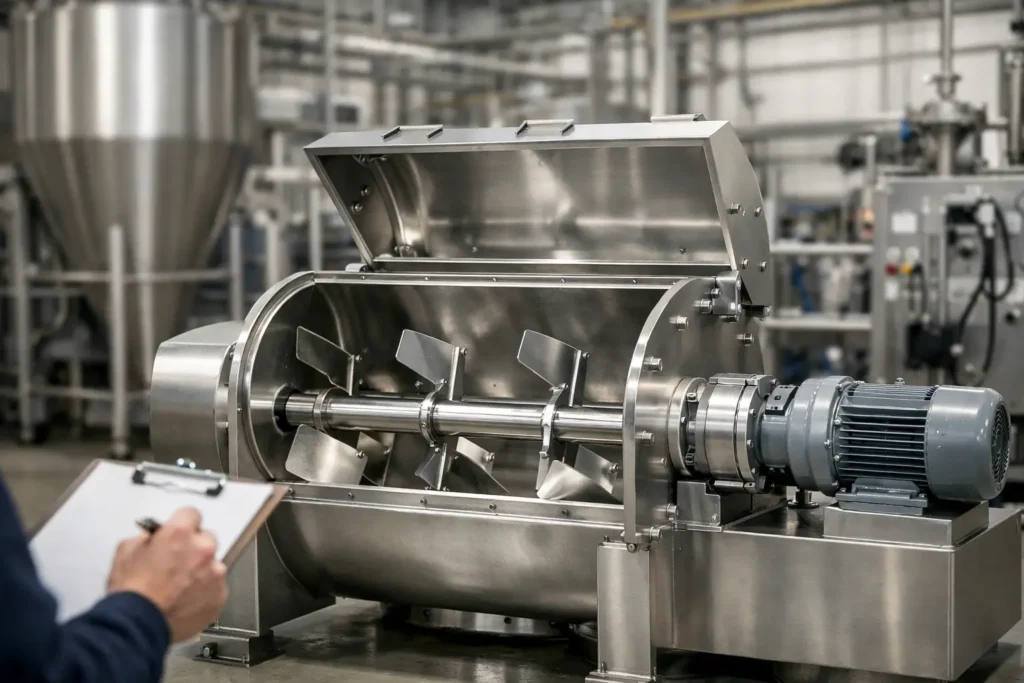
A horizontal paddle blender uses paddles mounted on one or more shafts to lift, split, fold, and redistribute material through the batch. This convective mixing action is often an excellent fit for dry powders, granules, flakes, and certain wet or paste-like materials. It can also support liquid addition when the formulation and equipment design are properly matched.
The first question is what “mixed” means for your process. A batch may need even distribution of trace ingredients, uniform color, controlled moisture, coating of particles, or consistent bulk density. These requirements affect the equipment specification because the most suitable blender for bulk homogenization may not be the right choice for intensive deagglomeration or high-shear dispersion.
Ask for representative testing when the formulation includes materials with substantially different particle sizes, shapes, or densities. Segregation can occur before blending, during filling, and after discharge. A blender that produces acceptable samples at the top of the vessel but inconsistent samples at the discharge is not meeting the production requirement.
Material behavior should be documented early. Include flowability, moisture content, particle size distribution, bulk density, angle of repose, abrasiveness, friability, temperature sensitivity, and any tendency to bridge, smear, or form agglomerates. These facts determine whether standard paddles are appropriate or whether the process needs intensifier choppers, special shaft geometry, heated jackets, vacuum capability, or a different mixer category.
Blender capacity should be based on working volume, not only total vessel volume. Paddle blenders need adequate headspace for material circulation. Overfilling reduces the open space needed for particles to move and exchange positions, which can extend mixing time and compromise uniformity. Underfilling can also reduce efficiency if the paddle tips do not engage the material correctly.
Define the minimum, normal, and maximum batch weights you expect to run, then convert those weights using the lowest and highest bulk densities in the product range. A single nominal batch size can be misleading when one formulation is light and fluffy while another is dense and granular.
Throughput is equally important. Consider the complete batch cycle: loading, blending, liquid addition, sampling, discharge, cleaning, and changeover. A blender with a short dry mixing time may still limit production if its discharge valve is too small, its loading arrangement is slow, or its cleanout procedure takes too long. For a high-volume line, cycle time often matters more than the blending time listed on a specification sheet.
Future production plans deserve the same attention. Selecting a much larger blender solely for anticipated growth can create poor performance on current small batches. In some cases, a properly sized unit today with a scalable process layout is the better commercial decision.
Paddle shape, shaft configuration, clearance, and rotational speed determine how the material moves through the vessel. The correct design creates broad circulation and rapid distribution while controlling particle damage, heat buildup, and power demand.
For fragile flakes, coated particles, and easily fractured granules, a lower-intensity paddle action may preserve particle integrity better than a more aggressive mixer. For powders containing small agglomerates, a paddle blender equipped with high-speed intensifier choppers can break lumps and disperse minor liquid additions without subjecting the entire batch to excessive shear.
Do not assume higher horsepower or higher speed automatically means better mixing. Excessive speed may cause attrition, generate heat, or drive fine powders into airborne dust. Insufficient speed can leave dead zones or produce long cycle times. The right operating range depends on the product and should be confirmed through testing whenever possible.
Variable-frequency drive control is a practical option for operations running multiple formulations. It allows operators to optimize speed by recipe, use a controlled start-up sequence, and adjust the process as material behavior changes. Recipe-based controls can also improve repeatability between shifts and facilities.
Many paddle blender applications involve more than dry blending. The process may require oil, flavoring, binder, color, water, or other liquids to be distributed evenly through a powder or granule bed. This is where nozzle selection, spray pattern, pump control, and chopper placement become critical.
A liquid should be added where the moving material can immediately distribute it, rather than sprayed onto a stagnant surface or vessel wall. Poor liquid distribution can create wet balls, wall buildup, extended cleaning requirements, and out-of-spec batches. For low liquid percentages, atomized spraying combined with chopper action is often effective. Higher liquid levels may require a different paddle arrangement, a jacketed vessel, or a mixer designed for paste processing.
Be direct about the formulation’s endpoint. If the product needs to remain free-flowing, the equipment must distribute liquid without creating stable agglomerates. If controlled granulation is the objective, the blender and intensifier system must deliver enough localized energy to build the desired particle structure. These are different processes, even when the starting ingredients appear similar.
For food, pharmaceutical, nutraceutical, health and beauty, and other regulated applications, a paddle blender must support the cleaning and validation strategy from the beginning. A polished product-contact finish, appropriate gasketing, sanitary access covers, flush-mounted fittings, and a full-opening discharge valve can reduce product retention and simplify inspection.
Consider how operators will clean the blender between batches. Dry cleaning may be suitable for some compatible powder products. Wet cleaning or clean-in-place arrangements may be necessary where allergens, potent compounds, flavors, colors, or high-value active ingredients are involved. The vessel design must provide access to the areas that matter, including shaft seals, paddle hubs, lid gaskets, and discharge components.
Containment requirements should also drive the specification. Fine powders may require dust-tight covers, sealed charging connections, vent filtration, and integration with plant dust collection. Potent or hazardous materials may call for higher containment levels, specialized seals, glovebox interfaces, or vacuum transfer. These features are process safeguards, not optional accessories.
A paddle blender must fit the operating environment as well as the recipe. Confirm available floor space, elevation, loading method, discharge destination, electrical requirements, utility connections, and maintenance clearance. A blender installed beneath a bulk bag discharger or beside a vacuum conveyor may need a different inlet design than a unit loaded manually from drums.
Discharge configuration deserves close review. A full-width bomb-bay style discharge can empty quickly and minimize residual material, while other valve designs may be appropriate for controlled feeding or limited installation space. The correct choice depends on whether the blender discharges into totes, conveyors, packaging equipment, reactors, or downstream processing systems.
The drive train, bearings, seals, and gearbox should be selected for the actual duty cycle and material load. Abrasive minerals, dense powders, and cohesive wet blends place different demands on mechanical components. Specify construction materials that match the product and cleaning chemistry, such as stainless steel for sanitary processing or specially lined contact surfaces for corrosive applications.
For combustible dusts, the evaluation must include dust hazard data and the applicable electrical and explosion-protection requirements. Equipment selection should align with the plant’s formal safety review, not be treated as a late-stage add-on.
The most reliable specification is built from process data and representative trials. Provide the supplier with a complete application package: formulation ranges, batch sizes, target blend uniformity, required cycle time, liquid addition details, cleaning expectations, utilities, installation constraints, and applicable industry standards.
A meaningful trial should evaluate more than whether the batch appears mixed. Sample at multiple locations and times, verify blend uniformity analytically, inspect particle condition, measure discharge residue, and document the full cycle. If liquid addition is involved, assess wall buildup and the time required to achieve a stable endpoint.
PerMix approaches paddle blender selection as an engineering decision rather than a standard catalog transaction. Custom vessel dimensions, paddle configurations, choppers, sanitary features, vacuum systems, heating or cooling jackets, and automation can be combined around the actual process requirement while keeping budget and long-term operating value in view.
The right paddle blender is the one that gives your operators a repeatable process, not just an acceptable first batch. Bring real material data, realistic production targets, and cleaning requirements into the equipment discussion early, and the final design will be far more likely to perform as expected on the plant floor.

Stay Connected