
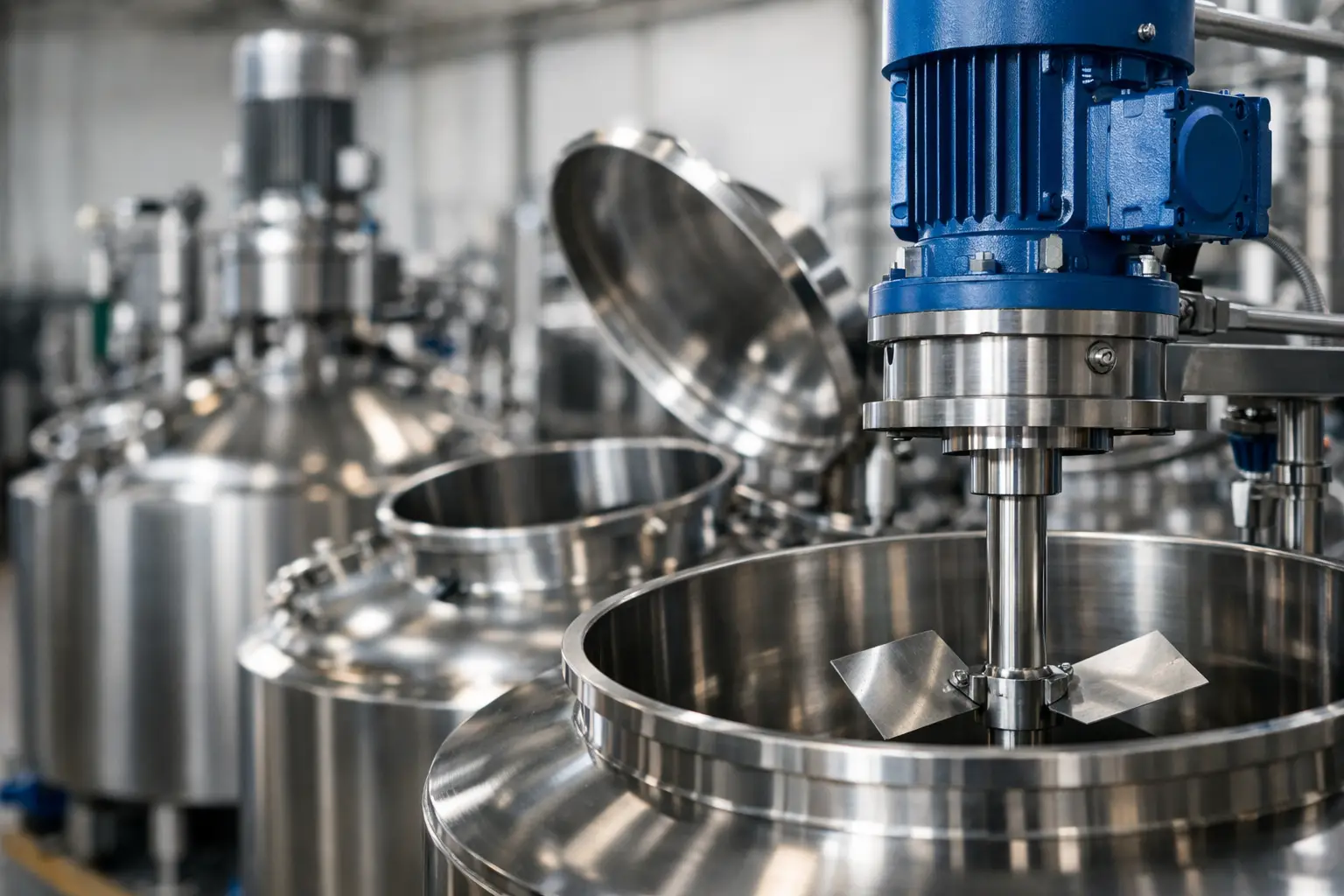
A mixer that looks right on paper can still create bottlenecks on the plant floor. The usual problem is not motor size or vessel volume alone. It is a mismatch between the mixer and the actual process – powder flow, liquid viscosity, shear sensitivity, batch time, cleanability, and downstream production demands. That is why knowing how to choose industrial mixers starts with the application, not the catalog.
For operations teams, engineers, and buyers, the stakes are straightforward. The wrong machine can reduce uniformity, extend cycle times, increase waste, and create maintenance headaches that show up month after month. The right machine improves consistency, throughput, and long-term operating cost. It also gives you room to scale.
How to choose industrial mixers by process need
The fastest way to make a poor equipment decision is to shop by mixer style before defining the material and the process target. A ribbon blender, paddle mixer, plow mixer, sigma mixer, vacuum mixer, or high shear emulsifier can all be the right answer in different conditions. They can also be the wrong answer if the material behavior is misunderstood.
Start with the product itself. Ask what the material does before, during, and after mixing. Does it flow freely, bridge, smear, cake, foam, heat up, or separate? Is the product dry powder, a slurry, a high-viscosity paste, or a liquid requiring emulsification? Does it need gentle blending or aggressive dispersion? These are not minor details. They determine the mixing principle that will actually perform in production.
A free-flowing dry powder blend often points toward a ribbon mixer or paddle mixer when the goal is uniformity with efficient batch turnover. A plow mixer may be a better fit when faster, more intensive mixing is needed, especially if liquid addition or deagglomeration is part of the process. High-viscosity materials such as doughs, sealants, putties, and heavy pastes usually require a different class of equipment entirely, such as a sigma mixer or a heavy-duty kneader. For emulsions, creams, and fine liquid-liquid or liquid-solid dispersions, homogenizers and emulsifiers become the practical choice because the process depends on controlled shear, not just bulk movement.
Define the mixing objective before the machine
Many buyers describe the material accurately but still skip over the actual production objective. That is where selection errors happen.
If the goal is simple blending, the best machine is not automatically the most aggressive one. Higher intensity can damage fragile particles, create heat, or overwork a formulation. On the other hand, if your process requires wetting powders into liquids, breaking lumps, coating particles, or forming granules, a gentle blender may never deliver the result consistently.
Mixing objectives usually fall into a few practical categories: homogenization, dispersion, emulsification, agglomeration, deagglomeration, heating or cooling during mixing, vacuum deaeration, and paste kneading. Some applications involve several of these at once. A nutraceutical powder that needs liquid binder addition behaves differently from a chemical paste under vacuum or a food emulsion requiring sanitary high shear processing. The machine should be selected around the outcome you need every batch, not the broad label attached to the product.
Material properties matter more than broad industry labels
It is useful to know whether an application is food, pharmaceutical, chemical, or agricultural. But industry alone does not tell you enough.
Two products from the same sector can require completely different mixer designs. A pharmaceutical excipient blend may need low-shear, high-uniformity powder mixing with validation-friendly cleanability. A pharmaceutical gel may require vacuum mixing, controlled heating, and high-shear dispersion. A food manufacturer may be blending spices one day and processing heavy fillings the next. The material properties drive the equipment decision far more than the market category.
Key properties to evaluate include bulk density, particle size distribution, moisture content, tendency to agglomerate, viscosity range, temperature sensitivity, abrasiveness, and whether the product is shear-sensitive. If liquids are added to powders, the rate and distribution of addition matter. If the process changes viscosity during the cycle, that matters too. A mixer that performs well at the start of the batch can struggle badly once the material thickens.
Batch size, throughput, and scale-up
Choosing capacity by nominal vessel volume is one of the most common mistakes in mixer selection. Usable working capacity depends on the material, the mixer geometry, and the process itself.
A plant may need a 20-cubic-foot batch, but the right equipment is not simply any 20-cubic-foot mixer. Fill level affects mixing efficiency. Some machines perform best within a defined working range, while others are more forgiving across different batch sizes. If your production schedule includes partial batches, frequent changeovers, or future capacity expansion, those realities should be built into the selection process.
Throughput matters just as much as batch size. A mixer with a shorter cycle time, faster discharge, and easier cleaning may outperform a larger machine over the course of a shift. For growing operations, scale-up should be considered early. Lab results do not always translate directly to production equipment unless the mixing principle remains consistent. That is why experienced engineering support adds value beyond quoting dimensions and horsepower.
Shear, temperature, and air control
Shear is not good or bad by itself. It is a tool. The right level depends on the formulation.
High shear can improve dispersion, emulsification, and particle size reduction. It can also damage crystal structure, break fragile ingredients, or generate unwanted heat. Low-shear mixing protects product integrity in many dry blending and delicate particulate applications, but it may be inadequate for wetting, dispersing, or emulsifying demanding materials.
Temperature control is another decision point. Some products need jacketed vessels for heating or cooling during mixing. Others are heat-sensitive and require a process that minimizes frictional heat. Air management also matters. If foaming, oxidation, or trapped air affects product quality, vacuum mixing or deaeration may be necessary. These features are not add-ons to think about later. In many applications, they are central to process success.
Sanitary design, cleaning, and compliance
For food, pharma, nutraceutical, and personal care manufacturers, cleanability can be as important as mixing performance. A machine that meets production targets but slows sanitation or validation can become an expensive compromise.
When considering how to choose industrial mixers, look closely at surface finish, weld quality, dead spots, discharge design, shaft seal arrangement, gasket materials, and access for inspection and cleaning. Clean-in-place capability may be appropriate in some liquid systems. In other cases, fast manual cleaning and changeover are the priority. The best choice depends on your product mix, allergen control plan, regulatory environment, and uptime target.
Stainless construction, sanitary valves, polished contact surfaces, and compliance-focused design details should match the real requirements of the plant. Over-specifying can waste budget. Under-specifying creates risk.
Customization vs. standard equipment
Standardized equipment can be the right move when the application is straightforward and production demands are well understood. It usually helps with lead time, cost, and maintenance familiarity.
But many industrial mixing applications are not standard. Materials behave differently at scale. Plants have space limitations. Utilities vary. Some processes require load cells, jackets, vacuum systems, choppers, specialized controls, or integration with upstream and downstream equipment. In those cases, customization is not a luxury. It is often what turns a workable machine into the best-performing machine for the job.
This is where a full-spectrum mixing supplier has a clear advantage. If the supplier only offers one or two machine types, the recommendation may be driven by inventory rather than fit. A broader product range allows the application to dictate the solution.
Cost should be measured over years, not only at purchase
Procurement teams are right to compare capital cost. But the lowest quote does not automatically mean the best value.
A lower-priced mixer that misses cycle time targets, creates off-spec batches, or requires frequent service can cost more than a better-engineered machine within a short period. Total value includes reliability, energy use, maintenance access, part life, cleaning time, operator efficiency, and consistency of output. Warranty and technical support matter here as well, especially for critical production lines.
The strongest buying decision balances budget with performance. That is where engineering consultation pays off. A supplier should be able to explain not just what machine to buy, but why it will outperform other options in your exact application.
The questions worth answering before you buy
Before final selection, the plant team should be aligned on a short set of practical questions. What material behavior has caused issues in the current process? What uniformity standard must be reached? How much shear is acceptable? What batch size and hourly output are required? Will the formula change over time? What sanitation standard must be met? What utilities and floor space are available? These answers narrow the field quickly and prevent expensive guesswork.
At PerMix, that application-first approach is exactly how high-performance mixer selection should work. The best result comes from matching material behavior, process objectives, and plant realities to the right mixing technology – with enough flexibility to support future production demands.
The smartest mixer purchase is rarely the one with the simplest spec sheet. It is the one that keeps delivering uniform batches, predictable throughput, and dependable performance long after installation.