
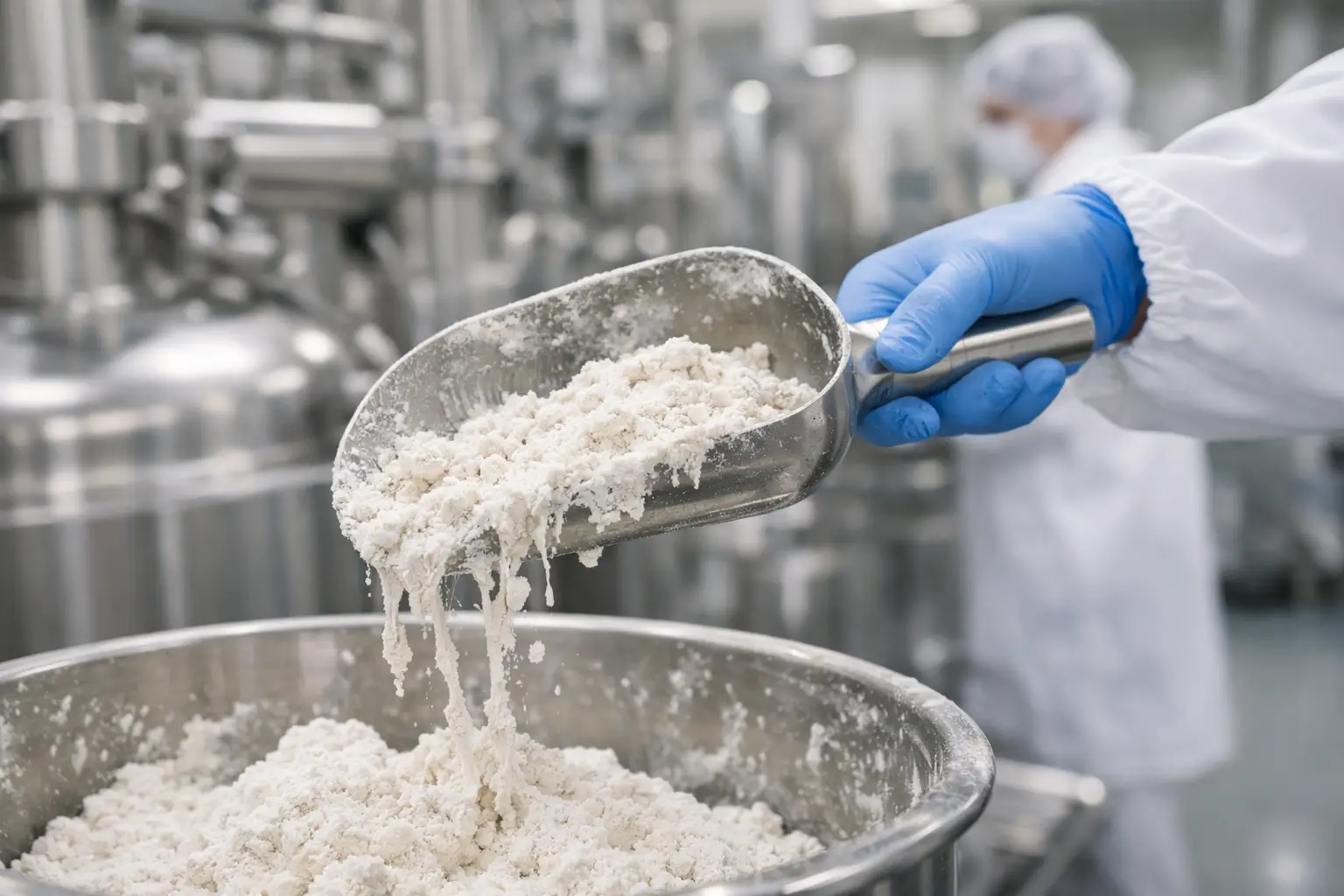
A powder that flows freely during pilot trials can become a production bottleneck as soon as humidity rises, product temperature changes, or batch size increases. When manufacturers ask how to handle sticky powders, the correct answer is rarely a single equipment upgrade. Reliable performance depends on understanding why the material adheres, where the process creates compaction or buildup, and which controls will keep the powder moving consistently from receiving through discharge.
Sticky powders affect far more than material handling. They can reduce throughput, create batch-to-batch variation, increase cleaning time, cause inaccurate dosing, and leave residual material in the mixer or transfer line. In food, chemical, pharmaceutical, mineral, and specialty material production, those problems directly affect quality, yield, labor requirements, and plant uptime.
Why Powders Become Sticky
A powder becomes difficult to handle when attractive forces between particles become stronger than the forces that separate and move them. Moisture is often the primary cause, but it is not the only cause. Hygroscopic materials can absorb water from ambient air, while fat-containing, sugar-based, polymeric, or waxy powders may soften when temperatures rise. Fine particle size increases surface area and creates more opportunity for particles to bond.
Particle shape also matters. Irregular, porous, or plate-like particles can interlock and form stable agglomerates. Electrostatic charge may cause dry, fine powders to cling to vessel walls, filters, and flexible connectors. In other applications, pressure from a full hopper or an improperly designed screw feeder compacts the powder into a dense mass that will not reliably discharge.
The same product can behave differently across the process. A powder may flow well from bulk bags but bridge in a day bin, smear inside a mixer after liquid addition, and cake during vacuum conveying. That is why a material data sheet alone is not enough for equipment selection. Process conditions determine the actual handling behavior.
How to Handle Sticky Powders at the Source
The most effective solution often begins before the powder reaches the mixer. If the material is moisture-sensitive, control storage and transfer conditions rather than trying to overcome severe caking with higher agitation. Enclosed receiving, conditioned air, insulated vessels, and shorter exposure times can prevent a manageable powder from becoming a production problem.
Temperature should be treated as a process variable, not just an environmental condition. Warm conveying air, friction in a mill, heat from a nearby process, or a delayed transfer can push a low-melting component beyond its handling limit. Cooling may improve flow, but it can also create condensation if equipment surfaces fall below the dew point. The right operating window depends on both product temperature and plant humidity.
Particle engineering can also be valuable when formulation changes are possible. Granulation, controlled agglomeration, milling adjustments, or a change in ingredient order may reduce fines and improve flow. These options involve trade-offs. Larger particles may improve handling but change dissolution, blend uniformity, density, or final product texture. The goal is not maximum flowability in isolation. It is stable material behavior while meeting finished-product specifications.
Design the Feed System for Actual Flow Behavior
Sticky powders should not be expected to behave like free-flowing salt or granular sugar. Standard hoppers with shallow wall angles, narrow outlets, and limited agitation commonly create bridging, ratholing, and erratic feed rates. Once a stable arch forms above an outlet, material may appear available while the feeder receives little or no powder.
Hopper geometry must be matched to wall friction, internal friction, bulk density, and the material’s tendency to consolidate. A mass-flow design can help ensure that all material moves during discharge, reducing stagnant zones and minimizing long residence times. However, mass flow alone does not solve every issue. Highly cohesive materials may still require mechanical assistance.
Useful discharge aids include properly selected agitators, live-bottom designs, screws, paddles, or other devices that promote controlled movement at the outlet. The selection must be deliberate. Excessive agitation can compact some powders, break fragile agglomerates, generate heat, or alter particle size. The objective is consistent feed, not aggressive mechanical force.
For continuous operations, the feeder is especially critical. Loss-in-weight systems must maintain a stable refill strategy, accurate weighing, and a feeder geometry that does not pulse or starve. A process line cannot deliver uniform blending if the incoming sticky powder arrives in intermittent slugs.
Select Mixing Equipment That Resists Buildup
Mixer selection should be based on the powder’s cohesiveness, batch size, liquid addition requirements, allowable shear, and cleaning standard. A mixer that performs well with a dry, free-flowing blend may leave unacceptable wall buildup once the formulation includes hygroscopic components, oils, binders, or heat-sensitive ingredients.
For moderately cohesive powders, a paddle mixer or plough mixer can provide active material movement and strong turnover across the vessel. Their mixing elements are designed to mobilize the batch rather than relying solely on gravity flow. Choppers or high-speed intensifiers may be used when deagglomeration or liquid incorporation is required, but they should be applied only when the product can tolerate the added shear and energy.
Ribbon mixers remain effective for many dry blending applications, particularly where the material retains reasonable flowability. With highly adhesive powders, however, ribbon geometry, clearances, and discharge configuration require closer evaluation. Material that accumulates on the shaft, ribbons, end walls, or discharge valve reduces usable batch volume and can compromise repeatability.
For highly sticky, paste-like, or high-viscosity transitions, sigma mixers, double planetary mixers, and multi-shaft mixers may be more appropriate than conventional powder blenders. These systems can apply the torque and wall sweeping action needed when the material no longer behaves as a true free-flowing powder. The key is recognizing that a process can cross from powder mixing into wet mass or paste processing as liquid level, temperature, or binder activation changes.
Control Liquid Addition and Process Timing
Many sticky powder problems begin during liquid addition. Adding liquid too quickly can create localized wet spots that form persistent balls or deposits before the liquid disperses. Adding too slowly may extend batch time and expose the material to unnecessary heat or humidity. The proper addition rate depends on mixer circulation pattern, droplet size, spray location, liquid viscosity, and the powder’s absorption rate.
A controlled spray system is generally more reliable than pouring liquid into a moving batch. Atomization can distribute the liquid over a wider surface area, but overly fine droplets can create airborne losses or wall deposits. Spray nozzles should be positioned where the mixer has active material movement, not where product is likely to accumulate against a vessel wall.
Sequence matters as much as rate. Some formulations benefit from preblending dry minor ingredients before adding liquids. Others require a carrier material to be charged first so it can absorb liquid before more cohesive ingredients enter the vessel. Pilot testing should examine the entire sequence, including hold times before discharge. A batch that is uniform at the end of mixing may become difficult to empty after a 20-minute delay.
Improve Discharge, Transfer, and Cleaning
Discharge is where sticky powder processes often reveal their real limitations. A mixer may achieve acceptable blend uniformity but still retain a significant quantity of material around the outlet, valve seat, or vessel corners. Residual product reduces yield and creates cross-contamination risk when the next batch differs in flavor, color, active ingredient, or formulation.
A full-size, properly designed discharge valve is typically more reliable than a restricted outlet. Valve selection should account for the material’s tendency to pack, smear, or form deposits. Transfer chutes and downstream equipment should be short, steep where practical, and designed to avoid ledges, flexible sections, and abrupt changes in direction that collect material.
Cleaning requirements must be considered at the beginning of system design. Highly adhesive powders may need accessible internal surfaces, removable components, clean-in-place capability, or validated washdown procedures. A design that minimizes buildup is generally more productive than one that simply makes buildup easier to remove.
Use Testing to Replace Assumptions
Sticky powder handling cannot be engineered confidently from a generic product description. Testing should evaluate the actual formulation at expected moisture levels, temperatures, particle-size distributions, and production dwell times. It should also account for the effects of upstream milling, conveying, liquid addition, and storage.
A useful test program measures more than final blend uniformity. It should assess feed consistency, mixer loading, power draw, mixing time, buildup location, discharge completeness, and cleanability. When a process will operate continuously, run time matters. A system that performs well for one short batch may show progressive accumulation after several hours.
PerMix approaches these applications as integrated process problems, evaluating the relationship between material characteristics, feeding, mixing action, discharge design, and controls before recommending equipment. That engineering discipline reduces the risk of specifying a mixer that addresses only one part of the production constraint.
Sticky powders can be managed successfully, but they demand a process designed around their behavior. Start with the conditions that create adhesion, then verify how the material feeds, mixes, discharges, and cleans under realistic operating conditions. The best result is not simply a powder that moves today, but a process that remains stable through seasonal humidity changes, production scale-up, and years of daily operation.