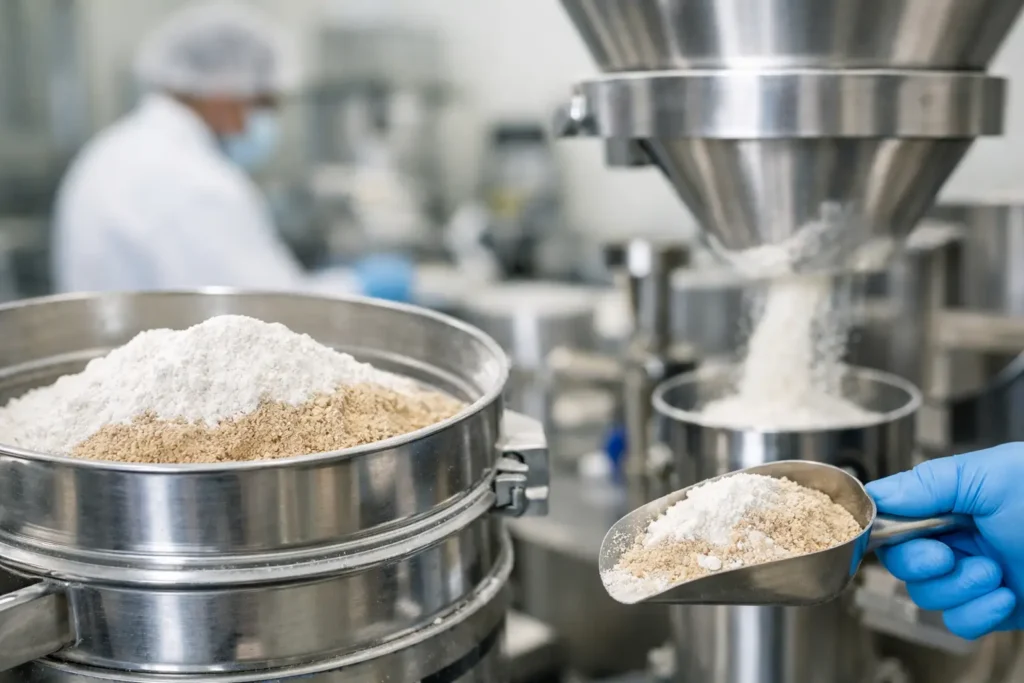
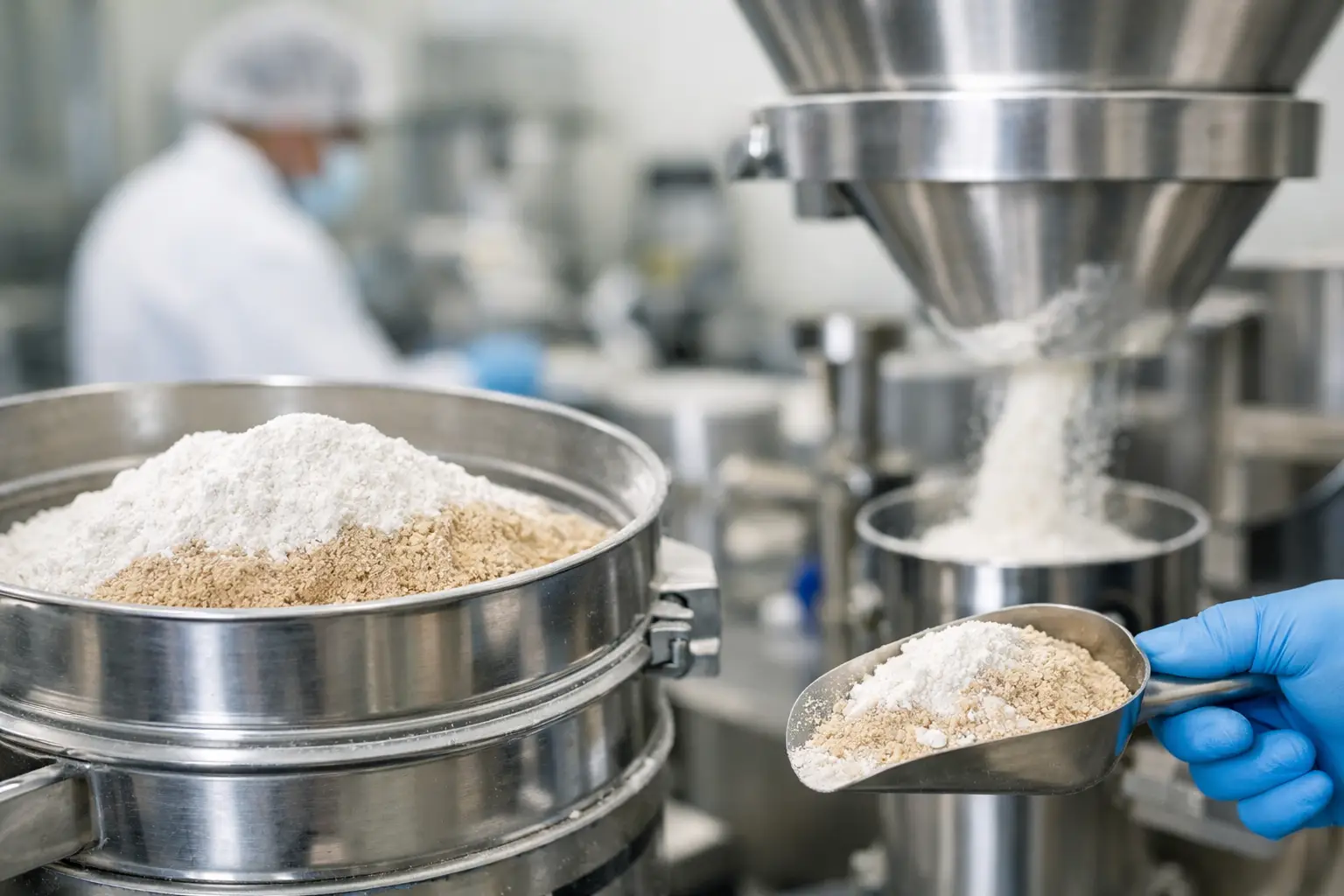
A blend can test uniform at the mixer discharge and still fail by the time it reaches a tablet press, packaging line, extruder, or batch reactor. That is the central challenge in learning how to reduce powder segregation: the mixing step matters, but so do every transfer, storage, and feeding step that follows. For manufacturers handling food ingredients, pharmaceutical excipients, specialty chemicals, nutraceuticals, and agricultural products, controlling segregation protects product quality, yield, compliance, and customer confidence.
Why Powder Segregation Happens
Powder segregation is the separation of particles within a blend due to differences in physical properties. A formulation may contain ingredients with different particle sizes, shapes, densities, surface textures, moisture levels, or flow characteristics. Once those materials move, vibration, air flow, and gravity can rearrange them.
The most common mechanism is sifting segregation. Smaller particles migrate through the void spaces between larger particles and collect lower in a container or hopper. Dense particles may also settle more quickly than light particles. During filling, fine particles can become airborne, while larger particles follow a different trajectory, creating zones of non-uniform composition.
Segregation is not always obvious. A powder may look visually consistent while assay, potency, color, flavor, active ingredient concentration, or bulk density varies from sample to sample. This is why a process must be evaluated as a complete system rather than judged only by the mixer’s blend time.
Start With the Material, Not the Mixer
Equipment selection is critical, but it cannot fully compensate for ingredients that are inherently prone to separation. The first engineering task is to characterize the materials and identify the property differences creating risk.
Particle size distribution deserves close attention. A blend containing very fine powder and coarse granules is generally more vulnerable than one with a narrow, matched size range. Particle density should be reviewed alongside size because a fine, high-density active can separate differently than a low-density botanical powder. Shape also matters: spherical particles tend to flow and rearrange more freely than irregular or fibrous particles.
Moisture is another variable that can change the process quickly. Too little moisture may increase dusting and free flow, while too much can create agglomerates, wall buildup, or inconsistent discharge. Hygroscopic ingredients can shift behavior during storage as they absorb water from the environment.
Where formulation flexibility exists, reducing the difference between major ingredients is often the most effective preventive action. This may involve milling coarse material, screening out oversized particles, selecting a different excipient grade, or granulating fine components with a compatible carrier. These changes require validation because a narrower particle size distribution can improve uniformity while also altering dissolution, flow, compaction, or downstream product performance.
Choose a Mixing Method That Fits the Application
A mixer should create the required level of distributive and, where appropriate, dispersive mixing without damaging the product. The best choice depends on batch size, ingredient ratios, particle behavior, required cleanability, shear sensitivity, and the way the material will be discharged.
For free-flowing powders with closely matched physical properties, a gentle tumble blender may provide effective mixing with low energy input. However, tumble mixing can be less forgiving when there are substantial density differences, small-dose ingredients, or cohesive powders. Overmixing can also become a problem. A blend may reach uniformity and then begin to separate again as particles continue to move and classify by size.
Ribbon mixers, paddle mixers, and plow mixers offer different mixing actions for a broader range of industrial powders. A ribbon mixer can provide efficient convective movement for many dry blends. A paddle mixer is often well suited to fragile materials and formulations that require a gentle but active mixing zone. A plow mixer can fluidize more challenging powders and break soft agglomerates, making it useful for cohesive materials or fast batch cycles.
There is no universal mixer for every powder. The correct design may require a specific agitator geometry, vessel fill level, chopper arrangement, discharge valve, surface finish, or liquid-addition system. PerMix engineers evaluate these details as part of the application, because blend uniformity depends on how the entire machine handles a specific material, not on a mixer category alone.
Control Fill Level and Mixing Time
Running a mixer at the wrong fill level changes its mixing pattern. An underfilled vessel may allow material to travel without sufficient interaction, while an overfilled vessel can reduce circulation and create stagnant zones. Manufacturers should establish an operating range, not simply a maximum batch weight.
Mix time must be determined through representative trials and sampling, then controlled in production. Longer is not automatically better. Once blend uniformity is achieved, extra rotation or agitation can encourage segregation, especially in blends with broad particle-size distributions. Use a defined mixing endpoint based on data rather than operator judgment.
Protect the Blend After Mixing
Many segregation problems occur after an acceptable blend leaves the mixer. A well-designed transfer path minimizes particle acceleration, free fall, vibration, and repeated handling.
Avoid long vertical drops wherever practical. A falling stream can separate by particle size and density before it enters the next vessel. Use short, controlled transitions, properly designed chutes, or enclosed conveying systems that limit free fall. If pneumatic conveying is required, evaluate air velocity carefully. High velocity can create attrition, dusting, and classification, particularly with fragile granules or blends containing fine powders.
Hoppers and bins require equal attention. A mass-flow hopper, designed so all material moves when discharged, generally provides better consistency than a funnel-flow hopper where material moves through a central channel and remains stagnant along the walls. Poor hopper geometry can cause one part of a batch to discharge first and another part much later, even when the original blend was uniform.
Reduce vibration during transport and storage. Forklift travel, vibrating feeders, and equipment vibration can cause fine particles to settle. When a portable tote is necessary, keep travel distance and handling events to a minimum. Avoid filling and emptying the same material multiple times.
Use Controlled Feeding and Discharge
The final few feet before processing are frequently overlooked. A loss-in-weight feeder, volumetric feeder, or rotary valve must pull material consistently from the hopper. If the feeder preferentially draws fines, large particles, or dense components, downstream uniformity will suffer.
Match the feeder design to the powder’s flow properties. Agitation, bridge breakers, live-bottom systems, and screw configurations can improve flow, but aggressive agitation may also promote separation. The objective is consistent mass flow with the least disturbance necessary.
Mixer discharge design matters as well. A full-width bomb-bay discharge or properly sized flush valve can reduce hold-up and allow rapid, even emptying. Narrow outlets, long discharge spouts, and dead zones increase the chance that material will stratify or that one batch will contaminate the next. For regulated products, discharge should also support complete cleanout and documented cleaning validation.
Validate Uniformity Across the Entire Process
A single sample from the mixer is not enough to prove control. A meaningful validation plan samples the blend at multiple locations and stages: after mixing, early and late in discharge, after transfer, and at the feeder or final package. This reveals where segregation begins.
Sampling must be designed carefully. Poor thief-sampling technique can disturb the powder or bias the result. Analytical methods should be sensitive enough to detect meaningful variation in the critical component, especially for low-dose active ingredients or minor additions.
Track practical process indicators alongside assay results. These can include mixer speed, blend time, fill level, moisture, particle-size data, transfer distance, feeder settings, and batch discharge time. When variation appears, those records help identify whether the root cause is material variability, operating discipline, or equipment design.
Build Segregation Control Into the Process
The most reliable way to reduce powder segregation is to prevent it at the formulation and equipment-design stage, then verify performance under real operating conditions. A mixer can produce a highly uniform blend, but the system must preserve that uniformity through discharge, conveying, storage, and feeding.
For a new line or a persistent quality problem, test the complete material path with representative ingredients and production-scale conditions. The right combination of particle control, properly matched mixing technology, mass-flow handling, and disciplined operating parameters turns powder uniformity from a recurring concern into a dependable production result.
Come see the Proc-X difference