
A heat-sensitive powder that looks perfect at pilot scale can fail fast in production. Color shifts, potency loss, caking, volatile loss, and poor flowability usually trace back to one problem – too much thermal exposure for too long. That is why selecting the right industrial dryer for heat sensitive materials is less about removing moisture at any cost and more about controlling temperature, residence time, pressure, and product movement as one process.
For manufacturers in food, pharmaceutical, nutraceutical, chemical, and specialty materials processing, dryer selection has direct consequences for yield, consistency, and operating cost. The wrong design can degrade product value even if it hits the target moisture content. The right design protects the material while still delivering practical throughput.
What makes an industrial dryer for heat sensitive materials different
Heat-sensitive materials do not all behave the same way. Some degrade chemically when exposed to elevated temperatures. Others melt, soften, oxidize, lose aroma, denature, or form hard agglomerates. In many cases, the issue is not just peak temperature. It is the combination of heat intensity, exposure time, oxygen contact, and mechanical stress.
An industrial dryer for heat sensitive materials is designed around that reality. Instead of relying on aggressive surface heating or high-temperature air alone, it uses lower-temperature drying conditions, improved heat transfer efficiency, vacuum operation, gentle agitation, or shorter residence times to remove moisture with less product damage.
This matters most when the material has a narrow process window. Protein powders, active ingredients, botanical extracts, enzymes, flavors, pigments, specialty polymers, and certain crystal or slurry products can all lose market value if drying is poorly controlled. A dryer that is technically capable of evaporation is not automatically suitable for these products.
The process variables that matter most
Before comparing dryer types, it helps to focus on the variables that actually protect sensitive materials.
Temperature is the first obvious concern, but product temperature often matters more than heating media temperature. Under vacuum, moisture can evaporate at a lower temperature, which is why vacuum drying is often preferred for fragile materials. Lower boiling points reduce thermal stress and can make a major difference in final quality.
Residence time is just as important. A product may tolerate moderate heat briefly but degrade during prolonged exposure. Dryers that achieve efficient moisture removal without holding product for extended periods can protect potency, appearance, and physical structure.
Oxygen exposure can be the hidden problem. Oxidation affects flavors, oils, bioactive compounds, and chemically sensitive materials. Closed systems and vacuum designs help limit this risk.
Agitation also requires attention. Some wet cakes and pastes need movement to expose fresh surface area and prevent hot spots. Others can fracture, smear, or compact under excessive mechanical action. The best dryer design balances gentle product handling with enough agitation to keep drying uniform.
Common dryer types for heat-sensitive products
No single dryer is best for every application. Material form, moisture load, batch size, sanitation requirements, and downstream handling all influence the right choice.
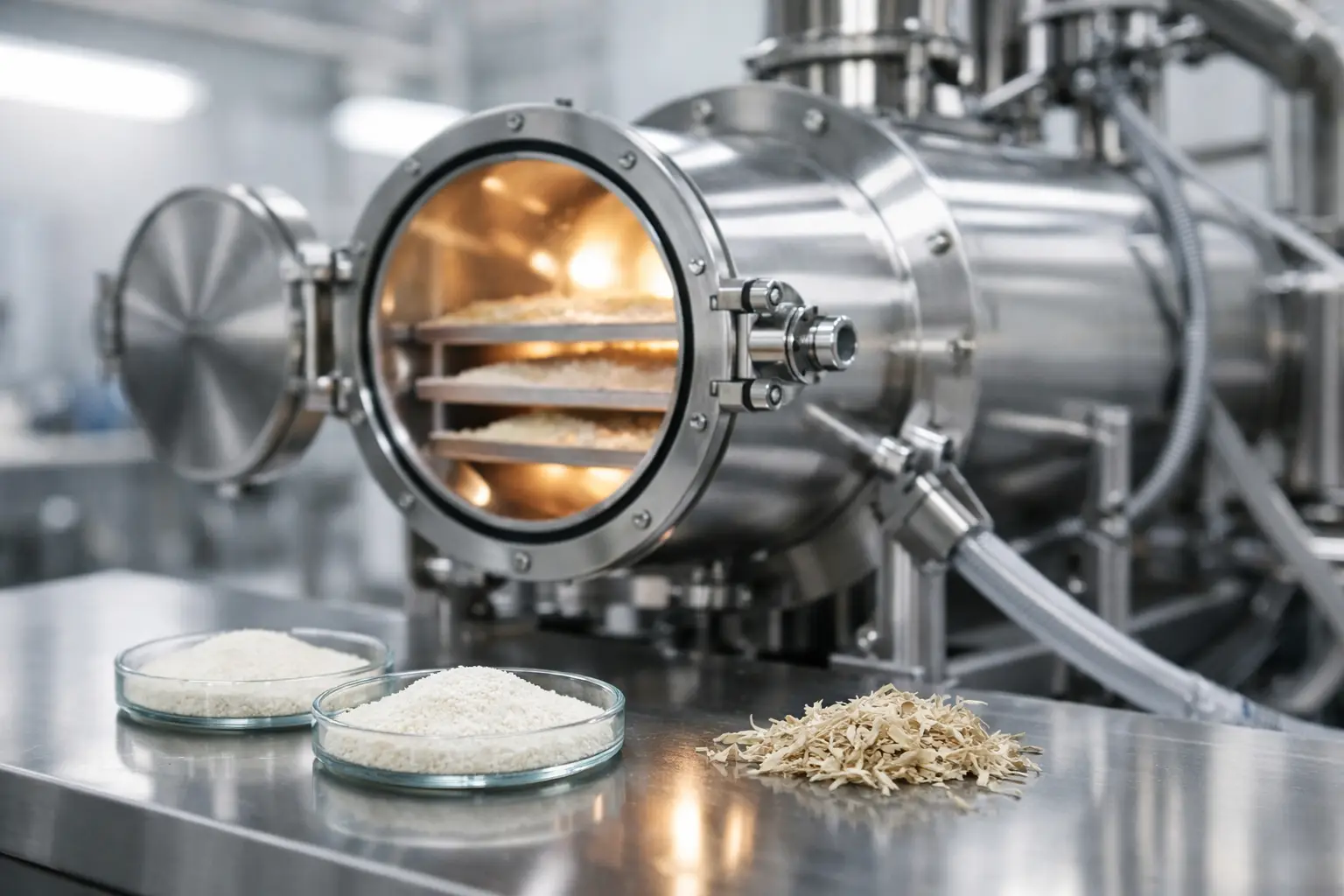
Vacuum tray dryers
Vacuum tray dryers are widely used when the priority is low-temperature batch drying with straightforward operation. They are a practical option for pharmaceutical ingredients, fine chemicals, and specialty materials that can be spread in shallow layers on trays.
Their strengths are simple vacuum drying conditions and relatively gentle treatment. Their limitations are labor, batch variability, and slower throughput compared to more advanced agitated systems. For some plants, that trade-off is acceptable. For larger-scale operations, labor intensity and floor space can become concerns.
Vacuum paddle dryers
Vacuum paddle dryers are often a strong fit for slurries, wet cakes, pastes, and filter cakes that require enclosed, low-temperature drying with continuous contact heat transfer. The paddles move the product while heated surfaces supply energy efficiently. Under vacuum, they can dry difficult materials at reduced product temperatures.
This design is especially useful when solvent recovery, containment, or product protection are important. It can also support multiple process steps, such as heating, reacting, drying, and cooling, within one system depending on the application. The trade-off is that process tuning matters. Paddle geometry, fill level, rotation speed, and heating conditions must align with the material behavior.
Vacuum shelf and oven-style systems
For lower-volume or highly specialized applications, vacuum shelf systems can offer excellent control. These are often chosen for products where handling must be minimal or where the batch process is tightly regulated.
The downside is scalability and throughput. They can be ideal for high-value products, but less attractive when production targets require faster turnover.
Conical screw dryers
Conical screw dryers are often selected when very gentle mixing and uniform vacuum drying are required. Their geometry supports efficient contact drying with comparatively low shear, making them suitable for fragile solids, crystals, and premium powders.
They are well suited for applications where product integrity is critical and where discharge performance matters. They can also offer strong cleanability for industries with strict hygienic standards. The trade-off is capital cost, which may be justified by higher product value and reduced batch loss.
Freeze drying and spray drying
These two categories come up often, but they fit narrower use cases.
Freeze drying is highly effective for extreme heat sensitivity, especially in pharma and biotech, but it is expensive, slow, and usually reserved for products that justify the cost. Spray drying can work for heat-sensitive liquid feeds because evaporation is rapid and droplet temperatures can remain controlled, but it is not automatically gentle in every case. Feed composition, inlet and outlet conditions, and powder characteristics determine whether spray drying is truly appropriate.
How to choose the right industrial dryer for heat sensitive materials
The best selection process starts with the material, not the machine brochure. Buyers should evaluate thermal sensitivity, starting moisture, final moisture target, particle size, stickiness, bulk density changes, solvent content, and whether the product is a powder, slurry, cake, paste, or crystal.
If the material degrades quickly with heat, vacuum drying is often the first place to look. If the product also tends to cake or form wet lumps, agitation becomes more important. If oxygen exposure is a problem, a closed vacuum system with controlled atmosphere may be necessary. If sanitation is central, the dryer must support the required surface finish, cleanability, and validation approach.
Capacity planning should also be realistic. It is common to focus on nominal evaporation rate while underestimating loading time, discharge time, cleaning time, and changeover constraints. For many plants, the true throughput picture depends on the full batch cycle, not just the drying phase.
Utilities matter too. Steam, hot water, thermal fluid, chilled water, vacuum capability, dust handling, condenser sizing, and solvent recovery can all affect total project cost. A dryer that appears economical on paper may create avoidable complexity in plant integration.
Why customization matters in sensitive drying applications
Heat-sensitive drying is rarely a one-size-fits-all decision. Even two products in the same industry can require different dryer geometry, heating surface area, agitation style, and control logic.
That is why engineered customization has real value. The best industrial dryer for heat sensitive materials is usually the one built around the actual product behavior and production goals. Jacket design, internal agitator configuration, vacuum level, surface finish, feed method, discharge design, and automation features can all change the result.
For example, a nutraceutical processor drying botanical extract may prioritize low-temperature solvent removal and sanitary construction. A specialty chemical producer may need corrosion-resistant materials and vapor recovery. A food manufacturer may care most about preserving color, flavor volatiles, and free-flowing powder characteristics. The dryer category might be similar, but the execution should not be generic.
This is where an experienced equipment partner matters. Process knowledge, application review, and practical manufacturing experience usually determine whether a project performs well after startup.
Mistakes that lead to product loss
The most common error is selecting based on dryer type alone without testing the product under realistic conditions. A second mistake is assuming lower temperature by itself guarantees product protection. If residence time is long or mixing is poor, quality can still suffer.
Another frequent issue is underestimating how the product changes during drying. Materials can become sticky at one stage, then brittle later, or form insulating layers that slow heat transfer. Dryer performance must be evaluated across the full moisture range.
It is also a mistake to separate drying from upstream and downstream process decisions. Feed consistency, filtration performance, particle formation, and final milling or packaging requirements all affect what dryer will work best.
For manufacturers weighing performance, cost, and flexibility, the smartest path is usually application-driven evaluation backed by pilot data and engineering input. Companies such as PerMix support that approach by combining broad dryer options with custom process design around real production conditions.
When the product is sensitive, drying should never be treated as the last utility step. It is a quality-critical operation that deserves the same level of engineering attention as mixing, reacting, and final packaging. Make that decision carefully, and the payoff is not just lower moisture – it is a better product leaving the plant every single batch.