Industrial Mixers
PerMix News & Updates
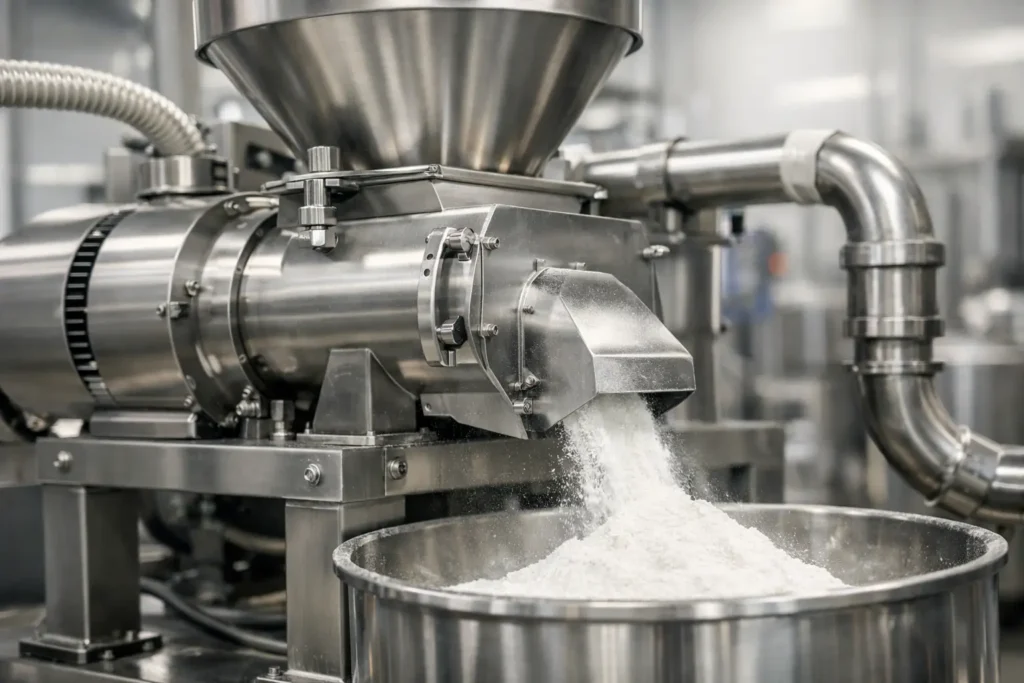
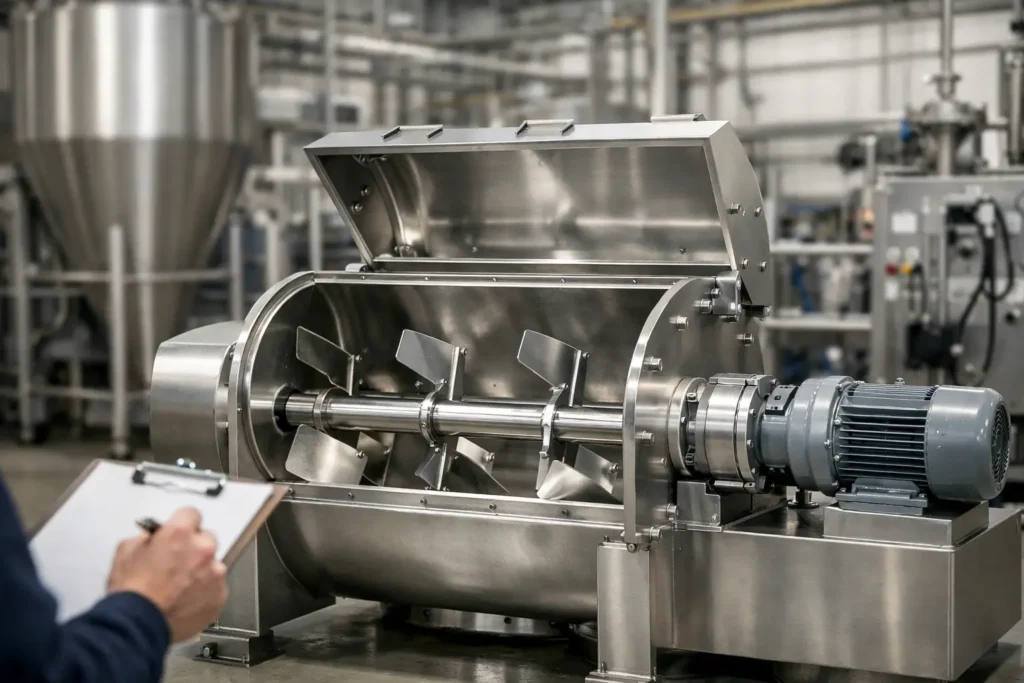
A powder that flows poorly, segregates during filling, or creates excessive dust can turn an otherwise stable production line into a source of rejected batches and lost capacity. The right industrial granulator for powder processing changes the physical behavior of the material by building controlled agglomerates that are easier to handle, dose, dry, package, and process downstream.
Granulation is not simply a size-enlargement step. It is a controlled process in which powder particle size, binder addition, shear energy, residence time, and drying conditions must work together. Equipment selection should begin with the material and the production objective, not with a standard machine configuration.
An industrial granulator converts fine powders into larger, more uniform granules. In most wet granulation applications, a liquid binder is introduced to a powder blend while an impeller, chopper, or other mixing element distributes the liquid and applies the energy needed to form agglomerates. The wet mass may then move to a dryer, mill, or screening system to achieve the required final particle size distribution.
For manufacturers, the result is often improved flowability, reduced dust, better content uniformity, and more reliable feeding into tablet presses, capsule fillers, packaging machines, extruders, or subsequent mixing operations. Granulation can also reduce segregation where ingredients have different particle sizes, shapes, or densities.
The benefits depend on process control. Over-granulation can create dense lumps that dry slowly or mill poorly. Under-granulation may leave a dusty product with weak agglomerates and inconsistent downstream behavior. The objective is not to make the largest possible granule. It is to consistently produce the particle structure your next process requires.
A granulator that performs well for one formulation may be unsuitable for another. Product behavior should drive the equipment design, including vessel geometry, mixing tools, chopper configuration, liquid-addition method, discharge arrangement, and controls.
High-shear granulators use a main impeller to circulate and compact powder while a high-speed side chopper breaks wet lumps and distributes liquid throughout the batch. This process is widely used where a relatively dense, uniform granule is needed within a controlled batch cycle.
Pharmaceutical, nutraceutical, food, and specialty chemical producers often use high-shear granulation when formulations require precise binder distribution and repeatable granule density. These machines can process a broad range of powders, but the operating window must be developed carefully. Impeller speed, chopper speed, liquid spray rate, and granulation endpoint all influence the finished material.
A high-shear system is a strong choice when batch consistency and compact equipment footprint are priorities. It may be less appropriate for fragile materials, formulations that cannot tolerate elevated mechanical energy, or operations where extremely low shear is required.
Fluid bed granulators suspend powder in a controlled air stream while binder liquid is sprayed into the moving bed. Granules form as particles contact the sprayed liquid and dry in the same chamber. This approach can combine mixing, granulation, and drying, reducing handling between process stages.
The process is particularly useful for heat-sensitive or moisture-sensitive products when drying conditions are tightly controlled. However, fluid bed processing requires careful management of airflow, atomization, inlet air temperature, exhaust conditions, and filter performance. Fine, highly cohesive, or difficult-to-fluidize powders can present challenges.
Not every powder needs high-speed mechanical processing. Some food blends, agricultural products, and chemical formulations benefit from gentler agglomeration methods that preserve particle shape or avoid excess fines. Other applications may require vacuum capability, jacketed temperature control, contained charging, or integrated milling after drying.
The correct solution depends on how the powder responds to moisture, compression, temperature, and shear. A practical equipment review should include laboratory trials or pilot-scale testing whenever the formulation is new, high-value, regulated, or difficult to process.
A purchase specification should state more than desired batch capacity. It should define the material characteristics and the quality attributes the granulator must achieve. Without this information, manufacturers may receive equipment sized for volume but not engineered for the actual process.
Start with the incoming powder. Particle-size distribution, bulk density, moisture level, angle of repose, cohesiveness, abrasiveness, and electrostatic behavior all affect mixing and agglomeration. The formulation also matters. A small change in binder concentration, surfactant level, or active ingredient loading can significantly change granule growth.
Next, define the target output. Important requirements may include final particle-size distribution, bulk density, moisture content, flowability, dissolution behavior, compressibility, dust level, and allowable percentage of oversize or fines. These specifications provide a meaningful basis for selecting a granulator and validating its performance.
Liquid addition deserves special attention. A binder applied too quickly can create localized wet balls before the liquid spreads through the powder. Applied too slowly, it may extend cycle time or produce weak granules. Spray nozzle design, droplet size, spray pattern, pump control, and nozzle position should be matched to the powder movement inside the vessel.
Endpoint determination is another key decision. Some processes use a fixed time recipe, while others monitor motor power, torque, current draw, product temperature, or granulation pressure to identify the point at which granules reach the desired condition. Time-based control can be effective for stable, well-proven formulations. For variable raw materials or demanding quality requirements, process feedback can provide greater consistency.
Moving from a small development batch to commercial production is where many granulation projects lose predictability. A larger vessel does not behave exactly like a smaller vessel. Fill level, impeller tip speed, chopper position, liquid distribution, and wall effects can change as capacity increases.
Successful scale-up focuses on process relationships rather than copying a recipe line by line. Depending on the application, engineering teams may evaluate impeller tip speed, power per unit mass, Froude number, liquid-to-solid ratio, spray flux, and wet mass residence time. No single scale-up rule applies to every formulation.
For this reason, the supplier should be able to discuss both process development and commercial equipment design. A properly engineered system may need a different impeller profile, a revised spray lance, or modified chopper geometry at production scale. These details are often the difference between repeatable output and an expensive trial-and-error program.
Food, pharmaceutical, nutraceutical, and health and beauty manufacturers must evaluate more than granulation performance. Product contact surfaces, cleanability, containment, documentation, and material traceability can be central to the purchase decision.
For sanitary production, specify the required stainless steel grade, internal surface finish, gasket materials, drainability, access openings, and clean-in-place or wash-in-place requirements. Dead zones can retain product and complicate cleaning, especially with sticky binders or potent active ingredients. A vessel should provide practical access for inspection and maintenance without creating unnecessary contamination risk.
Containment requirements are equally application-specific. Fine powders can become airborne during charging, venting, sampling, and discharge. Depending on product hazard and facility standards, the system may require sealed transfers, dust collection, local exhaust connections, glove ports, or integrated vacuum conveying. The best arrangement protects operators while keeping the process practical for daily production.
A granulator rarely operates alone. The full line may include raw material charging, powder blending, liquid preparation, wet milling, drying, dry milling, screening, vacuum transfer, and packaging. Each interface affects yield, sanitation, labor requirements, and batch traceability.
For example, a high-shear granulator may deliver a wet mass that requires a mill before drying to create a consistent bed for a fluid bed dryer. A drying step may create agglomerates that need calibrated milling before compression or filling. If these connections are not considered early, the plant can end up with bottlenecks, unnecessary manual handling, or a final particle-size distribution that shifts from batch to batch.
A full-process equipment supplier can evaluate the granulator as part of the larger material-handling and mixing system. PerMix applies this engineering approach to help manufacturers match granulation equipment with the blending, drying, milling, and transfer steps that determine overall production performance.
Before issuing a purchase order, confirm how the supplier will demonstrate the required result. Ask what material trials are available, what product properties will be measured, and how the proposed configuration addresses your specific powder behavior. Request clarity on usable working volume rather than total vessel volume, as well as expected batch time, cleaning time, utility demands, and maintenance access.
Also evaluate the commercial fit. The lowest initial equipment price may not produce the lowest operating cost if it creates long cleaning cycles, excessive rejects, difficult changeovers, or high labor demand. Conversely, an over-specified system can tie up capital without improving the product. The best value is equipment engineered around the actual formulation, production schedule, compliance needs, and growth plan.
A well-selected granulator gives production teams more than larger particles. It gives them a controllable process. Start with representative powder trials, define measurable output targets, and require an equipment design that supports those targets at commercial scale.

Stay Connected