
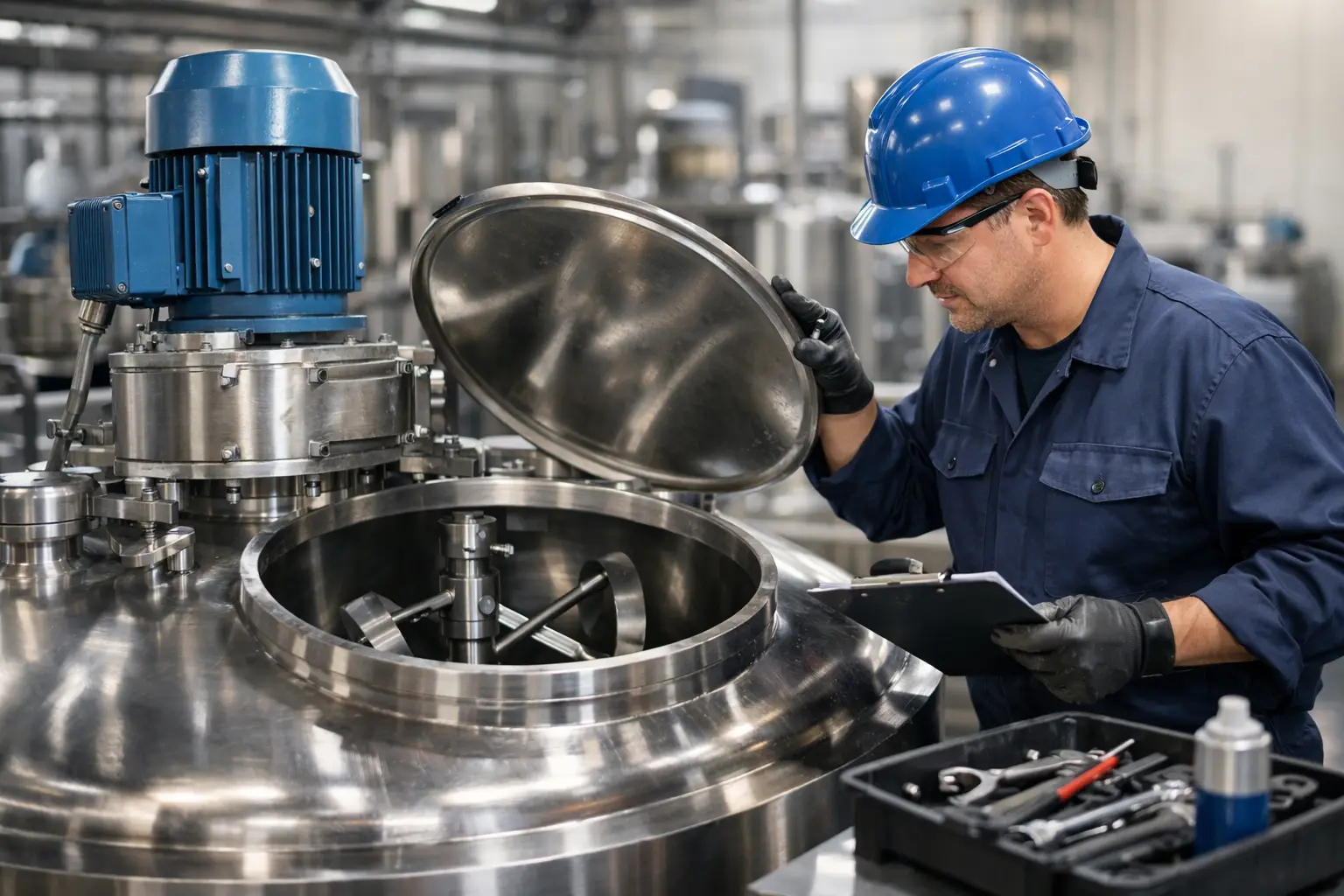
A mixer rarely fails at a convenient time. The first warning may be a rising motor load, an unusual bearing temperature, a damaged seal, or a batch that takes longer to reach uniformity. A disciplined industrial mixer maintenance guide turns those small signals into planned corrective work before they become lost production, rejected material, or an unplanned shutdown.
For powder blenders, high-viscosity kneaders, vacuum mixers, emulsifiers, and multi-shaft systems, maintenance is not separate from process performance. Shaft condition, agitator clearance, seal integrity, lubrication quality, and control accuracy all affect the way material moves through the vessel. The right program protects the equipment and preserves the repeatability the process was designed to achieve.
Start With the Actual Mixing Duty
A maintenance schedule should be based on operating conditions, not a generic calendar alone. A ribbon mixer handling dry, free-flowing powders has different wear mechanisms than a double planetary mixer processing adhesive paste or a high-shear emulsifier operating under vacuum. Running hours matter, but so do material abrasiveness, viscosity, temperature, clean-in-place chemistry, vacuum level, batch frequency, and the consequences of cross-contamination.
Begin by documenting the machine’s intended operating window: normal batch size, product density, maximum viscosity, agitator speed, motor amperage, jacket temperature, vacuum range, and expected cycle time. These values create a practical baseline. When a batch requires more time, the motor draws more current, or a vacuum system takes longer to pull down, the maintenance team has evidence that something in the process or machine condition has changed.
This approach also prevents a common mistake: treating mechanical wear as the only cause of poor mixing. A longer blend time may result from worn tools, but it can also reflect a change in particle size, bulk density, ingredient addition sequence, liquid distribution, or fill level. Maintenance and process engineering should review deviations together before replacing components.
Daily and Pre-Run Inspection Protects Production
Operators are the first line of equipment reliability. Their inspection does not need to be lengthy, but it must be consistent and recorded. Before startup, confirm that guards, covers, clamps, access doors, and interlocks are secure. Inspect the vessel, discharge valve, and seals for leakage or product buildup. Verify that utilities such as compressed air, cooling water, thermal fluid, and vacuum are available at the required condition.
During operation, listen for changes in gearbox noise, bearing sound, or agitation vibration. Watch motor load and compare it with established operating data. A motor that consistently runs at a higher amperage can indicate excessive product resistance, an overfilled batch, failing bearings, misalignment, or material accumulation on the agitator.
After discharge and cleaning, inspect areas that can retain material: shaft seals, discharge interfaces, chopper assemblies, vessel corners, lid gaskets, and spray devices. Residual product is not only a cleaning concern. It can harden, create drag, accelerate corrosion, compromise sanitary performance, and interfere with a reliable seal.
Build a Preventive Maintenance Schedule Around Failure Modes
The most effective preventive maintenance plans specify what is inspected, how it is measured, acceptable limits, and what action follows an abnormal finding. Vague instructions such as inspect gearbox or check seals leave too much to interpretation.
A practical schedule typically includes the following four inspection intervals:
- Per shift or daily: Check noise, vibration, leakage, motor load, safety devices, discharge operation, cleanliness, and visible fasteners.
- Monthly: Inspect lubrication condition, belt or coupling condition, air-system filters, sensor response, gearbox breather condition, and seal support systems.
- Quarterly or semiannually: Verify shaft alignment, agitator clearance, bearing condition, drive mounting, vibration trends, electrical terminals, and control calibration.
- Annually or by operating hours: Perform a detailed shutdown inspection of seals, bearings, gear reducers, wear liners, agitator tools, valve seats, structural welds, and safety systems.
The interval should be shortened for abrasive powders, frequent high-temperature cycling, corrosive products, intensive washdown, or continuous operation. Conversely, a lightly used pilot mixer may be better served by operating-hour triggers than calendar-based service. The objective is not to perform more maintenance. It is to perform the right maintenance before deterioration affects production.
Lubrication, Bearings, and Drives Need Controlled Attention
Over-lubrication can damage bearings as readily as under-lubrication. Excess grease creates heat, churns the lubricant, and can force contamination past seals. Use the lubricant type, quantity, and interval specified for the drive and bearing arrangement. If the process is sanitary or regulated, confirm that the selected lubricant meets the facility’s applicable requirements.
Gear reducers deserve trend-based attention. Monitor oil level, oil appearance, operating temperature, and abnormal noise. Darkened oil, metallic particles, water contamination, or a persistent temperature increase should trigger investigation rather than an automatic oil change alone. Replacing lubricant without finding the source of contamination can allow a gearbox problem to continue unnoticed.
Couplings and belts should be inspected for alignment, wear, tension, and guarding. Misalignment increases bearing loading and vibration, while an improperly tensioned belt can slip, generate heat, and alter mixer speed. On variable-frequency-drive systems, verify that programmed acceleration, speed limits, and torque settings still match the approved process. Controls changes made to solve a short-term production issue can create long-term mechanical stress.
Protect Seals, Discharge Valves, and Product Contact Surfaces
Seal failures often begin as minor leakage, but their consequences can be significant. In vacuum mixers, a compromised seal may prevent the system from achieving the required vacuum level and can affect deaeration, drying, or reaction performance. In sanitary applications, damaged elastomers or seal faces can create cleaning and contamination risks.
Inspect seal flush systems, barrier fluid levels, air pressure, cooling arrangements, and drain paths where applicable. Do not assume a seal is healthy because it is not visibly leaking. Changes in product temperature, vacuum performance, or power consumption may be early indicators of friction or seal-face damage.
Discharge valves also require close attention because they influence yield, cleaning efficiency, and batch-to-batch repeatability. Check valve seats, gaskets, actuator response, position feedback, and accumulated product around the discharge. A valve that does not fully open can leave valuable product in the vessel. A valve that does not fully close can create leakage, inaccurate dosing, or a serious safety concern.
For mixers processing abrasive materials, inspect vessel walls, plow tips, paddles, ribbons, choppers, and wear liners for erosion. Tool geometry matters. Even modest wear can change material circulation patterns, increase blend time, and reduce the performance of liquid addition or high-shear dispersion.
Use Condition Monitoring Before Failure Becomes Visible
A mature industrial mixer maintenance guide uses operating data to identify deterioration early. Motor current, vibration, bearing temperature, gearbox temperature, vacuum pull-down time, batch cycle duration, and discharge time are useful indicators because they connect machine condition with real process results.
Trend data is more valuable than a single reading. A vibration reading within a broad acceptable range may still require action if it has increased steadily over several weeks. Likewise, a small increase in mixing time may be meaningful when it occurs across the same validated formulation and batch size.
Work with production to define escalation limits. For example, a specified percentage increase in motor load, a failure to achieve target vacuum within the expected time, or a recurring interlock fault should create a maintenance work order. Clear limits prevent operators from normalizing abnormal equipment behavior.
Plan Shutdown Work and Keep Critical Spares Ready
Unplanned repairs are expensive because diagnosis, purchasing, access, and production scheduling all happen under pressure. Planned shutdowns allow teams to inspect the complete agitator assembly, replace known wear components, verify alignment, and test the equipment before returning it to service.
Critical spares should reflect the mixer design and the production risk of a failure. Common examples include shaft seals, gasket kits, bearings, coupling elements, belts, valve seats, instrument sensors, and drive components. The correct inventory level depends on lead time, equipment redundancy, regulatory requirements, and the cost of lost production. Keeping every possible part on the shelf is not efficient; having no replacement for a long-lead seal or gearbox component is equally poor planning.
When major work is completed, document dimensions, clearances, settings, replaced parts, and post-maintenance performance. This record supports future troubleshooting and helps distinguish normal operating variation from a recurring mechanical issue.
Maintenance Is a Process Performance Decision
The best maintenance programs treat a mixer as part of a complete production system, not an isolated asset. Material feeding, upstream milling, liquid addition, vacuum capability, thermal control, discharge design, and automation can all influence mechanical loading and equipment life.
PerMix engineers mixing systems around those process realities because reliable equipment performance begins with the application, not a maintenance checklist. When operating data, operator observations, and mechanical inspections are reviewed as one system, maintenance becomes a direct tool for protecting product quality, throughput, and long-term manufacturing performance.
The next time a mixer shows a small change in load, temperature, vibration, or cycle time, treat it as useful process information. Investigating that signal while production is still running is often the most cost-effective maintenance decision a plant can make.