When a formula looks stable in the lab but separates on the plant floor, the real issue is often equipment selection. The inline emulsifier vs batch mixer decision affects droplet size, cycle time, sanitation, operator involvement, and how reliably you can scale from pilot production to full throughput.
For many manufacturers, this is not a simple head-to-head comparison where one machine is always better. An inline emulsifier and a batch mixer solve different process problems. The right choice depends on product rheology, required shear, batch size, recirculation strategy, cleaning method, and whether your operation is trying to maximize flexibility or continuous output.
Inline emulsifier vs batch mixer: what is the real difference?
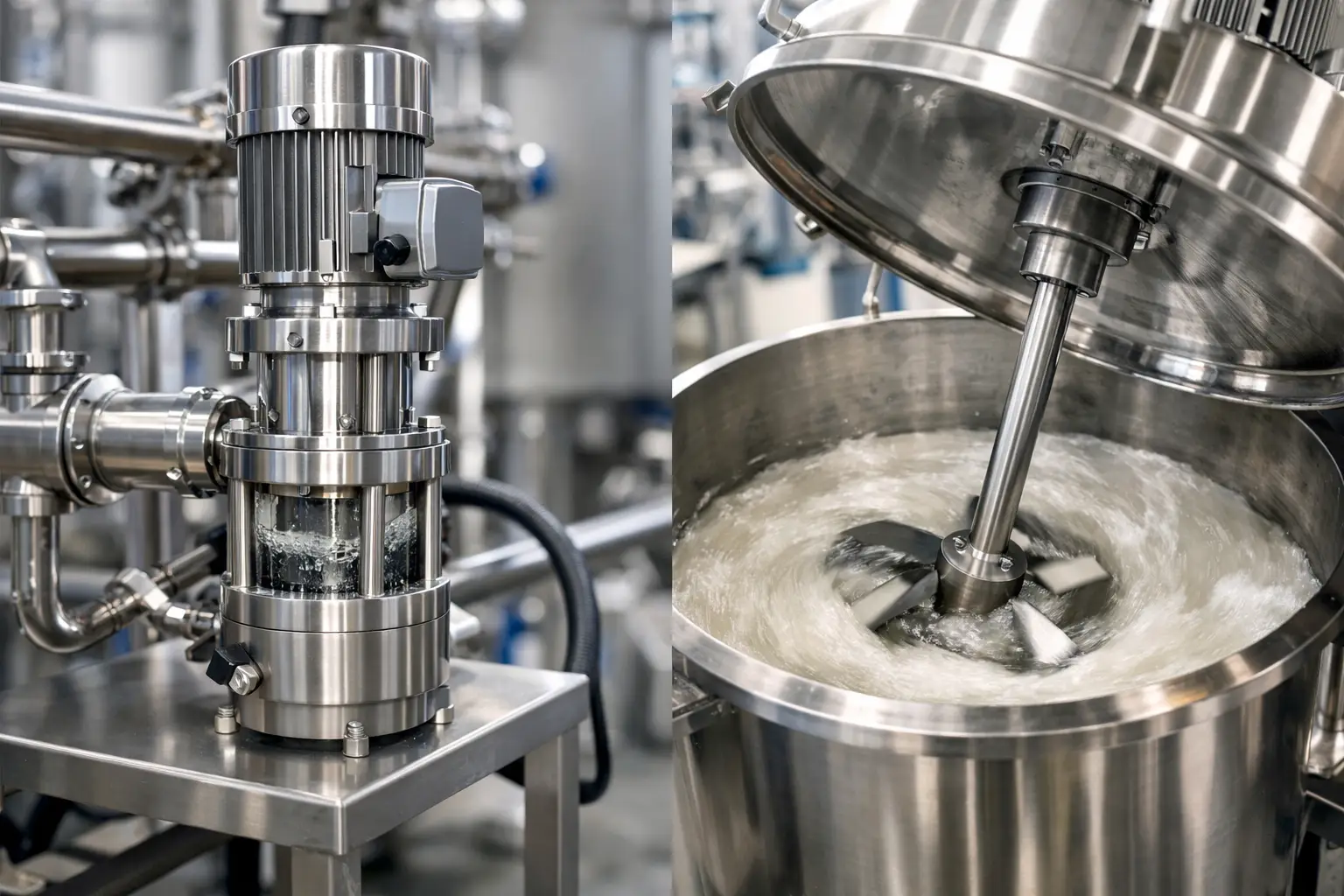
At the most basic level, a batch mixer processes material inside a vessel for a defined period. Ingredients are charged into the tank, mixed according to a set cycle, and discharged when the batch is complete. This format gives operators a high level of control over addition order, dwell time, temperature hold, and batch-specific adjustments.
An inline emulsifier works in a flow path rather than relying on bulk tank agitation alone. Product passes through a high-shear rotor-stator or similar workhead, where intense mechanical energy reduces droplet size and disperses immiscible phases. Instead of waiting for the entire vessel contents to slowly reach a target state, the emulsification event happens as material moves through the machine.
That design difference matters. A batch mixer is often the better fit when the process needs broad versatility, multiple ingredient additions, long blending windows, or strong handling of viscosity changes over the course of the batch. An inline emulsifier is often the better fit when the process requires repeatable fine emulsions, fast droplet size reduction, and higher production efficiency in recirculation or continuous operation.
Where inline emulsifiers usually outperform
If your product quality depends heavily on fine particle or droplet size, an inline emulsifier usually has the edge. This is especially true for sauces, creams, lotions, pharmaceutical suspensions, chemical emulsions, and other systems where phase stability depends on consistent high shear.
The key advantage is energy concentration. Instead of distributing mixing energy across a large vessel volume, an inline emulsifier applies intense shear in a very small working zone. That often leads to faster emulsification, narrower particle size distribution, and more repeatable results from batch to batch.
Inline systems also support efficient recirculation loops. In a tank-to-inline arrangement, material can pass through the emulsifier multiple times until the target result is reached. That gives processors a practical middle ground between pure batch manufacturing and fully continuous production. For plants trying to increase throughput without completely redesigning the process, this approach can be very attractive.
Sanitary operations may also prefer inline formats for certain products. Closed-loop processing can reduce exposure to air, lower contamination risk, and improve cleaning consistency when the system is designed for CIP. In regulated production, that level of control can be a major operational advantage.
Where batch mixers still make the most sense
Batch mixers remain the best choice in many industrial plants because they handle process complexity well. If you are making multiple SKUs, changing formulas frequently, or working with ingredients that must be added in stages, a vessel-based mixer gives more flexibility.
This matters in real production. A plant may need to wet out powders, add heat-sensitive ingredients late in the cycle, manage pH correction, or pause the process for quality checks. A batch mixer supports that workflow more naturally than a purely inline setup.
Batch systems are also often more forgiving when viscosity rises dramatically during production. Products such as pastes, gels, heavy slurries, and some high-solids formulations may become difficult to pump efficiently through an inline emulsifier. In those cases, the challenge is not just shear generation. It is material movement. If the product cannot circulate well, the benefits of inline processing diminish quickly.
Another practical factor is operator visibility. In a batch vessel, teams can observe the process, sample at intervals, and make direct adjustments. That can be valuable during product development, pilot work, or production environments where formulas are not fully standardized.
Shear is not the only buying criterion
A common mistake is choosing equipment based only on maximum shear. High shear matters, but it is only one variable in a much larger process equation.
Residence time matters. An inline emulsifier may generate excellent shear, but if flow rate is too high or recirculation is too short, the product may not receive enough total work. On the other hand, a batch mixer may run longer and still fail to create the same emulsion quality if the shear field is too weak or poorly distributed.
Temperature matters too. Emulsification performance often changes with viscosity, and viscosity changes with temperature. If your process requires heating and cooling in the same vessel, a batch system with an engineered process tank may simplify production. If your system already has controlled transfer, pumping, and thermal management, an inline setup may integrate well.
Ingredient behavior is equally important. Some powders are difficult to wet out and benefit from strong vortex control or specialized induction. Some materials are shear-sensitive and can be damaged by aggressive processing. Some formulations foam easily, making closed or vacuum-capable batch systems more attractive.
Inline emulsifier vs batch mixer for scale-up
Scale-up is where equipment decisions become expensive. A process that performs well at five gallons can fail at 500 gallons if the mixing principle does not translate cleanly.
Batch mixers can be easier to understand during development because operators can see and adjust the process directly. But scale-up can become difficult if larger vessel geometry changes top-to-bottom circulation, wall sweep, shear exposure, or ingredient incorporation time. What worked in a lab tank may not behave the same way in a production vessel.
Inline emulsifiers often offer stronger scale-up consistency because the workhead conditions can be replicated more predictably. If the machine is properly sized for flow, pressure, and product viscosity, the emulsification mechanism itself can remain more consistent across production levels. That said, scale-up still depends on the full system. Pump selection, line sizing, tank design, and recirculation time all affect the final result.
For many manufacturers, the best answer is not one machine replacing the other. It is a process system that uses a batch vessel for ingredient handling and thermal control, paired with an inline emulsifier for finishing shear. This hybrid approach is often the best in performance because it combines flexibility with product quality.
Cost, maintenance, and plant reality
On paper, equipment selection often looks like a simple performance comparison. In a plant, the decision is broader. Labor, cleaning time, maintenance access, floor space, and utility requirements all shape total cost.
A basic batch mixer can have a lower initial equipment cost, particularly for straightforward blending applications. It may also be easier for maintenance teams to service if the plant is already set up around vessel-based processing. But lower purchase price does not always mean lower operating cost. Long cycle times, inconsistent emulsion quality, and repeated rework can erase that advantage quickly.
An inline emulsifier may require more supporting infrastructure, including pumps, piping, controls, and integration planning. Yet when the application is right, it can reduce batch time, improve consistency, and support higher production rates with fewer process deviations. For many operations leaders, that performance gain justifies the system investment.
Cleaning is another area where the answer depends on the process. Some inline systems are excellent for CIP and sanitary validation. Some batch systems are easier to inspect visually and simpler to clean between frequent product changes. If you run allergen-sensitive formulations or highly regulated products, sanitation design should be evaluated as seriously as mixing performance.
How to choose the right system
The best buying process starts with the product, not the machine category. Ask what the formulation actually needs to succeed at production scale. Does it need fine droplet size or just thorough blending? Will viscosity stay pumpable? Is the process batch-based by necessity, or is higher-throughput recirculation realistic? How often will formulas change? What cleaning standard is required?
From there, evaluate the full process path. Look at ingredient addition, heating and cooling, shear demand, hold time, discharge method, and future capacity. A machine that solves one problem but creates two more downstream is not the right solution.
This is where engineering guidance matters. An experienced equipment partner should not force every application into one platform. The right recommendation may be an inline emulsifier, a batch mixer, or a custom combination based on your actual material behavior and production goals. For manufacturers that need dependable scale-up, process consistency, and budget-conscious performance, that application-first approach delivers the best long-term value.
If you are weighing inline emulsifier vs batch mixer, the smartest move is to define the process outcome before comparing horsepower, RPM, or vessel size. The equipment should fit the product, the plant, and the production plan you intend to run next year, not just the batch you need to make today.