
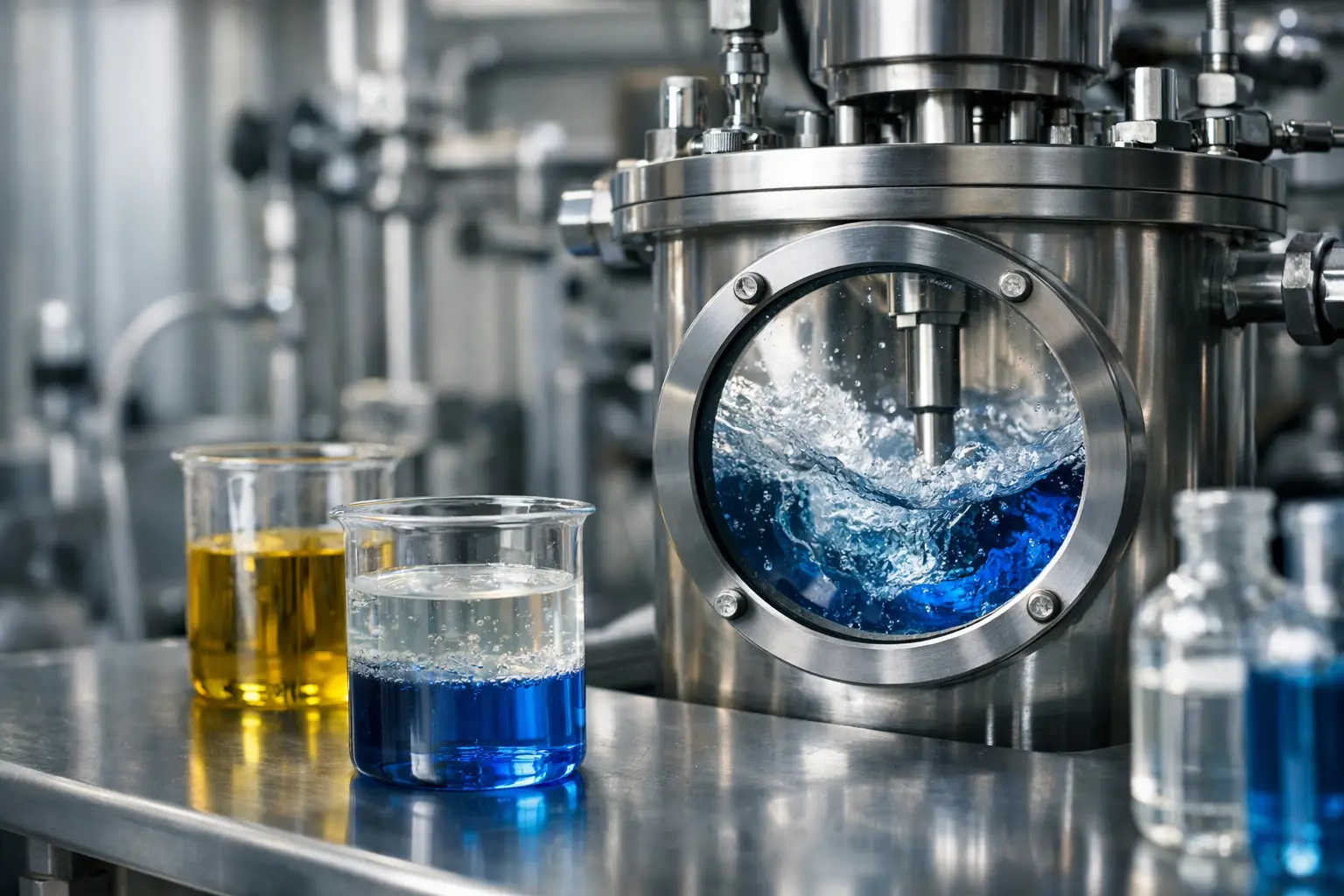
A batch can look fully blended at the surface and still fail a uniformity test at the discharge valve. That is why effective liquid liquid mixing troubleshooting starts with process evidence, not visual inspection. Variability in concentration, viscosity, color, pH, temperature, or active ingredient distribution usually points to a mismatch among fluid properties, vessel geometry, agitator design, and operating conditions.
For production teams, the objective is not simply to make the liquid move. It is to create repeatable circulation through the entire working volume, deliver the required dispersion or homogenization, and do so within a practical batch time and energy range. A change that corrects one problem can introduce another. Higher speed, for example, may shorten blend time while increasing air entrainment, shear damage, heat generation, or mechanical load.
Start Liquid Liquid Mixing Troubleshooting With the Process
Before changing impeller speed or replacing an agitator, establish what has changed and where the result is failing. Compare current performance against a known acceptable batch, not against assumptions about how the tank should behave. Review batch records, raw material certificates, feed sequence, temperature trends, mixer speed, liquid level, and sample results.
The most useful first question is whether the issue is new or inherent. A newly developed problem often relates to a raw material change, incorrect charging order, worn components, an instrumentation error, or a control setting. A problem that has existed since startup may indicate that the tank, impeller, motor, or process duty was not correctly matched to the application.
Sampling deserves particular attention. A top sample and a discharge sample can produce different results even after the nominal mixing time has elapsed. Confirm sample locations, sample timing, sample valve design, and laboratory method before diagnosing the mixer. Poor sampling practice can create apparent nonuniformity where the batch itself is acceptable.
Poor Blend Uniformity and Dead Zones
Poor uniformity is commonly caused by incomplete bulk circulation. In a properly designed system, fluid is drawn from remote regions of the vessel and returned through the main flow loop. When this loop does not reach the lower dish, upper liquid level, corners, or areas behind internal hardware, stagnant zones can persist.
Tank geometry matters as much as mixer horsepower. A tall, narrow vessel generally needs a different pumping pattern than a wide, shallow tank. Flat bottoms, dished bottoms, off-center nozzles, heating coils, dip tubes, and internal supports all change flow paths. An impeller that performs well in an open water-like batch can be ineffective in a viscous formulation or a vessel crowded with internals.
Start by verifying the actual working volume. Operating far below or above the designed liquid level can place the impeller in the wrong position relative to the batch. Then inspect impeller elevation, diameter, blade condition, shaft runout, and rotation direction. A reversed rotation direction or damaged impeller can drastically reduce axial pumping without an obvious mechanical alarm.
For moderate- and high-viscosity liquids, a small high-speed impeller may create intense local motion but limited tank turnover. Larger-diameter, lower-speed axial-flow impellers, close-clearance designs, or multiple impellers may be more appropriate. The correct solution depends on the viscosity profile during the entire batch, not only on the final product viscosity.
Vortexing, Air Entrainment, and Foaming
A deep vortex is not proof of good mixing. In many liquid systems, it indicates that rotational flow is dominating useful top-to-bottom circulation. The vortex can pull air into the batch, creating foam, oxidation, density variation, inaccurate level readings, and longer downstream deaeration time.
The usual causes are an unbaffled round tank, excessive agitator speed, an undersized impeller, or operation at a low liquid level. Baffles interrupt tangential rotation and convert more of the agitator energy into axial and radial flow. Their dimensions and placement must be engineered around the vessel and cleaning requirements. Adding baffles without considering CIP coverage, sanitary design, or viscous product buildup can create a maintenance problem.
Where permanent baffles are not practical, an off-center mixer, angled shaft arrangement, or alternate impeller selection may help. Reducing speed can also reduce air drawdown, but only if bulk circulation remains sufficient. For foam-sensitive applications, charging the liquid below the surface, minimizing free fall from recirculation returns, and controlling the addition rate of surfactants are often as important as the agitator itself.
Vacuum deaeration can remove entrained air, but it should not be used to compensate for an avoidable mixing deficiency. First determine why air is entering the process. Correcting the source improves batch consistency and can reduce cycle time.
Long Batch Times and Inconsistent Results
Long mixing times are frequently treated as a simple capacity problem. In reality, extending the batch may only hide inadequate flow. If the blend result improves slowly but never becomes repeatable, the system may have isolated regions that are not exchanging material effectively.
A useful diagnostic is to track a measurable tracer at multiple locations over time. Depending on the formulation, conductivity, pH, refractive index, color, density, or concentration can reveal how quickly the batch approaches uniformity. This creates a mixing curve rather than relying on an operator’s visual judgment.
Inconsistent results between batches can also originate upstream. Differences in ingredient temperature, viscosity, concentration, or addition rate change the fluid dynamics. A cold viscous component introduced quickly into a less viscous carrier may settle or form a concentrated layer before the agitator can distribute it. Preheating, controlled metering, recirculation, or a revised addition point may produce a better result than adding more mixer power.
When a formulation includes soluble powders, polymers, gums, or thickeners, apparent long mixing time may actually be a wetting or hydration problem. Surface lumps and fisheyes are not corrected by bulk agitation alone. The process may require a high-shear mixer, powder induction system, rotor-stator homogenizer, or a staged mixing sequence that combines rapid wetting with lower-shear bulk circulation.
When Liquid Layers Will Not Combine
Two liquid phases may remain visibly separated because of density difference, viscosity difference, interfacial tension, or insufficient emulsification energy. An axial-flow agitator can blend miscible liquids efficiently, yet it may not produce the droplet size required for a stable emulsion.
This distinction is critical. Bulk blending moves large volumes through the vessel. Emulsification creates and maintains fine droplets against coalescence. The correct equipment may involve a batch rotor-stator homogenizer, inline emulsifier, high-shear mixer, or a combination of bulk agitator and high-shear device.
Process sequence also determines the result. Adding the dispersed phase too rapidly can overload the high-shear zone and form large droplets that are difficult to break down later. The phase ratio, emulsifier chemistry, temperature, and viscosity all influence stability. If the product separates after mixing but before filling, investigate residence time, shear exposure, thermal history, and formulation compatibility alongside mixer performance.
Check Mechanical and Control Conditions
Not every mixing problem is a fluid mechanics problem. Mechanical wear and controls issues can quietly change performance over time. Inspect the drive system and confirm that the commanded speed matches actual shaft speed. Verify variable frequency drive limits, motor load, gearbox condition, coupling integrity, and shaft alignment. A mixer operating below its intended speed may still appear normal while failing to deliver required pumping capacity.
Review the following conditions when performance drifts or varies by shift:
- Actual agitator speed, direction, torque, and power draw during each batch
- Liquid level at the start, during addition, and at the end of mixing
- Impeller clearance from the vessel bottom and condition of blades or dispersing heads
- Raw material temperature, viscosity, density, and lot-to-lot variation
- Addition location, feed rate, and order of ingredients
- Sampling method, test method, and acceptance criteria
This information turns a vague complaint such as “the batch is not mixing” into an engineering problem that can be measured and solved.
Select the Correct Corrective Action
The lowest-cost adjustment is not always the best corrective action. Increasing speed may be appropriate for a low-viscosity blend with adequate baffling, but it can be counterproductive for foam-sensitive products. Installing a larger impeller may increase pumping but can require a motor, gearbox, shaft, and vessel structure review. Adding high shear may improve dispersion while risking particle damage or excess heat.
An engineered evaluation should consider the complete process window: minimum and maximum batch volume, viscosity through the cycle, temperature, solids content, phase behavior, desired batch time, cleaning method, and future production capacity. PerMix approaches mixer troubleshooting from this system perspective because the final outcome depends on the vessel, ingredients, sequence, and controls as much as the machine itself.
The most productive next step is to document the failed batch with operating data and representative samples, then compare it against a successful run. That disciplined baseline gives engineering teams a clear path to correct the real cause instead of spending production time treating symptoms.