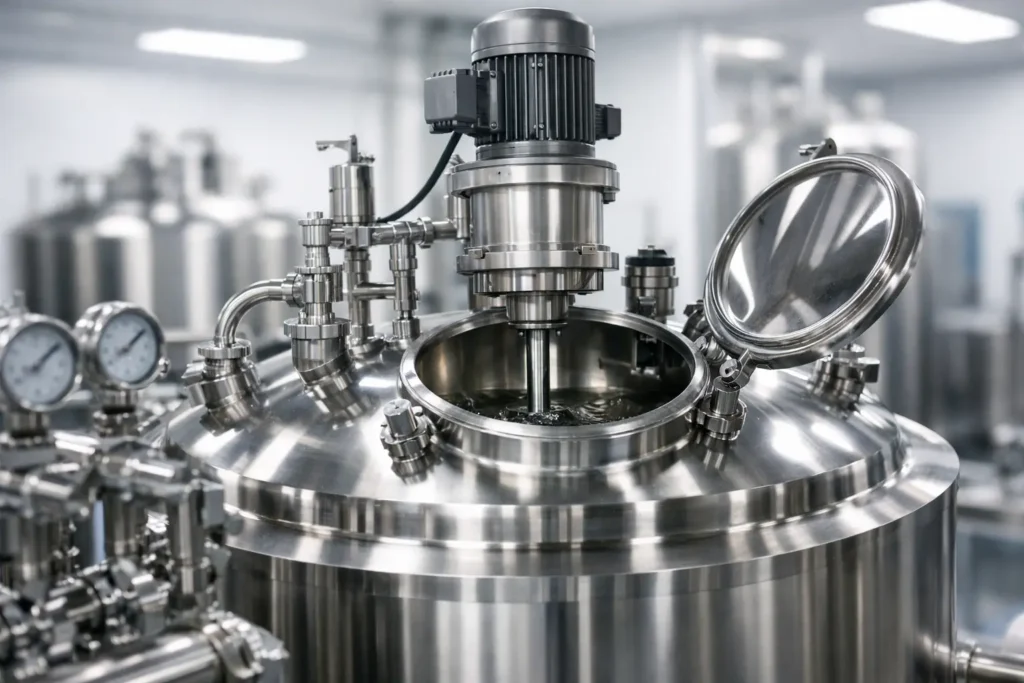
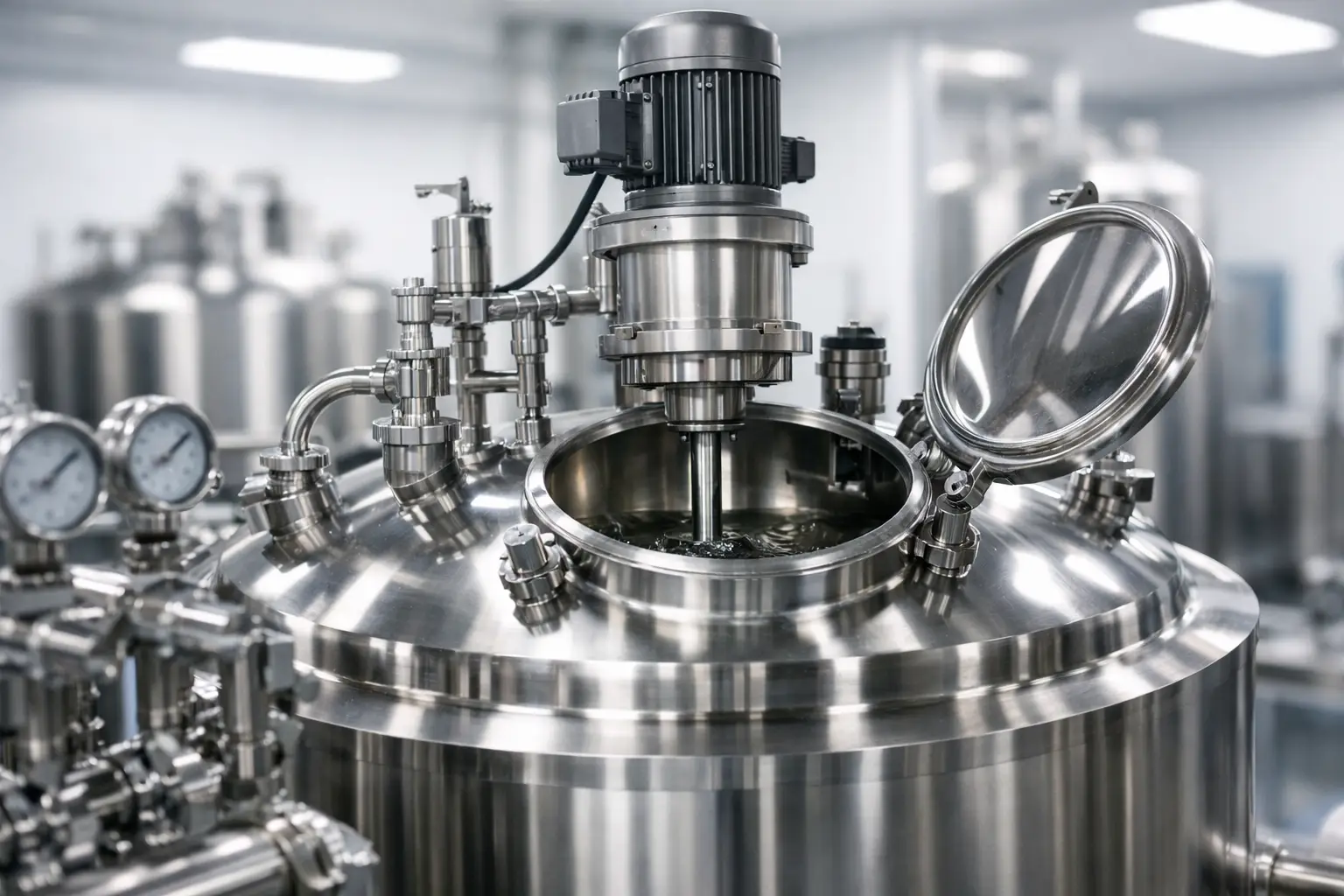
A mixing problem rarely starts with the mixer alone. In many plants, poor turnover, inconsistent viscosity, air entrainment, or long batch times come back to one issue: liquid mixing tank design. The tank, agitator, internals, and process conditions have to work as one system. If they do not, even a high-quality mixer can underperform.
For process engineers and production teams, that matters because tank design directly affects product quality, throughput, cleaning time, and operating cost. A tank that is right for a low-viscosity chemical blend may be wrong for a sanitary food process or a shear-sensitive emulsion. Good design is not about choosing the biggest motor or the fastest impeller. It is about matching the vessel and mixing method to the actual behavior of the product.
What liquid mixing tank design needs to accomplish
At the plant level, a mixing tank has a straightforward job: produce a consistent result, batch after batch, without wasting time or energy. In practice, that means more than simply circulating liquid. The design has to create the right flow pattern, suspend or dissolve ingredients as needed, control shear, manage heat transfer if required, and support cleanability and maintenance.
That is where trade-offs begin. Higher agitation speed can shorten blend time, but it can also increase foaming, damage fragile ingredients, or drive unnecessary power consumption. A tall narrow tank can improve top-to-bottom turnover in some applications, but may complicate access, installation, or powder induction. A jacketed vessel may support temperature control, but it adds cost and design complexity. The right answer depends on what the process is trying to achieve.
Start with the product, not the hardware
The best liquid mixing tank design always starts with the material profile. Viscosity is the obvious factor, but it is only one part of the equation. Density differences, solids loading, particle size, temperature sensitivity, tendency to foam, corrosiveness, and sanitation requirements all affect the design path.
For example, water-like liquids often respond well to high-flow impellers that create strong circulation with moderate shear. More viscous products may need anchor, gate, or helical-style agitation to keep material moving near the wall and prevent stagnant zones. If powders are being added into liquid, the design has to account for wet-out behavior, agglomeration risk, and whether the process benefits from high shear mixing, recirculation, or vacuum assistance.
This is why generic tank selection often creates long-term process problems. Two products may share similar batch sizes but require very different vessel geometry and agitation styles. A detergent, a pharmaceutical syrup, and a flavored beverage concentrate do not behave the same way in the tank, even if they are all classified as liquid products.
Tank geometry drives flow behavior
Tank shape is one of the most underestimated variables in mixing performance. Diameter-to-height ratio, bottom configuration, and internal clearances influence how effectively the agitator moves product through the vessel.
A common starting point for many liquid applications is a vertical cylindrical tank, but proportions matter. If the tank is too wide for the selected agitator, circulation weakens and dead zones become more likely. If it is too tall without the right impeller arrangement, you may get stratification or poor surface-to-bottom turnover. Multi-stage agitators can solve this in taller vessels, though they also increase mechanical and control considerations.
Bottom design is equally important. Flat bottoms may be acceptable in some applications, but dished, cone, or sloped bottoms often improve draining, solids handling, and cleanout. In sanitary processes, geometry must support complete drainage and eliminate areas where residue can collect. In chemical service, the priority may be different, such as containing solids or supporting a specific reaction profile.
Agitator selection is only effective when it fits the tank
Impeller choice gets attention for good reason, but it should never be separated from the tank itself. A turbine, propeller, paddle, anchor, saw-tooth disperser, rotor-stator head, or hybrid agitator will perform differently depending on vessel size, baffling, liquid depth, and product properties.
Low-viscosity blending often favors axial-flow impellers because they move large volumes of liquid efficiently. Radial-flow designs can be useful where gas dispersion, surface turnover, or localized shear is needed. Anchors and sweep agitators are common in more viscous systems, especially when heat transfer at the wall matters. High shear devices come into play when droplet size reduction, deagglomeration, or rapid ingredient incorporation is critical.
The mistake is assuming one agitator can cover every operating condition equally well. Some processes need broad turndown capability because batches vary, ingredients change, or future products are likely. In those cases, variable speed drives, multiple agitation stages, or custom hybrid designs may deliver better long-term value than a simpler one-purpose configuration.
Baffles, internals, and accessories are not minor details
In many standard liquid tanks, baffles are the difference between real mixing and simple vortexing. Without them, rotational flow can dominate, especially in low-viscosity liquids, and the batch may spin with the impeller rather than mix efficiently. Proper baffling improves turbulence and circulation, but sizing and placement still depend on the application.
There are exceptions. In some high-viscosity systems, baffles may be unnecessary or even counterproductive. In sanitary tanks, internal features must also be evaluated for cleanability. Spray devices, load cells, level sensors, manways, powder induction ports, recirculation loops, and heating or cooling jackets all affect the final design. Each addition should support a clear process requirement, not just reflect a standard specification.
Shear, temperature, and air control often decide the outcome
Some liquid products are forgiving. Many are not. Emulsions, suspensions, flavor systems, personal care products, and certain bio or pharmaceutical formulations can be highly sensitive to shear history, temperature rise, or trapped air.
That means the liquid mixing tank design must account for energy input, not just motion. High shear can improve dispersion speed and final texture, but too much can break structures down or create heat that damages the formulation. Air entrainment is another common issue. A fast mixer in the wrong tank can pull air into the batch, leading to foam, oxidation, density variation, and filling problems downstream.
When deaeration matters, the solution may involve lower surface turbulence, improved impeller placement, vacuum capability, or a different mixing sequence. If temperature control is critical, jacket design, wall sweep agitation, and heat transfer area become central to performance. This is why equipment should be designed around the full process, not just the mixing step in isolation.
Cleanability and compliance should be built in early
For food, beverage, pharmaceutical, nutraceutical, and cosmetics manufacturing, cleanability is not a finishing touch. It is part of the core engineering requirement. Surface finish, weld quality, drainability, dead-leg avoidance, gasket selection, and CIP compatibility all influence whether a tank will support the required hygiene standard and production schedule.
A tank that mixes well but takes too long to clean can still limit throughput. The same applies to a vessel that meets capacity targets but creates validation headaches. In regulated production, documentation, material traceability, and construction standards can be just as important as agitator horsepower.
Scale-up is where design decisions get tested
A process that works in a pilot vessel does not always transfer cleanly to production size. Blend times, tip speed, pumping rate, heat transfer, and ingredient addition behavior change with scale. That is why scaling a liquid system by copying proportions alone can be risky.
Good scale-up considers what parameter matters most for the product. Sometimes it is shear rate. Sometimes it is circulation rate, power per volume, or residence time in a high shear zone. The answer depends on the application. For manufacturers planning growth, it makes sense to choose a design platform that can be adapted across batch sizes rather than reinvented each time capacity increases.
This is also where an experienced equipment partner adds real value. A supplier with a broad range of liquid mixers, process vessels, and custom engineering options can help match the design to current production while keeping future expansion in view. That practical flexibility is often the difference between a tank that works on paper and one that performs reliably on the floor.
The commercial case for getting it right
A well-designed tank improves more than mixing. It can reduce batch time, improve first-pass quality, lower cleaning labor, minimize waste, and protect downstream equipment from inconsistent feed conditions. It can also reduce the need for operator workarounds, which is one of the clearest signs that the original system was not properly matched to the process.
For buyers comparing options, the lowest upfront number is rarely the lowest operating cost. A better-engineered tank may cost more initially, but if it shortens cycles, reduces rejects, and supports multiple products, the return becomes obvious. At PerMix, that is exactly how liquid processing equipment should be evaluated – by performance, fit, and long-term production value.
If you are specifying a new system or trying to fix an underperforming one, treat the tank as a process tool, not a commodity vessel. The right design pays for itself every time the batch runs the way it should.