
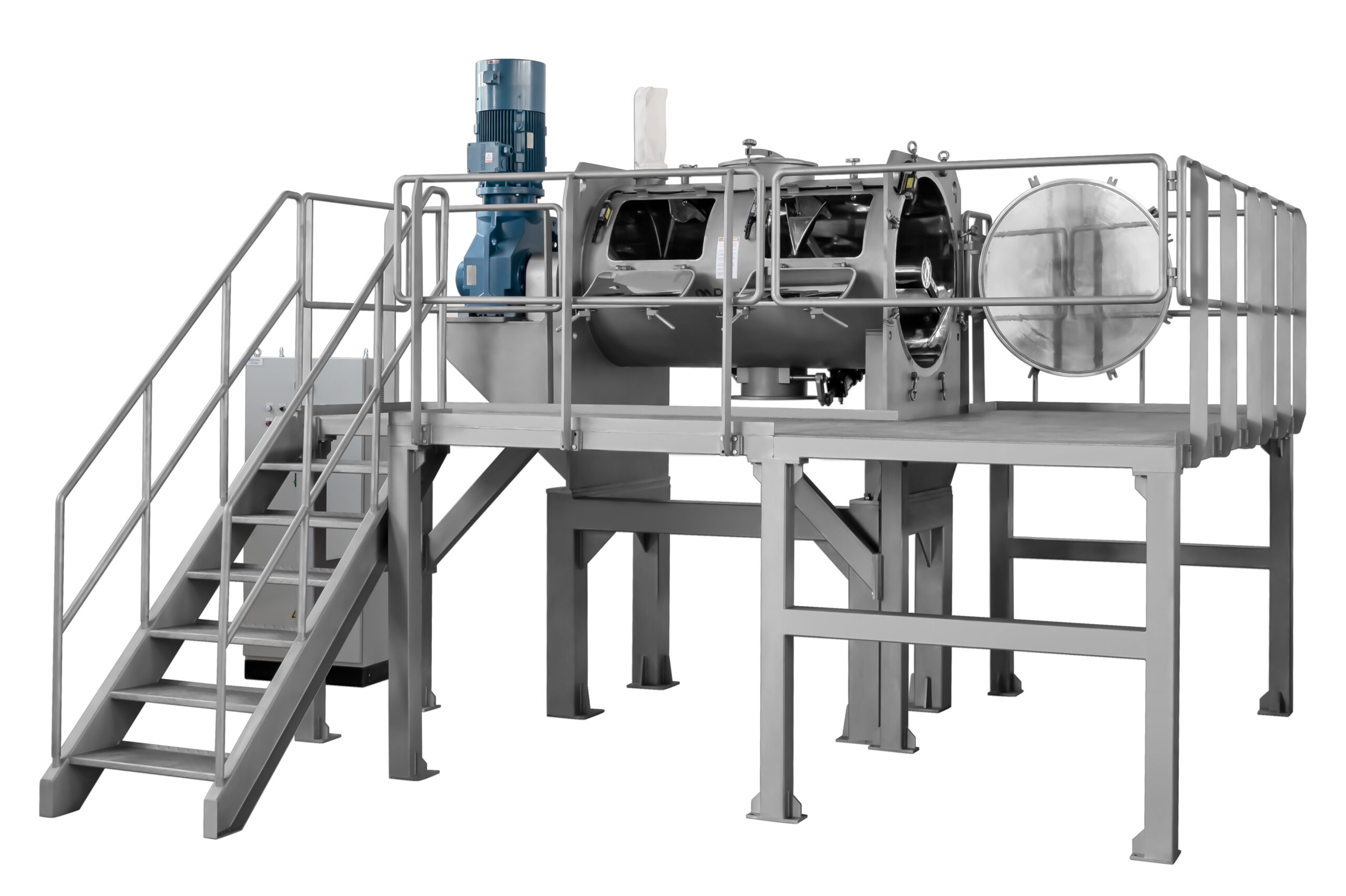
Broken flakes, chipped granules, and excess fines are not minor cosmetic issues in production. They change bulk density, flow behavior, dissolution rate, packaging performance, and finished product consistency. When the material itself is easy to damage, mixer selection becomes a process decision, not just an equipment purchase. In many of these applications, a paddle mixer for fragile materials is the most practical answer because it can produce a thorough blend while keeping shear and particle breakage under control.
Why fragile materials need a different mixing approach
Fragile solids behave differently from dense, free-flowing powders that can tolerate aggressive agitation. Breakfast cereals, snack inclusions, coated granules, instant beverage particulates, fertilizer prills, nutraceutical agglomerates, and certain chemical crystals all have one thing in common – once particle integrity is lost, the process usually does not recover it downstream.
That is why high tip speed alone is not a sign of better performance. In fragile applications, speed can become the problem. Excessive impact, compression, and particle-to-particle friction generate fines, segregation, dust, and yield loss. In regulated industries, damage can also affect content uniformity if active ingredients are carried in a coating or layered onto a core particle.
A paddle mixer addresses this challenge by moving material with a gentler, more lifting-and-folding action than many high-shear alternatives. Instead of relying on aggressive cutting or fluidizing energy, it creates controlled convective mixing across the vessel. That distinction matters when product quality depends on preserving shape, coating, and particle size distribution.
How a paddle mixer for fragile materials works
In a horizontal paddle mixer, paddles mounted on one or more shafts sweep through the product bed and move material in overlapping zones. The goal is not to grind or force the product through a narrow shear point. The goal is to circulate the batch efficiently enough to achieve uniformity without crushing delicate solids.
This design is especially effective when the application requires fast blending with low residence time and moderate mechanical stress. The paddles can be configured to promote gentle lifting, cross-mixing, and axial movement, which helps reduce dead spots while avoiding the harsher action associated with some other mixer geometries.
For processors handling fragile materials, the practical advantage is straightforward. You can often reach target blend uniformity in a shorter cycle than expected while keeping the percentage of damaged particles within acceptable limits. That balance between blend efficiency and product protection is where paddle mixers tend to outperform more aggressive systems.
Where paddle mixers perform well – and where it depends
A paddle mixer is often a strong choice for dry solids that are friable, coated, agglomerated, or structurally light. Food processors use this style for delicate inclusions, cereal blends, and prepared dry mixes. Nutraceutical and pharmaceutical producers may use it for granulations that must remain intact for downstream tableting, encapsulation, or sachet filling. Chemical manufacturers often select paddle mixers for crystals, pellets, and specialty compounds where particle breakdown changes product performance.
That said, application fit still depends on the material profile. If the product is extremely cohesive, highly compressible, or prone to smearing with liquid addition, the answer may not be a standard paddle configuration. A custom paddle geometry, adjusted fill level, or an entirely different mixer type may be the better engineering choice.
This is where many projects go wrong. Buyers sometimes ask only whether a mixer can blend the product. The better question is whether it can blend the product at the required batch size, cycle time, cleanability level, and damage threshold. A machine that achieves uniformity but creates too many fines is not solving the process problem.
Key design factors that control breakage
Not every paddle mixer for fragile materials performs the same way. Mechanical details have a direct effect on breakage rate, throughput, and repeatability.
Tip speed is one of the first variables to evaluate. Higher speed can improve mixing intensity, but it also raises impact energy. In delicate applications, the best result often comes from tuning speed to the lowest point that still achieves uniformity within production targets.
Paddle shape and pitch also matter. Wider or more gently angled paddles can move more product with less localized stress, while the wrong geometry can create unnecessary compaction or repeated impacts. Shaft arrangement, paddle overlap, and vessel proportions all influence how smoothly material circulates.
Fill level is another critical factor. An underfilled mixer may toss the product too aggressively. An overfilled mixer may create compression zones and poor flow paths. The ideal working volume depends on bulk density, particle strength, and the required mixing time.
Discharge design is often overlooked. Even if the mixing action is gentle, a poorly designed outlet can crush fragile product during emptying. Full-length bomb-bay discharges, oversized valves, or low-retention discharge configurations can help maintain product integrity while reducing residual hold-up.
For some applications, liquid addition is part of the process. Here, nozzle placement and spray rate become just as important as the agitator itself. Uneven wetting can create soft agglomerates, localized overmixing, or coating damage. A well-engineered paddle mixer can integrate liquid spray systems that distribute small additions evenly without overworking the bed.
Comparing paddle mixers to other mixer types
A ribbon blender is a common option for dry blending, but it can expose fragile particles to more rubbing and drag, especially over longer cycles. In some products that is acceptable. In others, the extra attrition shows up quickly as fines and broken particles.
Plow mixers deliver excellent intensity and are highly capable for fast blending, liquid incorporation, and difficult powder behavior. But for highly delicate solids, that intensity may be more than the application can tolerate unless the process is carefully engineered.
Tumble blenders can be very gentle, which makes them attractive for sensitive materials. The trade-off is that they may require longer cycle times, may offer less flexibility for liquid addition, and may not be the best fit for every production environment or throughput target.
That is why paddle mixers sit in a valuable middle ground. They offer more active mixing than passive tumble systems, while remaining gentler than many high-energy alternatives. For many production lines, that balance delivers the best combination of product protection, cycle efficiency, and commercial practicality.
What buyers should verify before specifying equipment
For plant managers and procurement teams, mixer selection should be grounded in measurable process criteria. Start with the acceptable breakage percentage, not just the desired batch size. If your specification ignores particle damage, you may end up with a mixer that looks productive on paper but drives hidden waste in operation.
Material testing is essential. Friability, particle size distribution, bulk density, moisture sensitivity, and segregation tendency should all be evaluated together. A product that looks stable in a sample jar may behave very differently once it sees full-batch circulation in a horizontal mixer.
It is also worth examining the full production context. Do you need sanitary construction for food or pharma service? Is there a requirement for clean-in-place, vacuum capability, jacketed temperature control, or downstream feeding integration? A paddle mixer may be the right process technology, but the right build specification is what turns a good concept into a dependable asset.
Experienced manufacturers such as PerMix typically approach this from an application engineering standpoint rather than a catalog-only standpoint. That matters because fragile material handling is rarely a standard, one-variable decision. It usually involves trade-offs between throughput, uniformity, residence time, cleanability, and particle preservation.
The best results come from matching the mixer to the material
There is no universal rule that says fragile products always belong in a paddle mixer. Some do, some do not. But when the process requires gentle convective blending, limited particle attrition, practical cycle times, and flexible industrial design options, a paddle mixer is often one of the best performers available.
The real value is not just in the mixer style. It is in selecting the right paddle configuration, speed range, vessel geometry, discharge arrangement, and application-specific features for the product you actually run. Fragile materials leave little room for guesswork. The right machine protects the product, supports throughput, and reduces the quiet costs of dust, fines, rework, and inconsistency.
If your operation is seeing particle damage during blending, the next step is not to accept breakage as normal. It is to evaluate whether your current mixing action matches the reality of your material.