
A plow mixer vs fluidized blender decision is not a comparison of mixing speed alone. It is a decision about how the material moves, how it responds to shear, whether liquid must be incorporated, and how consistently the system must perform at production scale. Two machines can both produce an apparently uniform sample, yet deliver very different results when batch size, ingredient sequence, moisture level, or operating conditions change.
For manufacturers working with powders, granules, minor ingredients, and dry formulations, the best choice starts with the product rather than the equipment name. Particle size distribution, bulk density, flowability, segregation risk, required batch time, cleaning method, and downstream packaging all influence the correct process design.
How a Plow Mixer Works
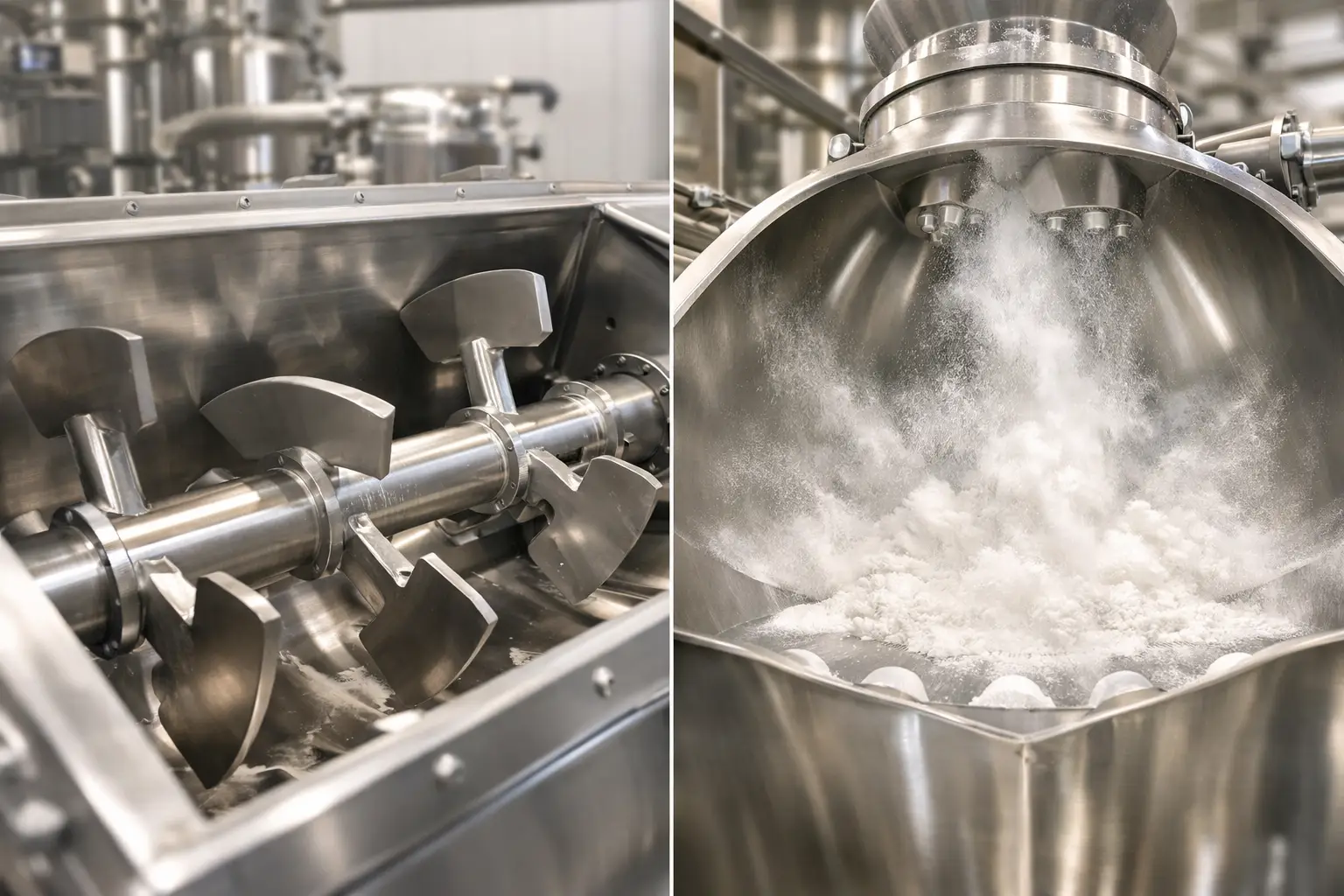
A plow mixer, also called a ploughshare mixer, uses plow-shaped mixing elements mounted on a horizontal shaft. As the shaft rotates, the plows lift and throw material into a mechanical fluidized bed. This three-dimensional movement rapidly distributes ingredients throughout the batch while preventing material from simply rotating as a mass with the vessel.
High-speed choppers can be added when the process requires more than dry blending. Choppers break down agglomerates, disperse liquid additions, and support processes such as wet granulation, coating, pigment dispersion, and incorporation of small quantities of binders or oils. The result is a highly flexible mixer architecture that can handle free-flowing powders as well as more difficult, cohesive formulations.
The principal strength of a plow mixer is controlled mechanical energy. It can develop the mixing action needed for fast blend uniformity without relying on compressed air to suspend the product. This makes it practical for formulations with variable particle characteristics and for processes where air handling is undesirable or impractical.
A plow mixer is not automatically the correct answer for every powder. Its intensity can be excessive for fragile particles, and the plow geometry, shaft speed, fill level, and chopper selection must be engineered around the formulation. A poorly matched high-intensity mixer can cause particle attrition, heat generation, or unwanted changes to product texture.
How a Fluidized Blender Works
A fluidized blender uses gas, usually filtered air or an inert gas, introduced through a distribution plate to lift and suspend particles. Once the gas velocity exceeds the material’s minimum fluidization point, the powder behaves more like a fluid. This movement promotes intimate contact between particles and can create effective blending with very low mechanical shear.
Fluidized blending is especially attractive for free-flowing, relatively uniform powders with predictable fluidization behavior. The process can be gentle, which benefits breakable granules, coated particles, and products where preserving particle shape is critical. Depending on the system design, fluidized technology can also support conveying, cooling, heating, drying, or conditioned transfer within a larger process line.
The limitation is equally important: not every powder fluidizes well. Fine, cohesive, sticky, broad particle-size-distribution, or high-moisture materials may channel, form dead zones, agglomerate, or require gas velocities that are impractical for the process. Segregation can also occur when components differ significantly in particle size or density, particularly during filling, fluidization, and discharge.
Fluidized blenders require close attention to air quality, filtration, dust collection, containment, pressure balance, and explosion protection where combustible dust is present. The blower and filter system are part of the process, not peripheral accessories. Their performance directly affects blend repeatability.
Plow Mixer vs Fluidized Blender: The Process Differences
The central difference is the source of mixing energy. A plow mixer produces movement mechanically through rotating elements. A fluidized blender uses a controlled gas stream to suspend and circulate particles. That distinction affects nearly every aspect of equipment selection.
A plow mixer generally offers broader application range. It can process materials that are difficult to fluidize, manage moderate variations in bulk density, and incorporate liquids through spray nozzles and high-speed choppers. It is commonly selected where one machine must support multiple products, including formulations that evolve over time.
A fluidized blender is usually more specialized. When the material fluidizes consistently, it can provide gentle, efficient blending with limited mechanical contact. It is often a strong candidate for powders that are free-flowing, low in cohesion, and sensitive to particle damage. The equipment becomes less attractive as product behavior becomes more variable or as the process requires intensive deagglomeration.
Neither technology should be judged by the word “gentle” or “high intensity” alone. A sensitive product may still require a plow mixer if the formulation includes a minor liquid addition, cohesive functional ingredient, or low-dose component that must be uniformly distributed. Conversely, a fluidized blender may be the better solution for a simple blend of compatible, fragile granules where mechanical agitation creates unacceptable attrition.
Material Behavior Determines the Best Choice
Material characterization should lead the specification. Before selecting either system, process engineers should evaluate flowability, particle size and shape, bulk density, moisture content, compressibility, electrostatic behavior, and segregation tendency. A representative blend trial is often more valuable than a specification sheet because it reveals how the ingredients behave together rather than individually.
Plow mixers are commonly effective for formulations containing dissimilar powders, moderate levels of cohesive material, and small liquid additions. The mechanical fluidized bed helps move material across the vessel, while choppers can address localized wet spots or agglomerates. They are often used in food ingredients, chemical blends, mineral products, detergents, nutraceuticals, premixes, and specialty powders.
Fluidized blenders are better suited to materials that can be reliably supported by air. Typical candidates include certain granules, dry crystalline materials, and uniform free-flowing powders. The technology can be particularly valuable when the process also benefits from air-based heating, cooling, or drying, provided that the powder’s fluidization characteristics remain stable throughout the operating cycle.
For either machine, the blend quality target must be defined correctly. A mean assay result is not enough. The process team should establish acceptable sample-to-sample variation, account for low-dose ingredient distribution, and test product after discharge and handling. A blend that is uniform in the vessel can segregate in a transfer line, hopper, or packaging machine.
Liquid Addition and Agglomerate Control
Liquid addition often decides the plow mixer vs fluidized blender question quickly. A plow mixer can be equipped with spray bars, atomizing nozzles, and choppers to distribute oils, flavors, binders, and other liquids through the powder bed. Proper nozzle location, droplet size, feed rate, and mixing sequence are essential. Simply adding a spray system does not guarantee uniform wetting.
Fluidized systems can handle some spraying and coating applications, but the process window is narrower. Excess liquid can collapse fluidization, create wet agglomerates, blind filters, and destabilize airflow. If the formulation requires substantial liquid loading or rapid breakup of wet lumps, a mechanically agitated plow mixer generally offers greater control.
This is also where pilot testing matters. A liquid that disperses cleanly at laboratory scale may form agglomerates at production scale if spray coverage, air velocity, or material circulation changes. The machine should be evaluated as part of the full process, including ingredient feeding and final discharge.
Cleaning, Containment, and Operating Cost
Cleaning requirements vary by industry and product family. A plow mixer has internal mechanical components, including the shaft, plows, choppers, and discharge valve. These components must be designed for access and cleanability, especially in food, pharmaceutical, and high-value specialty applications. Clean-in-place systems may be appropriate, but their effectiveness depends on vessel geometry and validated coverage.
A fluidized blender may have fewer moving internal parts, yet its air distributor, filters, ductwork, and dust collection equipment introduce their own cleaning and validation requirements. Fine powders can lodge in filter media or distribution plates. Where allergen control, product changeover, or containment is critical, cleaning must be evaluated across the entire gas path.
Operating cost should include more than motor horsepower. Plow mixers use mechanical drive power and may require chopper power, while fluidized blenders consume blower energy and often require air treatment, filtration, and dust handling. Inert gas operation can add significant cost but may be necessary for oxidation-sensitive or combustible materials. The right comparison is total process cost per acceptable batch, not the purchase price of the blender alone.
Scale-Up and System Integration
Scale-up is where many apparently successful mixing projects fail. Batch time, fill level, tip speed, air velocity, spray rate, and discharge behavior cannot be copied directly from a small trial unit to a production vessel. The target is equivalent product behavior, not identical machine settings.
A plow mixer should be sized around usable working volume, expected fill range, material density, required cycle time, and discharge requirements. The design may also include choppers, vacuum capability, heating or cooling jackets, load cells, automated dosing, and recipe controls. These options can turn a mixer into a controlled production system rather than an isolated batch vessel.
A fluidized blender requires equally careful integration of the air system. Airflow distribution, blower control, pressure monitoring, filter performance, gas temperature, and safety interlocks must be matched to the powder. A fluidized process that performs well under ideal airflow can become inconsistent when filters load or feed conditions change.
PerMix approaches this selection as an engineering question: define the material, confirm the process window, then configure the equipment around measurable production objectives. That approach reduces the risk of specifying a machine that performs well only under demonstration conditions.
The most useful next step is to test representative materials under realistic conditions, including the hardest product in the range, the lowest and highest fill levels, expected liquid additions, and actual discharge handling. The right blender is the one that keeps delivering the required product after the formulation, operator, and production schedule stop being ideal.