
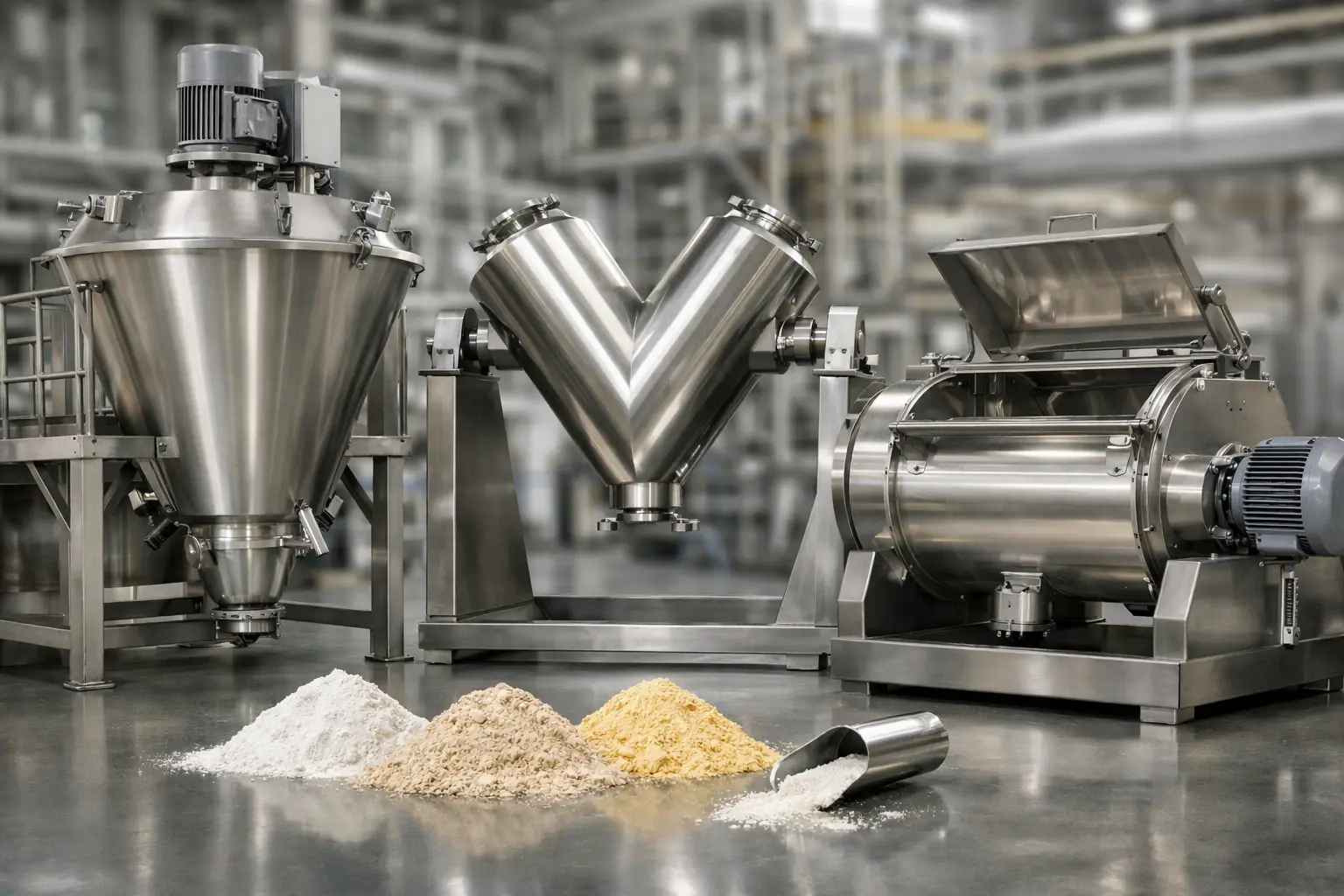
A powder blender that looks right on paper can still fail on the plant floor. The usual reason is simple: selection was based on capacity and price before anyone worked through material behavior, batch targets, cleaning demands, and the real process objective. This powder blender selection guide is built for manufacturers that need repeatable blending, predictable throughput, and equipment that fits the product instead of forcing the product to fit the machine.
Start with the process, not the machine
Most powder blending problems begin with an incomplete application definition. “Blend dry ingredients” is not enough to specify industrial equipment. A proper starting point is the behavior of the material and the result the process must deliver.
Bulk density, particle size distribution, flowability, friability, moisture level, electrostatic tendency, and segregation risk all affect blender performance. The same is true for the production goal. Some applications need a simple, gentle homogenization. Others require dispersion of minor ingredients, liquid addition, deagglomeration, heating or cooling through a jacket, vacuum operation, or a downstream discharge that feeds packaging, granulation, or further processing.
That is why powder blender selection should begin with a process review. If your team skips that step, you risk buying a unit that blends well in one narrow operating window but struggles when formulations change, batch sizes vary, or sanitation requirements tighten.
Powder blender selection guide: match the mixer to the material
No single powder blender is best for every application. The right choice depends on how the material moves, how sensitive it is, and what else the system must do besides blend.
Ribbon blenders
Ribbon blenders are often the first option considered because they are versatile, cost-effective, and well suited for many free-flowing powders and powder blends. Their counter-flow mixing action can deliver good batch uniformity with relatively short cycle times. They are widely used in food, chemicals, building materials, and agricultural products.
The trade-off is that ribbon blenders are not ideal for every product. Fragile particles can break down. Very cohesive powders may require more aggressive action than a ribbon design can provide. If liquid addition is significant, wall buildup and cleaning requirements become more important.
Paddle blenders
Paddle blenders are a strong choice when a gentler mixing action is required. They are often selected for friable solids, blends with moderate liquid addition, and applications where preserving particle integrity matters. Their mixing pattern can also reduce heat generation compared to more intensive designs.
That said, “gentle” does not automatically mean better. If your formulation includes hard-to-disperse minor ingredients or lumpy materials, a paddle blender may need longer blend times or additional process support.
Plow mixers
Plow mixers are designed for more intensive mixing. Their high-energy mechanical action creates fluidized movement in the vessel, making them effective for difficult powders, rapid blending, liquid addition, and applications that benefit from choppers for deagglomeration.
This extra intensity is a major advantage in the right process, but it comes with considerations. Higher energy input can be excessive for sensitive materials. Wear rates, cleaning procedures, and operating cost may also differ from lower-intensity blender designs.
Other specialized options
Some applications move beyond conventional dry blending. Vacuum mixing, heated mixing, containment, and integrated size reduction can all change the equipment decision. Double cone, V-type, conical screw, and high-shear systems may all be valid depending on the product and the process environment. For regulated industries, sanitary design details can matter as much as the mixing principle itself.
Material behavior should drive the decision
A practical powder blender selection guide has to deal with the realities of powders, because powders rarely behave the way a spec sheet assumes they will.
Free-flowing products generally give you the widest equipment range. Cohesive powders narrow it quickly. If the product bridges, rat-holes, or forms lumps, the blender needs enough mechanical action to break resistance and create reliable turnover. If the formula contains trace ingredients at very low inclusion rates, the mixer must disperse them without creating dead zones.
Segregation risk is another critical issue. A blender can produce a good sample result and still fail after discharge if particle size and density differences cause separation. In those cases, blender type, fill level, discharge design, and transfer method all matter. The wrong discharge arrangement can undo the blend quality achieved inside the vessel.
Heat sensitivity also changes the selection. Some powders can tolerate aggressive mixing. Others degrade, melt, smear, or lose functionality if too much friction is introduced. For nutraceuticals, foods, specialty chemicals, and pharmaceuticals, that difference can directly affect quality and yield.
Capacity is more than vessel volume
Many buyers start with batch size and work backward from there. That is necessary, but it is not sufficient. A 1,000-liter vessel is not a 1,000-liter working capacity in real production. Fill levels vary by mixer type and by product behavior.
Working volume, bulk density, blend time, loading time, discharge time, and cleaning time all determine true throughput. A smaller blender with a faster cycle can outperform a larger unit that spends too much time loading, sampling, and cleaning. This matters when production planning is tight or when multiple SKUs compete for the same equipment.
Future growth should also be considered honestly. Oversizing can hurt blend performance at low fill levels. Undersizing creates chronic scheduling pressure and pushes operators to run outside optimal conditions. The better approach is to define current production demand, likely growth, and acceptable batch flexibility, then select equipment around the real operating window.
Cleaning, sanitation, and changeover requirements
In many plants, the blender is judged less by blend time than by how easily it can be cleaned and turned to the next product. This is especially true in food, pharma, nutraceutical, and specialty chemical production.
A sound powder blender selection guide should evaluate internal geometry, shaft seals, access doors, spray devices, surface finish, weld quality, and discharge design. Dead spots, hard-to-reach crevices, and product-holding areas create risk. So do designs that look clean externally but trap residue around seals or choppers.
If your process has frequent product changeovers, allergen controls, validation requirements, or washdown procedures, cleanability is not an accessory feature. It is a core part of the equipment decision. Plants that ignore it often pay for the mistake every day through labor hours, downtime, and cross-contamination controls.
Consider liquid addition, vacuum, and integrated processing
Many “powder blending” applications are not purely dry. They involve oils, flavors, binders, actives, or other liquids added during the mix cycle. Once liquid addition enters the process, mixer selection becomes more specific.
The questions shift from whether the blender can mix powders to whether it can distribute liquids evenly, control agglomeration, and avoid wet pockets. Some applications benefit from high-speed choppers. Others require jacketed vessels, vacuum capability, or tighter process control around temperature and moisture.
This is where engineered application support matters. A blender should support the full process duty, not just the simplest part of it. For many manufacturers, the best value comes from selecting a system that handles blending and secondary process demands in one integrated platform.
Scale-up is where weak selections get exposed
A blender that performs well in testing does not always perform the same way in production. Scale-up changes fill depth, residence patterns, power per unit mass, discharge behavior, and cycle timing. Those differences can alter uniformity, liquid distribution, and batch repeatability.
That is why mixer selection should include a serious discussion of scale-up methodology. Similar geometry alone is not enough. The supplier should understand how the process behaves from test to production, what variables must stay consistent, and where adjustments may be required. This is one of the clearest differences between buying equipment and buying a production solution.
Evaluate total value, not just purchase price
Purchase price gets attention because it is immediate and visible. Operating cost is less visible, but over time it often matters more. Blend efficiency, maintenance requirements, wear life, cleaning labor, spare parts, reliability, and downtime exposure all affect the actual cost of ownership.
A low-cost blender that misses blend targets, requires frequent rework, or slows changeovers is expensive equipment. A properly engineered unit that fits the application, supports consistent output, and holds up in daily production usually produces the stronger return.
This is where manufacturers benefit from working with a supplier that offers broad mixer types instead of pushing a single design into every application. Companies such as PerMix can evaluate the process across multiple technologies and recommend a practical fit based on material behavior, production goals, and budget expectations.
What a strong powder blender selection process looks like
The best equipment decisions are based on complete application data, not assumptions. That includes material characteristics, batch size range, target uniformity, liquid addition rate, cleaning method, construction requirements, controls, and downstream integration. It also includes the less obvious issues – how often products change, whether operators need fast access, how the blender will be fed, and what happens after discharge.
When those details are addressed upfront, equipment selection becomes more accurate and scale-up becomes more predictable. The result is better performance on day one and fewer process surprises after installation.
The right powder blender is not the one with the broadest claims. It is the one that fits your material, your plant, and your production economics closely enough to perform under real operating conditions. If your team treats selection as an engineering decision instead of a catalog exercise, you will usually make the right investment the first time.