
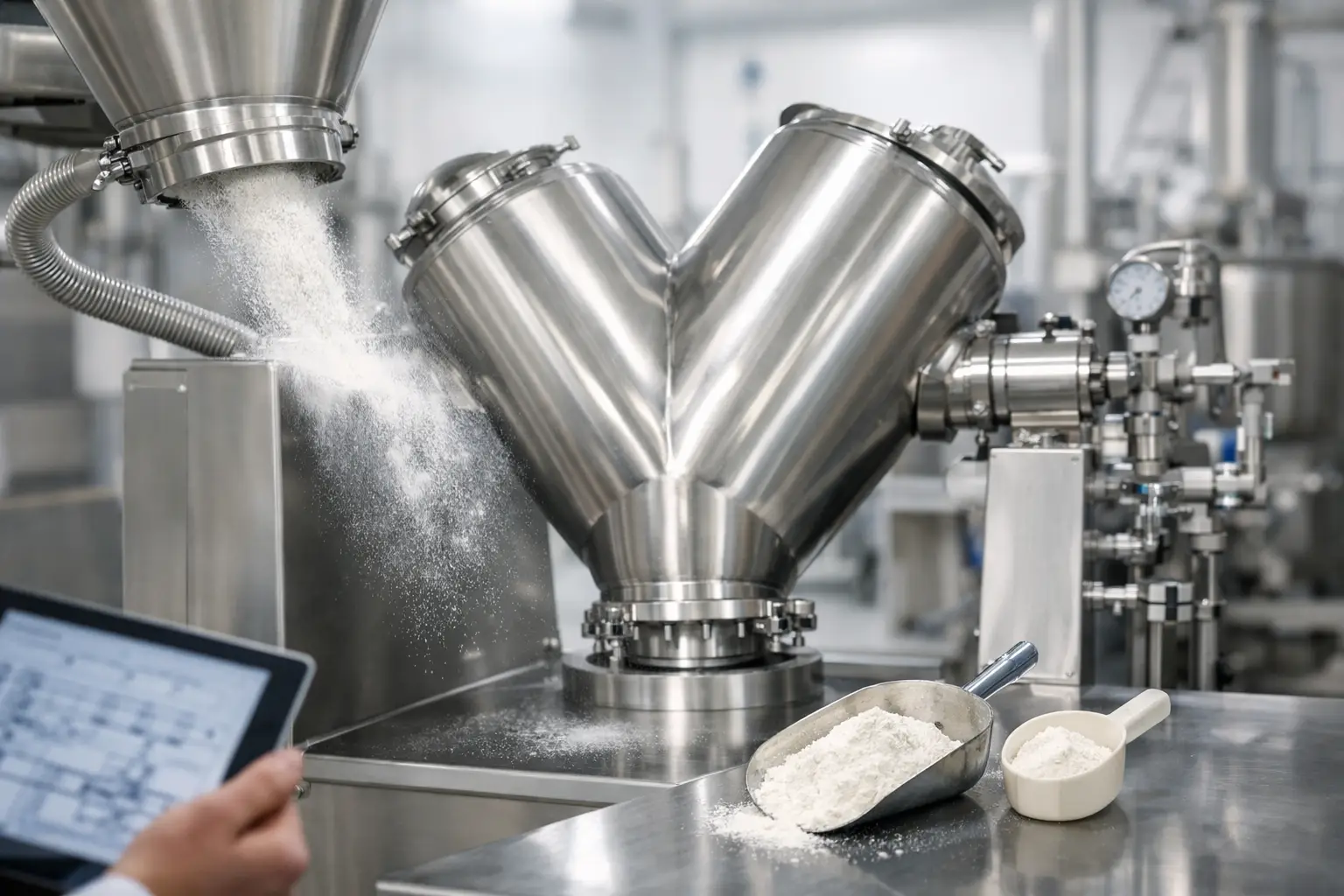
A powder line usually looks fine on paper right up to the point where the blend separates in transfer, the minor ingredients do not distribute evenly, or changeovers start eating half the shift. That is why a powder blending system design guide matters. Good system design is not just about choosing a mixer. It is about matching material behavior, batch targets, plant constraints, and downstream handling into one process that performs consistently under real production conditions.
What a powder blending system design guide should solve
For most manufacturers, the main objective is straightforward: achieve the required blend uniformity within an acceptable cycle time and at a practical operating cost. The complication is that powders rarely behave in a straightforward way. Bulk density varies. Particle size distributions drift. Some products aerate, some smear, some pack, and some separate the moment they leave the mixer.
A useful powder blending system design guide starts by addressing the full process, not a single machine. The mixer matters, but so do ingredient charging, dust control, liquid addition, discharge, conveying, screening, packaging, and cleaning. A system that blends well but feeds poorly, discharges inconsistently, or creates sanitation bottlenecks is not a successful design.
This is where many projects go off course. Teams often compare mixer horsepower, vessel volume, and price before they have defined the product behavior or the production target clearly enough. The better path is to establish the application first, then select equipment around it.
Start with the material, not the machine
Powder blending performance is driven by the actual properties of the ingredients being handled. If a formulation contains free-flowing powders with similar particle sizes and densities, the design window is wider. If it includes fragile particles, cohesive powders, fibers, pigments, trace actives, or liquid binders, the system needs tighter engineering.
The first design question is what kind of blend is required. A simple dilution of similar ingredients is different from a nutraceutical premix with low-dose actives, and both are different from a detergent base with spray addition. Uniformity targets, sampling methods, and blend times should all reflect the real product requirement.
Material testing is especially important when powders are prone to agglomeration or segregation. A mixer can create an excellent blend in the vessel, then lose that uniformity during discharge into a screw conveyor or hopper. In those cases, system design has to reduce drop heights, limit overhandling, and maintain controlled flow throughout transfer.
Choosing the right mixer for the process
Mixer selection should follow the material and the production objective. Ribbon blenders are widely used for dry powder blending and can be an efficient, cost-conscious choice for many applications. They work well when ingredients are relatively free-flowing and the process does not require intensive deagglomeration.
Paddle mixers are often preferred when gentler handling is needed or when a broader range of powder characteristics must be accommodated. Their action can support good uniformity with less shear, which matters for fragile materials or formulations that should not be overworked.
Plow mixers are better suited to more demanding applications, especially when fast blending, agglomerate breakup, or liquid addition is part of the process. With high-speed choppers, they can handle more difficult powders and support higher-intensity mixing. That said, the trade-off is usually higher capital cost, more mechanical complexity, and a process that needs tighter control.
Tumble blending may fit some low-shear pharmaceutical or specialty applications, but it is not always the best choice for industrial throughput targets. It depends on batch size, blend sensitivity, and how much process time can be allocated.
The best answer is rarely about which mixer is universally superior. It is about which mixer fits the actual formulation, plant utilities, cleaning requirement, and production rate.
Batch size, fill level, and throughput planning
One of the most common design errors is sizing the mixer only by desired batch weight. Powders with low bulk density can require much larger working volume than expected, while dense products may allow a more compact footprint. Effective working capacity, not total vessel volume, should drive the decision.
Fill level also affects blend quality. Many mixers perform best within a defined range. Running too low can reduce mixing efficiency, while overfilling can create dead zones and longer cycle times. If your plant expects multiple products with different densities and batch sizes, the system should be designed around the realistic operating range, not just the largest projected campaign.
Throughput planning should include the whole cycle: loading, mixing, sampling, discharge, cleaning, and changeover. A mixer with a short blend time may still underperform if ingredient charging is slow or if discharge leaves residual material behind. In production, the true benchmark is pounds per hour or batches per shift at acceptable quality, not theoretical mix time.
Ingredient feeding and trace addition accuracy
Most blend failures start upstream of the mixer. If the wrong quantity enters, or if ingredients are introduced in a sequence that promotes clumping or segregation, the mixer has to compensate for a problem it may not be able to fix.
A sound design looks closely at how major ingredients, minors, and micro-ingredients are added. Manual charging may be acceptable for lower-volume operations, but as accuracy, throughput, and dust control become more critical, automated feeding systems often provide better process control. Loss-in-weight feeders, bag dump stations, vacuum conveying, and dedicated minor ingredient hoppers can all improve consistency when they are selected correctly.
Sequence matters too. Fine actives added onto moving powder beds may distribute better than ingredients dumped all at once. Liquid additions may need spray nozzles positioned to avoid wet pockets. These are not small details. They determine whether the blend reaches target uniformity efficiently or turns into a rework problem.
The hidden impact of discharge and transfer
A well-designed blending system protects the product after mixing, not just during mixing. Discharge valve design, hopper geometry, and transfer method all influence whether the blend remains uniform on its way to the next step.
Segregation risk increases when the blend contains particles with different sizes, shapes, or densities. Long vertical drops, uncontrolled screw feeding, and high-velocity pneumatic conveying can separate the product that the mixer just brought together. Sometimes a simple gravity transfer works best. In other applications, a controlled conveyor or intermediate surge hopper is the safer choice. The right answer depends on the formulation and the plant layout.
This is also where flow aids, lump breakers, and screens may be helpful, but they should be used carefully. Added equipment can improve handling, yet every extra step also introduces retention points, cleaning work, and another opportunity for separation.
Sanitary design, cleaning, and validation
In food, pharma, nutraceutical, and health-related production, the system design has to support more than output. It must also support hygiene, inspection, and repeatable cleaning.
Sanitary powder blending systems often require polished contact surfaces, crevice-free construction, appropriate gasket materials, and access for verification. If allergen control or product-to-product changeover is part of the operation, cleanability may be just as important as blend speed. A highly efficient mixer that takes too long to clean can become the least efficient asset on the line.
For regulated environments, the design should also consider documentation, validation support, and sampling access. Those requirements can influence everything from weld finish to control architecture. It is much easier to engineer that upfront than to retrofit it later.
Controls, data, and operator consistency
A modern powder blending system design guide should also account for control strategy. Consistent results depend on more than mechanical design. Operators need repeatable process parameters, and management needs visibility into cycle times, alarms, and batch records.
Basic systems may only need timer-based mixing and simple interlocks. More advanced applications may justify recipe management, weigh integration, automated liquid addition, and batch traceability. The level of control should match the risk and value of the process. Overengineering a simple line adds cost without much return. Underengineering a high-value formulation can create quality drift that costs far more.
The best systems make operators more consistent, not more dependent on tribal knowledge.
Designing for maintenance and growth
Equipment access, wear components, and long-term serviceability are easy to overlook during procurement. They become very important once the system is in production. Seals, bearings, choppers, valves, and instrumentation should be selected with maintenance reality in mind. If a part fails, how fast can it be replaced? If a mixer needs inspection, can that be done without tearing apart the surrounding line?
Growth planning matters too. Many facilities start with one target output and need more capacity within a few years. A scalable system might include controls that can expand, support structures that accept added feeders, or a line layout that leaves room for future automation. Budget matters, but short-term savings should not trap the plant in a dead-end design.
For that reason, experienced manufacturers often work with an engineering partner that can compare multiple mixer technologies, test materials, and tailor the line around the process instead of forcing the process into one standard machine. That approach is often the difference between buying equipment and building a reliable production solution.
Powder blending system design guide for better project outcomes
The strongest powder blending system design guide is the one that keeps the project grounded in production reality. Define the material behavior. Set measurable blend and throughput targets. Evaluate the mixer in context with feeding, transfer, sanitation, controls, and maintenance. Then make decisions based on the line’s full operating life, not just the initial quote.
In industrial powder processing, the best performance comes from systems designed around the product, the plant, and the business case at the same time. Get that alignment right, and the line will do more than blend. It will support higher consistency, cleaner operation, and better use of every production hour.