Industrial Mixers
PerMix News & Updates
A smooth lotion, a stable sauce, a uniform pigment dispersion, and a pharmaceutical suspension all depend on the same question: what is shear mixing, and how much of it does the process actually need? In industrial production, the answer determines product texture, stability, batch time, equipment wear, and whether a formula performs consistently from the first batch to the thousandth.
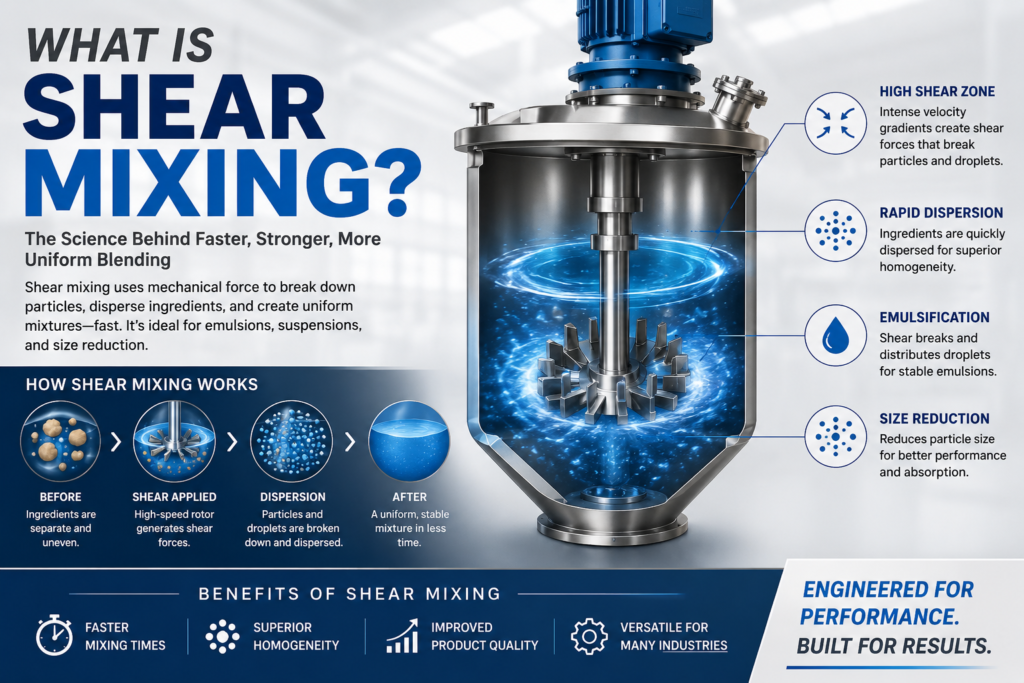
Shear mixing is the application of force that causes adjacent layers of material to move at different speeds or in different directions. That velocity difference creates shear stress. In practical terms, shear breaks apart agglomerates, disperses powders into liquids, reduces droplet size in emulsions, and distributes ingredients that ordinary bulk blending may leave behind.
The objective is not simply to mix faster. It is to apply the right level of mechanical energy for the material and the required finished-product specification.
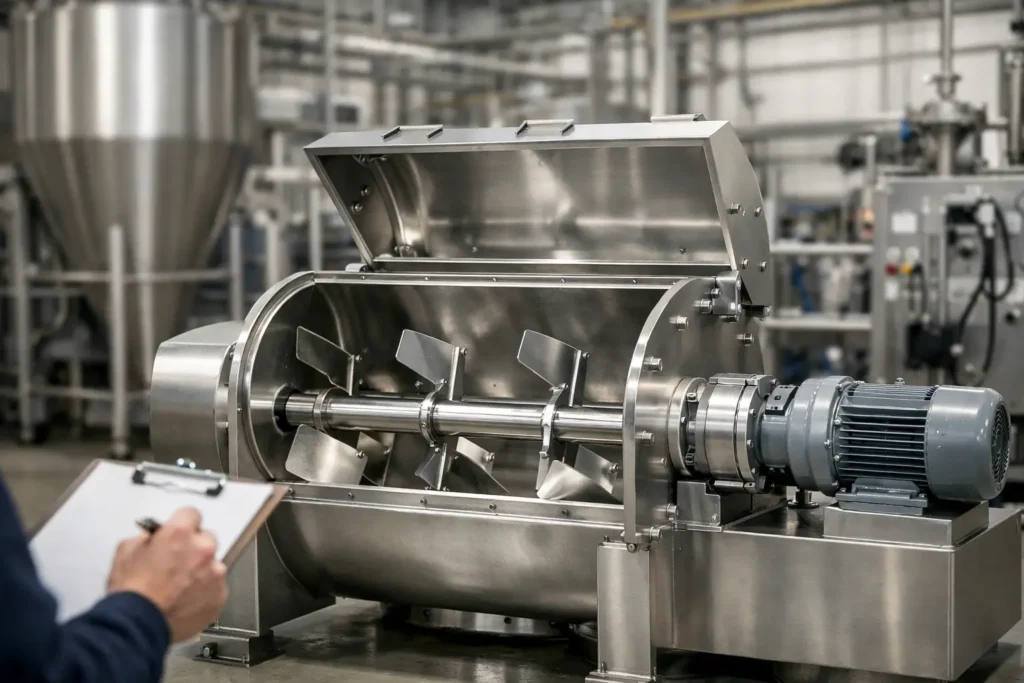
Every mixer creates some degree of shear, but not every mixer is designed to produce high shear. A slow-moving ribbon or paddle mixer primarily moves material through the vessel in a broad, convective pattern. That action is highly effective for many dry powders, granules, and paste-like products. A rotor-stator homogenizer, by contrast, forces material through a narrow gap at very high speed, creating intense localized shear.
This distinction matters when ingredients resist wetting, form soft or hard agglomerates, separate after mixing, or must reach a defined particle or droplet size. If a powder is added to water and remains as visible fish eyes, more batch time in a conventional agitator may not solve the problem. The process may require a high-shear zone that pulls in the powder, wets it rapidly, and breaks the clumps before they can persist.
For manufacturers, the result can be improved product uniformity, shorter processing cycles, better stability during storage, and fewer rejected batches. In regulated applications, consistent shear conditions can also support a more repeatable and defensible process.
Shear occurs wherever one portion of material slides past another at a different velocity. In an industrial mixer, that can happen around an impeller blade, between a rotating rotor and a stationary stator, within a tight clearance, or as material passes through a screen or perforated head.
The shear rate is influenced by rotor speed, impeller diameter, the clearance between components, viscosity, and product flow through the mixing zone. A high rotational speed alone does not guarantee the desired result. The geometry must direct the product into the high-energy zone and recirculate enough of the batch through that zone to achieve uniform treatment.
A rotor-stator system illustrates the principle clearly. The rotor accelerates the product, while the stationary stator controls and redirects flow through openings or slots. The material experiences intense mechanical action as it passes through the narrow gap. Repeated passes can deagglomerate solids, disperse powders, or reduce the size of oil droplets in an emulsion.
High shear is therefore a localized process. Good equipment design combines that high-energy zone with effective bulk circulation so that all material reaches the zone rather than allowing untreated pockets to remain near the vessel wall, bottom, or surface.
High-shear mixing is often selected when a production formula requires more than ingredient distribution. In food processing, it can be used to produce stable dressings, sauces, dairy blends, beverage bases, and flavor emulsions. In cosmetics and personal care, it supports creams, lotions, gels, shampoos, and pigment-containing products where texture and stability are highly visible quality measures.
Chemical producers use shear mixing for dispersing pigments, fillers, resins, additives, and fine powders into liquid systems. Coatings, inks, adhesives, sealants, and specialty chemical products may require tightly controlled dispersion to meet performance targets. Pharmaceutical and nutraceutical operations use high shear for suspensions, emulsions, wet granulation, and active ingredient dispersion, often with sanitary construction and validated process controls.
The same principle applies in agricultural, bio, and livestock-related manufacturing. When powders must be incorporated into liquids without persistent agglomerates, or when a stable suspension is needed for dosing and downstream handling, controlled shear can be a major process advantage.
Neither high shear nor low shear is automatically better. The correct choice depends on the material behavior and the intended result.
Low-shear mixing is typically preferred when preserving particle size, preventing product damage, or gently folding ingredients is the priority. Fragile flakes, coated particles, dry blends with different particle shapes, and products prone to heat buildup may benefit from a ribbon mixer, paddle mixer, or plow mixer operating at an appropriate speed.
High-shear mixing is justified when the process must overcome agglomeration, wet out fine powders, create an emulsion, improve dispersion, or achieve a smoother and more uniform structure. The trade-off is energy input. More shear can increase product temperature, introduce air, accelerate wear in abrasive applications, or damage shear-sensitive materials such as certain crystals, biological materials, or delicate solids.
For this reason, production teams should avoid specifying a mixer solely by motor horsepower or maximum RPM. A properly designed system considers the full process: batch volume, viscosity range, powder addition method, vessel geometry, temperature limits, cleaning requirements, and target particle or droplet size.
Equipment selection begins with the product, not the machine name. A low-viscosity liquid with a small amount of readily dispersible powder may only need an inline high-shear mixer for rapid recirculation. A viscous cream may require a vessel-mounted homogenizer combined with a slow-speed anchor agitator that sweeps the vessel wall and returns material to the high-shear head.
Vacuum may be needed when air entrainment is a concern. This is common in cosmetic creams, gels, adhesives, and high-viscosity products where trapped air affects appearance, density, filling accuracy, or shelf life. A vacuum mixing system can support deaeration while also improving powder incorporation and product consistency.
Temperature control is another major consideration. High shear generates heat, particularly in viscous materials or long processing cycles. Jacketed vessels, controlled recirculation, and staged ingredient addition can keep the product within its allowable temperature range. For heat-sensitive products, the best process may use intermittent high shear rather than continuous operation.
Sanitary requirements must also shape the design. Food, pharmaceutical, and personal care manufacturers may need polished product-contact surfaces, hygienic seals, clean-in-place capability, drainable vessel geometry, and materials compatible with cleaning chemicals. Chemical operations may require corrosion-resistant alloys, explosion-proof components, or specialized sealing arrangements.
A high-shear mixer cannot compensate for poor ingredient sequencing. The order and rate of addition often determine whether powders disperse efficiently or form difficult agglomerates. Introducing powder too quickly can overwhelm the liquid surface and create floating rafts or dry centers. Controlled induction, vacuum powder charging, or an eductor-based feed system may improve wetting and reduce operator exposure.
Viscosity changes during the batch also matter. Many formulations become thicker as powders hydrate, polymers activate, or emulsions form. A mixer that performs well at the start of the batch may not provide adequate circulation near the end. Conversely, a unit sized for the finished viscosity may apply excessive shear during the early liquid stage unless speed control is available.
Scale-up requires equal care. Maintaining the same RPM from a laboratory mixer to a production vessel rarely produces the same result. Vessel diameter, impeller diameter, flow pattern, residence time in the shear zone, and heat removal all change with scale. Pilot trials and application testing are the most reliable way to establish a production-ready process window.
Many industrial products need both bulk movement and high-intensity dispersion. A combination system may pair an anchor, paddle, or scraper agitator with a high-shear homogenizer. The slow-speed agitator handles circulation and wall sweeping, while the homogenizer performs the fine dispersion or emulsification work.
This arrangement is particularly effective for viscous creams, ointments, gels, pastes, and filled chemical products. It can reduce dead zones, improve temperature transfer at the vessel wall, and ensure that the entire batch receives consistent treatment. For dry-to-wet processing, a high-shear granulator or a dedicated powder induction system may be more appropriate than a conventional liquid mixer.
Proc-X Manufacturing Group engineers these systems around actual material behavior rather than forcing an application into a standard machine configuration. That approach helps manufacturers balance performance, sanitation, capacity, and budget without paying for unnecessary complexity.
The most productive next step is to define what “mixed” means for your product: no visible agglomerates, a target droplet size, a stable suspension, a specified viscosity, or a repeatable sensory profile. Once that standard is clear, the required shear level and mixer configuration become engineering decisions instead of guesswork.

Stay Connected