
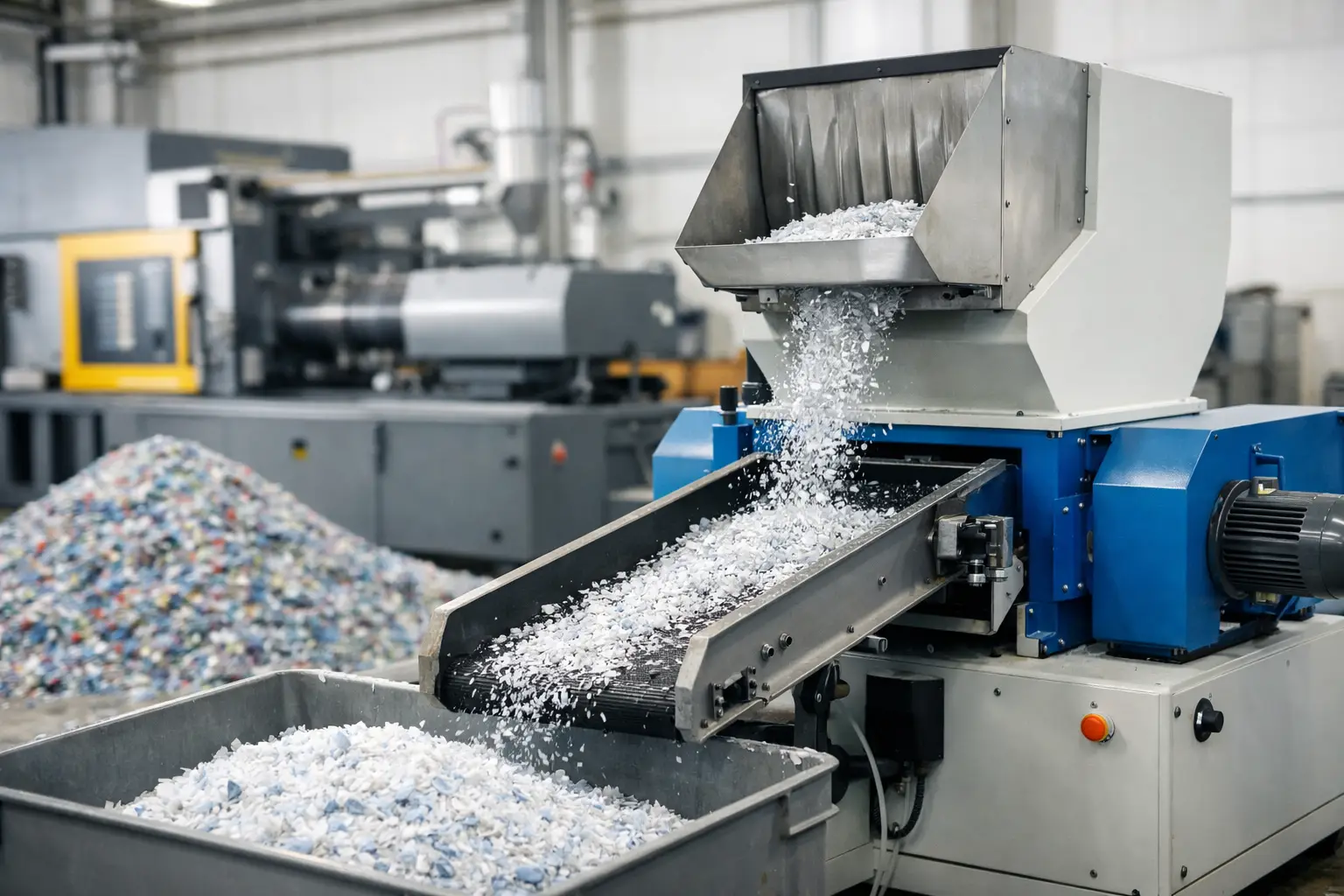
A production line can have the correct formulation and still underperform because the material is the wrong size, shape, or consistency when it reaches the next process step. If you are asking when should you use a granulator, the practical answer is when uncontrolled particle size is creating measurable problems in flow, mixing, drying, dosing, product appearance, or downstream handling. The correct decision depends on more than reducing material to a smaller size. It requires understanding what the granulator must achieve within the full process.
When Should You Use a Granulator?
Use a granulator when material must be broken down, conditioned, or sized to meet a defined process requirement. In many manufacturing environments, incoming raw materials, recycled product, dried solids, extruded material, or finished-product rejects do not have a sufficiently consistent particle size distribution for reliable processing.
A granulator creates a more controlled material stream. Depending on the machine design, screen selection, rotor configuration, and operating conditions, it can reduce oversized pieces, break down agglomerates, reclaim process scrap, or prepare material for mixing, packaging, compaction, dissolution, or further particle processing.
The need is usually visible in operating data before it is visible in the equipment specification. Frequent feeder interruptions, inconsistent batch density, slow dissolution, segregation after blending, screen blockage, variable fill weights, or poor finished-product texture can all indicate that particle size needs to be controlled more effectively.
Use It Before Mixing When Particle Size Is Limiting Uniformity
Powder blending is not only a mixer selection issue. Large differences in particle size, bulk density, and particle shape can cause segregation before, during, or after mixing. Fine ingredients may migrate through a blend while larger particles concentrate in another area, particularly during transfer and discharge.
A granulator is often placed upstream of the mixer when raw materials contain lumps, compacted powder, brittle solids, or inconsistent pieces that prevent uniform distribution. By establishing a more manageable and repeatable particle size range, the granulator helps the mixer perform as intended.
This does not mean every powder should be granulated before blending. Fragile particles may generate excessive fines, and some formulations depend on a broad particle-size distribution for texture, dissolution, or packing behavior. The engineering objective is not the smallest possible particle. It is the particle profile that delivers the required blend quality and process stability.
Use It After Drying to Break Lumps and Restore Flow
Drying frequently changes material behavior. Powders and pastes that entered a dryer as a uniform mass may leave as sheets, crusts, agglomerates, or dense irregular chunks. If this dried material goes directly to packaging, conveying, or a subsequent blending stage, poor flow and inconsistent dosing can follow.
Post-drying granulation breaks dried material into a controlled form that is easier to convey, screen, weigh, and package. This is common in chemical, food, pharmaceutical, nutraceutical, mineral, and specialty-material applications where drying creates hard or semi-hard solids.
The key is matching the granulator to the moisture level and mechanical strength of the dried product. Material that is still tacky may smear rather than fracture. Extremely dry, abrasive, or heat-sensitive material may require a different rotor speed, screen design, cooling approach, or method of particle reduction. A trial with representative material is often the fastest way to identify the workable operating window.
Use It for Rework and Scrap Recovery
Granulation can turn production losses into usable material, provided the reworked product remains within quality and regulatory limits. Oversized tablets, extrudates, rejected formed products, trim waste, off-spec dry material, and startup scrap may be returned to a controlled particle size before reintroduction into the process.
For manufacturers handling high material costs or high production volumes, this can reduce waste disposal, improve raw-material utilization, and lower the cost of poor quality. However, reclaim is not automatically beneficial. The allowable rework percentage, thermal history, moisture pickup, contamination risk, and effect on finished-product performance must be defined before the system is designed.
A well-engineered rework system includes more than a granulator. It may also require controlled feeding, metal detection, dust collection, screening, material identification, and automated limits on how much recovered material can enter a new batch.
Signs Your Process Needs Granulation
Several recurring operating conditions justify a closer evaluation of granulation. The following signs are particularly relevant when they affect throughput, consistency, or labor requirements:
- Oversized pieces or hard agglomerates regularly block feeders, valves, screens, or pneumatic conveying lines.
- Mixers require longer cycle times because raw materials do not disperse consistently.
- Bulk density varies enough to affect volumetric feeding, package fill weights, or tablet and compaction performance.
- Dried material requires manual breaking, screening, or repeated handling before it can move to the next process stage.
- Finished products show unacceptable variation in texture, appearance, dissolution, dispersion, or reconstitution.
- Rework material is accumulating because there is no controlled method to return it to the process.
These symptoms do not always point to a granulator. A feeder issue may result from poor hopper geometry. Segregation may originate in conveying rather than mixing. Moisture variation may be the root cause of lumping. Process engineering should identify the mechanism causing the issue before equipment is selected.
Granulation Is Not the Same as Milling
The terms granulation and milling are sometimes used interchangeably, but their process objectives can differ significantly. Milling often focuses on reducing particles to a finer size. Granulation may focus on breaking material into a specified, usable range while avoiding excess fines.
That distinction matters. If a material needs a narrow, fine particle distribution for dissolution or reaction performance, a mill may be the better solution. If the material needs to be de-lumped after drying, conditioned for flow, or reduced from irregular chunks into a manageable granule, a granulator may offer better control and higher practical throughput.
Wet granulation is a separate process consideration. In wet granulation, powders are combined with a binder liquid to create larger, more uniform granules, often followed by drying and sizing. This approach can improve flow, reduce dust, support compression, and improve content uniformity. It is not simply size reduction. The appropriate process may involve high-shear mixing, fluid-bed processing, drying, and final sizing as an integrated system.
How to Select the Right Granulator
A granulator should be specified around the material and the operating objective, not selected from capacity alone. Throughput claims are meaningful only when the feed form, moisture level, target particle size, screen open area, and required product quality are known.
Start with the material. Evaluate hardness, friability, abrasiveness, elasticity, temperature sensitivity, moisture content, fat or oil content, and dust characteristics. A brittle dry crystal behaves very differently from a fibrous food ingredient, a tacky dried paste, or a polymeric scrap stream.
Next, define the target. Is the goal to pass all material through a specified screen? Is a narrow distribution required? What level of fines is acceptable? Does the material need to flow through a screw feeder, dissolve within a defined time, or remain visually distinct in the finished product? These questions determine the rotor, knife arrangement, screen design, drive power, and discharge configuration.
Capacity should be evaluated under real conditions, including peak rate, batch duration, feeding consistency, cleaning time, and expected screen changes. A machine sized only for average throughput can become a production bottleneck when material is wetter, denser, or more difficult than expected.
Consider Cleaning, Containment, and Integration Early
In regulated or high-value applications, the granulator must support the complete manufacturing standard. Product-contact finishes, cleanability, access for inspection, dust containment, washdown requirements, and validation documentation can be as important as mechanical performance.
Integration also determines whether the equipment delivers its expected value. The best granulator can still perform poorly if material bridges in the feed hopper, enters in uncontrolled surges, or discharges into an unsuitable conveyor. Upstream feeding and downstream transfer should be engineered as part of one process solution.
PerMix approaches granulation with this broader process view: material behavior, capacity requirements, particle-size objectives, cleaning standards, and integration requirements are evaluated together. The result is not simply a machine that reduces size, but a particle-processing system designed to improve repeatability on the production floor.
The Business Case Is Process Control
The strongest reason to use a granulator is not that a production line needs another piece of equipment. It is that the line needs more control over a variable that affects multiple operations at once.
Proper particle sizing can reduce manual handling, minimize unplanned stoppages, shorten downstream cycle times, improve feeding accuracy, and make product quality more consistent from batch to batch. In high-volume production, even a small reduction in waste or mixing time can create a meaningful return.
The most productive next step is to test representative material under conditions that reflect actual manufacturing, including worst-case moisture, feed rate, and target size requirements. That work converts a general equipment question into a clear engineering decision and gives the production team a process it can rely on for years.