Industrial Mixers
PerMix News & Updates
A batch that looks fine in the lab can fail fast on the plant floor. The usual reason is not the formula. It is the gap between required particle reduction, actual shear input, residence time, and the realities of production scale. That is where the right industrial homogenizer becomes a process tool, not just another line item.
For manufacturers producing emulsions, suspensions, creams, beverages, sauces, slurries, or high-value liquid blends, homogenization affects more than visual consistency. It influences shelf stability, texture, mouthfeel, ingredient distribution, reaction efficiency, filling performance, and downstream cleaning demands. If the machine is undersized, poorly matched to viscosity, or selected without regard to ingredient behavior, the result is inconsistent product and avoidable operating cost.
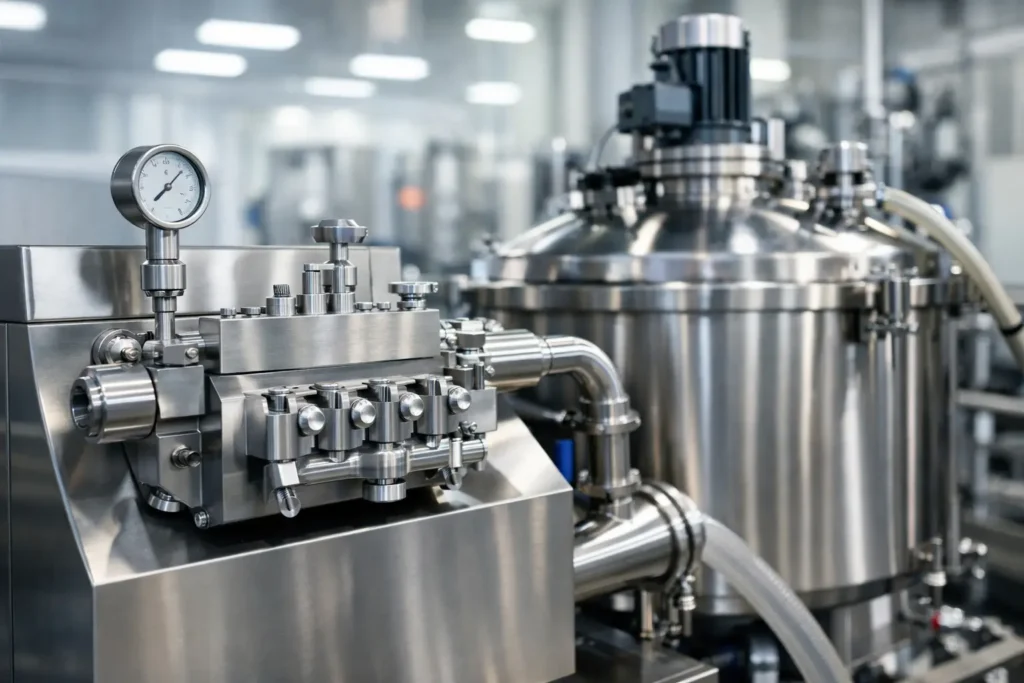
An industrial homogenizer reduces particle or droplet size and distributes phases more uniformly through controlled mechanical force. In practical terms, it helps create a stable and repeatable product from ingredients that do not naturally stay together. Oil and water systems are an obvious example, but the same principle applies to many solids-in-liquid and liquid-in-liquid processes.
The mechanism depends on the equipment design. Some systems rely on high pressure and intense disruption across a valve. Others use rotor-stator action to generate high shear in a defined work zone. The right choice depends on the product target, the viscosity range, the required throughput, and how the homogenizer fits into the larger process.
That distinction matters. Many buyers use homogenizer, emulsifier, and high shear mixer interchangeably. Sometimes that is acceptable in conversation, but not in equipment selection. If your process requires a narrow particle size distribution at high throughput, one machine style may be far better than another. If you are handling a viscous cream under vacuum with powder induction and deaeration in the same vessel, the best answer may be a fully integrated system rather than a standalone unit.
In food production, homogenization often determines texture, stability, and consumer acceptance. Dressings, dairy systems, sauces, and functional beverages all depend on repeatable droplet size and phase distribution. Too little shear can lead to separation. Too much can damage sensitive ingredients or change the final mouthfeel in ways that hurt the product.
In pharmaceutical, nutraceutical, and personal care applications, the margin for variation is narrower. Creams, gels, lotions, syrups, and active ingredient suspensions require tight process control, especially where product appearance, dose uniformity, or sanitary design are critical. The machine has to do more than create dispersion. It has to support validation, cleaning, and consistent operation batch after batch.
Chemical and agricultural applications bring a different set of demands. Abrasive solids, corrosive ingredients, variable feed properties, and broad viscosity swings can put real stress on mechanical components. Here, material of construction, seal arrangement, maintenance access, and motor sizing are not secondary details. They are part of the productivity equation.
The fastest way to make a bad equipment decision is to start with horsepower and price before defining the process objective. A better starting point is simple: what exactly must change in the product, and what conditions are required to make that happen reliably at production scale?
If the goal is emulsion stability, ask how stable and for how long. If the goal is particle reduction, define the size range that matters. If the goal is better appearance or smoother texture, identify whether that result depends on true homogenization, deaeration, improved wet-out, or a combination of steps.
This is where process nuance matters. Two formulations can look similar on paper and behave very differently under shear. One may homogenize quickly with moderate energy input. Another may need higher intensity, multiple passes, vacuum support, or temperature control to reach the same visual result.
Low-viscosity systems often allow more equipment options. As viscosity rises, the acceptable range narrows. High-pressure designs can be effective for certain liquid systems, but thick products may call for an in-tank high shear homogenizer or a purpose-built vacuum mixing and homogenizing platform.
Flow pattern also matters. If the process depends on recirculation through a vessel, the homogenizer must work with the batch geometry, not against it. Poor turnover can leave dead zones, unprocessed material, or uneven temperature distribution. A machine may deliver excellent shear at the head while still failing the overall batch because vessel movement is inadequate.
Many failures trace back to powder incorporation, not final homogenization. Agglomerates formed during charging can survive downstream shear and show up later as fish eyes, grit, or inconsistent viscosity. If powders are part of the process, consider whether the system should include induction, vacuum draw, or staged addition to improve wet-out before intensive homogenization begins.
A machine rated for a certain flow or batch size may not deliver that number with your product. Viscosity, temperature, solids loading, and target finish all affect real throughput. This is why application testing and engineering review are so valuable. The best in performance is not the machine with the biggest published number. It is the machine that reliably hits your product specification at your required production rate.
There is no universal best homogenizer, only the best fit for the process.
Higher shear generally improves dispersion and particle reduction, but it can also increase heat generation. That may be harmless in one application and unacceptable in another. Some sensitive ingredients lose functionality with excess temperature or prolonged mechanical stress.
A more aggressive machine can shorten cycle time, but it may also raise wear rates if the product contains abrasive solids. Sanitary designs improve cleanability and compliance, though they may cost more upfront than general industrial configurations. Integrated vacuum homogenizing systems can reduce air entrainment and improve finish quality, but they also require more thoughtful installation planning and utility coordination.
These are not reasons to avoid advanced equipment. They are reasons to specify it correctly.
An industrial homogenizer should be judged on total process performance, not just purchase price. Over the life of the machine, buyers usually feel the impact of downtime, inconsistency, cleaning time, and maintenance more than the original quote.
Motor sizing and drive configuration should support the actual load profile, including startup conditions and viscosity peaks. Mechanical seal design should match the product and operating environment. Wetted materials must fit both chemistry and cleaning regime. If the machine will run in regulated production, surface finish, documentation, and sanitary construction should be addressed upfront, not after approval delays begin.
Control strategy also deserves attention. Basic manual operation may be enough for a simple process, but repeatable production often benefits from variable speed control, timed sequences, temperature integration, and recipe-based operation. Better controls do not replace sound process design, but they help preserve it across shifts and operators.
This is where an engineering-driven supplier adds real value. PerMix approaches homogenization as part of the full production system, which is often the difference between a machine that runs and a process that scales.
Standard equipment is often the right answer for straightforward applications. But many plants are not dealing with straightforward applications. They are managing product variations, tight footprints, sanitation requirements, utilities constraints, and future capacity goals at the same time.
Custom engineering makes sense when the process includes unusual viscosity ranges, multiple product families, vacuum requirements, heating or cooling jackets, CIP expectations, or upstream and downstream equipment that must work as one line. It also makes sense when the cost of inconsistency is high. A machine that is slightly cheaper but routinely leaves rework, operator intervention, or longer batch times on the table is not the budget-friendly option.
The best in quality is rarely about adding complexity for its own sake. It is about giving the production team a machine that fits the material, the operating method, and the business case.
Before selecting a homogenizer, define your target particle or droplet size, viscosity range, batch or flow rate, sensitivity to heat, solids content, cleaning requirements, and future production plans. Also ask whether the machine must work as a standalone unit or as part of a broader mixing, vacuum, heating, cooling, or powder handling system.
Those answers will narrow the field quickly and keep the discussion focused on application fit instead of generic specifications. For most industrial buyers, that is the shortest path to dependable performance and long-term value.
The right industrial homogenizer should make production more predictable, not more complicated. If the equipment matches the process, operators notice it immediately – faster cycles, more consistent batches, fewer surprises, and a line that is easier to scale when demand grows.

Stay Connected