Industrial Mixers
PerMix News & Updates
A useful ribbon blender review starts where many equipment comparisons stop: with the material. A horizontal ribbon blender can be an efficient, economical batch mixer for dry powders, granules, and certain wet formulations. But its performance is determined less by a catalog capacity number than by how the product flows, segregates, accepts liquids, discharges, and must be cleaned between batches.
For manufacturers evaluating a new blender or investigating inconsistent batches, the central question is not whether ribbon technology is proven. It is. The question is whether its mixing action matches the process well enough to deliver repeatable quality at the required production rate.
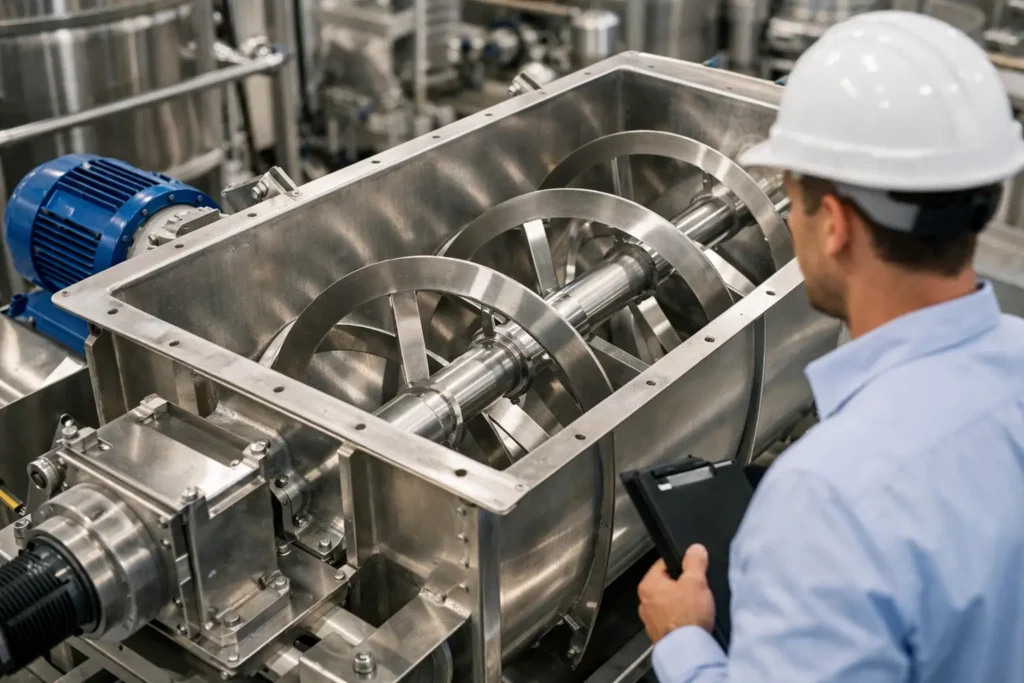
A ribbon blender uses a horizontal U-shaped trough and a double helical agitator. The outer ribbon moves material inward from the vessel ends, while the inner ribbon moves it outward along the center. This opposing axial flow, combined with radial movement around the shaft, continuously redistributes material through the batch.
The design is highly effective for many free-flowing powders, premixes, spice blends, dry chemicals, mineral products, animal nutrition products, and similar applications. It provides a large mixing area, moderate energy input, and practical batch-cycle economics. For the right material, it can achieve highly uniform blends in a predictable time.
That does not mean every powder belongs in a ribbon blender. Very cohesive powders, sticky materials, formulations with high liquid addition, and products requiring intensive deagglomeration may need a paddle mixer, plough mixer, high-shear system, or a multi-stage process. Selecting a ribbon blender because it is familiar or initially lower in cost can create years of lost throughput, difficult cleaning, and quality variation.
Suppliers often discuss mixing time, but a short cycle is valuable only when the final blend meets the required uniformity specification. The critical measurement is usually the variation among representative samples collected after mixing and, just as importantly, after discharge.
Ingredient ratio, particle size distribution, density difference, particle shape, moisture level, and trace-addition level all affect the result. A formula with components of similar size and bulk density may blend rapidly. A formula combining a dense mineral, a fine low-density powder, and a low-dose active ingredient requires more careful engineering.
The risk is not limited to under-mixing. Some blends segregate after reaching acceptable uniformity, particularly when material is conveyed, dropped into packaging, or discharged too quickly. A proper review considers the full handling path. If the product separates after leaving the blender, a favorable sample taken inside the trough does not represent actual manufacturing performance.
A ribbon blender should not be specified based on total vessel volume alone. Most applications operate best within a defined fill range, commonly below the top of the agitator and above the point where there is insufficient material for effective circulation. The optimum range depends on product behavior and the agitator geometry.
An oversized mixer running half-empty may have longer blend times and poor batch-to-batch repeatability. An overloaded trough can restrict circulation, increase power demand, and create regions that do not exchange material effectively. Capacity calculations should begin with bulk density at actual plant conditions, desired batch weight, and target fill level, then account for formula changes that may alter density.
This is especially important for manufacturers producing multiple products. One vessel may be suitable for a high-density mineral blend and poorly sized for a low-density food powder at the same batch weight. The blender needs to support the operating range, not merely one ideal formulation.
Ribbon blenders can distribute modest liquid additions effectively when the liquid is introduced at the right rate, in the right location, and with appropriate atomization. Oils, flavors, binders, colors, and other liquids must contact moving solids rather than pool on a stagnant surface.
The limit depends on powder absorbency, liquid viscosity, addition rate, and the tendency of the product to form lumps. A small amount of oil applied through a properly engineered spray system is very different from a viscous binder added at a high percentage. As liquid loading rises, the process can shift from blending to agglomeration. Ribbon action may no longer provide the shear needed to break wet clusters and distribute the liquid consistently.
A serious equipment evaluation should define the liquid-to-solid ratio, liquid temperature, viscosity, pump and nozzle selection, addition duration, and cleaning method. These details often determine whether the mixer performs as intended on the production floor.
Fast, complete discharge is a major advantage of a well-designed ribbon blender. It reduces cycle time, limits retained material, and supports batch traceability. Yet discharge is also one of the most common sources of residual product and segregation.
The outlet must be sized for the product and the downstream process. A narrow valve may extend discharge time and leave material at the trough ends. An oversized opening can overwhelm a downstream feeder or create a high-velocity drop that separates components. Valve selection also matters. A flush-mounted bomb-bay door, slide gate, butterfly valve, or custom discharge arrangement should be selected based on sanitation, product flow, sealing requirements, and the transfer equipment below.
For high-value formulations, retained material is not simply a housekeeping issue. It affects yield, allergen control, active-ingredient accountability, and the quality of the next batch.
The trough, ribbons, shaft, seals, bearings, drive, and controls should be engineered as a system. Material contact construction may range from carbon steel for industrial products to stainless steel with polished welds for food, pharmaceutical, or specialty chemical applications. Surface finish, crevice control, access doors, and drainability should reflect the cleaning standard the plant must actually meet.
Seal selection deserves particular attention. Standard packing may be suitable for a straightforward dry-powder duty, while specialty seals may be required for fine powders, hazardous materials, pressure or vacuum conditions, or formulations sensitive to contamination. External bearing arrangements and maintenance access can improve serviceability and reduce the chance that lubricants or wear debris enter the process zone.
Drive sizing should be based on the product’s worst credible condition, not only a normal batch. A powder that flows easily in a test sample may compact after storage, become more cohesive in humid weather, or require startup under a full load. Variable-frequency control can be valuable when the process benefits from different speeds during charging, liquid addition, blending, and discharge. It is not automatically necessary, but it can improve operating flexibility when formula demands change.
Plants commonly focus on mixing performance during the purchase decision, then discover that cleaning governs the usable production schedule. This is most visible in food, nutraceutical, pharmaceutical, and specialty chemical operations, but it applies wherever product carryover is costly.
A blender that achieves excellent uniformity but requires extensive manual cleaning between products may be the wrong business decision. Evaluate internal geometry, access openings, agitator clearances, discharge-valve construction, shaft seal arrangement, and the ability to inspect the vessel. If wet cleaning is required, consider whether the vessel can drain fully and whether clean-in-place coverage is validated for the product and soil type.
Dry cleaning methods can be efficient for compatible powder campaigns, but they require a realistic assessment of residual material in the trough, ribbons, and valve. Where allergen, flavor, color, or potent active carryover is a concern, cleaning validation requirements should influence the equipment design from the beginning.
A ribbon blender is not a universal answer, and an honest review should state its limits. Materials that form strong agglomerates may require the fluidized mixing and optional choppers associated with a plough mixer. Dense, fragile particles may benefit from gentler paddle action. Highly viscous pastes and dough-like products generally require more torque-intensive equipment, such as a sigma mixer or double planetary mixer.
Likewise, a ribbon blender may not be the first choice when an application requires rapid vacuum drying, reaction control, intensive emulsification, or continuous processing. The correct equipment is determined by the process objective, not by the mixer category requested at the beginning of a project.
PerMix approaches ribbon blender selection by reviewing the complete process: incoming material condition, formulation variability, feeding method, liquid addition, batch size, discharge, cleaning, controls, and downstream handling. That engineering work helps identify whether a ribbon design is the best fit or whether another mixing technology will produce a better manufacturing result.
Before releasing a specification, establish measurable acceptance criteria. Define the required blend uniformity, batch size range, maximum cycle time, liquid-addition requirements, allowable residual quantity, cleaning standard, material-contact construction, utility needs, and automation scope. Where the formulation is difficult or the consequences of failure are high, representative product testing is more valuable than assumptions based on a similar application.
Ask for evidence tied to your material, not broad claims about mixer performance. The most useful conversation addresses particle behavior, density variation, sampling strategy, discharge behavior, and the conditions that may change after scale-up. A ribbon blender earns its place in a production line when it improves both product consistency and the economics of every batch that follows.
Stay Connected