Industrial Mixers
PerMix News & Updates
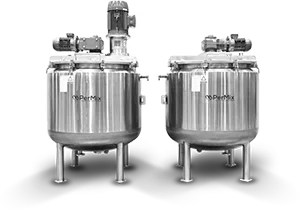
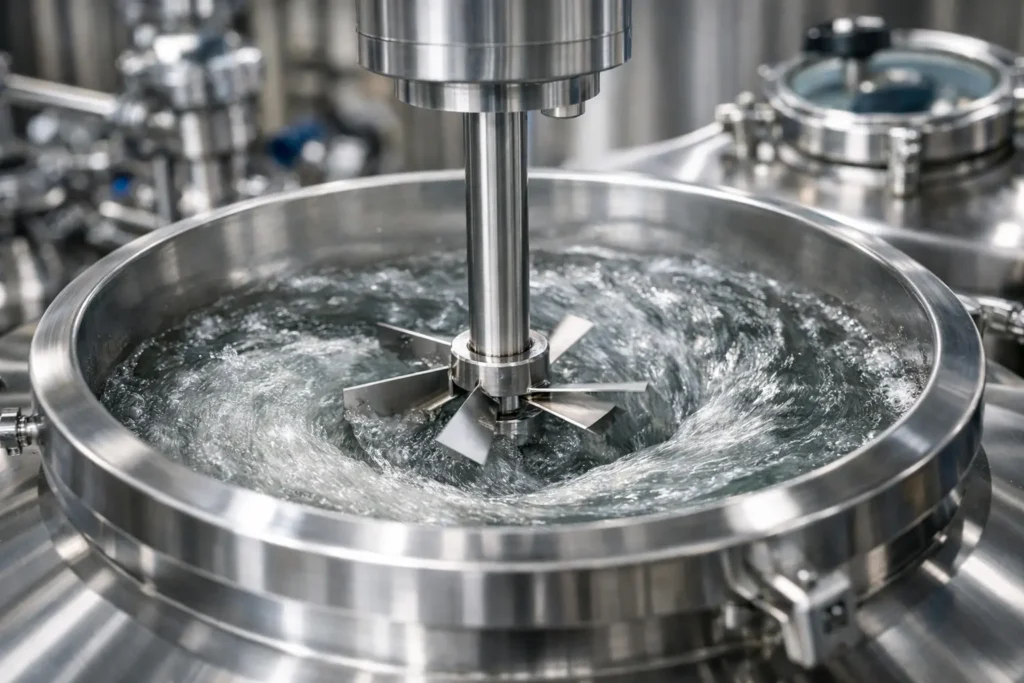
A batch can appear fully blended and still fail its product specification. An emulsion may break during storage, a polymer solution may lose viscosity, or a suspension may contain agglomerates that were never properly dispersed. Shear control in liquid mixing determines whether the energy delivered by the mixer produces the intended result or damages the material being processed.
For industrial manufacturers, shear is not a generic equipment feature. It is a process variable that must be matched to formulation behavior, vessel geometry, batch size, temperature, and production objectives. The right amount of shear can reduce particle size, create stable emulsions, hydrate powders, and eliminate agglomerates. Too much shear can alter texture, entrain air, degrade sensitive ingredients, increase temperature, and create unnecessary operating cost.
Shear occurs when adjacent layers of fluid move at different velocities. In practical terms, it is created by the relative motion between an impeller, rotor-stator assembly, liquid, vessel wall, and baffles. This motion generates velocity gradients that can stretch, break apart, disperse, or reorient material within the batch.
Shear intensity is influenced by more than mixer RPM. Impeller diameter, tip speed, blade geometry, clearance, liquid viscosity, recirculation pattern, and the location of ingredients all affect the actual energy experienced by the product. A small, fast rotor-stator head can generate very high localized shear, while a large hydrofoil impeller may create broad bulk circulation with comparatively low shear.
That distinction matters because homogeneous distribution and high shear are not the same process outcome. A low-shear mixer can rapidly circulate a large liquid volume and blend compatible ingredients effectively. A high-shear device is required when the process must break agglomerates, disperse fine solids, reduce droplet size, or form an emulsion. Selecting one when the other is needed creates predictable quality and throughput problems.
The correct shear range depends on what the formulation needs to become. A beverage syrup, fragrance blend, coating, personal care emulsion, adhesive, chemical intermediate, and pharmaceutical suspension can all be liquid systems, yet their mixing requirements are fundamentally different.
In emulsification, shear reduces droplet size by overcoming interfacial forces between immiscible phases. Higher shear can produce a finer dispersion, but only when the emulsifier system and process conditions support it. If the formula lacks sufficient emulsifier coverage, applying more mechanical energy may create a temporary emulsion that separates after processing.
For powders introduced into liquid, shear is often needed to wet and deagglomerate particles. This is especially true for gums, thickeners, pigments, proteins, carbomers, clays, and other materials that form surface gels or fish eyes during addition. However, the powder induction method is as important as the high-shear zone. A well-designed powder induction system delivers material into the zone where it can be immediately wetted and dispersed rather than allowing it to float, clump, or stick to the vessel wall.
Some products must be protected from excessive shear. Cell-based materials, crystal suspensions, long-chain polymers, delicate food particulates, and shear-sensitive thickeners can lose critical properties when processed too aggressively. The operational target is not the highest available shear. It is the minimum effective shear needed to meet the finished-product specification with repeatable results.
As viscosity rises, bulk movement becomes more difficult. A mixer that performs well in water-like liquids may create only a localized circulation pattern in a viscous batch. High shear near the impeller can coexist with stagnant zones elsewhere in the vessel.
This is why viscous products often require multi-shaft mixing systems. A slow-speed anchor or scraper can move material from the vessel wall and support heat transfer, while a high-speed disperser or rotor-stator provides the localized shear required for dispersion or emulsification. The combined system manages both macro-mixing and micro-mixing rather than forcing one agitator to perform incompatible duties.
A useful shear-control strategy begins by defining what must be measured at the end of the batch. Depending on the application, that may include particle-size distribution, droplet-size distribution, viscosity, yield stress, color development, dissolution time, suspension stability, density, air content, or sensory texture.
Once the target is clear, engineers can identify the mechanism needed to achieve it. Dissolving a soluble ingredient requires circulation and contact time. Breaking down a pigment agglomerate requires higher localized stress. Creating a stable emulsion may require staged addition, controlled temperature, and a specific rotor-stator residence time. Those are different process duties, even when they occur in the same vessel.
The operating window should then be established through testing. RPM alone is not a transferable scale-up parameter because a laboratory mixer and a production mixer may have different impeller diameters and hydraulic behavior. Tip speed, power per unit volume, shear zone design, batch turnover, and processing time provide a more meaningful basis for comparison. Even then, scale-up must account for vessel proportions, liquid level, baffle arrangement, and feed rates.
Low- to medium-shear impellers such as hydrofoils, pitched-blade turbines, and marine propellers are effective where bulk turnover, blending, heat transfer, and suspension are the primary requirements. They are commonly used for compatible liquids and processes where product structure must be preserved.
High-speed dispersers provide stronger shear near the blade edge and are frequently applied to pigment dispersion, powder wetting, coating production, and moderate-viscosity formulations. Their performance depends heavily on blade position, operating depth, viscosity, and whether the batch can continuously pass through the high-energy zone.
Rotor-stator homogenizers create intense mechanical shear in a controlled zone between the rotating and stationary elements. They are suited to emulsification, particle deagglomeration, fine dispersion, and demanding liquid-solid applications. Inline rotor-stator systems can add a recirculation loop for repeatable processing and tighter control over the number of passes through the shear head.
For difficult high-viscosity products, a dual- or multi-shaft configuration may be the best engineering choice. An anchor agitator, scraper, disperser, and homogenizer can be arranged to address vessel-wall turnover, heat transfer, bulk movement, and localized shear in one integrated process. The appropriate configuration depends on the rheology across the entire batch cycle, not only the final viscosity.
Mechanical design alone does not guarantee controlled shear. Ingredient addition sequence often determines whether a batch disperses efficiently or develops persistent agglomerates. Introducing a thickener too quickly can create gels that resist subsequent mixing. Adding oil at the wrong stage can increase emulsion processing time. Feeding powders into a vortex without controlled induction can introduce air and create operator-dependent results.
Temperature also deserves close attention. Shear energy can raise product temperature, particularly in viscous formulations or long homogenization cycles. In some applications, this heat is useful because it lowers viscosity or supports melting. In others, it may degrade active ingredients, change flavor, accelerate reactions, or alter the final texture. Jacket capacity, coolant flow, batch temperature limits, and processing time must be evaluated as part of the same design decision.
Automation strengthens repeatability by controlling speed ramps, addition timing, temperature, vacuum, recirculation, and batch hold times. A documented recipe reduces variation between operators, shifts, and production sites. It also gives quality teams traceable process data when investigating deviations or supporting validation requirements.
When a process is under-sheared, common evidence includes visible agglomerates, poor color development, coarse emulsions, incomplete hydration, long batch times, and settling during storage. Increasing mixer speed may help, but only if the product is actually reaching the active mixing zone.
Over-shearing can appear as viscosity loss, excess foam, air entrainment, temperature rise, phase instability, damaged particles, or changes in finished-product appearance. These problems are frequently misdiagnosed as raw-material variation. In reality, they may be caused by excessive tip speed, overly long processing time, an unsuitable rotor-stator configuration, or a recirculation rate that repeatedly exposes the product to high energy.
PerMix evaluates these interactions as a complete production process, including material behavior, feed method, thermal requirements, vessel configuration, cleaning needs, and automation objectives. That engineering approach produces a more useful answer than selecting a mixer from horsepower and capacity alone.
The most productive next step is to compare the actual product specification with the conditions of the current batch: where energy enters, how material circulates, what happens during addition, and which quality attribute changes first. That review usually reveals whether the process needs more shear, less shear, or better control of the shear already available.
Stay Connected