
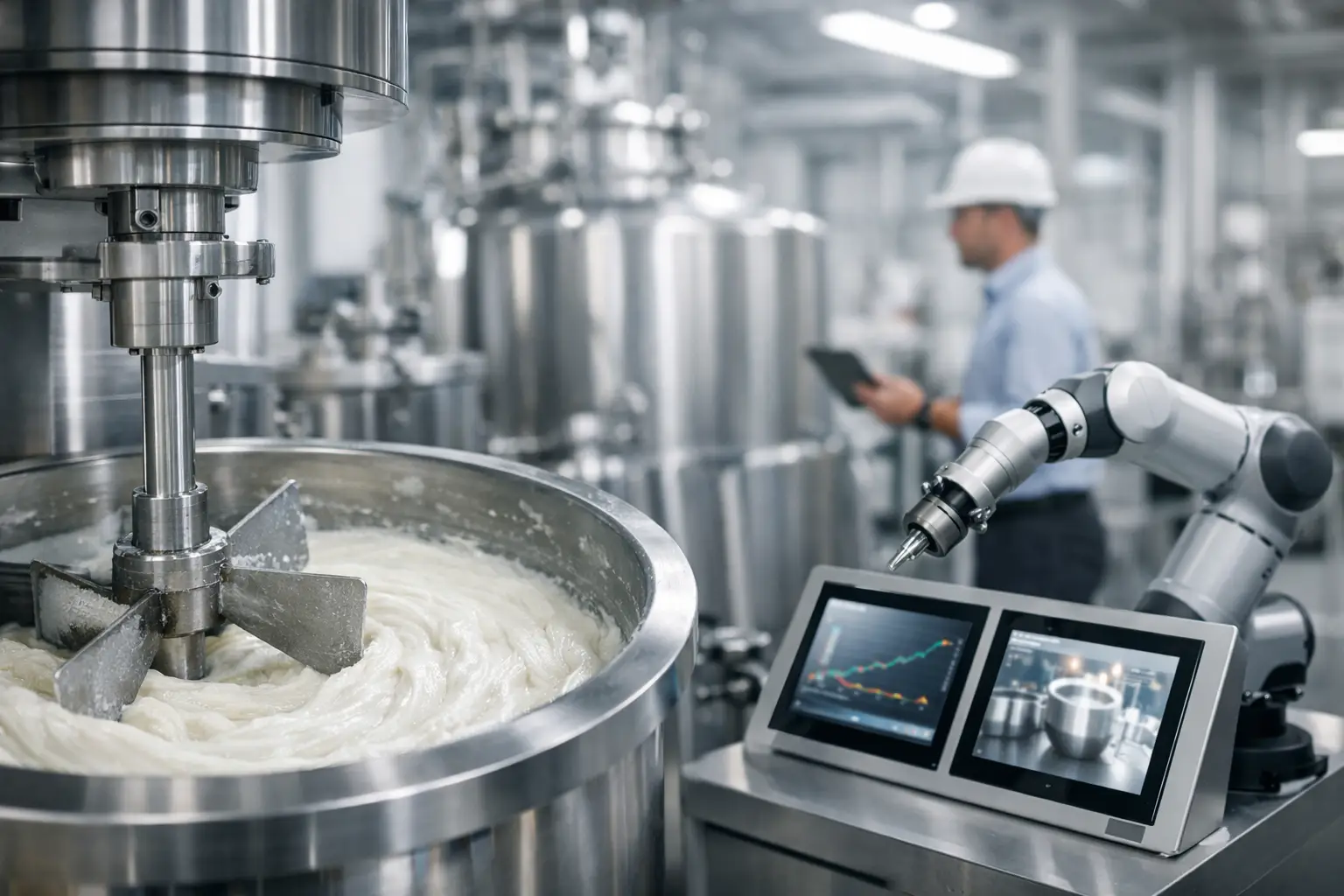
A mixer can achieve excellent uniformity in a trial and still underperform on the plant floor if feeding, liquid addition, temperature control, discharge, and operator actions vary from batch to batch. That is why mixing automation trends matter: manufacturers are no longer evaluating automation as an add-on to the mixer. They are evaluating it as a process-control strategy for improving repeatability, throughput, traceability, and operating cost.
For powders, pastes, slurries, emulsions, and high-viscosity products, the value of automation comes from controlling the variables that determine the finished product. The mixer remains central, but its performance depends on how accurately the complete process is managed before, during, and after the mixing cycle.
Mixing Automation Trends Moving Beyond Basic PLC Control
A programmable logic controller and recipe screen are now common expectations in industrial mixing systems. The more meaningful development is the expansion from basic sequence control to coordinated, data-driven process control. Modern systems increasingly connect ingredient handling, weighing, mixing, thermal management, vacuum, discharge, cleaning, and downstream equipment into one engineered operating sequence.
This shift is especially relevant where raw materials vary. Powder bulk density, moisture content, particle size distribution, liquid viscosity, and ambient conditions can all influence mixing time and product behavior. A fixed timer may be adequate for a stable, low-risk formulation. It is less effective when a process must consistently handle material variation while meeting demanding quality requirements.
The best automation strategy depends on the process. A dry blend with a narrow ingredient list may benefit most from controlled weighing and recipe enforcement. A vacuum mixer processing viscous compounds may require torque monitoring, jacket temperature control, staged liquid addition, vacuum management, and controlled discharge. Automation should reflect the real critical process parameters, not simply the number of available signals.
Recipe Management Is Becoming a Production Control Tool
Recipe management has evolved beyond storing mixer speed and cycle time. Well-designed recipes define the operating logic of the entire batch, including ingredient order, feed rates, agitator speed profiles, liquid addition timing, temperature limits, vacuum setpoints, hold times, and discharge conditions.
For manufacturers producing multiple formulas on shared equipment, this control is essential. It reduces dependence on operator memory and provides a practical way to protect validated processing conditions. It also helps prevent small deviations that create larger downstream problems, such as inconsistent viscosity, incomplete dispersion, poor particle coating, segregation, or extended drying time.
A useful recipe system should permit authorized adjustment without creating uncontrolled process drift. Production teams need enough flexibility to respond to legitimate raw material behavior. Quality and engineering teams need a clear record of what changed, who changed it, and how the batch performed. The right balance depends on the product, regulatory environment, and maturity of the operation.
Closed-Loop Control Gains Value When It Measures the Right Thing
Closed-loop control is one of the most practical developments in mixing automation, but it is often misunderstood. Adding sensors does not automatically create better control. The measurement must be reliable, relevant to the process, and connected to an action that improves the result.
In a high-shear emulsification process, temperature, pressure, flow, and motor load may indicate whether the product is receiving the intended mechanical and thermal treatment. In a powder mixing application, load cells, feeder feedback, mixer power draw, or a near-infrared measurement may help identify deviations in feed or material condition. In vacuum processing, pressure trends can reveal whether deaeration or drying is progressing as expected.
Motor torque is a useful example. Rising torque in a double planetary mixer or sigma mixer can reflect increasing viscosity, product development, insufficient temperature control, or an issue with material addition. However, torque alone does not confirm product quality. It must be interpreted alongside formulation, temperature, speed, batch weight, and process history. Engineers should avoid treating one sensor as a universal quality indicator.
Traceability Is Now an Operating Requirement
Traceability has long been critical in food, pharmaceutical, chemical, and specialty materials manufacturing. More plants are now applying similar discipline across industrial products because customers, regulators, and internal quality systems expect defensible batch records.
An automated mixing system can document lot identities, actual ingredient weights, time stamps, operator actions, alarm events, process values, cleaning status, and batch release information. This documentation shortens investigations when a quality issue occurs and provides the production data needed to identify recurring losses.
The business case is not limited to compliance. If batches regularly require rework, take longer than planned, or show inconsistent physical properties, historical data allows engineering teams to compare successful and unsuccessful runs. The goal is not to collect data for its own sake. The goal is to establish which operating conditions reliably produce acceptable material.
Data architecture deserves early attention. A plant may need local machine control, plant-level historian integration, manufacturing execution system connectivity, or secure remote support capability. These requirements affect panel design, communication protocols, cybersecurity measures, and commissioning scope. Retrofitting a disconnected system later is usually more disruptive and more expensive than defining the information needs during project engineering.
Automated Feeding and Liquid Addition Often Deliver the Largest Gains
Many mixing problems originate upstream of the mixer. Manual ingredient addition can introduce weighing errors, inconsistent addition rates, dust exposure, poor ergonomics, and avoidable delays. For high-value formulations, even a minor loading error can create a costly rejected batch.
Automated weighing, loss-in-weight feeding, bulk bag unloading, powder induction, and metered liquid addition improve control at the point where the batch is formed. They are particularly valuable when an ingredient must be introduced slowly to prevent agglomeration, when liquids must be sprayed or injected at a controlled rate, or when multiple minor ingredients require precise dosing.
The equipment selection still depends on material behavior. A free-flowing powder may feed accurately through a simple gravimetric system. A cohesive or moisture-sensitive material may bridge, smear, compact, or flood. In those cases, feeder agitation, hopper geometry, screw design, refill logic, and material conditioning are as important as the automation platform. Controls cannot compensate for poor material handling design.
Cleaning Automation Must Be Designed Around Product Risk
As product portfolios expand, cleaning time can become a major capacity constraint. Automated clean-in-place systems, validated cleaning sequences, rinse verification, and automated drain management can reduce labor and improve consistency. They can also create problems if the vessel geometry, spray coverage, seals, discharge design, and residual material behavior were not considered from the beginning.
A ribbon mixer, plough mixer, conical mixer, and high-viscosity vacuum mixer present different cleaning challenges. Some applications require dry cleaning to protect against moisture or preserve material recovery. Others demand full washdown or sanitary clean-in-place operation. A cleaning program must match the product, allergen or cross-contamination risk, cleaning chemistry, and required turnaround time.
For this reason, cleaning automation should not be specified as a standard checkbox. It should be developed with the process equipment, including access points, spray devices, piping slopes, drainability, seal selection, and verification approach. A faster cleaning sequence has limited value if it leaves residual product in areas that affect the next batch.
AI and Advanced Analytics Need a Practical Role
Artificial intelligence is receiving significant attention in manufacturing, but its strongest near-term role in mixing is not autonomous decision-making. It is pattern recognition and process support. Analytics can identify batch conditions associated with extended cycle times, abnormal energy use, feeder instability, temperature excursions, or maintenance risk.
Predictive maintenance is a credible application when plants have dependable data on motor load, vibration, bearing temperature, gearbox condition, and operating hours. It can help maintenance teams schedule intervention before an unplanned failure affects production. Yet no algorithm can replace inspection, lubrication discipline, alignment checks, or an understanding of how the equipment is actually used.
Similarly, digital models can support scale-up and process development, but they require sound material data and validation against real production behavior. Highly variable powders and non-Newtonian materials do not always behave as simplified models predict. The engineering value comes from combining analytics with practical process knowledge.
Automation Projects Must Start With the Process, Not the Controls List
The most successful projects begin by defining the production problem. Is the plant trying to increase batch repeatability, reduce operator exposure, improve lot traceability, shorten changeovers, increase throughput, control viscosity, or integrate a new line? The answer determines which measurements, equipment functions, and control logic are worth funding.
PerMix approaches integrated mixing systems from this process-first perspective. Mixer type, agitator configuration, feeding method, vacuum capability, heating or cooling, discharge arrangement, and automation architecture must work as one production solution. Specifying controls separately from the mechanical process often leaves performance gaps that appear only after startup.
Manufacturers should also plan for commissioning and operator adoption. A sophisticated interface that does not reflect real operating decisions will be bypassed or misused. Clear alarm philosophy, practical operating screens, maintenance access, training, and documented recovery procedures are essential to sustained performance.
The right next step is to map the actual batch sequence from raw-material receipt through discharge and cleaning, then identify where variation, delay, or risk enters the process. That exercise usually reveals whether the priority is better mixer control, more accurate feeding, stronger batch records, improved cleaning, or a fully integrated automation system.