Industrial Mixers
PerMix News & Updates
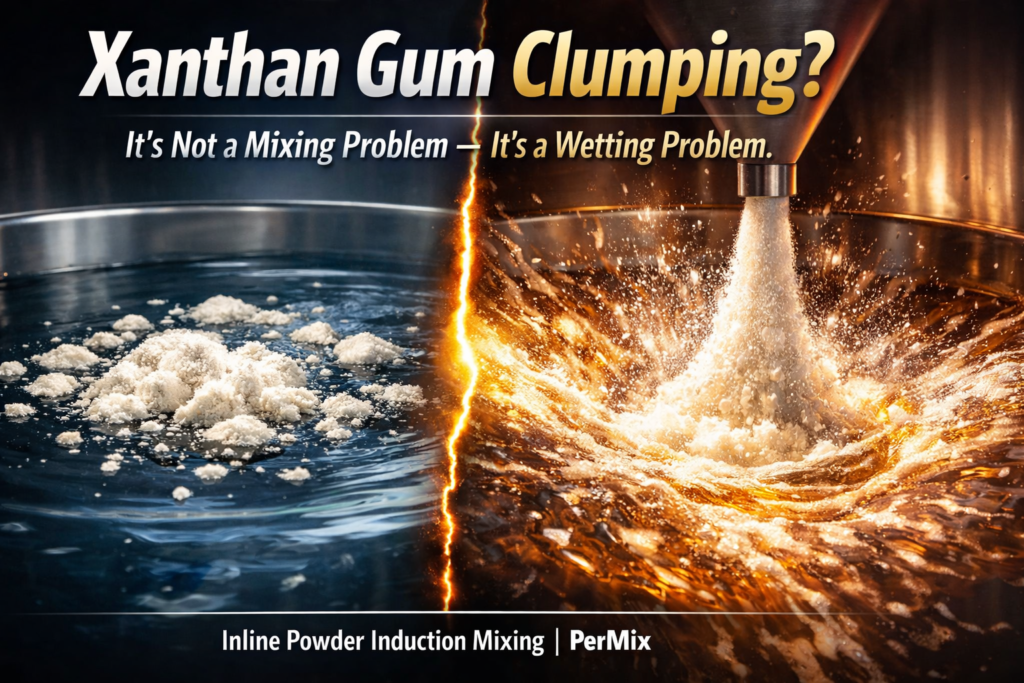
Mixing Xanthan Gum? Xanthan Gum Clumps? It’s Not a Mixing Problem — It’s a Wetting Problem.
In the strange little universe of food chemistry, xanthan gum behaves like a microscopic trickster. The moment it touches water it begins to hydrate and form a gel layer. That gel layer traps dry powder inside, creating the dreaded “fish eyes” every production operator has seen floating in a tank.
The mixer keeps turning.
The clock keeps ticking.
And suddenly what should have been a 10-minute step turns into an hour of agitation.
Here’s the key insight: this usually isn’t a mixing horsepower issue.
It’s a wetting problem.
When powders like xanthan gum, citric acid, salt, or stabilizers are sprinkled onto the surface of a liquid, the first contact with water determines everything. If the powder hydrates before it disperses, you get clumps. If it disperses first, you get smooth hydration.
Physics wins before the agitator ever has a chance.
Traditional top-entry tank mixing works by slowly pulling powders down into the liquid under agitation and recirculation. For simple ingredients this works fine. But hydrocolloids like xanthan gum hydrate so quickly that they form a gel barrier before the powder can disperse.
That’s why operators often see floating rafts of powder that refuse to break down.
The result is familiar across food, beverage, and cosmetic plants:
• Long mixing cycles
• Inconsistent hydration
• Lumps or “fish eyes”
• Operators babysitting tanks waiting for powders to dissolve
The solution is to change where the powder meets the liquid.
Inline powder induction mixers introduce powders directly into a high-velocity shear zone. Instead of landing on the liquid surface, the powder is pulled into the rotor-stator mixing head where intense shear forces immediately wet and disperse each particle.
Imagine moving the moment of contact from the calm surface of a tank… to the center of a controlled turbulence field.
When powders are inducted into the shear stream:
• Particles wet instantly
• Agglomerates are broken apart
• Hydration becomes uniform
• Batch times drop dramatically
This approach is widely used for ingredients such as:
Xanthan Gum
Citric Acid
Salt (PDV or fine grades)
Trisodium Citrate
Starches
Stabilizers and hydrocolloids
For manufacturers producing sauces, beverages, cosmetic gels, or functional foods, the difference can be dramatic. Processes that once required extended agitation can often be reduced to minutes while improving product consistency.
At PerMix, we design inline powder induction mixers specifically to solve these wetting and dispersion challenges. By integrating powder induction hoppers with high-shear rotor-stator mixing technology, powders are introduced directly into the shear zone where dispersion happens instantly and efficiently.
Come see the PerMix difference
#PerMix #InlineMixing #FoodProcessing #CosmeticManufacturing #ProcessEngineering #HighShearMixing

Stay Connected