
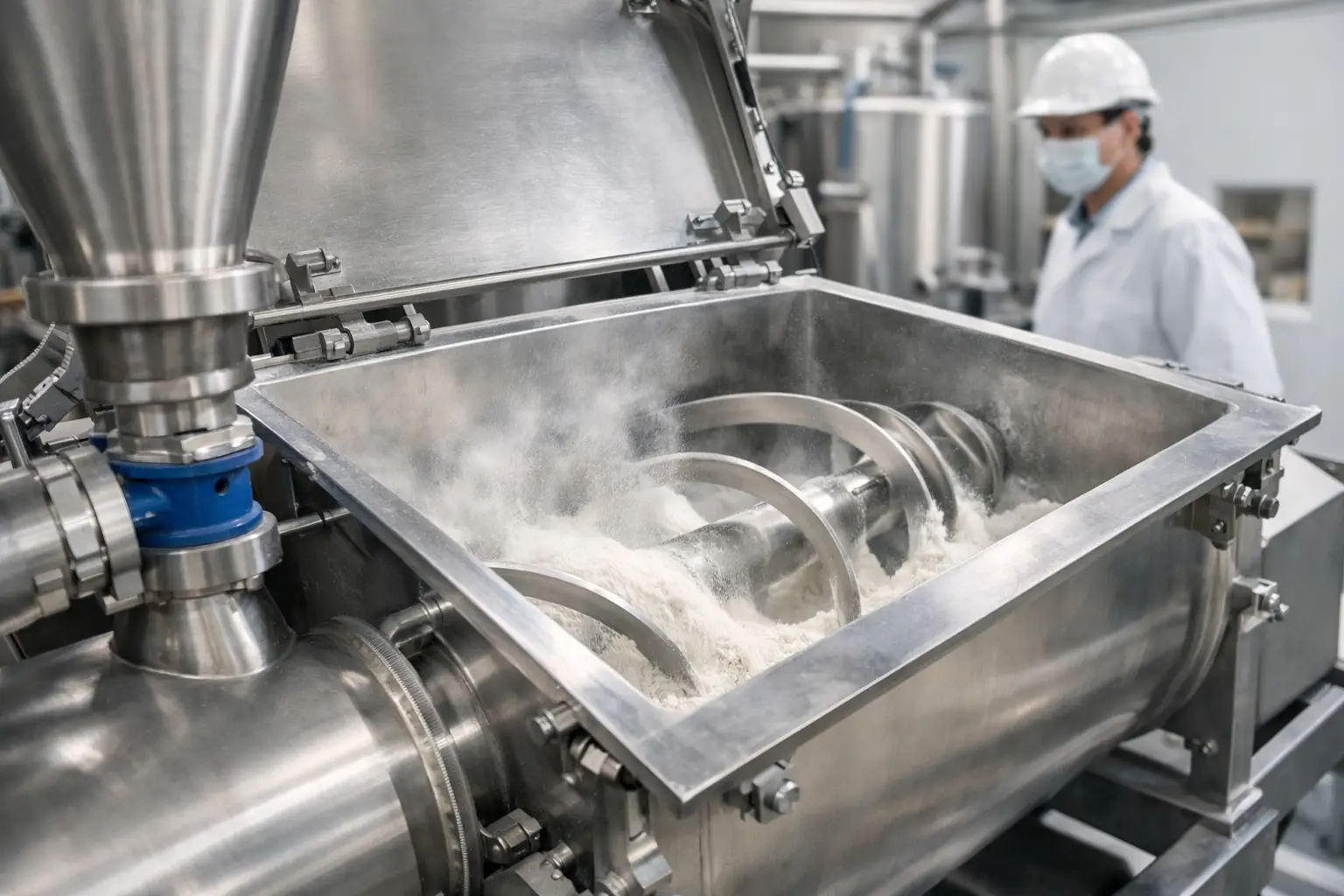
A free-flowing powder can often be blended with modest agitation. A cohesive powder cannot. When particles stick together, form stable agglomerates, bridge over outlets, or compact under their own weight, the central question becomes: what mixer works for cohesive powders without damaging the formulation, extending cycle time, or creating an unreliable discharge?
The answer is rarely a single mixer name. Cohesive powders require a mixer selected around the material’s actual behavior: cohesive strength, bulk density, particle-size distribution, moisture, electrostatic charge, liquid additions, batch size, and required finished-particle condition. For many applications, a plough mixer or a high-intensity mixer is the strongest starting point. But paddle, ribbon, conical, and multi-shaft designs also have a place when the process objective is different.
Why Cohesive Powders Behave Differently
Cohesion occurs when interparticle forces are strong enough to resist normal powder flow. Fine particles, hygroscopic ingredients, oils, waxes, fat-coated materials, and powders with a wide particle-size distribution are common examples. Van der Waals forces, capillary forces from moisture, electrostatic attraction, and mechanical interlocking can all contribute.
In production, the result is not simply poor flow. Cohesive materials can enter a mixer as soft lumps, remain in dead zones, adhere to vessel walls, or move as large masses rather than as individual particles. A mixer that produces an acceptable blend with dry, free-flowing granules may leave unbroken agglomerates in a cohesive formulation.
This is why mixing uniformity must be evaluated alongside deagglomeration, wall sweeping, discharge behavior, and cleanability. A short mixing time is not meaningful if the product still contains ingredient-rich clumps or if material remains in the vessel after discharge.
What Mixer Works for Cohesive Powders?
For cohesive powders that need both distributive mixing and controlled deagglomeration, a horizontal plough mixer is often the most capable general-purpose solution. Its plough-shaped elements mechanically fluidize the product, creating a high-energy mixing zone throughout the vessel. This movement continuously lifts, separates, and folds the powder rather than allowing it to travel as a static bed.
Choppers can be added when the process needs more aggressive lump breakup. Operating at high speed, these localized devices break agglomerates and disperse liquid additions without requiring the entire batch to receive excessive shear. The combination is especially effective for powders that form soft-to-moderate lumps during storage, conveying, or wetting.
That does not mean every cohesive powder requires a plough mixer with choppers. The correct choice depends on whether the agglomerates must be broken, preserved, coated, wetted, or converted into granules. The mixer must support the product specification, not merely overcome poor flow.
Plough Mixers for High-Intensity Powder Processing
Plough mixers are well suited to cohesive powders when rapid mixing, strong particle movement, and deagglomeration are required. They are commonly specified for dry blending, powder-liquid mixing, wet granulation, coating, and vacuum processing applications where material behavior changes during the cycle.
Their key advantage is active mechanical fluidization. This reduces the risk that cohesive material will sit in a low-motion area or remain attached to the vessel wall. A properly engineered plough mixer can also accommodate high-speed choppers, spray systems, heating or cooling jackets, vacuum capability, and process controls in a single platform.
The trade-off is intensity. Fragile particles, crystals, coated granules, or formulations with a narrow acceptable particle-size range may be damaged by excessive mixing energy or prolonged chopper operation. Testing should establish the minimum intensity and cycle time needed to meet blend and agglomerate specifications.
Paddle Mixers for Cohesive Materials That Need Gentler Handling
A horizontal paddle mixer can be a strong choice for moderately cohesive powders, particularly when the product needs a gentler mixing action than a plough mixer provides. Paddles create a fluidized, low-shear mixing pattern that can achieve excellent uniformity while limiting particle attrition.
This design is frequently appropriate for bulk powder blends, dry premixes, nutrition products, minerals, chemicals, and other formulations where the material is cohesive but does not contain persistent agglomerates requiring aggressive breakup. A paddle mixer may also be preferred when a broad particle-size distribution makes segregation control a priority.
The limitation is straightforward: gentle mixing is not a substitute for deagglomeration. If incoming ingredients arrive with compacted lumps, a standard paddle configuration may distribute those lumps rather than break them apart. In that case, choppers, upstream milling, screening, or a higher-intensity mixer should be evaluated.
Ribbon Mixers for Cost-Effective Blending Within Limits
Ribbon mixers remain widely used because they are economical, familiar, and effective for many dry powder blends. Their inner and outer helical ribbons move material in opposing axial directions, producing a consistent circulation pattern.
For mildly cohesive powders with good flow after feeding, a ribbon mixer can provide reliable batch blending. It is often a practical selection where the process does not need major lump breakup, precision liquid distribution, or intensive wet processing.
However, ribbon mixers are not usually the first recommendation for highly cohesive powders. Their mixing action may not generate enough localized energy to break tough agglomerates, and sticky materials can accumulate on ribbons and vessel surfaces. As fill level, moisture, or product tackiness increase, the real process window can narrow quickly.
Conical and Tumble Mixers for Low-Shear Applications
Conical mixers and other tumble-style blenders can be valuable when particle integrity is the highest priority. Their low-speed, gravity-driven action suits free-flowing to moderately cohesive powders that must not be fractured, heated, or compacted by aggressive mechanical mixing.
For truly cohesive materials, these designs require careful evaluation. If the powder bridges, adheres to surfaces, or contains lumps, gravity alone may not create sufficient particle exchange. Intensifier bars can improve performance in some cases, but they should be considered an application-specific solution rather than a universal fix.
The Process Around the Mixer Determines the Result
The mixer is only one part of cohesive powder handling. An otherwise capable machine can underperform when the upstream feeding system delivers compacted material inconsistently or when liquid is added in large droplets rather than uniformly atomized spray.
Start with representative material data. Bulk density, particle-size distribution, moisture, flow function, angle of repose, compressibility, and lump strength provide a more useful basis for selection than a general description such as “sticky” or “hard to mix.” Product samples should represent seasonal moisture variation, supplier variation, and recycled material where applicable.
The feed method also matters. Screw feeders, loss-in-weight systems, lump breakers, mills, and sieves may be necessary to deliver a controlled ingredient stream. For liquid addition, nozzle location, spray pattern, droplet size, pump stability, and the timing of chopper operation directly influence whether the powder is evenly wetted or forms oversized balls.
Discharge deserves equal attention. Cohesive powders can bridge over a discharge valve or cling to internal surfaces after the mixer stops. Full-width discharge doors, properly designed valve geometry, wall scrapers where appropriate, and sufficient vessel slope can reduce retained material and improve batch-to-batch consistency. For sanitary or allergen-sensitive production, the cleaning method must be considered during initial equipment design rather than treated as a later modification.
How to Specify a Mixer for Cohesive Powder Blending
A productive specification begins with performance targets. Define the acceptable blend variation, maximum agglomerate size, desired particle-size retention, batch capacity, cycle time, discharge time, and cleaning standard. These criteria let the engineering team distinguish between a blending problem and a deagglomeration, wetting, granulation, or materials-handling problem.
Pilot trials are especially valuable for cohesive powders. They reveal how the material responds to mixing intensity, fill level, chopper speed, liquid-addition rate, and discharge configuration. They also expose changes that may not appear in a small laboratory sample, including heat buildup, wall adhesion, and scale-related compaction.
PerMix approaches this selection as a process engineering decision. The goal is not to install the most aggressive mixer available. It is to deliver the required uniformity, throughput, product condition, and operating reliability with a process configuration that can perform consistently at production scale.
The best mixer for cohesive powders is the one that creates enough particle movement and deagglomeration to meet the finished-product specification, while avoiding unnecessary shear, attrition, cleanup burden, and downtime. That balance is where equipment selection becomes manufacturing engineering rather than catalog comparison.