Zevia: The Science Behind Zero-Sugar Beverages – A Complete Guide to Flavor Engineering

Introduction: Why Zero-Sugar Beverages Are So Hard to Get Right

The global shift toward zero-sugar, clean-label beverages has created one of the biggest formulation challenges in modern food science.

Consumers want:

  • No sugar
  • No artificial sweeteners
  • Clean labels
  • And still expect full, rich flavor

Brands like Zevia have succeeded not because they removed sugar…
but because they rebuilt the entire sensory experience of sweetness using chemistry, formulation strategy, and precision processing.

This guide breaks down exactly how that works—and how beverage manufacturers can replicate it.


1. The Role of Stevia in Zero-Sugar Formulation

At the heart of most zero-sugar beverages is stevia, a plant-derived high-intensity sweetener.

Why Stevia Works

  • 200–300x sweeter than sugar
  • Zero calories
  • Derived from natural sources
  • Label-friendly (“clean label”)

The Problem with Stevia

Stevia alone does NOT taste like sugar.

It introduces:

  • Bitter notes
  • Metallic aftertaste
  • Slow onset and long linger

👉 This is why early “diet” beverages failed.


2. Flavor Architecture: Rebuilding Sugar Without Sugar

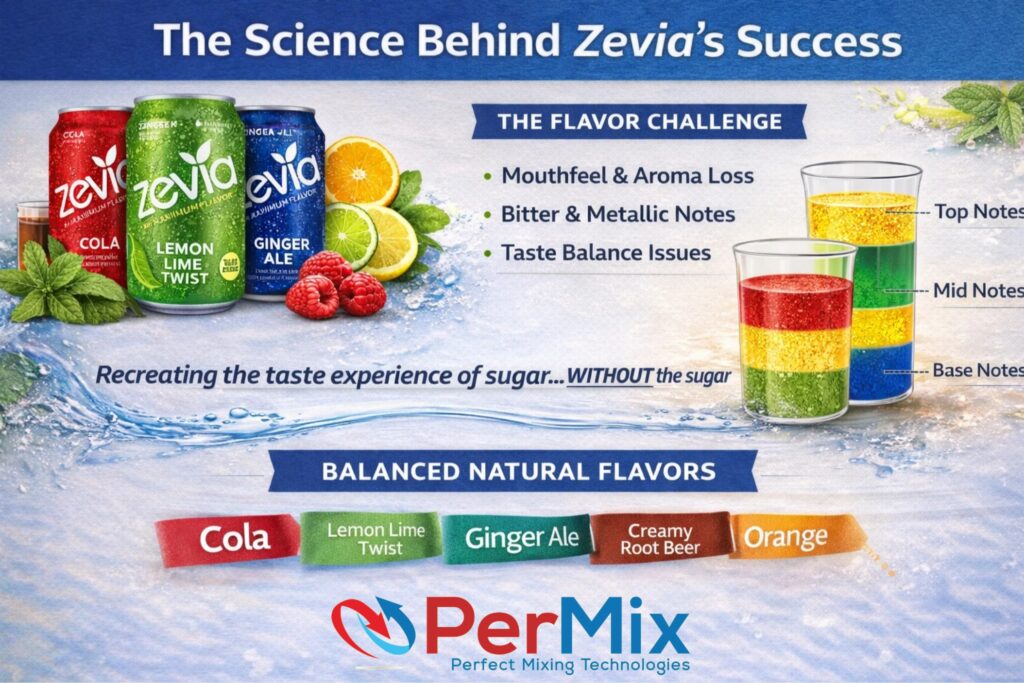
Zevia’s real innovation lies in flavor layering.

Instead of replacing sugar directly, formulators build a multi-dimensional flavor system:

Top Notes (Aroma Impact)

  • Citrus oils
  • Fruit esters
  • Volatile compounds

👉 These create the first impression


Mid Notes (Flavor Body)

  • Botanical extracts
  • Natural flavor blends
  • Spice and fruit complexity

👉 These define the beverage identity


Base Notes (Sweetness & Finish)

  • Stevia
  • Monk fruit (in some formulations)
  • Flavor modulators

👉 These recreate sweetness and mouthfeel


The Key Insight

Sugar is not just sweet—it provides:

  • Mouthfeel (viscosity)
  • Flavor carry
  • Temporal balance

Without it, you must engineer all three.


3. The Hidden Challenge: Mouthfeel Without Sugar

One of the biggest technical hurdles is texture.

Sugar contributes:

  • Body
  • Weight
  • Smoothness

Without it, beverages feel:

  • Thin
  • Hollow
  • Incomplete

Solutions Used in Industry

  • Hydrocolloids (gum acacia, pectin)
  • Glycerol or erythritol (in some systems)
  • Emulsified oils for perceived body

👉 But these must be perfectly dispersed and stabilized


4. Emulsification: The Backbone of Flavor Stability

Many natural flavors—especially citrus—are oil-based.

Without proper emulsification:

  • Oils separate
  • Flavor becomes inconsistent
  • Shelf life drops dramatically

What Needs to Happen

  • Oil droplets must be reduced to micron or submicron size
  • Distribution must be uniform
  • Emulsion must remain stable over time

👉 This is where high-shear mixing and homogenization become critical


5. Deaeration: Protecting Flavor Integrity

Air is one of the most overlooked enemies in beverage processing.

Entrained air causes:

  • Oxidation of flavors
  • Loss of volatile aromatics
  • Foaming issues during filling

Proper Deaeration Achieves

  • Longer shelf life
  • More consistent taste
  • Improved carbonation control

6. Powder Integration: The Stevia Challenge

Stevia and other functional ingredients are often added as powders.

Without proper incorporation:

  • Clumping occurs
  • Floating powders resist wetting
  • Inconsistent sweetness results

Best Practice


7. Homogenization: Creating a Sugar-Like Experience

High-pressure homogenization plays a major role in:

  • Improving mouthfeel
  • Stabilizing emulsions
  • Enhancing flavor perception

Result

A beverage that feels:

  • Fuller
  • Smoother
  • More “complete”

👉 Even without sugar


8. The Complete Process Flow for Zero-Sugar Beverages

A modern zero-sugar beverage production line typically includes:

  1. Liquid base preparation
  2. Powder induction (stevia, acids, functional ingredients)
  3. High-shear mixing
  4. Emulsification of flavor oils
  5. Homogenization
  6. Deaeration
  7. Carbonation
  8. Filling & packaging

9. Why Most Beverage Startups Fail

Many brands get the formulation right—but fail in execution.

Common issues:

  • Poor dispersion of ingredients
  • Flavor separation over time
  • Inconsistent batch quality
  • Shelf-life instability

👉 The difference between success and failure is process control


10. How PerMix Enables Beverage Innovation

While formulation creates the concept…
processing makes it real at scale.

PerMix supports beverage manufacturers with:

Integrated Processing Solutions

From R&D to Production

  • Scalable process design
  • Repeatable batch quality
  • Clean-label compatible processing

Conclusion: The Future of Beverage Manufacturing

The success of brands like Zevia proves one thing:

👉 The future is not about removing ingredients.
👉 It’s about engineering better experiences.

Zero-sugar beverages require:

  • Advanced flavor science
  • Precise processing
  • Deep understanding of ingredient behavior

And the companies that master this…

Will define the next generation of the beverage industry.