Industrial Mixers
PerMix News & Updates
When a dry powder blend misses spec, the problem is often not mixing time – it is mixer selection. In the ribbon blender vs paddle blender decision, the right answer depends on bulk density, fragility, liquid addition, fill level, and how your material actually moves in the trough.
For plant managers and process engineers, this is not a theoretical comparison. It affects batch consistency, cycle time, cleaning effort, utility use, and how easily you can scale production without creating a new set of process problems. Ribbon and paddle blenders can both handle solids and powder blends, but they do not behave the same way under load.
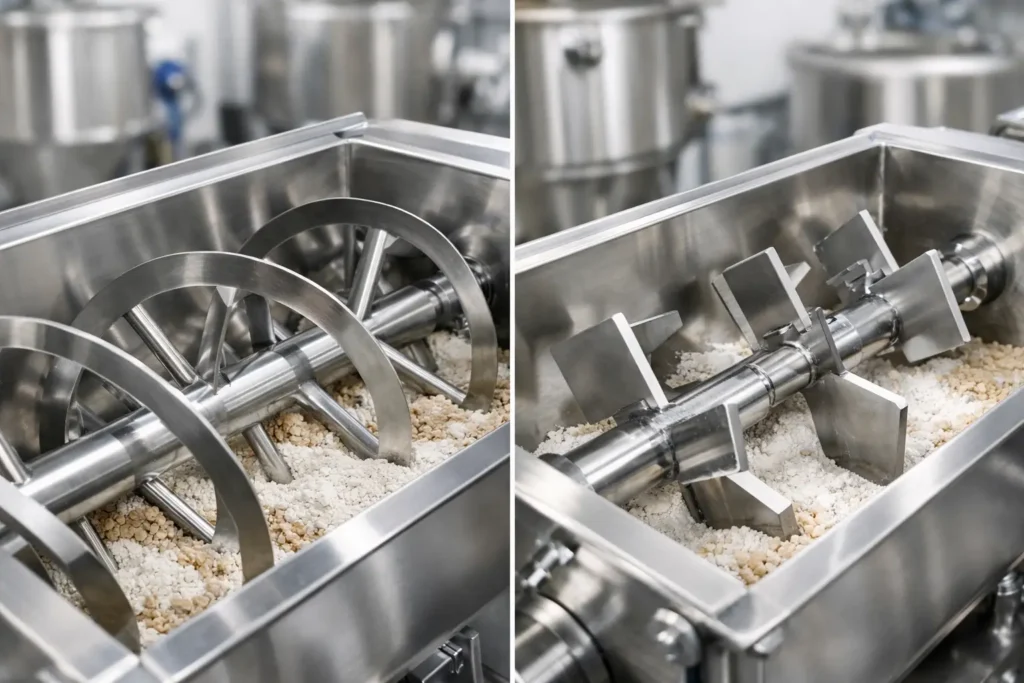
A ribbon blender uses inner and outer helical ribbons mounted on a horizontal shaft. Those ribbons move product in opposing axial directions while also creating radial movement. The result is a continuous folding action that is highly effective for free-flowing powders and relatively uniform dry materials.
A paddle blender uses paddles rather than helical ribbons to lift, tumble, and fluidize product. That action is often gentler and more three-dimensional, especially with materials that are friable, irregular, or prone to segregation. Paddle designs can also perform well when the batch includes liquid addition, light agglomerates, or ingredients with different particle sizes and densities.
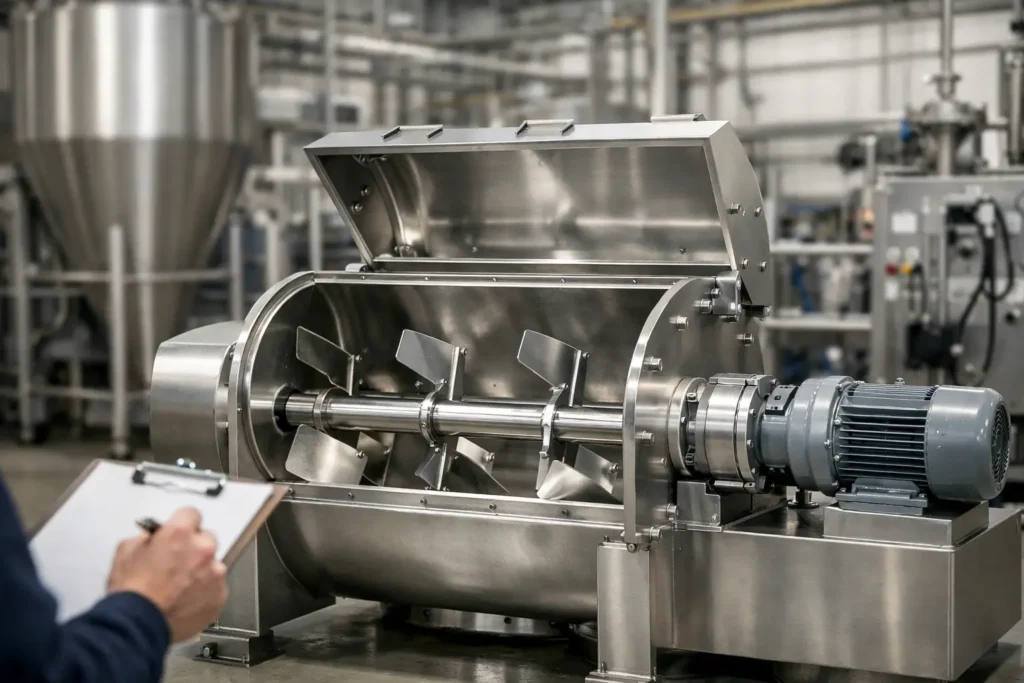
At a distance, both machines may look like horizontal trough mixers. In production, their differences show up quickly. A ribbon blender tends to deliver strong convective mixing with efficient turnover. A paddle blender often provides better control for sensitive materials and more forgiving performance across a wider range of fill conditions.
Ribbon blenders remain one of the most widely used industrial powder mixers for a reason. They are cost-effective, mechanically straightforward, and highly productive for many standard dry blending applications. If your product is free-flowing, has relatively similar particle characteristics, and does not require aggressive deagglomeration or unusually gentle handling, a ribbon blender is often the practical choice.
In food, chemical, and agricultural production, ribbon blenders are commonly used for powdered ingredients, dry premixes, seasonings, mineral blends, and other formulations where the objective is fast, repeatable homogenization. Their geometry supports good batch circulation, and they can deliver consistent results when process conditions are well defined.
They also make sense when your priority is throughput per dollar. For many operations, especially those scaling from manual blending or replacing aging equipment, ribbon blenders offer a strong balance of performance, simplicity, and budget control.
That said, ribbons are not ideal for every material. Fragile particles may break down under extended mixing. Some sticky formulations can smear on the agitator. Very low-density materials or blends with major component differences may need more specialized handling than a standard ribbon action can provide.
Paddle blenders are often chosen when the product is less cooperative. If you are dealing with fragile solids, wider particle size distribution, or ingredients that tend to separate rather than integrate, paddles can create a gentler and more adaptive mixing environment.
The paddle action lifts and turns the product instead of pushing it primarily through opposing helical flow paths. That can reduce mechanical stress and improve mixing quality for materials that are easily damaged or prone to segregation. It can also help with liquid addition, because the bed movement often exposes fresh product surfaces more evenly during spraying.
This matters in sectors such as nutraceuticals, specialty foods, chemicals, and health and beauty products, where ingredient value is high and batch variation is expensive. In those cases, protecting particle integrity can be just as important as hitting a blend uniformity target.
Paddle blenders can also be a better fit when process flexibility matters. If your plant runs multiple formulations with changing bulk densities or varying fill percentages, paddles may offer more forgiving performance than ribbons, depending on the application and machine configuration.
The best mixer is the one that matches the way your material wants to move. That is why a ribbon blender vs paddle blender comparison should start with product behavior, not just equipment price or installed horsepower.
Ribbon blenders create efficient convective flow and generally move product quickly through the batch. That is useful when you want short blend times with standard powder systems. But the same action can produce more shear and compression in certain zones, especially for delicate particles or products that cake under pressure.
Paddle blenders usually generate a gentler mixing pattern. They can suspend and tumble the batch in a way that reduces particle attrition. For some products, this improves final quality. For others, especially very free-flowing powders, the gentler action may not be an advantage unless the design is properly matched to capacity, speed, and batch properties.
This is where testing and application review matter. Two materials that look similar on paper can behave very differently once they are inside the trough.
Many dry blending processes are not truly dry. They include oil, flavoring, binders, surfactants, colorants, or other liquid components added in small percentages. This changes the selection process.
Ribbon blenders can handle liquid addition well when the spray rate, nozzle placement, and batch loading are engineered correctly. For many applications, they produce acceptable coating and distribution without issue. But as liquid content rises, or as the formulation becomes more cohesive, the material may begin to smear, stick, or build on the agitator.
Paddle blenders often have an advantage when liquids must be distributed evenly without overworking the batch. Their tumbling action can improve exposure of particles to the spray pattern and reduce localized overwetting. If your process includes repeated liquid injection or calls for light agglomeration, paddles may provide a better operating window.
Minor ingredients also matter. If actives, colors, or micro-components need very tight distribution, the mixer must generate enough movement to prevent dead spots while still protecting sensitive ingredients. That balance is application-specific, and it is one of the main reasons off-the-shelf assumptions can lead to poor results.
Production realities often decide the winner. A mixer that performs well in ideal conditions may still be the wrong fit if your batch sizes fluctuate, changeovers are frequent, or sanitation standards are strict.
Ribbon blenders are typically optimized around a target working volume. They perform best when the batch falls within the intended fill range. If actual production regularly runs well below or above that range, mixing efficiency may suffer. Paddle blenders can sometimes tolerate variable fill conditions better, though that depends on the exact agitator design and trough geometry.
Cleanout is another practical issue. Ribbon assemblies have more continuous surface area and tighter clearances along the helical flights. That can increase cleaning time in applications with sticky materials or strict changeover requirements. Paddle assemblies may offer easier access in some sanitary or multi-product environments, especially when the machine is designed for washdown or rapid inspection.
For regulated industries, this becomes more than convenience. It affects uptime, labor cost, and validation effort.
If your product is a conventional free-flowing powder blend with stable ingredient behavior and a strong emphasis on economical throughput, a ribbon blender is often the right answer. It is proven, efficient, and widely accepted across industrial mixing applications.
If your material is fragile, segregation-prone, variable in density, or dependent on careful liquid incorporation, a paddle blender may deliver better process control and a wider margin of safety. That is especially true when product quality is highly sensitive to shear or particle damage.
The key is not to ask which mixer is better in general. Ask which one is better for your batch, your production targets, your cleanability requirements, and your future product mix. That is the difference between buying a machine and specifying a process solution.
At PerMix, that is exactly how mixer selection should be approached – through material behavior, operating goals, and engineered fit rather than assumptions based on appearance alone. The right blender should not just run. It should improve consistency, reduce waste, and support growth without forcing process compromises later.
Before you choose, look closely at what your material is telling you. The mixer that matches that behavior will usually outperform the one with the more familiar name.

Stay Connected