An adhesive mixing throughput case study rarely begins with a mixer that is simply too small. More often, the installed system has enough nominal volume but loses production time to slow material incorporation, extended deaeration, difficult discharge, batch-to-batch adjustments, and cleaning between formulations. For adhesive manufacturers, the practical question is not how many gallons a vessel holds. It is how many saleable, specification-compliant pounds leave the process every shift.
This representative case examines a high-viscosity adhesive operation that needed to increase capacity without expanding its production footprint or compromising bond strength, viscosity control, and air-free product quality. The outcome depended on treating mixing as a complete process rather than a standalone equipment purchase.
The Production Constraint Was Not Vessel Volume
The manufacturer produced filled, solvent-free construction adhesive in multiple colors and package sizes. Its formulation combined a viscous polymer base with mineral fillers, tackifiers, additives, pigments, and moisture-sensitive components. The existing batch process used a conventional low-speed agitator in a jacketed vessel.
On paper, the vessel could process the required batch size. In practice, each batch required nearly five hours from charging to release. Operators needed to stop and scrape the vessel walls, stage filler additions slowly to prevent agglomerates, and extend mixing after each addition to correct visible inconsistency. Vacuum deaeration occurred late in the batch, after the material had already developed high viscosity and entrained air.
Discharge created another significant bottleneck. The adhesive moved reluctantly through the bottom outlet, leaving substantial heel material in the vessel and delaying the next batch. The plant was operating at approximately 62 percent of its intended daily output, despite adding labor and running longer shifts.
The original request was straightforward: increase throughput by at least 30 percent. The engineering requirement was more demanding. The plant needed higher output while maintaining established viscosity limits, filler dispersion, color consistency, bulk density, and downstream packaging performance.
Adhesive Mixing Throughput Case Study: Process Review
Before selecting replacement equipment, the process team evaluated the adhesive itself. This step matters because products described as “high-viscosity adhesives” can behave very differently under shear, temperature, and vacuum.
The adhesive showed shear-thinning behavior. Its apparent viscosity decreased when subjected to sufficient shear, but the formulation also became difficult to turn over as solids loading increased. Fine mineral filler tended to form dry pockets when introduced too quickly, while pigment concentrates required localized high shear for acceptable color development. The polymer base was sensitive to excessive temperature rise, which could affect viscosity and application behavior.
The review identified five connected limitations:
- The existing agitator moved the bulk mass but did not create enough localized shear to rapidly wet out and disperse filler.
- Ingredient additions were controlled by operator judgment rather than repeatable weight-based sequencing.
- Air entered during charging and remained trapped as the batch viscosity increased.
- The outlet geometry and low discharge force extended emptying time and increased product hold-up.
- Heating control did not account for frictional heat generated during the most demanding part of the mix cycle.
Each issue reduced throughput. Together, they made it impossible to improve capacity by increasing rotational speed alone. Higher speed on the existing system would have raised energy input without solving wall-zone turnover, deaeration, or discharge limitations.
Why a Single-Shaft Mixer Was Not the Best Fit
A larger conventional agitator was considered because it appeared to be the lowest-capital option. It was rejected for a practical reason: volume was not the core constraint. The process required independent control of bulk movement, high-shear dispersion, and vessel-wall sweeping as viscosity changed through the batch.
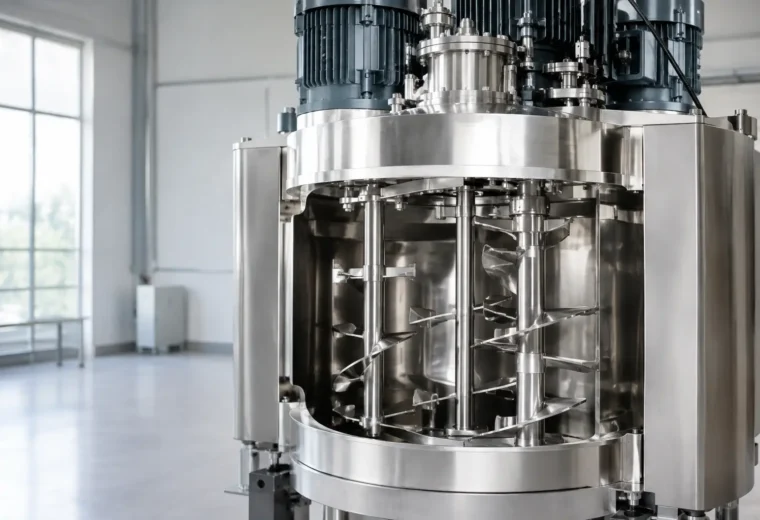
A multi-shaft vacuum mixing system was selected for the representative application. The configuration combined a slow-speed anchor agitator with wall scrapers, a high-speed disperser, and a high-torque mixing element designed for viscous mass turnover. This arrangement allowed each mixing function to operate at the intensity required by the material and the stage of the batch.
The selection was not based on a claim that one mixer style is best for every adhesive. A double planetary mixer, for example, may be a stronger fit for extremely high-viscosity products with smaller batch sizes and demanding kneading requirements. A sigma mixer may suit certain heavily filled or dough-like adhesive systems. Continuous mixing can be appropriate where formulations, feed rates, and demand profiles are stable. Equipment selection depends on rheology, solids loading, batch size, cleanability, and production flexibility.
Engineering Changes That Increased Throughput
The new process was engineered around the full batch cycle. The polymer base was charged under controlled agitation, followed by a programmed addition sequence for fillers and liquid ingredients. Loss-in-weight feeding improved repeatability and prevented the large filler dumps that had previously created dry agglomerates.
The anchor agitator maintained movement at the vessel wall and pushed material into the active mixing zone. The disperser operated at controlled speed during pigment and fine-filler incorporation, then reduced as dispersion targets were reached. This prevented the common mistake of applying maximum shear for the entire batch, which adds heat and power consumption without necessarily improving the finished adhesive.
Vacuum was introduced earlier in the cycle, after initial wet-out but before the product reached its highest viscosity. The system included vapor handling appropriate for the formulation and controlled vacuum ramps to prevent excessive foaming. Early deaeration reduced entrained air before it became difficult to remove, improving density consistency and reducing packaging defects.
Thermal management was equally important. The jacket was designed to remove frictional heat during dispersion while maintaining the temperature range needed for efficient material flow. For adhesives with temperature-sensitive polymer systems, insufficient heat removal can trade a faster mix cycle for unstable product properties. Throughput improvements only count when the released batch remains within specification.
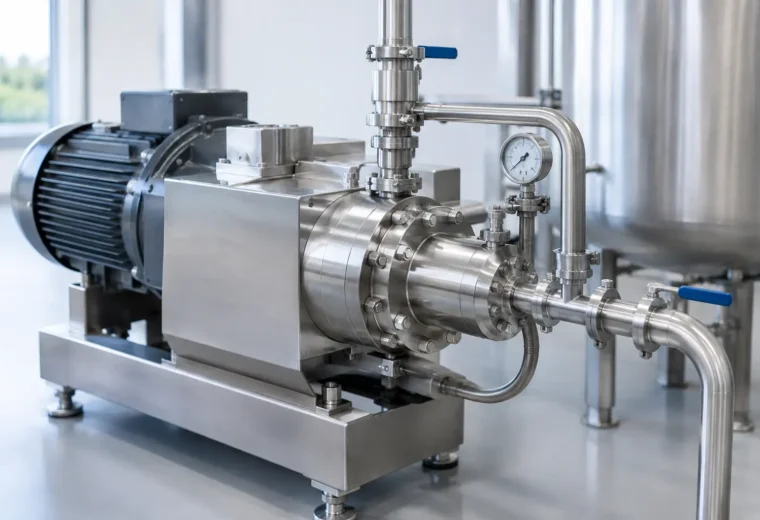
Finally, discharge was designed as part of the production system. A properly sized outlet, short transfer path, and positive displacement discharge arrangement reduced emptying time and lowered residual material left in the mixer. The improvement was operational as well as financial: less retained product meant fewer losses during color changes and a more predictable next-batch start.
Measured Production Results
Following process validation, the representative operation reduced its average batch cycle from 4.9 hours to 3.1 hours. Mixing and dispersion time fell because filler wet-out improved, but the full gain came from the combined reduction in charging delays, vacuum time, discharge time, and manual intervention.
Usable throughput increased by approximately 48 percent within the same production area. The plant exceeded its original 30 percent target without adding a second production line. Operators also reported fewer corrective additions because viscosity and color readings were more consistent from batch to batch.
The results should not be treated as a universal expectation for every adhesive plant. A facility already using automated feeds and optimized vacuum processing may see a smaller increase. Conversely, a plant relying on manual additions and an underperforming discharge system may have a larger opportunity. The engineering value is in identifying where time is actually lost, then designing the process around those constraints.
What Manufacturers Should Evaluate Before Expanding Capacity
When adhesive output is constrained, adding vessel volume can be the right answer, but it should not be the first assumption. Production teams should map the actual batch timeline from raw material staging through final discharge and cleaning. A mixer that runs for 90 minutes may occupy the process for four hours when charging, temperature control, deaeration, testing, and transfer are included.
Material behavior must also be evaluated under real production conditions. Lab samples can confirm dispersion quality, but scale-up requires attention to tip speed, torque, heat transfer area, vacuum performance, feed rate, and the changing viscosity of the full batch. Pilot testing is particularly valuable for high-solids adhesive formulations because it exposes whether the material will circulate, shear, and discharge as expected at production scale.
Controls should support the process rather than merely record it. Recipe-driven ingredient sequencing, load-cell verification, variable-speed drives, temperature limits, vacuum control, and batch reporting provide the repeatability needed to sustain higher output after commissioning. The best in performance is not a mixer with the highest speed. It is a controlled production system that produces the same adhesive reliably, batch after batch.
For adhesive manufacturers, capacity improvement is usually found in the details: how a filler enters the batch, when vacuum begins, where heat is removed, and how completely the product discharges. A purpose-built mixing system turns those details into measurable production performance.