A failed inline homogenizer specification rarely fails because the motor was too small. It fails because the machine was selected from a flow rate and horsepower table without accounting for viscosity, formulation behavior, required particle reduction, recirculation time, or cleaning constraints. This inline homogenizer equipment review focuses on the factors that determine whether a system produces a stable, repeatable product at production scale.
Inline homogenizers are highly effective tools for emulsifying immiscible liquids, dispersing powders, reducing agglomerates, and improving the uniformity of liquid and slurry products. They are not, however, a universal replacement for batch mixing, high-viscosity processing, or all particle-size reduction duties. The correct selection begins with the process objective, then works backward to the machine geometry, operating window, and system layout.
Inline Homogenizer Equipment Review Criteria
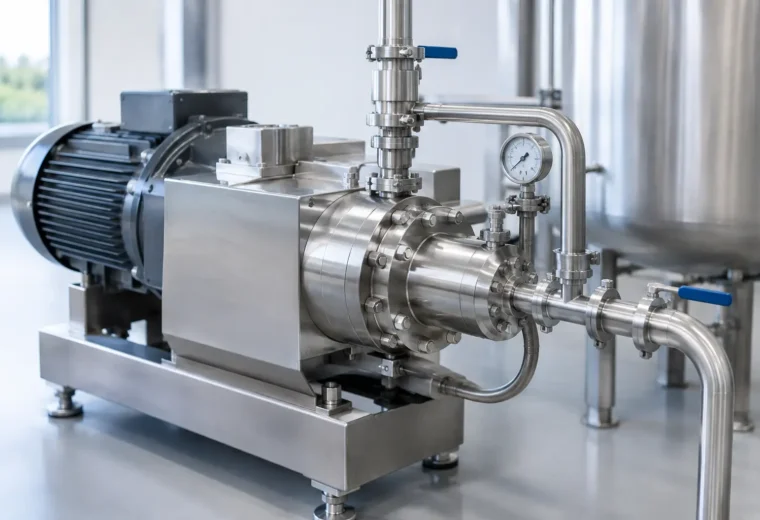
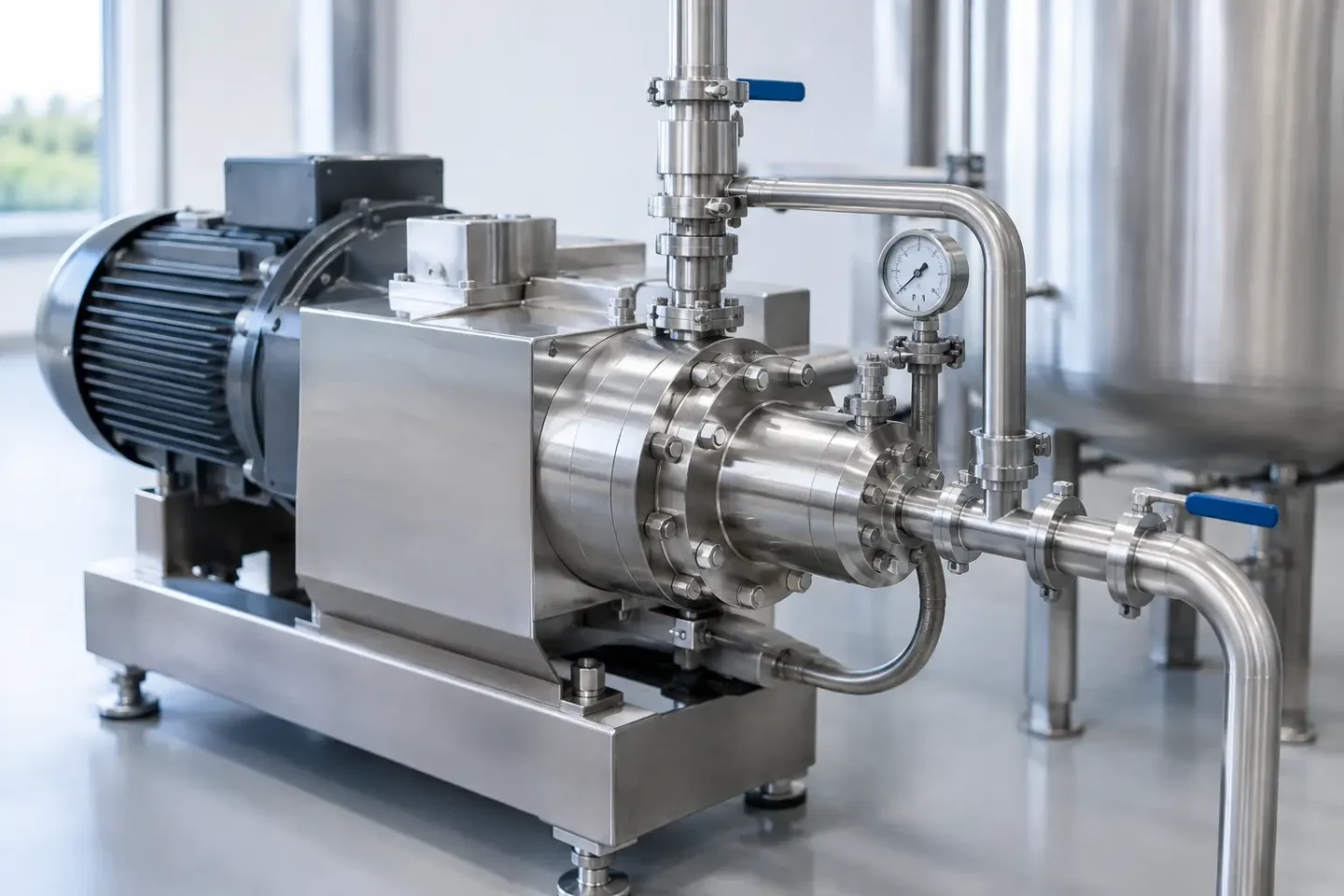
An inline homogenizer uses a high-speed rotor and stationary stator to create intense mechanical and hydraulic shear. Product is drawn into the workhead, accelerated through the rotor-stator clearance, and discharged at high velocity. The resulting turbulence, impact, and shear can break agglomerates, distribute phases, and produce finer droplets in emulsions.
That description is accurate, but it does not establish performance. Two machines with similar motor ratings can deliver materially different results because rotor tip speed, stator pattern, workhead clearance, product residence time, and recirculation design all affect the shear exposure experienced by the material.
Start with the required product result
A useful specification defines the desired outcome in measurable terms. For an emulsion, that may be droplet-size distribution, visual stability, viscosity, or resistance to phase separation after thermal cycling. For a powder dispersion, it may be the absence of fisheyes, a target particle-size distribution, hydration time, or downstream filter performance.
“Homogenized” is not a sufficient acceptance criterion. It gives equipment suppliers too much room to interpret the duty and gives production teams no practical benchmark for validation. Process engineers should establish how product quality will be measured, at what point in the process it will be measured, and which variables can change without compromising the specification.
The target result also determines whether a single pass is realistic. Some products respond well to a once-through inline homogenizer installed after a premix tank. Others require controlled recirculation through the workhead until the required droplet size or dispersion quality is achieved. A continuous process may need multiple homogenization stages, a recirculation loop, or a different technology altogether.
Evaluate viscosity at actual process conditions
Viscosity is one of the most common sources of incorrect equipment selection. A product that measures 3,000 cP in a laboratory sample may behave very differently at 45°F, at elevated solids loading, or after a polymer has fully hydrated. Many formulations are also non-Newtonian: their apparent viscosity changes with shear rate, temperature, and time.
Inline homogenizers perform best when product can reliably enter and pass through the workhead. As viscosity rises, flow through a standard inline unit can become limited, pressure drop increases, and the machine may no longer generate the desired circulation or shear distribution. A positive displacement feed pump, a recirculation loop, a larger workhead, or a batch high-shear mixer may be the better engineering answer.
This does not mean high-viscosity products cannot be processed inline. It means the system must be designed as a system. Feed conditions, piping diameter, pump capability, jacket temperature, and the position of the homogenizer all matter as much as the homogenizer itself.
Distinguish homogenization from milling
An inline rotor-stator homogenizer is excellent for deagglomeration, emulsification, wetting, and dispersion. It can reduce soft agglomerates and disperse many powders effectively. It is not automatically the right choice for hard crystalline particles, narrow micron-level particle-size targets, or materials requiring tightly controlled milling energy.
When particle reduction is the central process requirement, a colloid mill, media mill, wet mill, or other dedicated size-reduction technology may be necessary. In other applications, the most effective arrangement combines equipment: a powder induction system for rapid wetting, an inline homogenizer for dispersion, and a finishing mill only where final particle size demands it.
The trade-off is straightforward. More aggressive processing may improve appearance or stability, but it can also raise product temperature, damage shear-sensitive ingredients, introduce air, or consume unnecessary energy. The best process is the one that meets the product specification with a stable operating margin, not the one that applies the maximum possible shear.
The Equipment Features That Affect Production Performance
A meaningful inline homogenizer equipment review should look beyond the workhead. Production performance depends on mechanical design, sanitary construction, maintainability, controls, and how well the equipment fits the full process line.
Rotor-stator configuration and tip speed
Rotor-stator design governs how material is pulled into the workhead and how it exits. Coarse stators generally support faster circulation and initial powder wetting. Fine slots or holes can create higher localized shear and finer dispersion, but may restrict flow or increase plugging risk with fibrous, high-solids, or particulate products.
Tip speed is an important indicator of shear potential, but it should not be used alone. Higher tip speed can improve dispersion, yet it can also generate heat and accelerate wear. A capable supplier should review the product rheology, solid particle characteristics, temperature limit, and required throughput before recommending a workhead design.
Flow rate, recirculation, and residence time
Nameplate flow capacity is frequently misunderstood. A unit may be capable of moving a stated volume of low-viscosity water, but that number does not confirm it will process a viscous emulsion or slurry at the same rate. It also does not indicate the number of passes needed to reach the required quality level.
For batch processing, calculate the recirculation turnover time using the actual product flow rate, not the maximum theoretical flow rate. Then validate the result with a representative trial. A 1,000-gallon batch recirculated at 100 gallons per minute behaves differently from a 1,000-gallon batch recirculated at 400 gallons per minute, even if both use the same motor power.
For continuous processing, flow stability becomes equally important. Pulsation from upstream pumps, variable ingredient addition, and changing viscosity can cause inconsistent treatment. Instrumentation for flow, pressure, and temperature provides the operating data needed to maintain repeatability.
Sanitary design and cleanability
For food, beverage, pharmaceutical, personal care, and specialty chemical operations, cleaning performance is a process requirement, not an afterthought. Product-contact materials, surface finish, elastomer compatibility, drainability, seal design, and clean-in-place coverage should be evaluated against the actual cleaning protocol.
A machine that produces excellent dispersion but requires frequent manual disassembly can become an expensive bottleneck. Conversely, an elaborate clean-in-place design may not be justified for a non-sanitary product with long campaigns and simple washout requirements. The appropriate design depends on contamination risk, changeover frequency, regulatory expectations, and labor availability.
Ask how seals are cooled and lubricated, how wear components are inspected, and whether the workhead can be serviced without removing major piping. These details affect uptime more than a catalog photograph ever will.
Integration Often Determines the Result
An inline homogenizer is only one part of the process. Poor upstream wetting can overwhelm even a high-performance workhead. Inadequate tank agitation can leave unmixed zones that never reach the recirculation loop. Incorrect pump selection can starve the homogenizer, while undersized piping can create avoidable pressure losses and cleaning difficulties.
Powder addition deserves particular attention. Adding powders directly into a recirculation stream without sufficient vacuum induction, liquid velocity, or wetting control can create persistent agglomerates. A properly engineered powder induction system may reduce batch time and improve dispersion before the product reaches the homogenizer.
Automation should reflect the process risk. At a minimum, monitored flow, temperature, pressure, and motor load help operators recognize changes in product behavior. For critical formulations, recipe control, controlled recirculation time, valve sequencing, and data capture provide stronger batch repeatability and simplify troubleshooting.
How to Compare Suppliers and Validate the Selection
The most useful supplier comparison is not a feature checklist. It is a review of how each supplier approaches the application. A credible proposal identifies the assumptions behind capacity, viscosity range, flow conditions, particle characteristics, and expected product result. It also identifies uncertainties that should be resolved through testing.
Request a trial using representative ingredients whenever product quality or throughput is consequential. Laboratory trials are valuable for screening, but pilot or production-scale trials are more reliable when viscosity, batch volume, thermal behavior, and powder addition dynamics are likely to change with scale. Define the test criteria before the trial starts, including sample points, analytical methods, acceptable variation, and cleaning observations.
Total cost should include more than purchase price. Evaluate utility demand, seal and workhead wear, planned maintenance, cleaning time, operator intervention, spare-parts availability, and lost production during changeovers. A lower-cost homogenizer can become the higher-cost choice when it cannot maintain the required product quality at the intended throughput.
PerMix approaches inline homogenization as a process-engineering decision: characterize the material, establish the required result, and configure the equipment and surrounding system to perform reliably under real production conditions. The right unit is not simply the fastest or highest-shear option. It is the one that gives your operation measurable product consistency, practical cleanability, and dependable capacity shift after shift.