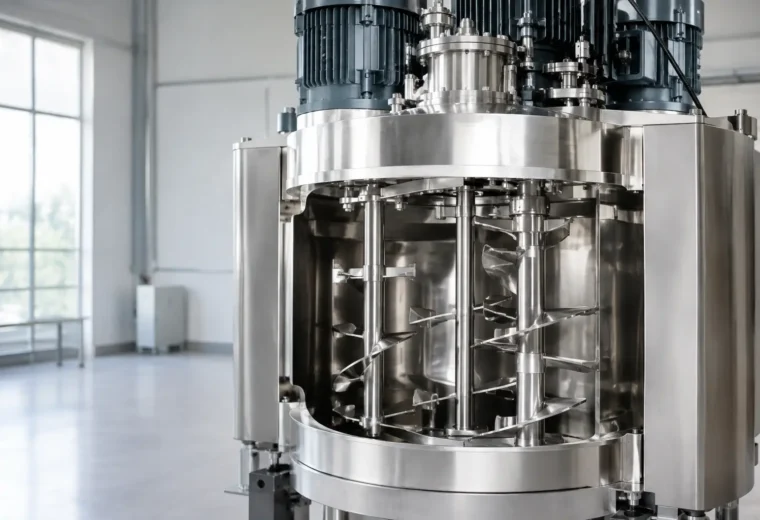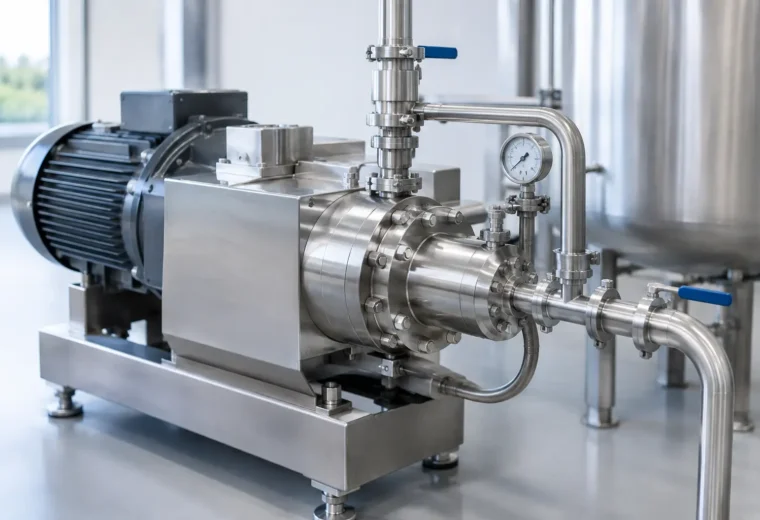
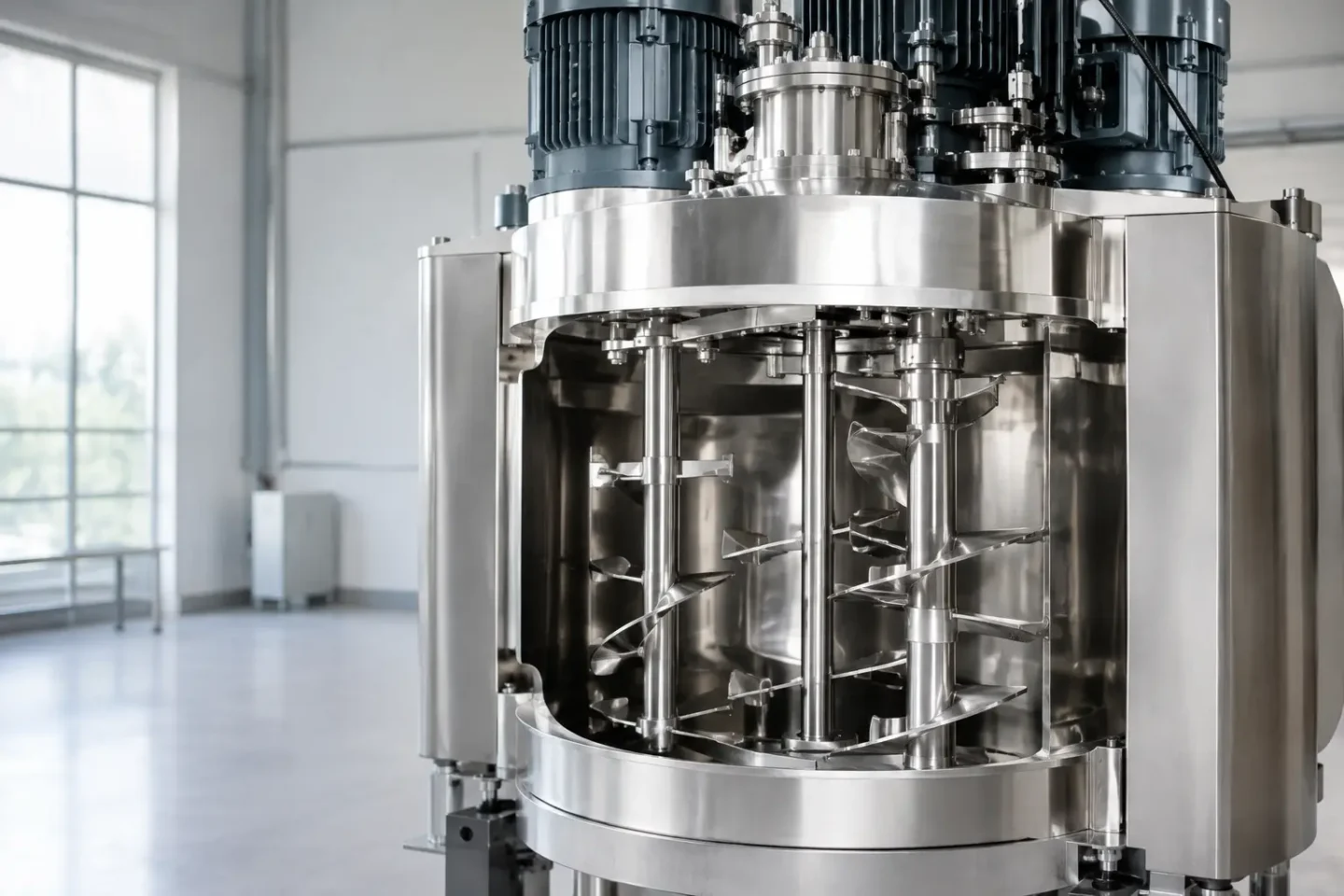
A formulation can look homogeneous at the vessel wall while dry powder pockets, unmixed pigments, or entrained air remain in the batch center. That is the production problem planetary multishaft mixers are designed to solve. By combining multiple independently driven mixing elements with planetary motion, these systems apply controlled bulk turnover and localized shear where conventional single-shaft equipment can lose effectiveness.
For manufacturers processing adhesives, sealants, battery materials, composites, coatings, inks, silicone compounds, pharmaceuticals, cosmetics, and other high-value viscous products, mixer selection is not a catalog decision. It directly affects dispersion quality, batch cycle time, yield, downstream filling, and the ability to repeat a validated process at production scale.
How Planetary Multishaft Mixers Work
A planetary multishaft mixer uses two or more mixing tools that rotate on their own axes while traveling around the vessel. This planetary path continually changes the tools’ position within the batch, sweeping the vessel volume rather than working only in a fixed circular pattern.
The exact tool arrangement depends on the product and process objective. A common configuration pairs slow-speed planetary blades or sweeping elements with one or more high-speed dispersers. The slow-speed elements move dense material from the vessel wall and bottom toward the active mixing zone. High-speed dispersers create the localized velocity gradients needed to wet powders, break agglomerates, distribute pigments, or disperse functional additives.
This division of work matters. High shear alone is not a complete answer for a viscous batch because material may resist movement into the disperser zone. Bulk movement alone may produce a uniform-looking blend without achieving the required particle dispersion. A properly engineered multishaft system coordinates both mechanisms.
The role of vessel geometry and clearance
Tool design is only one part of the mixing system. Vessel diameter, working volume, blade-to-wall clearance, bottom profile, and tool elevation all influence circulation patterns and dead-zone risk. A small change in clearance can affect wall sweeping, heat transfer, product retention, and cleanout performance.
For this reason, a mixer that performs well with a low-viscosity premix may not produce the same result after powder loading increases viscosity by several orders of magnitude. The operating condition at the most difficult point in the batch, not only the starting condition, should drive equipment design.
Where Planetary Multishaft Mixers Deliver Value
Planetary multishaft mixers are particularly effective when formulations transition from liquid to paste, contain high solids, or require the simultaneous control of dispersion and bulk homogenization. They are widely used where product consistency carries a high cost, such as a coating with a narrow color tolerance or an adhesive whose rheology controls application performance.
In battery slurry production, for example, conductive additives and active powders must be incorporated without persistent agglomerates while solvent level, solids loading, and air inclusion are controlled. In sealants and silicone compounds, the mixer must distribute fillers through a highly viscous base while maintaining a repeatable temperature profile. In inks and coatings, pigment wetting and deagglomeration must be balanced against excess shear that can alter the formulation or generate unnecessary heat.
The equipment can also support development-to-production scale-up when the process is defined correctly. Scale-up should not rely only on matching vessel volume or motor horsepower. Engineers must consider tip speed, power per unit volume, torque demand, mixing time, heat-transfer area, addition sequence, and the evolving rheology of the material.
Vacuum Processing Changes the Result
Many demanding formulations benefit from vacuum mixing. Entrained air can cause defects in filled products, reduce density consistency, interfere with coating quality, create voids during curing, or compromise downstream packaging accuracy. Vacuum also assists with powder incorporation by removing air released during wetting.
A vacuum-rated planetary multishaft system can mix and deaerate in the same closed vessel, reducing transfers and limiting material exposure. That can improve both product quality and process control, especially for moisture-sensitive, solvent-based, or high-value formulations.
Vacuum is not automatically required. If a product has low viscosity, tolerates air, and is processed through a downstream degassing step, a non-vacuum system may be the more economical choice. The correct decision depends on the material behavior and the quality requirements of the finished product, not on adding features that the process does not need.
Thermal Control Must Be Engineered Into the Batch
Viscous mixing generates heat. High-speed dispersion adds more. If that heat is not managed, temperature-sensitive binders, resins, flavors, actives, or solvents can be affected before operators see a clear warning in the batch.
Jacketed vessels, temperature-controlled circulation systems, and appropriately designed mixing tools help manage this risk. However, jacket area alone does not guarantee thermal control. The batch must circulate effectively near the heat-transfer surface, and the process must account for heat generated by shear as well as heat removed through the vessel wall.
Thermal requirements often become more demanding as solids loading rises. A low-viscosity liquid may transfer heat efficiently, while a dense paste can insulate the vessel wall and create localized temperature differences. Evaluating the complete batch profile is more useful than specifying a jacket based only on final volume.
Selecting the Right Configuration
The right planetary multishaft mixer begins with material data and a clear production objective. Viscosity is a useful starting point, but it is not enough. Many materials are non-Newtonian, thixotropic, shear-sensitive, temperature-dependent, or prone to rapid viscosity increases during powder addition.
An effective engineering review should establish how the batch is made today, where defects occur, and what measurable improvement is needed. That includes raw material particle size, bulk density, powder-to-liquid ratio, order of addition, target dispersion quality, allowable batch temperature, cleaning method, and expected production schedule.
Several questions have a direct effect on machine selection:
- Does the product require true particle deagglomeration or only bulk blending?
- At what stage does the batch reach its highest viscosity and torque demand?
- Is vacuum needed for deaeration, solvent control, or moisture protection?
- Must the vessel support heating, cooling, pressure, or inert gas blanketing?
- How will the batch discharge into downstream packaging, extrusion, milling, or further processing?
These questions also determine whether a multishaft planetary design is the best fit. A double planetary mixer may be preferable for very high-viscosity products that need strong bulk kneading but limited high-shear dispersion. A high-speed disperser may be sufficient for lower-viscosity coatings or emulsions. For continuous production, an inline system may offer better throughput than a batch mixer. The process requirement should determine the equipment category.
Design Details That Affect Long-Term Performance
Industrial buyers should evaluate more than drive power and vessel capacity. Torque capacity at low speed is critical for heavy formulations. Variable-speed control allows operators to manage powder wetting, shear input, and temperature rise through different stages of the batch. A reliable lift system, properly designed seals, and accessible cleaning surfaces affect uptime just as much as mixing performance.
Controls also deserve careful attention. Recipe management can standardize sequencing, mixer speeds, vacuum level, temperature limits, and hold times across shifts. Load cells can improve dosing accuracy and provide useful batch data. For validated or regulated production, the automation architecture must align with documentation, traceability, and quality requirements from the start.
Discharge is another frequent source of lost productivity. A well-mixed product still creates a poor process if it remains in the vessel, requires excessive manual scraping, or cannot feed the next operation consistently. Vessel tilt, bottom discharge valves, extruder discharge systems, and transfer pumps must be matched to final product rheology.
PerMix approaches these systems as complete process solutions, considering the mixer, vessel, drive train, vacuum capability, thermal control, automation, and downstream handling as connected engineering decisions rather than separate purchases.
A Better Basis for Investment
The lowest initial machine price is rarely the lowest process cost. A mixer that extends batch time, requires repeated rework, leaves excessive heel, or produces inconsistent dispersion can consume far more value than it saves during procurement. Conversely, overspecifying shear, vacuum, or automation adds capital cost without a return when the formulation does not require those capabilities.
The best investment is the configuration that achieves the specified product result at the required batch size with predictable cycle time, manageable cleaning, and dependable operation. When the formulation is difficult, pilot testing and process evaluation provide a much stronger basis for specification than assumptions drawn from a similar-looking product.
For manufacturers facing high-solids, high-viscosity, or quality-sensitive batch processes, the practical question is not simply which mixer can turn the material. It is which engineered mixing system can produce the same acceptable result, batch after batch, as production demands increase.