Industrial Mixers
PerMix News & Updates
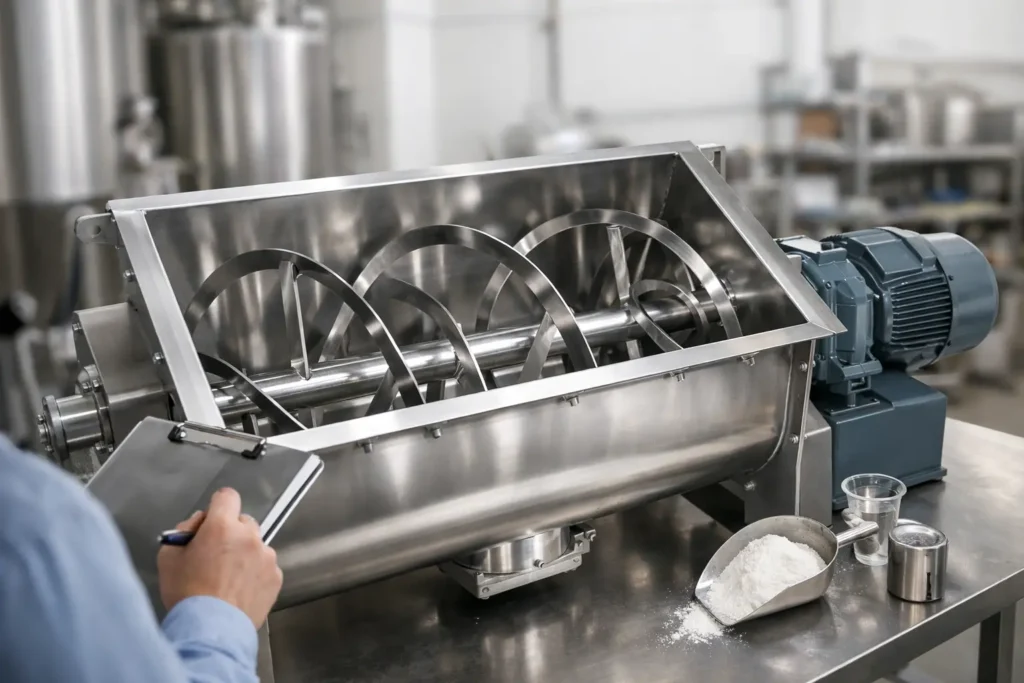
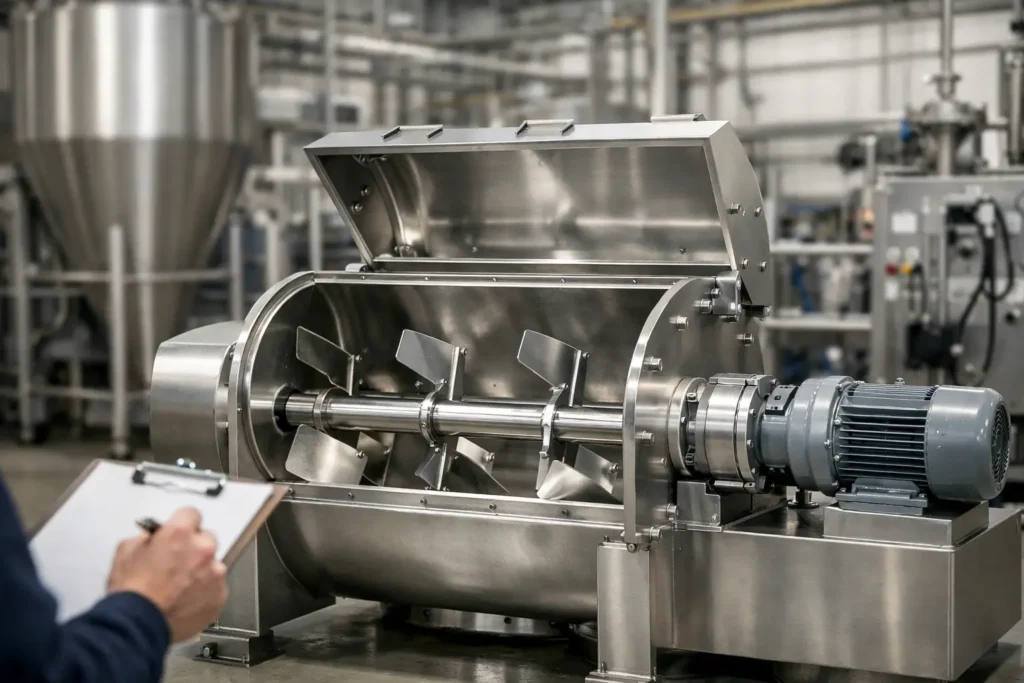
A ribbon blender that looks right on paper can still miss the mark on your production floor. The issue is usually not the machine category itself. It is a mismatch between the blender design and the material, batch target, cleaning standard, or discharge requirement. If you are evaluating how to select ribbon blender equipment for an industrial process, the right starting point is not horsepower or price. It is application fit.
Ribbon blenders remain one of the most efficient and cost-effective options for dry blending across food, chemical, nutraceutical, agricultural, and many other manufacturing environments. They handle free-flowing powders and granules exceptionally well, and with the right configuration they can also support liquid addition, light paste conditioning, heating, cooling, vacuum operation, and sanitary production. But they are not a one-size-fits-all answer. Selection should be driven by what you are mixing, how you run production, and what level of performance you need to protect product quality and throughput.
The most common buying mistake is selecting by vessel volume alone. Capacity matters, but usable working volume, material bulk density, fill level, and blend cycle target all affect real output. A 500-cubic-foot machine does not automatically produce the same practical result across different formulations. Fine spice blends, dense mineral powders, and fragile agglomerated ingredients all behave differently inside the same trough.
Start with the material profile. A ribbon blender performs best when the product flows well enough to circulate through the inner and outer ribbons. If the formulation bridges, packs, smears, or forms hard lumps during the cycle, you may need a modified ribbon design, choppers, a different discharge arrangement, or in some cases a different mixer style entirely. This is where technical review matters. The right machine is the one that fits the material behavior, not the one with the most familiar name.
Bulk density is one of the first numbers to verify because it affects both batch weight and motor load. Many buyers start with the desired pounds per batch, then back into required volume based on density. That is the correct direction. If density varies widely from one formula to another, you should size around the most demanding or most important production case.
Particle size distribution also matters. Blending a narrow, similar-size powder is generally straightforward. Mixing ingredients with major differences in particle size, shape, or density raises the risk of segregation during blending, discharge, or downstream transfer. In those cases, the blender may still be appropriate, but the design and operating window need closer attention.
Liquid addition is another key checkpoint. Many ribbon blenders can incorporate a controlled amount of oil, flavor, binder, or active solution through spray nozzles. The question is not simply whether liquid can be added. The real question is how much can be added before the product shifts from free-flowing to sticky and starts coating the ribbons or vessel wall. That threshold varies by formulation.
Ribbon blenders are typically designed to operate within a defined fill range rather than at full geometric volume. Overfilling reduces circulation efficiency. Underfilling can also hurt blend performance because the ribbons do not engage the product mass properly. That means your expected batch size should align with the machine’s effective working capacity, not just its total shell volume.
Throughput planning should include more than blend time. In real production, total cycle time includes loading, blending, liquid addition if required, sampling, discharge, and cleaning. A blender that mixes in eight minutes but takes twenty minutes to empty or clean may become a bottleneck. Plant managers and production engineers should evaluate the full operating cycle before making a decision.
If future growth is part of the equation, it is worth balancing current efficiency against expansion plans. Oversizing too aggressively can reduce performance on smaller batch runs. On the other hand, a machine sized only for today’s demand may force an earlier capital upgrade than expected. The best answer depends on your product mix and forecasted production pattern.
Standard horizontal ribbon blenders are widely used because they deliver reliable convective mixing with a practical cost profile. But within that category, there are meaningful design choices. Ribbon geometry, shaft speed, trough shape, discharge valve style, end plate sealing, surface finish, and optional intensifier choppers all influence performance.
For straightforward dry powder blending, a standard double-ribbon design is often enough. For formulations that need faster deagglomeration or liquid dispersion, high-speed choppers may improve results. For heat-sensitive materials, jacketed designs can help control product temperature. For sanitary applications, weld quality, polished surfaces, clean-out access, and shaft seal selection become far more important than cosmetic specifications.
Discharge design deserves more attention than it usually gets. A ribbon blender can mix well and still leave too much heel if the valve arrangement is not suited to the product. Butterfly valves, bomb-bay doors, slide gates, and custom outlet configurations each have trade-offs. If expensive actives or allergen changeovers are involved, residual hold-up is not a minor detail.
If you operate in food, nutraceutical, pharmaceutical, or health and beauty manufacturing, cleaning validation and hygienic design can drive the selection as much as mix performance. In those environments, smooth internal finishes, crevice-free welds, sanitary access ports, spray systems, and seal design all affect how practical the machine is to own.
A lower-cost unit may appear attractive until cleaning labor, downtime, and cross-contamination risk are factored in. That is why procurement should evaluate total operating value, not just initial equipment cost. The best-priced blender is the one that supports production efficiency, consistent quality, and acceptable maintenance over the long term.
Material of construction should also reflect the application. Carbon steel may be suitable for some industrial powders, while stainless steel is often preferred or required for sanitary and corrosion-sensitive processes. Product reactivity, washdown practice, and environmental exposure should guide the choice.
Motor size should be based on the heaviest expected load, product resistance, startup conditions, and any special duty such as liquid addition or densifying blends. More horsepower is not automatically better. Excessive speed or power can damage fragile particles, create heat, and reduce consistency in some formulas.
What matters more is balanced mechanical design. A well-engineered ribbon blender should deliver dependable torque transmission, stable shaft support, proper ribbon clearances, and durable seals and bearings suited to the duty cycle. For industrial buyers, uptime is a specification. A cheaper machine that requires repeated maintenance is usually more expensive in practice.
This is also where vendor engineering support becomes important. Application testing, specification review, and custom adaptation often separate a good purchase from a marginal one. PerMix, for example, works with customers across powder, liquid, and paste applications where standard equipment may need process-specific modifications.
When teams ask how to select ribbon blender equipment, the best answers usually come from a short list of practical questions. What is the bulk density range? What is the target batch size and acceptable cycle time? How free-flowing is the product before and after liquid addition? Is the process sanitary, explosive, abrasive, or corrosive? How clean does the discharge need to be? Will the blender run one formula all week or multiple changeovers every day?
Those answers shape the right configuration far more than catalog capacity alone. They also help determine whether a ribbon blender is truly the best fit or whether another mixer type would produce better uniformity, gentler handling, faster cycles, or easier cleaning.
A strong equipment decision should reduce process risk, not just fill a line item on a capital plan. If you approach selection with clear material data, realistic throughput goals, and attention to cleaning and discharge details, a ribbon blender can deliver excellent value for years. The smartest purchase is not the biggest machine or the cheapest one. It is the blender engineered for the way your plant actually runs.

Stay Connected