
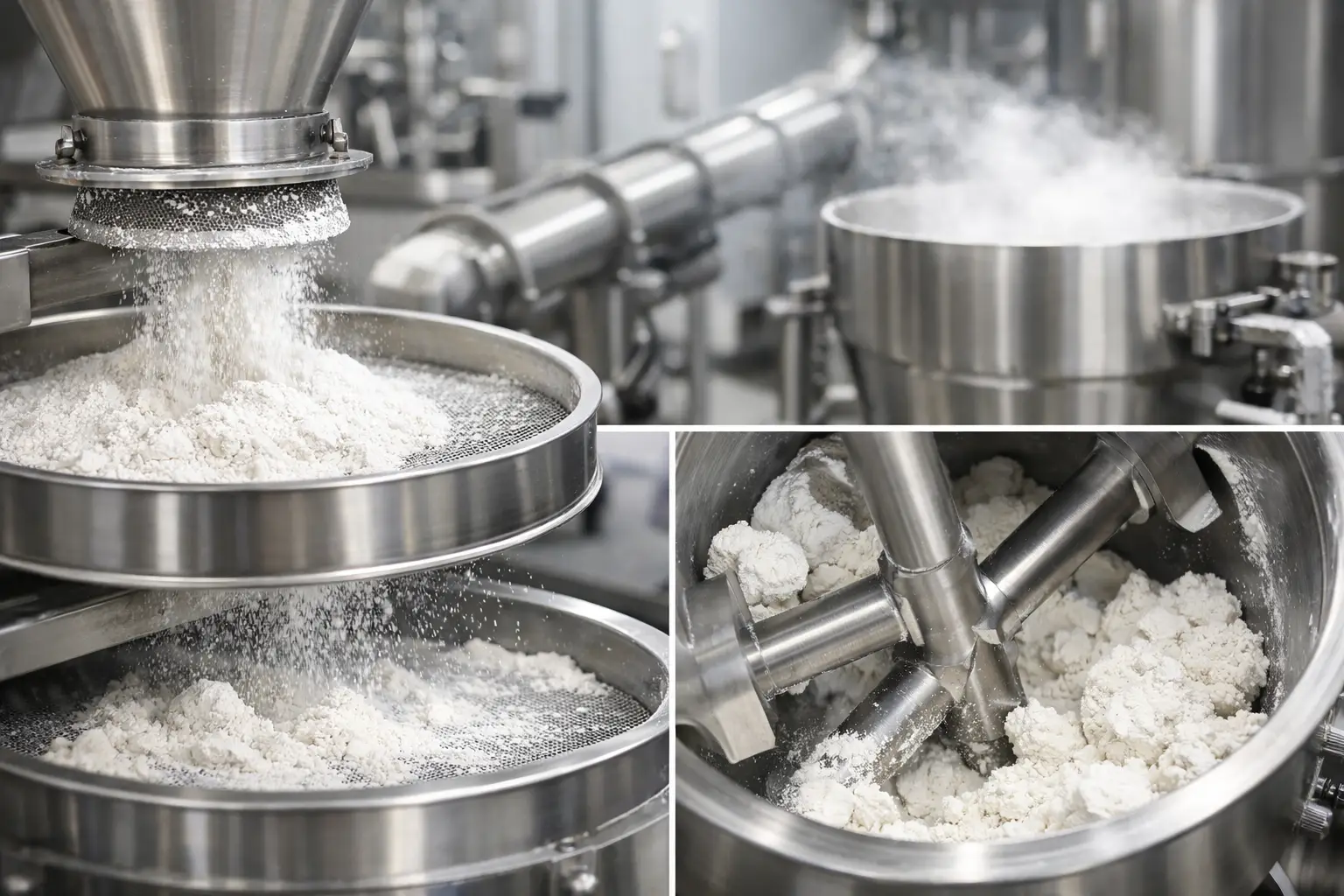
Powder lumps rarely begin at the mixer. They often enter with hygroscopic raw materials, develop during storage, or form the moment liquid contacts an unprepared powder bed. For manufacturers asking what equipment reduces lump formation, the correct answer depends on when the agglomerates form, how strong they are, and whether the process must preserve or intentionally change particle size.
A lump can create far more than an appearance problem. In dry blends, it can carry a concentrated dose of an active ingredient, colorant, flavor, or mineral. In liquid systems, undispersed fish eyes and hydrated gel particles can extend batch time, obstruct downstream filters, and compromise product texture. The equipment decision should therefore begin with material behavior and process objectives, not with a general-purpose machine selection.
What Equipment Reduces Lump Formation Most Effectively?
The most effective equipment is usually a combination of controlled feeding, particle conditioning, and mixing energy applied at the right point in the process. Milling systems, rotary sifters, high-shear mixers, powder induction systems, and plough mixers each address a different mechanism of lump formation.
A simple rule is useful: use screening or milling when lumps already exist in a dry ingredient; use high-intensity mixing when agglomerates must be broken during blending; and use powder induction with high shear when powders form hydrated clumps on contact with liquid. Some applications require all three approaches in sequence.
Milling systems for dry, compacted agglomerates
A mill is often the first equipment to evaluate when raw materials arrive with soft to moderately hard lumps caused by transport, compression, moisture pickup, or long storage. Cone mills, hammer mills, and other particle-size reduction systems can condition the ingredient before it enters the blender or process vessel.
The right mill must deliver a defined particle-size range without excessive heat generation, fines production, or damage to fragile ingredients. A hammer mill can provide aggressive reduction for tougher agglomerates, while a cone mill may be a better fit for controlled deagglomeration and narrow screen-defined sizing. For heat-sensitive food ingredients, pharmaceuticals, specialty chemicals, and low-melting materials, excessive tip speed may solve the lump problem while creating a new quality problem.
Milling is not always necessary. If the material contains only occasional oversize pieces, screening may protect the process at lower energy and with less particle attrition.
Rotary sifters and screens for oversize control
Rotary sifters, vibratory screeners, and inline screens remove or separate oversize material before it reaches critical downstream equipment. They are especially valuable when the goal is to protect a mixer, filling line, extruder, powder induction system, or final product specification from isolated foreign material and persistent hard lumps.
A screen does not truly break a lump apart unless its operating design applies enough mechanical action. Its primary value is classification. Material that passes proceeds to production, while oversize is rejected, recovered, or routed back through a mill. This approach is often preferable when product particle size must remain intact.
Screen selection requires attention to mesh size, throughput, screen blinding risk, and cleaning access. Sticky, fatty, damp, or electrostatically charged powders may blind a fine screen quickly. In those cases, upstream drying, a larger screen opening, a milling step, or a different conveying method may be required.
Plough and paddle mixers for dry-blend deagglomeration
For dry powders and granules, a plough mixer can combine rapid convective movement with high-speed choppers that break soft agglomerates as the batch circulates. The plough tools fluidize and exchange material throughout the vessel, while the choppers apply localized shear where it is needed.
This configuration is effective for formulations in which small lumps form during ingredient addition or where modest agglomeration develops during storage. It can also distribute liquids, fats, binders, or minor ingredients more consistently than low-energy blending alone when the formulation is prone to localized wet spots.
A paddle mixer may be the better choice when ingredients are fragile, density differences are substantial, or the process requires gentler handling. Paddle mixing can deliver excellent uniformity, but it generally provides less deagglomeration energy than a plough mixer equipped with choppers. The trade-off is clear: more shear can reduce lumps, but it can also create fines, alter particle shape, and increase equipment wear.
High-shear mixers for wet lumps and viscous dispersions
When powder is added to liquid, the most persistent lumps often form through surface hydration. Water-soluble gums, starches, proteins, carbomers, cellulose derivatives, and similar materials can develop a hydrated outer shell before the dry center has dispersed. These fish eyes may resist ordinary agitation for hours.
A high-shear mixer uses a rotor-stator assembly to create intense local turbulence, suction, and mechanical shear. It draws material into the workhead, accelerates it through tight clearances, and forces it back into the batch at high velocity. This action rapidly disperses wetted powder and breaks down soft agglomerates.
High-shear mixing is particularly effective when the batch needs emulsification, suspension, hydration, or fine dispersion in addition to lump elimination. However, it should be specified carefully. Excessive shear can entrain air, raise product temperature, reduce viscosity in shear-sensitive systems, or damage particles that need to remain intact. Batch geometry, rotor-stator design, circulation rate, and processing time all matter.
Powder induction systems for controlled wetting
A powder induction system is often the strongest process solution when lump formation occurs during powder addition to liquid. Instead of manually dumping bags into an open vessel, the system uses vacuum to draw powder from a hopper or bag station into a high-velocity liquid stream. The powder is wetted and dispersed immediately before it can float, bridge, or form a surface crust.
This arrangement improves both product quality and manufacturing control. It can reduce dust exposure, shorten addition times, lower operator handling, and improve repeatability from batch to batch. For difficult hydrocolloids and other fast-hydrating materials, the addition rate must still be matched to the available liquid flow and shear capacity. Feeding powder faster than the system can wet it will recreate the same lumping problem inside the process line.
Powder induction also works best when the upstream material flows consistently. Bridging in the hopper, variable bulk density, or moisture-affected powders can cause surging. Agitation, hopper geometry, load-cell control, and loss-in-weight feeding may be justified for demanding formulations.
Select Equipment Based on the Lump Mechanism
Equipment selection should follow a material and process assessment. The key questions are whether lumps are present before processing, form during storage, develop during liquid addition, or appear after thermal treatment or drying. A dry, compacted sugar agglomerate and a hydrated xanthan gum fish eye may look similar in a sample, but they require entirely different process strategies.
Particle strength is equally important. Soft agglomerates may break with mixer choppers or a moderate-energy mill. Hard compacted material may require a dedicated milling stage. If particle-size distribution is critical, the system should target deagglomeration rather than broad size reduction.
The production environment also affects the final recommendation. Hygroscopic powders may require conditioned storage, sealed transfer, dry-air handling, or shorter exposure time before processing. Materials that form lumps after spray drying may need cooling before packaging. High-fat powders can require temperature control to prevent smearing and screen blinding. No mixer can permanently correct a raw-material handling problem that continuously creates new agglomerates upstream.
Design the Full Process, Not Just the Mixer
The best equipment for reducing lumps is often part of an integrated system: bulk bag unloading or bag dumping, controlled conveying, screening or milling, batching, mixing, liquid addition, and automated cleaning. Each stage affects the next.
For example, a manufacturer may install a more powerful mixer and still see inconsistent batches because the powder is dumped too quickly into liquid. Another plant may add a mill but continue to experience lumps because humidity causes re-agglomeration before the ingredient reaches the blender. Process diagnostics should include raw-material moisture, storage time, transfer distance, feed rate, liquid temperature, mixer speed, and batch sequence.
PerMix engineers these systems around the material, not around a standard machine configuration. That means validating the required mixing energy, screening or milling duty, powder addition method, sanitary design, automation level, and discharge performance against actual production targets.
A practical starting point is to test representative material under realistic conditions. Measure lump size before and after processing, check blend uniformity or dispersion quality, and evaluate whether the solution affects throughput, product temperature, cleanability, or particle integrity. The right equipment should reduce agglomerates while improving the repeatability that production teams depend on.
Lump formation is a process signal. Treating it as a single-machine problem can lead to unnecessary capital cost or inconsistent results. When the source of agglomeration is defined first, the equipment selection becomes clearer – and the resulting process is more stable, cleaner, and easier to scale.