Abrasive formulations do not fail because a mixer lacks horsepower. They fail when the mixer’s geometry, contact surfaces, seals, and discharge arrangement are not matched to particle hardness, size distribution, bulk density, and batch duty. The best mixers for abrasive materials are therefore not a single equipment category. They are engineered systems selected around the material’s wear mechanism and the production result the plant must achieve.
Silica, mineral fillers, ceramic powders, metal powders, cementitious blends, glass frit, catalysts, battery materials, and refractory compounds can all create accelerated wear. Some erode vessel walls and mixing tools through sliding contact. Others attack high-velocity zones, valve seats, bearings, and seals. A mixer that produces a uniform blend on day one but develops clearance changes, contamination risks, or unreliable discharge after several months is not the right production solution.
Start With the Abrasion Mechanism
Abrasiveness is more complex than a material safety data sheet classification. The first engineering question is how particles move through the mixer. Fine, hard powders can act like polishing media against surfaces. Coarse angular particles can cut and gouge. Dense solids can concentrate load at the bottom of the trough or vessel, while high-speed agitation can turn a manageable wear issue into a recurring maintenance event.
Particle hardness is relevant, but it is only one input. Engineers should also evaluate particle shape, median and maximum particle size, moisture content, bulk density, flowability, batch size, mixing time, operating temperature, and whether liquid binders are introduced. A dry mineral blend and a dense abrasive slurry may contain similar solids, yet they can require entirely different mixer configurations.
The target process matters just as much. Is the goal a fast dry blend, a gentle distribution of fragile granules, coating of powders with a small liquid addition, dispersion into a viscous binder, or vacuum processing to remove entrained air? The equipment choice should protect both product uniformity and long-term mechanical reliability.
Best Mixers for Abrasive Materials by Process Duty
Plough Mixers for Fast, Intensive Powder Blending
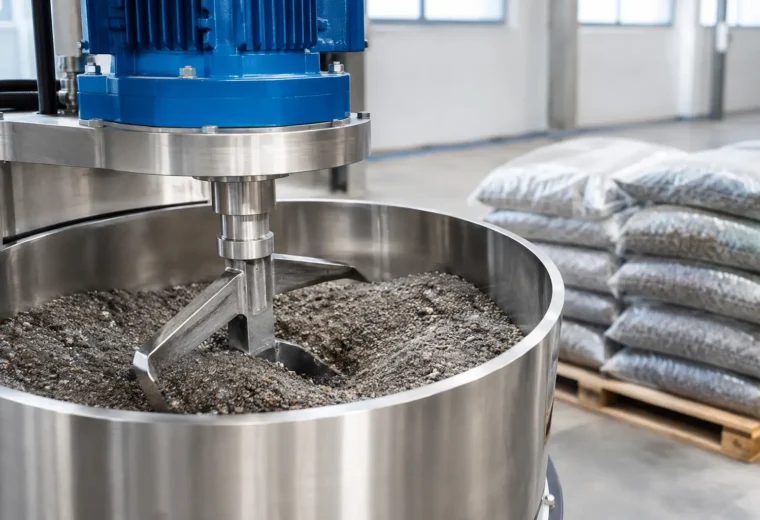
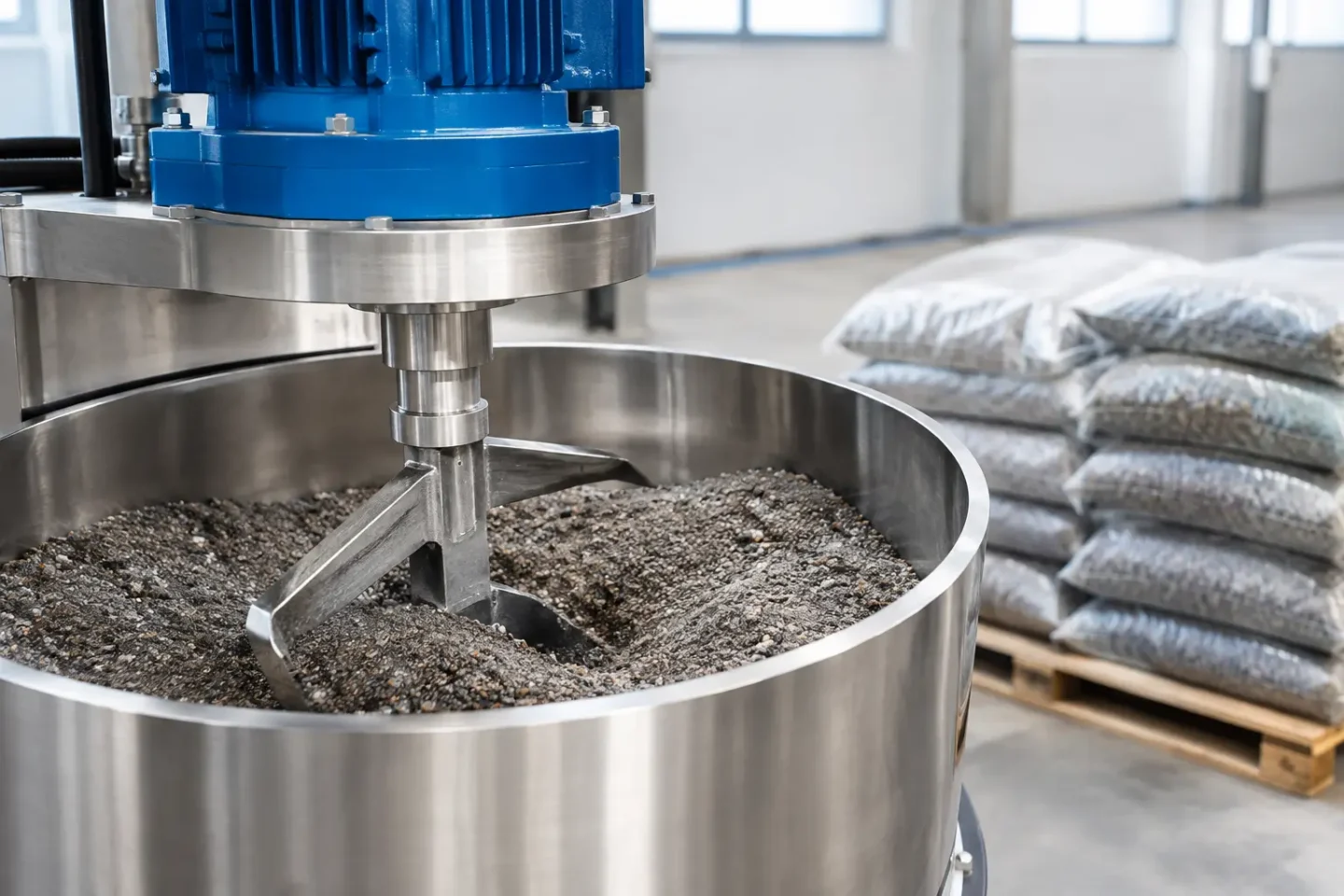
Plough mixers are often a strong choice for abrasive powders and granules requiring rapid, high-intensity mixing. Their plough-shaped elements create a mechanically fluidized mixing zone, moving material away from the vessel wall and promoting three-dimensional particle exchange. This makes them effective for dry blends, low-level liquid additions, and processes that need short cycle times.
For abrasive service, the key is not simply specifying a standard plough mixer. Wear liners, hardfaced ploughs, replaceable wear tips, reinforced choppers where required, and protected discharge components should be evaluated as a complete package. Choppers can be valuable when breaking soft agglomerates or dispersing liquid additions, but they also introduce high-speed wear zones. If the formulation does not require them, eliminating unnecessary high-speed components can reduce lifecycle cost.
Plough mixers are less suitable when the product is highly viscous, cohesive, or prone to packing into a dense mass. In those cases, a different mixing mechanism is usually more efficient and more predictable.
Paddle Mixers for Controlled, Lower-Shear Blending
Paddle mixers provide a more controlled mixing action than plough designs and can be well suited to abrasive materials where preserving particle shape or limiting fines generation matters. The overlapping paddle pattern creates a fluidized mixing bed while operating with lower mechanical intensity. This is often beneficial for dry mineral blends, granular products, and formulations containing a fragile component alongside abrasive solids.
A paddle mixer can also offer practical advantages in wear management. Its mixing elements may be simpler to inspect and replace, and lower operating speed can reduce erosion in certain duties. However, lower shear is not automatically better. If a process requires aggressive deagglomeration, coating, or very rapid distribution of low-dose ingredients, a paddle mixer may need a longer cycle or supplemental intensification.
The decision should be based on blend uniformity at production scale, not on a general preference for gentle or aggressive mixing.
Ribbon Mixers for Moderate Abrasion and Broad Batch Flexibility
Ribbon mixers remain a practical option for many dry powder applications, particularly where the material is free-flowing to moderately cohesive and the abrasion level is manageable. Inner and outer ribbons move product in opposing directions, creating an axial folding pattern that can deliver consistent blends with relatively straightforward mechanical construction.
For abrasive duty, ribbon mixers need careful review of ribbon thickness, flight clearance, trough wear protection, shaft support, and end-seal design. Clearances that are too tight can increase contact wear and generate metal contamination. Clearances that are too large after extended service can reduce mixing efficiency and leave unmixed zones near the vessel wall.
Ribbon mixers are usually not the first choice for severely abrasive materials combined with demanding dispersion requirements. They can be an economical and effective solution when production conditions are understood and wear components are designed for replacement rather than treated as permanent parts.
Sigma and Multi-Shaft Mixers for Abrasive Pastes and High Viscosity Materials
When abrasive solids are incorporated into heavy pastes, dough-like compounds, mastics, sealants, friction materials, or high-solids slurries, a horizontal powder mixer is rarely adequate. Sigma mixers and multi-shaft mixers are designed to develop the torque and wall sweeping action needed to process high-viscosity materials.
Sigma blades are particularly effective for dense, cohesive masses that require kneading, folding, and intensive bulk movement. Abrasion protection may include hardfaced blades, wear-resistant liners, reinforced sidewalls, and discharge designs capable of handling a dense product without excessive scraping or bridging.
Multi-shaft mixers are often preferred where the process combines high-viscosity bulk movement with high-speed dispersion or emulsification. This can be useful in coatings, composites, specialty chemicals, and battery-related formulations. The trade-off is greater system complexity. High-speed dispersers, vessel scrapers, and mechanical seals all need to be specified for abrasive service, with maintenance access considered during the design stage.
Wear Protection Is a System Decision
Wear-resistant construction should be targeted, not applied indiscriminately. The most economical design protects the surfaces that experience meaningful material contact and allows wear parts to be serviced without extensive downtime. Common measures include abrasion-resistant steel liners, replaceable liner panels, hardfacing, tungsten carbide coatings, ceramic protection, hardened mixing tools, and upgraded seals.
Each option has limitations. Ceramic materials provide excellent wear resistance but can be vulnerable to impact or thermal shock in certain applications. Hardfacing extends component life but must be applied and repaired correctly to avoid distortion. Highly wear-resistant surfaces may also affect cleanability, especially where product changeovers or validated cleaning are required.
Discharge deserves the same attention as the mixing chamber. Abrasive material often concentrates at the bottom outlet, where it can erode valve seats, seals, and actuators. A properly selected bomb-bay door, flush valve, or other discharge arrangement can substantially reduce retained material, cleaning time, and unplanned maintenance.
Specify for Lifecycle Cost, Not Initial Price
The lowest initial equipment price can become the highest-cost decision when it creates frequent liner replacement, lost production, product contamination, or inconsistent batches. A better comparison considers expected wear life, planned maintenance intervals, spare-parts availability, accessibility of internal components, energy consumption, and the value of recovered production hours.
Plant teams should also account for how the mixer will operate outside ideal conditions. Feed variation, occasional oversized particles, extended cycle times, and operator cleaning practices all affect actual wear. A pilot trial or representative product test can reveal behaviors that are difficult to predict from material specifications alone, including particle breakdown, dead zones, heat generation, and discharge consistency.
Engineering Inputs That Improve the Selection
A productive mixer evaluation begins with representative material data and a clear process definition. Provide particle size distribution, bulk density, moisture range, hardness information where available, formulation ratios, batch volume, required throughput, desired mixing time, and cleaning expectations. Explain whether the process requires liquid addition, vacuum, heating or cooling, lump breaking, dust control, automation, or integration with upstream milling and downstream packaging.
This information allows the equipment design to be evaluated as part of a process rather than as an isolated vessel. For example, inconsistent feed particle size may require upstream milling before mixing. A high dust load may require enclosed charging and dust collection. A blend that segregates after discharge may need changes to transfer equipment as well as the mixer itself.
PerMix approaches abrasive applications through this process-first lens, matching mixing technology, wear protection, discharge design, and controls to measurable production requirements. The right solution is the one that maintains blend quality while making wear predictable, serviceable, and economically controlled over the equipment’s operating life.
Before committing to a mixer, ask a practical question: where will the material create wear after 1,000 production hours, not just during the first successful test batch? The answer should shape the equipment specification from the beginning.