A batch can meet its mixing-time target and still fail because its temperature profile was wrong. Viscosity may rise before dispersion is complete, an emulsion may break, a heat-sensitive ingredient may degrade, or a reaction may accelerate beyond the intended rate. Knowing how to control mixing temperature means managing the complete thermal balance of the process, not simply adding a jacket to a vessel.
For industrial manufacturers, temperature control must protect product quality while supporting repeatable cycle times, efficient energy use, and safe operation. The correct approach depends on material behavior, mixer geometry, batch size, mixing intensity, and the temperature range required at every stage of the recipe.
Start With the Process Heat Balance
Every mixing operation creates, removes, or transfers heat. A reliable design begins by identifying where that heat originates and where it must go. Heating or cooling media are only one part of the calculation. Mechanical energy from the agitator also becomes heat, especially in high-viscosity products and high-shear applications.
In a low-viscosity liquid blend, motor-generated heat may be minor compared with the energy supplied through a jacket. In a double planetary mixer, sigma mixer, or intensive plough mixer handling a viscous paste or wet powder, frictional heating can be substantial. Under vacuum, evaporation can remove significant heat and lower product temperature quickly. Ingredient additions can also change the thermal balance: chilled liquids, warm oils, ambient powders, or exothermic reactants may each affect the batch differently.
The engineering objective is to establish the required product temperature profile. That profile may call for controlled warm-up, a tightly held mixing temperature, rapid cooling before discharge, or distinct temperature steps during one batch. A single final-temperature specification is often insufficient because the product may be exposed to damaging conditions earlier in the cycle.
Define the operating window, not just a setpoint
A practical specification identifies the starting temperature, target temperature, maximum allowable temperature, heating or cooling rate, hold time, and permitted batch-to-batch variation. It should also define what happens during deviations. For example, a formulation may require mixing below 95 degrees Fahrenheit until a heat-sensitive active is added, followed by controlled heating to improve flow before filling.
This detail gives process engineers a basis for selecting the mixer, heat-transfer surface, utility system, instrumentation, and control logic. It also prevents a common capital-equipment mistake: sizing a heating or cooling system only for average conditions rather than the worst credible batch.
Match the Temperature-Control Method to the Material
The vessel jacket is the most common method for controlling mixing temperature, but it is not automatically the best method. Standard dimple jackets, half-pipe coil jackets, and conventional jackets can provide effective heating and cooling when the product wets the vessel wall, the batch remains mobile, and cycle time allows gradual heat transfer.
For difficult products, a jacket alone may leave the center of the batch poorly controlled. Highly viscous materials resist circulation and can form temperature gradients between the vessel wall and the bulk material. Products that coat the wall may create an insulating layer. In these cases, additional heat-transfer area and improved product movement are needed.
An engineered system may use a heated or cooled jacket together with a thermal-control agitator, heated shaft, or internally circulated elements. Scrapers can continually renew the product layer at the wall, increasing heat-transfer performance while reducing local overheating. In a high-viscosity application, this combination can be the difference between a predictable batch and a long, energy-intensive cycle.
External recirculation loops are useful when a product can be pumped without damage and requires rapid temperature adjustment. They can incorporate heat exchangers, filters, inline homogenizers, or static mixers. However, recirculation adds hold-up volume, cleaning requirements, pressure drop, and another potential source of shear. It should be selected because it improves the process, not because it appears to be a universal solution.
Select utilities for control range and response
The heating or cooling medium must fit the required temperature range and response speed. Hot water is practical for moderate heating duties, while steam can deliver faster heat input when properly controlled. Chilled water works for many cooling duties, but glycol solutions or refrigeration systems may be needed when temperatures must fall below the practical limit of plant water.
Thermal fluid systems are often selected for high-temperature duty or when very stable temperature control is required. Their operating cost, maintenance requirements, and safety considerations must be evaluated against the production benefit. Utility selection is a process decision, not an accessory selection.
Use Mixer Design to Prevent Hot and Cold Zones
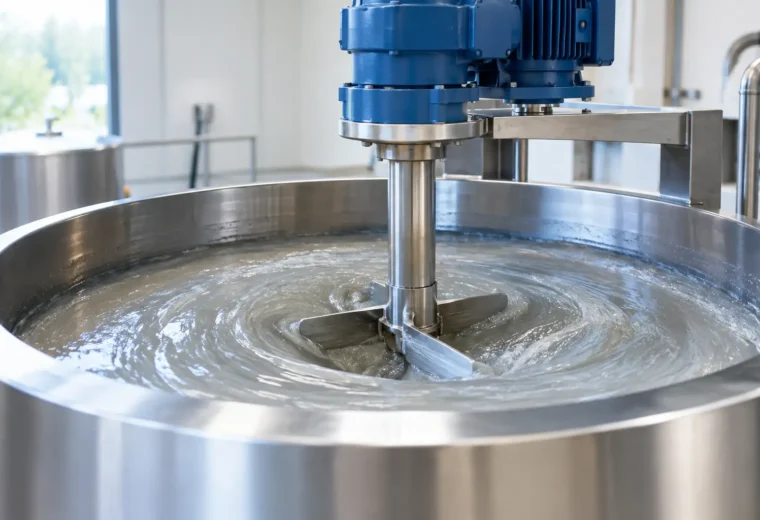
Temperature control depends on mixing uniformity. A well-sized thermal system cannot compensate for an agitator that does not move material through the heat-transfer zone. The mixer must circulate all material through the vessel, break up stagnant regions, and maintain consistent contact with heated or cooled surfaces.
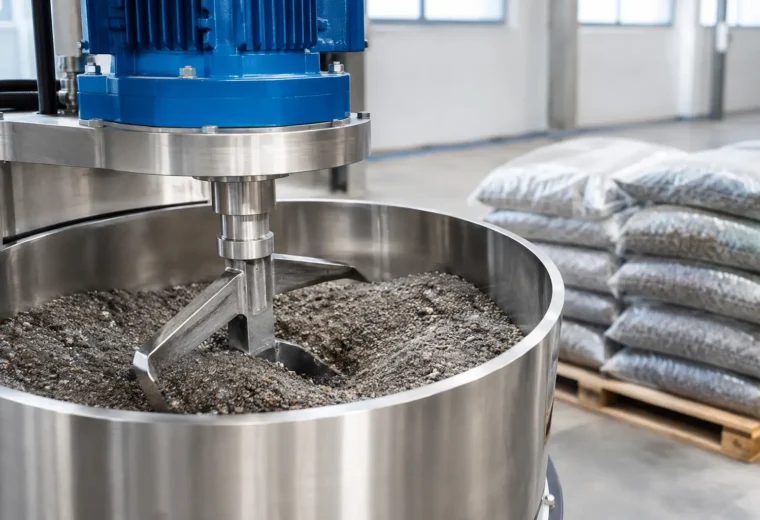
Ribbon mixers can provide effective convective movement for many powder and paste applications, particularly when paired with a jacketed trough. Paddle and plough mixers can create more intensive particle movement and are often effective for wet granulation, coating, and applications involving rapid liquid addition. Double planetary and multi-shaft mixers are suited to viscous products where wall scraping, folding action, and controlled shear are central to thermal performance.
The trade-off is clear: more intensive mixing can improve temperature uniformity and shorten heat-transfer time, but it can also add mechanical heat. Higher agitator speed is not always the answer. For shear-sensitive emulsions, crystal-containing systems, or temperature-sensitive formulations, the process may require staged speeds, intermittent mixing, or a lower-shear agitator design.
Measure Product Temperature Where It Matters
A temperature sensor installed in the vessel wall measures wall temperature, not necessarily product temperature. This distinction becomes critical when heating viscous materials or operating with a cold or hot jacket. The control system should use a product-contact sensor placed in a representative, well-mixed zone whenever possible.
For large vessels or challenging formulations, multiple sensors may be justified. A sensor near the wall can help monitor jacket performance, while sensors at different product locations can reveal gradients during development or validation. Product temperature should be measured at a depth that remains covered across the working batch range. A probe exposed during low-level operation produces misleading data and unstable control.
Sensor response time also matters. A slow or poorly positioned probe can cause overshoot because the control loop reacts to old information. Sanitary design, pressure rating, cleanability, and compatibility with abrasive or corrosive materials must be included in the instrumentation review.
Apply automation that reflects the actual recipe
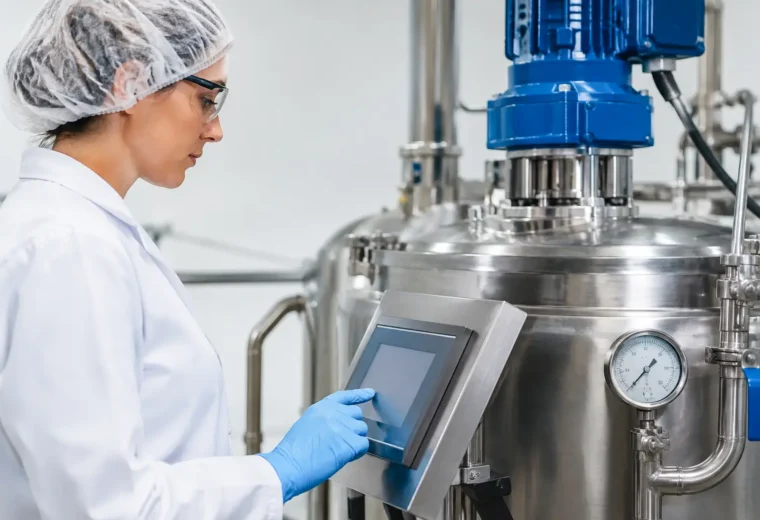
A basic temperature loop modulates the utility valve to maintain a setpoint. That may be sufficient for a stable, well-mixed liquid. More demanding processes benefit from recipe-based control that changes setpoints, agitator speed, vacuum level, and ingredient-addition permissions by batch phase.
Cascade control can improve response by using jacket temperature as a secondary loop while product temperature remains the primary controlled variable. Rate-of-rise limits can reduce overshoot during heating. High-temperature alarms and interlocks can stop heating, slow the agitator, initiate cooling, or prevent a sensitive ingredient from being added until the batch is within specification.
Automation should not hide poor process design. A sophisticated control platform cannot correct inadequate heat-transfer area, insufficient utility capacity, or a mixer that leaves unmixed material at the vessel perimeter.
Control Temperature During Ingredient Addition and Vacuum Processing
Many temperature deviations occur at the moment materials are introduced. Liquid additions may need to be preheated or chilled before entering the mixer. Powders can be conditioned when moisture uptake, melt behavior, or reaction rate is affected by their incoming temperature. Addition rate matters as well. Introducing a large volume of cold liquid too quickly can collapse product temperature and increase viscosity, slowing subsequent mixing.
Vacuum processing deserves separate attention. Pulling vacuum can remove air and support deaeration, drying, or reaction control, but evaporation consumes energy and cools the product. This cooling may be beneficial, or it may extend the batch cycle if the jacket cannot replace the lost heat. Conversely, applying vacuum to a hot material can create rapid vapor generation that challenges condenser capacity and process stability.
The most reliable process sequences coordinate vacuum level, jacket duty, agitator speed, and feed rate. Pilot trials should document actual temperature response rather than relying only on theoretical heat-transfer calculations.
Validate Performance at Production Conditions
Temperature-control performance should be proven with the actual formulation or a representative worst-case material. Water trials are useful for equipment checkout, but water has very different viscosity, heat capacity, wall adhesion, and circulation behavior than most industrial products.
During qualification, record the temperature profile at each stage, utility inlet and outlet temperatures, agitator speed, motor load, pressure or vacuum level, and batch time. These data show whether the process is limited by available utility energy, heat-transfer surface, material circulation, or control tuning.
A capable system should demonstrate repeatable heat-up and cool-down rates, minimal product-temperature variation, and stable operation across the intended batch range. It should also be evaluated after cleaning, during seasonal utility changes, and with expected raw-material variability.
For manufacturers seeking better product consistency, mixing temperature is not a secondary operating detail. It is a controllable process variable that connects equipment design, formulation behavior, utilities, and automation. PerMix approaches thermal control by first understanding the material and production objective, then engineering the mixer and process system around the required temperature profile. The best result is not simply a batch that reaches a number on a display, but a process that reaches it uniformly, safely, and repeatably every time.