A slurry that looks uniform at the end of a pilot batch can behave very differently at production scale. Solids may settle during holds, powders may form agglomerates at the liquid surface, and viscosity can rise sharply as the formulation develops. Slurry mixers must control those realities consistently, not simply turn an impeller in a tank.
For manufacturers processing mineral suspensions, battery materials, food systems, coatings, chemical intermediates, ceramics, pharmaceuticals, and similar formulations, mixer selection directly affects quality, throughput, waste, and downstream reliability. The right system is defined by material behavior and process objectives, not by vessel volume alone.
What Makes Slurry Mixing Different
A slurry contains solid particles suspended in a liquid, but that description leaves out the variables that determine equipment performance. Particle size distribution, solids concentration, particle density, liquid viscosity, wetting behavior, and the tendency to form agglomerates all influence how energy must be applied.
At low solids loading, the primary requirement may be suspension. The mixer must generate enough bulk circulation to lift particles from the tank bottom and prevent sedimentation. At higher solids loading, the process often becomes more demanding. The material may develop a yield stress, form a thick paste-like zone near the wall, or resist flow until sufficient shear is applied.
This is why a mixer that performs well on a thin suspension may fail when the formula reaches its final concentration. It may create a visible vortex while leaving unmixed material near the vessel bottom, under the impeller, or around the tank perimeter. A satisfactory slurry process requires both macromixing – movement throughout the entire batch – and the local shear needed to wet, disperse, or deagglomerate solids.
Start With the Process, Not the Mixer Name
The first engineering question is not whether the application needs a paddle, high-shear rotor-stator, or multi-shaft mixer. It is what the material must become and how it must get there.
A process that only requires uniform solids suspension has different demands from one that must break powder agglomerates, disperse pigments to a specified fineness, manage an exothermic reaction, or remove entrained air before filling. In many applications, these operations occur in sequence. Bulk agitation may be needed during charging, high shear may be required during powder incorporation, and low-speed sweep agitation may be preferred while the batch is held under vacuum.
A useful slurry mixer specification accounts for four connected requirements:
- The full viscosity range, including the highest expected viscosity rather than only the starting liquid viscosity
- Solids loading, particle density, particle size, and settling tendency
- Required dispersion quality, including whether agglomerates must be broken or merely wetted and suspended
- Operating steps such as powder induction, heating or cooling, vacuum deaeration, reaction, transfer, and cleaning
These inputs determine the necessary horsepower, torque, impeller design, shaft configuration, vessel geometry, and controls strategy. They also reveal when a single agitator is sufficient and when an integrated multi-function system is the better investment.
Selecting the Right Mixing Mechanism
Bulk agitation for suspension and circulation
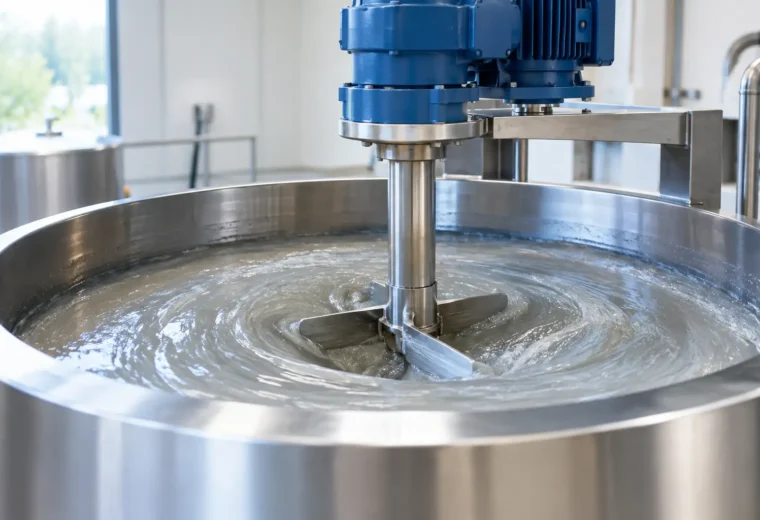
Axial-flow impellers, pitched blades, and hydrofoil-style designs are commonly used where a relatively mobile slurry needs strong top-to-bottom circulation. Their purpose is to keep solids suspended and maintain uniform concentration through the batch. Proper placement matters as much as impeller type. An undersized impeller or incorrect clearance from the vessel bottom can leave a settled bed that grows during long production holds.
For many mineral slurries, wastewater formulations, and lower-viscosity chemical suspensions, this approach provides efficient mixing. However, it may not supply enough localized shear for difficult powder wetting or pigment deagglomeration.
High shear for wetting and dispersion
High-shear mixers use intense mechanical energy to pull powder into liquid, break agglomerates, and accelerate dispersion. They are especially valuable when fine powders resist wetting, when viscosity rises quickly after addition, or when product specifications depend on particle distribution and appearance.
High shear is not automatically better. Excessive energy can damage shear-sensitive particles, entrain air, raise product temperature, or alter a formulation’s structure. The engineering target is sufficient shear at the correct stage of the batch, not maximum tip speed at all times.
Multi-shaft systems for changing rheology
Many demanding slurries pass through several flow regimes in one batch. A formulation may begin as a low-viscosity liquid, become difficult to circulate as solids are added, then require high shear to complete dispersion. Multi-shaft mixers combine independent agitators, often including a slow-speed sweep or anchor, a disperser, and a high-shear emulsifier or rotor-stator.
This arrangement gives operators more control over the process. The sweep moves high-viscosity material from the vessel wall toward the active mixing zone, while the disperser or high-shear head manages powder incorporation and agglomerate reduction. It is often the practical choice for coatings, adhesives, electrode slurries, specialty chemicals, and other formulations where batch viscosity changes substantially.
Planetary and heavy-duty mixers for dense materials
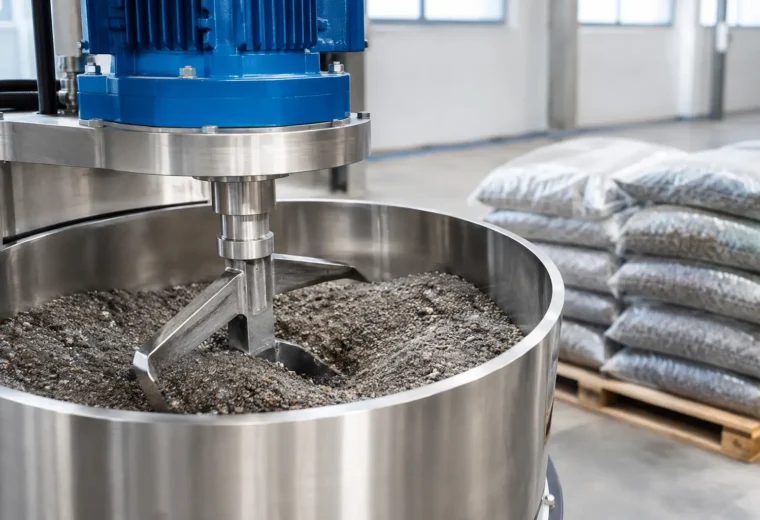
When solids loading is very high or the material behaves more like a paste than a flowing liquid, conventional tank agitation may no longer be effective. Double planetary, sigma, and other heavy-duty mixing technologies are designed to work through dense, cohesive material with higher torque and more complete wall-to-wall movement.
The trade-off is that these systems can have different charging, discharge, and cleaning requirements than open-tank agitation. They should be selected when the rheology justifies them, rather than used as a default solution for every high-solids slurry.
Vessel Design Is Part of Mixer Performance
A properly sized drive cannot compensate for poor vessel geometry. Tank diameter, liquid height, headspace, bottom shape, baffle design, impeller location, and discharge configuration all affect circulation and cleanout.
Baffles are often needed to prevent liquid from rotating as a single mass and to convert rotational energy into useful flow. Yet baffles can also create areas where highly viscous material accumulates. In abrasive slurries, they may increase wear. The correct design depends on the product and the required flow pattern.
Thermal control deserves equal attention. Some slurries generate heat through viscous dissipation or chemical reaction; others must be heated to lower viscosity or controlled within a narrow temperature range. Jacket surface area, agitation near the vessel wall, heat-transfer fluid selection, and batch cycle time should be evaluated together. A mixer may produce an excellent dispersion but still limit production if it cannot heat or cool the batch at the required rate.
Powder Addition and Deaeration Often Determine Batch Time
Slow, poorly controlled powder addition is a common source of batch delays. Material can float at the surface, form fisheyes, bridge in a feed hopper, or enter the vessel faster than the mixer can incorporate it. The result is extended mix time, inconsistency between operators, and rework.
Engineered powder induction systems can meter and draw powders directly into the liquid stream or high-shear zone. For dust-sensitive, hazardous, or high-value ingredients, closed transfer can also improve housekeeping, operator protection, and material accountability.
Air management is equally significant. High-speed dispersion and powder addition can introduce air that causes density variation, poor coating appearance, inaccurate filling, or defects in downstream processing. Vacuum-capable slurry systems remove entrained air after dispersion, but vacuum must be applied with the appropriate agitation level. Aggressive surface turbulence under vacuum can cause foaming or pull product into the vacuum line.
Design for Cleaning, Wear, and Maintenance
Production performance is not measured only while the mixer is running. It also depends on how consistently the system can be cleaned, inspected, and returned to service.
For sanitary applications, vessel finish, drainability, clean-in-place coverage, seal design, and elimination of dead zones are core requirements. For abrasive materials, wetted materials of construction, hardened components, replaceable wear parts, and shaft sealing strategy can have a direct effect on lifecycle cost. Corrosive slurries may require stainless steel grades, specialty alloys, or nonmetallic lining systems selected for the actual chemical exposure and operating temperature.
Maintenance access should be considered during design, not after installation. A mixer that requires excessive downtime to replace seals, inspect shafts, or clean the discharge valve will reduce the effective capacity of the entire process line.
Scale-Up Requires Evidence, Not Assumptions
Mixer scale-up should not rely on matching motor horsepower per gallon. Similar power density does not guarantee comparable flow, shear, heat transfer, or dispersion performance across different vessel sizes. Scale changes the relationship between impeller diameter, tip speed, pumping capacity, vessel geometry, and product residence in high-shear zones.
The most reliable route is process testing with representative materials and a defined acceptance target. That target may include viscosity, particle size, density, dispersion quality, mix time, temperature profile, deaeration level, or solids uniformity at multiple sample points. Pilot testing also exposes practical constraints such as charging sequence, powder feed rate, and discharge behavior before they become production problems.
PerMix approaches slurry mixer selection as an integrated process decision. The objective is not simply to supply a mixing vessel, but to engineer a system that produces the required batch quality within the required production window.
The best slurry mixing solution is the one that keeps solids suspended, achieves the required dispersion, protects the formulation, and remains practical to operate and maintain shift after shift. When those requirements are defined early, mixer selection becomes a measurable production decision rather than a costly trial-and-error exercise.