
A chemical blend can meet specification in the laboratory and still fail economically at production scale. Segregation during transfer, incomplete wetting, long batch cycles, residual material at discharge, and inconsistent raw materials can all erode margin. Chemical blending optimization addresses the complete process, not simply the mixer speed or mixing time.
For chemical manufacturers, the objective is measurable: produce a homogeneous, repeatable formulation at the required rate, with controlled energy use, reliable cleaning, and minimal off-spec material. Achieving that objective requires matching the equipment and operating method to the actual behavior of the formulation.
What Chemical Blending Optimization Must Improve
Optimization should begin with a defined production problem. A plant may need to reduce blend time, improve active ingredient distribution, eliminate agglomerates, increase batch capacity, or shorten changeover. These goals can conflict. A higher agitator speed may improve dispersion but increase heat input, air entrainment, particle attrition, or wear. Larger batches may raise output while reducing freeboard needed for effective turnover.
The correct target depends on the product and the risk associated with variation. For a specialty additive, concentration uniformity may be the primary requirement. For a bulk chemical, throughput and discharge efficiency may carry more value. For reactive or temperature-sensitive materials, thermal control and safe addition rates can govern the entire system design.
A useful optimization program evaluates performance through several connected measures:
- Blend uniformity and batch-to-batch repeatability
- Batch cycle time, including charging, mixing, discharge, and cleaning
- Yield loss from vessel hold-up, dust collection, transfer lines, and rejected batches
- Energy input, temperature rise, and material degradation
- Operator intervention, cleaning effort, maintenance requirements, and process safety
These measures reveal whether a faster mixer is truly improving production. A short mixing phase has limited value if discharge takes longer, cleaning becomes more difficult, or the process creates more rework.
Start With Material Behavior, Not a Mixer Model
The same chemical plant may process free-flowing powders, cohesive pigments, abrasive minerals, viscous resins, shear-sensitive crystals, and liquid-solid suspensions. They do not respond to the same mixing mechanism.
Bulk density, particle size distribution, particle shape, moisture level, electrostatic behavior, flowability, and segregation tendency affect powder blending. For liquid and slurry systems, viscosity, yield stress, density difference, surface tension, solids loading, and heat-transfer requirements become critical. A formulation that appears simple on a bill of materials can become difficult once materials are introduced at commercial quantities.
For example, a minor active powder added at 0.1 percent may require a preblend or controlled feeding arrangement to achieve acceptable distribution. Adding it directly into a large batch of coarse carrier material can produce localized concentration variation even when the mixer appears to turn over the full vessel contents.
Likewise, a liquid binder added to a dry powder blend must be distributed at a rate the material can absorb. If liquid addition exceeds the rate of dispersal, wet lumps form. More mixing time may not correct the problem because the process has already created agglomerates that require higher shear or milling to break apart.
Representative testing is therefore a practical engineering requirement. Testing should use actual raw materials whenever possible, including normal variation in particle size, moisture, and temperature. Process engineers should also test at realistic fill levels rather than drawing conclusions from a small, idealized batch.
Select the Mixing Mechanism for the Process
Equipment selection should follow the required mixing action. It should not begin with the lowest purchase price or a familiar equipment type.
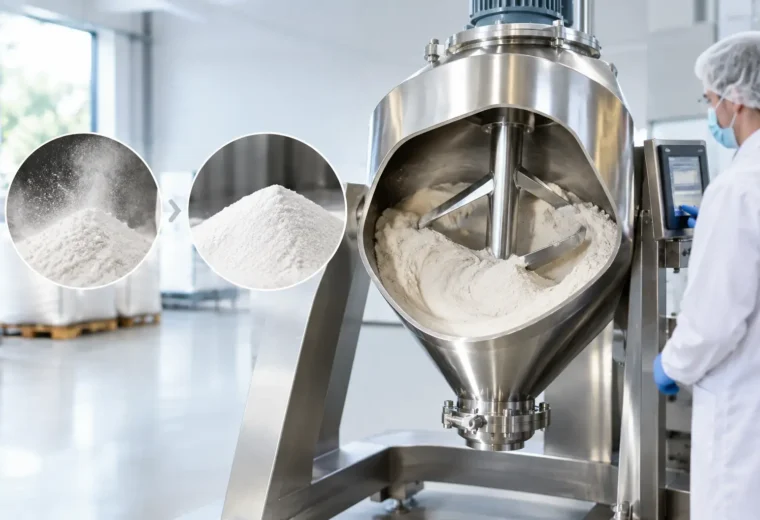
Ribbon mixers are effective for many dry powders and moderate-density blends where gentle convective movement can achieve uniformity efficiently. Paddle mixers can provide fast, controlled mixing with lower shear and are often suited to fragile particles or formulations requiring a defined residence profile. Plough mixers generate a mechanically fluidized mixing zone and can handle more cohesive materials, rapid liquid incorporation, and applications requiring intensified mixing action.
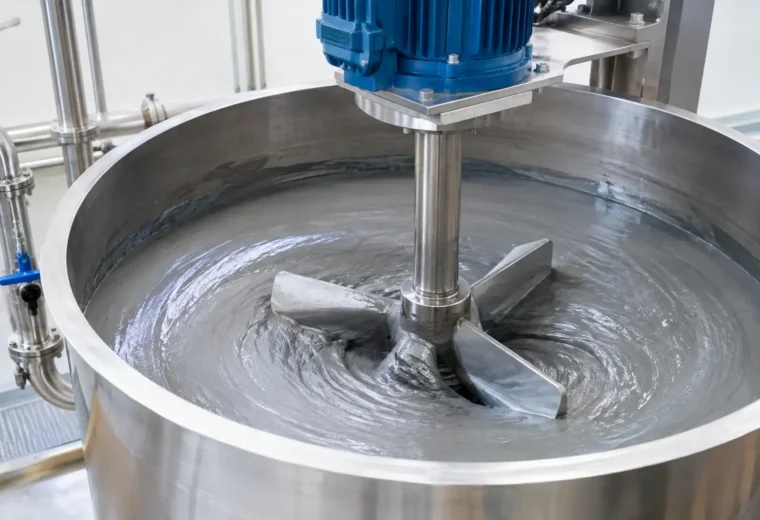
High-shear mixers, rotor-stator systems, and homogenizers are appropriate when emulsification, particle size reduction, dispersion, or deagglomeration drives product quality. For highly viscous pastes, adhesives, sealants, and filled compounds, sigma mixers, double planetary mixers, and multi-shaft mixers provide the torque and wall-sweeping action required to move material that will not flow under gravity.
No single mixer is best across all chemical applications. High intensity can reduce blend time, but it can also fracture particles, change crystal morphology, increase temperature, or introduce air. Gentle mixing protects sensitive ingredients, but it may not overcome cohesive lumps or density-driven segregation. The best in performance is the system that reaches the specified product condition with the lowest total production burden.
Vessel Geometry and Fill Level Matter
Mixing tools operate within a vessel, and vessel geometry directly affects circulation patterns. A mixer that performs well at 70 percent fill may lose efficiency when operated at 30 percent or 90 percent. Insufficient material can prevent complete tool engagement. Excessive fill can limit movement and reduce the free volume needed for ingredient turnover.
Discharge design also deserves attention. A blend that is uniform in the vessel can segregate as it exits through a restricted outlet, drops through a long transfer line, or enters a storage hopper. Mass-flow discharge, valve geometry, and the path to the next process step should be evaluated as part of the blending system.
Control the Sequence, Not Only the End Point
Many blending problems originate before the main mixing cycle begins. Charging order, feed location, feeder accuracy, liquid spray pattern, and timing determine whether the mixer receives a blendable material state.
A practical sequence may start with a carrier material, followed by low-percentage actives through a loss-in-weight feeder, then a controlled liquid addition after the dry ingredients have dispersed. In another process, a viscous liquid may need to be warmed, recirculated, or metered into a high-shear zone to prevent localized overconcentration. The correct sequence depends on ingredient properties and the mixing mechanism.
Automation improves repeatability when it controls the variables that matter. Batch management should verify ingredient identity and weight, control the addition sequence, record mixer speed and time, monitor temperature or vacuum where required, and provide traceable batch data. Automation cannot compensate for an unsuitable process design, but it can prevent routine variability from becoming product variability.
For continuous blending, feeder performance becomes even more critical. Short-term feeder fluctuations can appear immediately in the final product because there is less batch averaging. Continuous systems require attention to feeder resolution, refill effects, residence-time distribution, start-up material, and the method used to confirm steady state.
Validate Uniformity With a Defensible Sampling Plan
A single acceptable sample does not prove a blend is homogeneous. Sampling must account for potential variation across the vessel and through discharge. The sampling method should be appropriate for the product, whether that means thief sampling, point sampling, in-line analysis, or timed samples collected during discharge.
Validation should measure the attribute that matters to product performance. For some products, assay variation is appropriate. For others, moisture content, particle size, viscosity, color, conductivity, or rheology may better indicate blend quality. Statistical evaluation should establish whether observed variation is within process capability, rather than relying on an average that hides localized failures.
It is also wise to test the process at operating boundaries: minimum and maximum fill level, different raw-material lots, and realistic production rates. This exposes sensitivities before they cause a costly production interruption.
Treat Cleaning, Containment, and Reliability as Production Variables
Chemical blending optimization is incomplete if the process produces cross-contamination risk, burdens operators with difficult cleaning, or requires frequent unplanned maintenance. Internal surfaces, shaft seals, access doors, spray devices, and discharge valves all affect turnaround time and product integrity.
For hazardous, toxic, or moisture-sensitive materials, containment and inerting requirements can change equipment selection. Vacuum-capable vessels, dust-tight construction, local exhaust connections, nitrogen blanketing, and appropriate seal arrangements may be necessary. These features should be designed into the process early, not added after the operating method has been established.
Reliability also affects the economics of a blend. Abrasive solids may require hardened contact surfaces. Corrosive formulations may demand specific alloys, linings, or elastomers. High-torque applications need a drive train sized for real material resistance, including difficult start-up conditions. Engineering for these realities protects both uptime and product consistency.
Build Optimization Around the Entire Production System
The strongest projects connect raw-material handling, blending, liquid addition, thermal management, discharge, downstream processing, and controls into one engineered solution. A mixer may be central to the process, but it is not isolated from the equipment before and after it.
PerMix approaches chemical processing equipment selection from this system perspective: understand the formulation, define the required performance, validate the process, and engineer the equipment around actual operating conditions. That approach helps manufacturers make decisions based on throughput, quality, safety, and long-term cost rather than catalog specifications alone.
The next improvement may not be a larger mixer or a higher motor rating. It may be a better feed point, a revised addition sequence, a more suitable mixing mechanism, or a discharge arrangement that preserves the uniformity already achieved. The right answer comes from treating the blend as a process with connected variables, then proving which changes deliver performance on the plant floor.