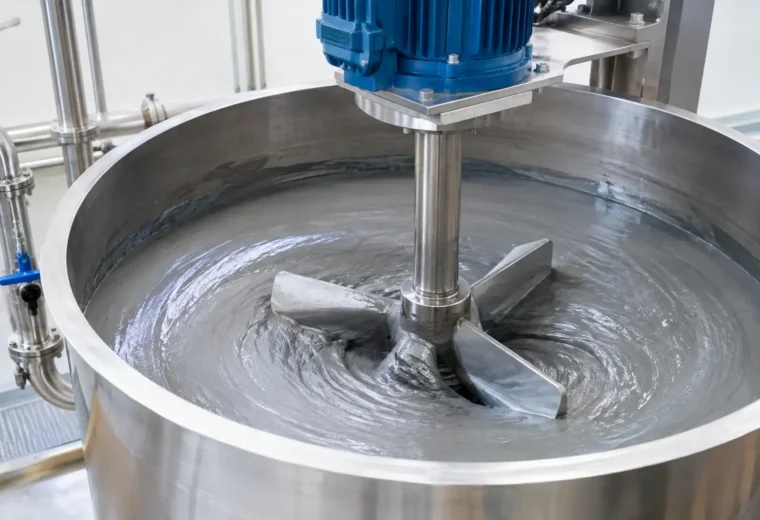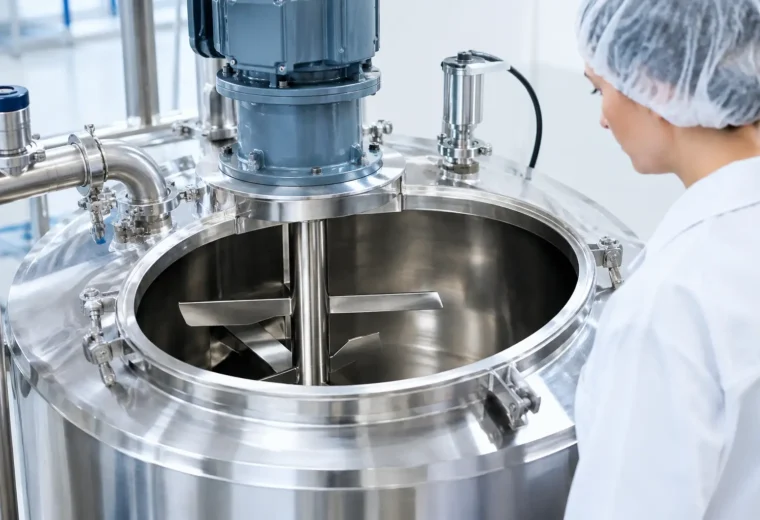
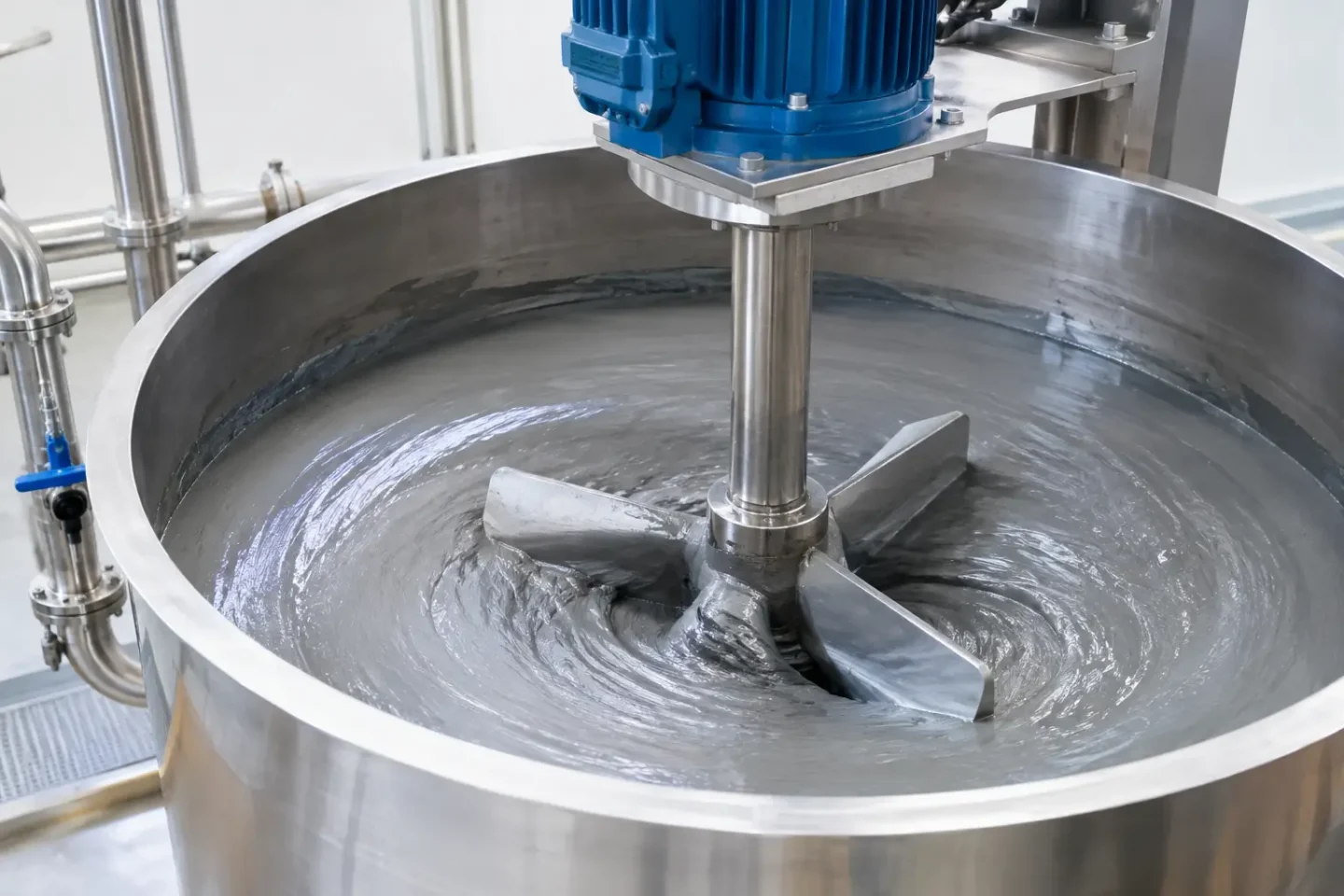
A slurry that looks uniform at the surface can still contain settled solids, dry agglomerates, air pockets, and concentration gradients that appear later in the process. Those hidden variations can cause inconsistent viscosity, poor coating quality, unstable reactions, blocked transfer lines, and off-spec finished product. Knowing how to optimize slurry mixing starts with treating the slurry as a complete process system, not simply a vessel with an agitator.
The correct solution depends on the solids, liquid phase, target viscosity, batch size, temperature, addition sequence, and the required level of uniformity. A mixer that performs well for a low-solids mineral slurry may be ineffective for a high-solids battery paste, ceramic suspension, food formulation, or chemical intermediate. The objective is controlled, repeatable dispersion and suspension at the lowest practical cycle time and energy input.
Start With the Slurry, Not the Mixer
Slurry mixing performance is governed by material behavior. Before selecting or changing equipment, define the physical properties that determine how the batch will move under shear.
The most relevant variables are particle size distribution, particle density, solids concentration, liquid viscosity, wetting characteristics, yield stress, and whether the formulation changes during mixing. Fine powders may agglomerate because of moisture, electrostatic attraction, or poor wetting. Dense particles may settle rapidly when agitation slows. Some formulations become significantly more viscous as solids are added, while others thin under shear and then rebuild structure at rest.
Rheology is especially important. A Newtonian slurry behaves predictably as mixer speed changes. A non-Newtonian slurry may require a minimum shear level to begin flowing, then behave very differently once its internal structure breaks down. Without rheology data or representative trials, equipment selection becomes an assumption based on viscosity alone. That often leads to oversized drives with poor circulation or high-speed dispersers that create a vortex without adequately moving material at the vessel wall or bottom.
A practical evaluation should document the slurry at each stage of the batch, not only after it is complete. The material condition during powder induction is often the point that determines total cycle time and final quality.
How to Optimize Slurry Mixing Through Process Control
A well-designed slurry process manages four separate actions: wetting the solids, breaking agglomerates, distributing particles throughout the liquid, and maintaining suspension until discharge. One mixing element does not always perform all four actions efficiently.
Control the order and rate of addition
Adding powder too quickly is one of the most common causes of persistent lumps and batch variability. When dry solids contact liquid faster than the mixer can wet and disperse them, they can form fish eyes – dry powder enclosed by a wetted outer layer. Increasing speed afterward may not fully eliminate them, particularly with cohesive powders or polymeric thickeners.
Use a controlled feed rate matched to available liquid circulation and shear. For difficult powders, introduce a portion of the liquid first, establish circulation, and add solids gradually into the active mixing zone. A powder induction system can improve operator safety, reduce dust, and provide a more repeatable feed condition than manual dumping.
The best addition method depends on the formulation. A top-entry addition may work for free-flowing, easily wetted solids. Materials prone to floating, dusting, or lump formation may require subsurface injection, vacuum powder induction, or recirculation through an inline high-shear device. Faster feeding is not automatically higher throughput if it adds 30 minutes of rework to every batch.
Match shear to the actual dispersion requirement
High shear is valuable when particle deagglomeration, emulsification, or rapid wetting is required. It is not a substitute for bulk circulation. A high-shear rotor-stator head processes material close to the rotor, while the rest of the vessel must still be brought repeatedly through that zone.
For lower-viscosity slurries, a properly designed impeller system can create the axial flow needed for suspension and turnover. For higher-viscosity or yield-stress materials, a multi-shaft mixer may combine a slow-speed sweep agitator with a high-speed disperser. The sweep moves material from the vessel wall and heat-transfer surface, while the disperser supplies localized shear where agglomerates must be broken down.
Excessive shear also has consequences. It can damage shear-sensitive particles, alter crystal structure, entrain air, increase temperature, or change the final rheology. The right operating point is the minimum shear and mixing time that consistently achieves the product specification.
Design for suspension, not surface movement
A visible vortex is not proof of good mixing. In many slurries, a deep vortex pulls air into the batch while leaving dense solids at the bottom or stagnant zones near the wall. The more meaningful question is whether all particles remain uniformly suspended at the required operating speed.
Impeller diameter, impeller elevation, tank geometry, liquid level, and baffle arrangement all affect suspension. A small, fast impeller may generate high local tip speed but insufficient bulk flow. A larger, slower axial-flow impeller can deliver better bottom lifting and lower energy consumption for some applications.
Where solids settle quickly, consider whether the process needs continuous agitation during hold, transfer, and recirculation. A slurry can be perfectly mixed at the end of the batch and still separate before it reaches the next operation. Transfer piping, pump selection, line velocity, and dead-leg elimination must support the same suspension standard established in the vessel.
Select Equipment Around the Process Window
Mixer selection should be based on a defined process window rather than a single viscosity value. That window includes minimum and maximum batch volume, solids loading range, expected viscosity profile, required temperature control, cleaning method, available headroom, and future production capacity.
A high-shear mixer may be the best fit for dispersion-focused liquid slurries. A multi-shaft mixer is often appropriate when a formulation transitions from low viscosity during initial wetting to a high-viscosity paste as solids increase. Paddle, plough, or specialized mixing systems may be more effective when the process begins with dry blending and progresses into controlled liquid addition. Vacuum-capable systems can be necessary where entrained air affects density, coating performance, downstream filling, or product appearance.
The discharge design deserves equal attention. A mixer that produces a uniform batch but leaves concentrated solids in the bottom outlet, valve cavity, or transfer hose has not solved the process. Evaluate discharge speed, residual heel, valve geometry, pump compatibility, and the ability to clean product-contact areas between formulations.
PerMix approaches slurry applications by evaluating the complete operating sequence, including feeding, mixing, vacuum processing, heating or cooling, and discharge. That engineering perspective helps prevent a mixer from becoming the isolated answer to a system-level problem.
Use Temperature and Vacuum Deliberately
Mixing energy becomes heat. In high-solids or high-viscosity slurries, that heat can be substantial enough to change viscosity, accelerate reactions, degrade sensitive ingredients, or increase evaporation. Monitor batch temperature throughout the cycle, especially after solids addition and during high-shear dispersion.
Jacketed vessels, internal heat-transfer surfaces, and controlled mixing profiles can maintain the required temperature range. The design must account for the actual heat load, not only the jacket area. Highly viscous materials transfer heat slowly from the vessel wall to the center of the batch, making wall sweep action and residence time important.
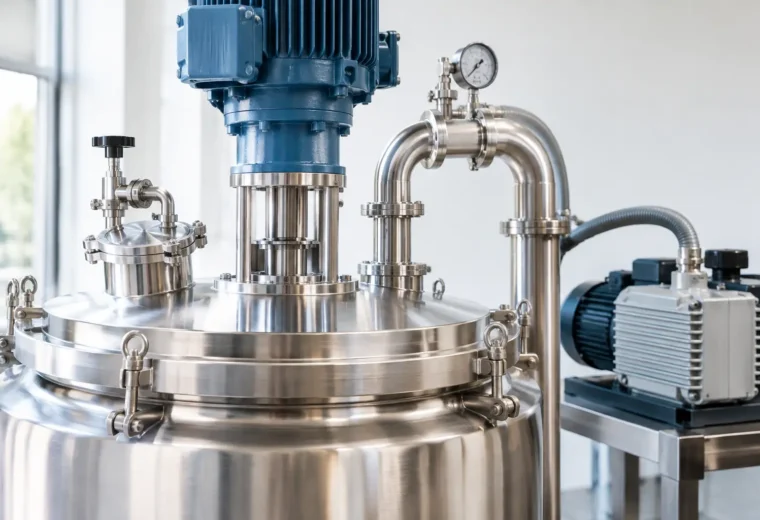
Vacuum processing can remove air entrained during powder addition or high-speed dispersion. This improves density consistency and can prevent defects in coatings, molded products, and filled containers. Vacuum is not always beneficial, however. It may increase foaming in volatile systems or create operational complexity when the formulation is easily stripped or moisture-sensitive. Trial data should determine whether vacuum is required and at what stage it should be applied.
Validate the Result With Meaningful Measurements
Optimization requires more than observing a smooth-looking batch. Establish acceptance criteria tied to product performance: solids content, viscosity at defined shear conditions, particle size, density, moisture, pH, color, conductivity, coating weight, or other application-specific measures.
Sample from more than one location when validating a process. Compare top, middle, bottom, and discharge samples to identify concentration gradients. Repeat the study across multiple batches and at realistic production volumes. A process proven in a half-filled pilot vessel may not scale directly to a production mixer because the flow pattern, power per unit volume, and wetted surface area change.
Automation turns a validated method into a repeatable operation. Recipe control can manage addition rates, mixer speed, temperature limits, vacuum level, hold time, and discharge sequence. Recording these parameters also gives engineering and quality teams a factual basis for investigating deviations rather than relying on operator observations.
Treat Optimization as a Controlled Trial Program
The most productive slurry improvements come from changing one meaningful variable at a time: feed rate, impeller speed, solids addition point, temperature, or mixing duration. Track both quality results and operating cost, including cycle time, energy use, labor, cleaning time, scrap, and maintenance exposure.
A slurry process is optimized when it repeatedly delivers the required material condition, at production scale, without unnecessary shear, prolonged mixing, or avoidable operator intervention. The next useful step is to map the current batch sequence against the material behavior and identify where wetting, dispersion, suspension, thermal control, or discharge first becomes unstable.