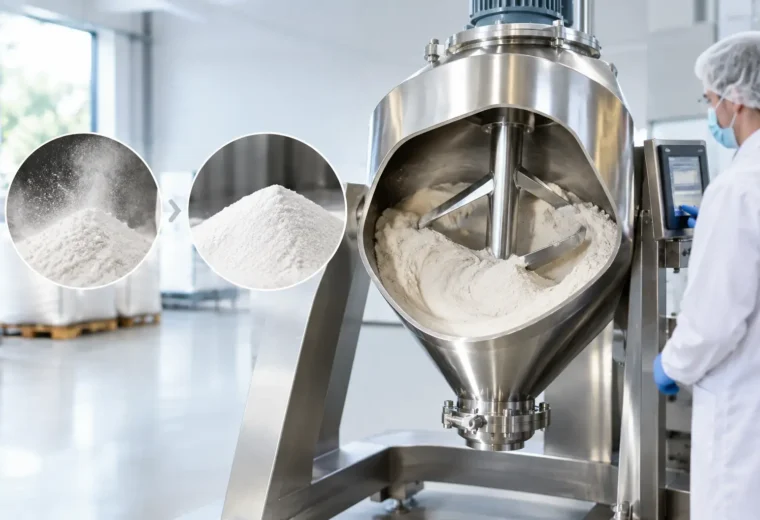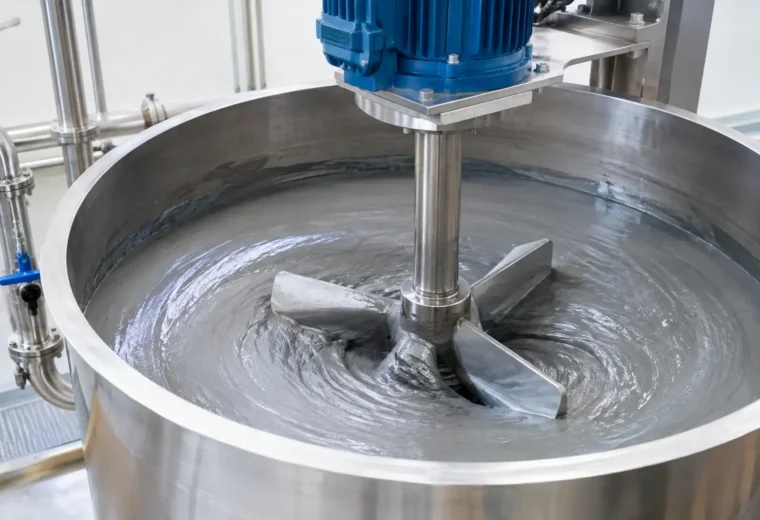
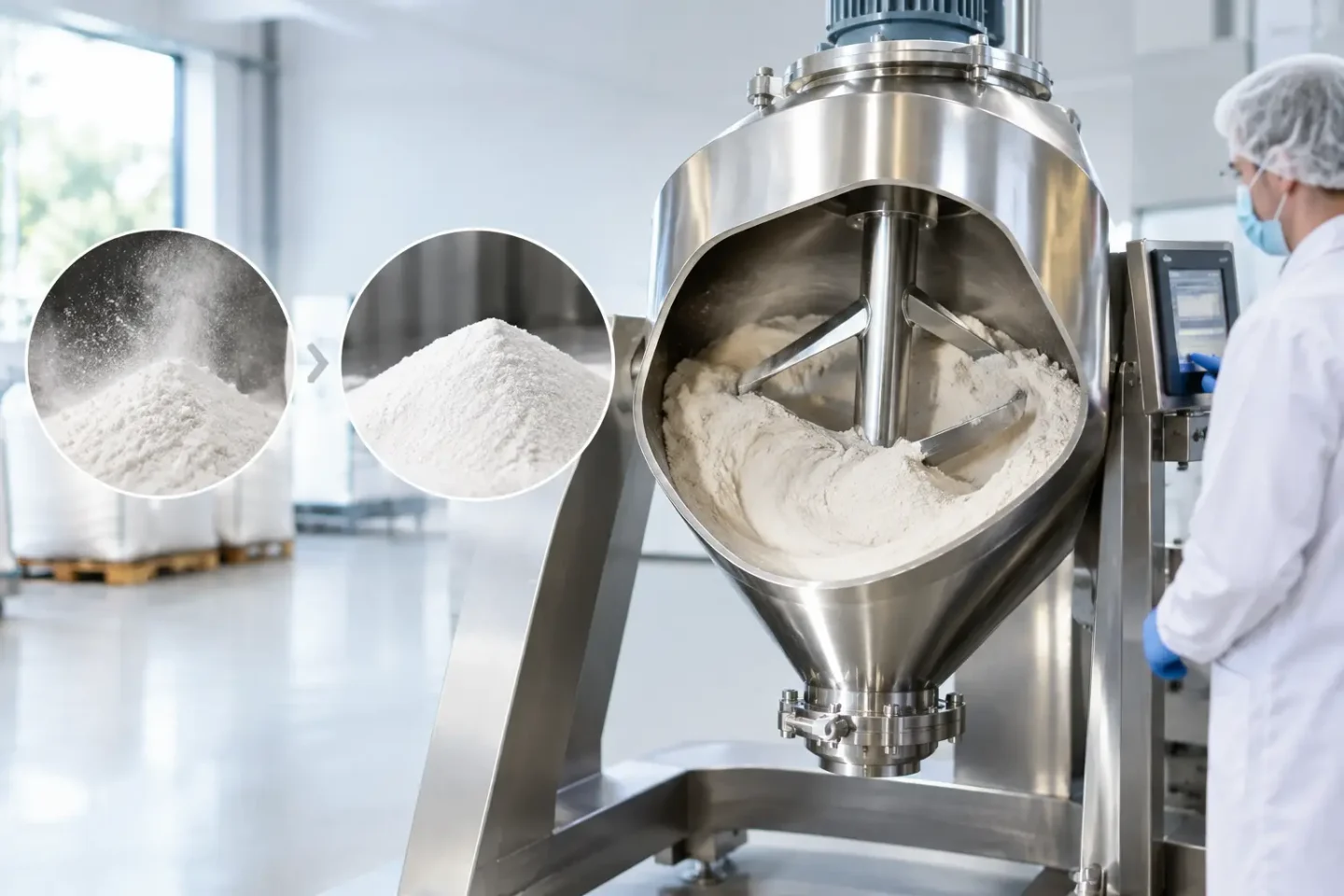
Dust is often created before the mixer begins its blending cycle. A bag is opened, an ingredient drops through an uncovered inlet, air is displaced from the vessel, or a finished batch is discharged into an open container. So, when manufacturers ask which mixer reduces dust, the engineering answer is not simply a mixer model. The best result comes from an enclosed mixing system designed around how the material is charged, mixed, vented, and discharged.
For dry powders, a vacuum mixer or fully enclosed horizontal mixer with controlled ingredient charging will generally provide the greatest dust reduction. The correct choice still depends on powder behavior, batch size, cleaning requirements, formulation sensitivity, and the level of containment required. A mixer can reduce dust substantially, but it cannot compensate for poorly controlled upstream feeding or downstream transfer.
Which Mixer Reduces Dust Most Effectively?
For applications requiring the highest level of dust containment, a vacuum-capable mixer is often the strongest option. A closed vessel operates under controlled pressure and can draw powders from bags, drums, or bulk containers through a sealed vacuum conveying arrangement. This limits the airborne release that commonly occurs during manual dumping.
Vacuum mixing is particularly effective for fine, low-density, cohesive, or potentially hazardous powders. It can also support liquid addition, deaeration, and closed transfer in a single process platform. The trade-off is that vacuum systems require a properly engineered vessel, seals, filtration, conveying controls, and cleaning strategy. They should be selected because the process requires closed handling, not because vacuum alone is expected to solve every dust issue.
A fully enclosed ribbon mixer, paddle mixer, or plough mixer can also achieve very low fugitive dust emissions when equipped with sealed covers, gasketed access doors, correctly sized vent filtration, and enclosed charging and discharge points. For many food, chemical, mineral, nutraceutical, and specialty-material applications, this is the most practical balance of containment, capacity, and cost.
The impeller style affects how powder behaves inside the vessel, but enclosure design usually has the greater effect on dust escaping into the room. A high-performance mixer with an open loading hatch remains a dust source. A well-sealed mixer integrated with controlled material handling can transform the operating environment.
Mixer Type Matters, but Process Design Matters More
The right mixer must deliver uniformity without creating unnecessary air entrainment or powder agitation. Material behavior determines whether a gentle or intensive mixing action is appropriate.
Ribbon mixers for free-flowing powder blends
Ribbon mixers are widely used for batch blending of dry powders and granules. Their relatively gentle convective action can be effective for free-flowing formulations, particularly where particle size and density are reasonably compatible. With a dust-tight cover, sealed shaft seals, and a contained ingredient inlet, a ribbon mixer can operate with minimal visible dust.
However, ribbon mixers are not automatically the right answer for every low-dust application. Very fine powders can become airborne during rapid loading, and difficult formulations may require longer mixing times or more aggressive agitation. If the product needs deagglomeration, liquid incorporation, or rapid dispersion of minor ingredients, another mixer design may be more suitable.
Paddle mixers for gentle, controlled blending
Paddle mixers provide a gentle fluidized mixing zone with less shear than many high-intensity designs. They are often selected for fragile particles, blends that must avoid particle degradation, and applications where mixing uniformity must be achieved without excessive energy input.
In a closed system, a paddle mixer can be an excellent low-dust solution because it minimizes aggressive powder projection while maintaining efficient batch turnover. This is not a guarantee that all powders will remain settled. Fine, aeratable materials can still become suspended inside the vessel, making proper venting and controlled discharge essential.
Plough mixers for intensive powder processing
Plough mixers create a mechanically fluidized bed and are highly effective for challenging powders, rapid blending, liquid addition, and deagglomeration. Their intensive action makes them a strong choice when product quality requires more than gentle blending.
That same fluidization means the mixer must be engineered for containment. A plough mixer should include a dust-tight vessel, reliable shaft sealing, appropriately designed air relief or filtration, and closed charging. For high-performance powder processing, the question is not whether the mixer generates airborne powder internally. It will. The question is whether the system keeps that powder safely inside the process boundary.
Conical and vacuum mixers for containment-sensitive processes
Conical mixers are well suited to some low-shear blending applications, especially where low residual volume, gentle handling, or efficient discharge is required. Their enclosed geometry can support controlled processing, though material charging remains a critical design point.
Vacuum mixers offer another level of process control. They can combine closed powder induction, blending, vacuum deaeration, and sealed discharge. They are especially valuable where operator exposure, product loss, moisture pickup, oxidation, or combustible-dust risk drives the project requirements. The additional engineering investment is justified when containment is a production and compliance priority rather than a cosmetic improvement.
The Four Places Dust Control Is Won or Lost
A mixer specification should evaluate the entire handling sequence, not just the mixing chamber. Dust commonly escapes at four points: ingredient charging, vessel venting, access openings, and product discharge.
Ingredient charging requires the most attention. Manual dumping through an open hatch creates a pressure pulse and exposes operators directly to airborne powder. Better options include bag dump stations connected to the mixer, vacuum powder induction, loss-in-weight feeders, screw feeders, or enclosed bulk bag discharge systems. The best selection depends on throughput, formulation complexity, ingredient packaging, and required batching accuracy.
Vessel venting must manage displaced air without releasing product. As powder enters a closed mixer, air needs somewhere to go. A correctly sized dust collector or filter receiver captures entrained particles while preventing pressure buildup. Undersized filtration can create slow charging, product carryover, or dust release at weak points in the system.
Access doors, sight ports, and shaft seals must be designed for the operating condition. Gaskets and seals are small components with a large impact on containment and maintenance reliability. A mixer that is tight when new but difficult to inspect, clean, or reseal will not stay dust-tight in production.
Discharge is the final test. A sealed slide gate, butterfly valve, or rotary valve should transfer material into a closed downstream hopper, conveyor, tote, or packaging line. Discharging into an open bin may erase much of the dust-control benefit achieved during mixing.
Powder Properties Change the Recommendation
The same mixer design will not control every powder in the same way. Fine particle size, low bulk density, high air retention, electrostatic charge, poor flowability, and moisture sensitivity all influence containment strategy. A lightweight powder may require slower charging rates and larger filter area. A cohesive material may require agitation assistance, a specialized discharge valve, or controlled vacuum release to prevent bridging.
Combustible dust adds another level of responsibility. Where the material presents a dust explosion hazard, the system must be evaluated for hazard classification, grounding and bonding, ignition-source control, explosion protection, isolation, and applicable facility standards. Selecting a closed mixer is not a substitute for a complete combustible-dust assessment.
Product hygiene also affects the decision. Food, dairy, pharmaceutical, and specialty chemical producers may need sanitary construction, clean-in-place capability, validated cleaning access, and filtered air handling that prevents cross-contamination. The lowest-emission mixer is only the right choice if it can also be cleaned and verified efficiently between products.
Specify a Low-Dust Mixing System, Not Just a Mixer
The most effective purchase specification defines measurable outcomes. Instead of requesting a “dust-free mixer,” identify the required containment performance, charging method, production rate, material characteristics, cleaning standard, and downstream transfer arrangement. This gives process engineers a basis for selecting equipment that performs reliably under actual plant conditions.
A practical specification should establish the powder bulk density and particle-size range, batch volume, ingredient-addition sequence, desired mixing time, discharge destination, and whether the system must operate under vacuum or inert gas. It should also state whether the objective is housekeeping improvement, operator exposure reduction, product recovery, contamination control, or hazardous-material containment. These goals may overlap, but they do not always require the same equipment configuration.
PerMix approaches dust reduction as an integrated process challenge. The mixer, feeder, filter, seals, controls, and discharge equipment must operate as one engineered system. That approach prevents a common capital-project mistake: purchasing a capable mixer and then discovering that the surrounding handling steps remain the plant’s primary dust source.
The right next step is to map the powder path from receiving through final discharge and identify where air and material separate. Once those points are understood, the appropriate enclosed mixer and containment system become a clear engineering decision rather than a guess.