A stable emulsion is not created when two liquids simply appear mixed. It is created when the dispersed phase is reduced to a controlled droplet size, protected against recoalescence, and held in a continuous phase that remains stable through processing, storage, filling, and end use. This emulsification process guide explains the engineering decisions that determine whether an industrial batch performs consistently or separates after production.
For food, cosmetics, pharmaceutical, chemical, and specialty-material manufacturers, emulsification is a product-quality operation and a production-performance operation. Small changes in raw-material temperature, addition sequence, shear exposure, or equipment geometry can affect viscosity, texture, appearance, shelf life, and batch repeatability.
What Industrial Emulsification Must Achieve
An emulsion combines two immiscible liquids, most commonly oil and water, by dispersing one phase as droplets throughout the other. An oil-in-water emulsion places oil droplets in a water-based continuous phase. A water-in-oil emulsion reverses that structure. The intended product, emulsifier system, phase volumes, and processing conditions determine which structure is appropriate.
Industrial emulsification has three practical objectives: create the required droplet-size distribution, stabilize the new interfacial area, and do so consistently at production scale. These objectives are related, but they are not identical. High shear may reduce droplets effectively while excessive heat damages a heat-sensitive active. A highly effective emulsifier may stabilize the product but require a narrow pH range or specific hydration procedure.
The target is therefore not maximum shear. It is the lowest practical energy input and the most controllable processing route that delivers the specified product attributes.
Emulsification Process Guide: Start With the Formula
Equipment selection begins with formulation behavior, not with motor horsepower. Before defining a mixer or homogenizer, establish the properties of both phases and the finished product specification.
The most useful starting data include phase ratio, viscosity of each phase, density difference, interfacial tension, required droplet size, emulsifier type and concentration, solids loading, temperature limits, pH, and desired shelf life. If the product contains waxes, polymers, gums, proteins, pigments, or insoluble actives, their hydration, melting, or dispersion behavior must also be understood.
Viscosity deserves particular attention. A low-viscosity lotion may be processed efficiently with an inline rotor-stator homogenizer after bulk blending. A heavy cream, ointment, silicone compound, or water-in-oil paste may require an in-vessel high-shear emulsifier combined with an anchor, scraper, or multi-shaft mixing system. As batch viscosity rises, bulk circulation becomes just as important as local shear intensity.
Phase inversion is another formulation risk. An emulsion can invert when the internal-phase volume rises beyond what the emulsifier system can support, when ingredients are added in the wrong sequence, or when processing conditions disrupt the intended structure. In some applications, controlled inversion is part of the process. In others, it is a batch failure. The distinction must be designed into the operating procedure.
Select and Prepare the Emulsifier System
Emulsifiers lower interfacial tension and form a protective layer around dispersed droplets. Their suitability depends on the emulsion type, oil chemistry, electrolyte content, processing temperature, pH, and required storage stability. A system that works in a laboratory beaker may not remain effective after a heated production hold, a cooling cycle, or high-speed filling.
Many formulas also require stabilizers such as hydrocolloids, polymers, fatty alcohols, waxes, or particulate thickeners. These components can improve viscosity and reduce droplet movement, but they can also create processing challenges. Powders may agglomerate, hydrate slowly, or form fish eyes if added directly to the vessel without sufficient wetting and dispersion energy.
A controlled powder induction system or properly designed liquid addition point can be more valuable than increasing homogenizer speed after lumps have formed.
Build the Right Process Sequence
The sequence of operations often determines emulsion quality before the primary homogenization step begins. A typical batch involves preparing the water phase, preparing the oil phase, hydrating or dissolving functional ingredients, bringing phases to the appropriate temperature, introducing one phase into the other at a controlled rate, homogenizing, then cooling under managed agitation.
The exact order depends on the formula. Oil-soluble emulsifiers generally need to be incorporated where they can dissolve fully. Water-soluble gums may need separate dispersion and hydration. Waxes and high-melting solids require sufficient heat to melt completely, but extended exposure to high temperature can affect fragrance, flavor, volatile solvents, biological materials, and heat-sensitive actives.
Addition rate matters because it controls the instantaneous local phase ratio at the point of contact. Adding oil too quickly into an aqueous phase can overload the emulsifier, produce large droplets, or cause temporary inversion. Metered addition through a recirculation loop or directly into the high-shear zone can improve consistency, particularly where the dispersed phase represents a large fraction of the final formula.
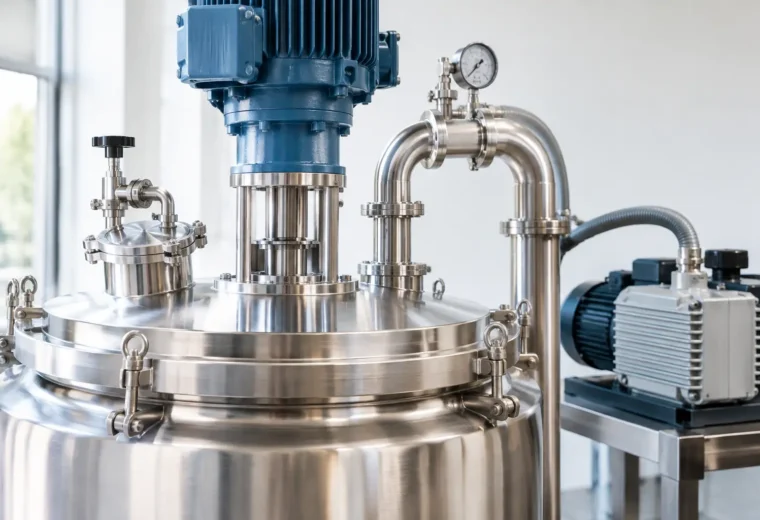
Vacuum processing may be required when entrained air compromises density, appearance, oxidation resistance, filling accuracy, or pump performance. However, vacuum is not automatically beneficial at every stage. Applying vacuum while a low-viscosity system is being aggressively mixed can promote foaming if vapor generation and surface turbulence are not controlled.
Match Shear and Flow to the Product
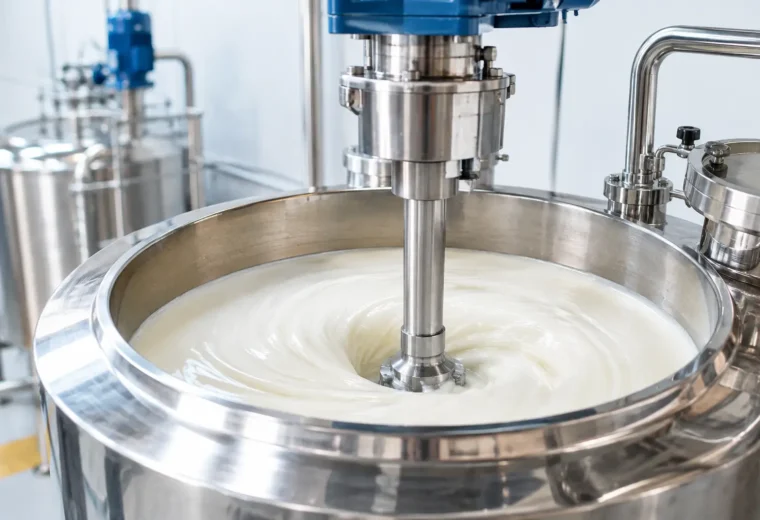
Rotor-stator emulsifiers generate intense mechanical shear in a small processing zone. They are highly effective for reducing droplets, dispersing powders, and breaking agglomerates. Their limitation is that local shear alone does not guarantee complete vessel turnover, especially in viscous batches.
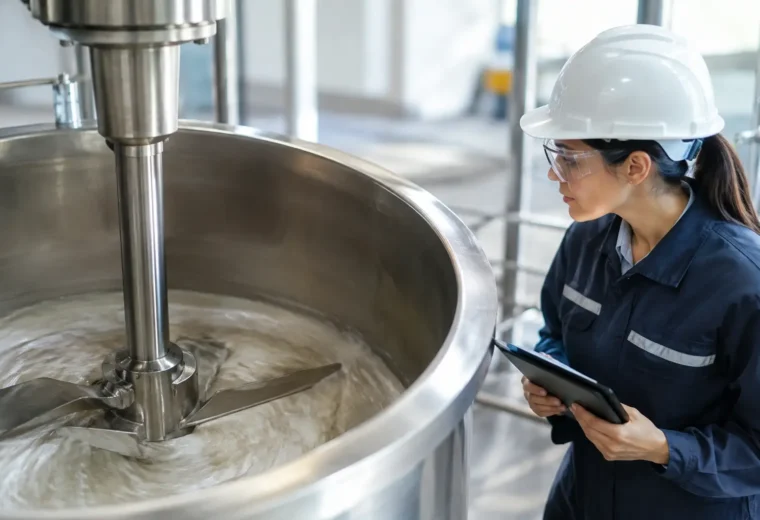
For this reason, many industrial emulsion systems use complementary mixing actions. An anchor or scraper mixer moves high-viscosity material from the vessel wall, improves heat transfer, and maintains bulk circulation. A high-shear homogenizer develops the required droplet reduction. In demanding applications, a multi-shaft mixer combines slow-speed sweeping, medium-speed bulk agitation, and high-speed dispersing or emulsifying action in one vessel.
Inline homogenizers are often advantageous for continuous processing or batch recirculation. They provide a defined processing pass and can simplify integration with heat exchangers, holding tanks, and automated dosing. Their performance depends on recirculation rate, total passes, viscosity, pressure drop, and the quality of feed entering the unit. A poorly mixed tank feeding an excellent inline homogenizer will still produce variable results.
Overprocessing is a real concern. More passes and higher tip speed can reduce droplets beyond the target range, increase product temperature, introduce air, alter rheology, or damage shear-sensitive structures. The correct endpoint should be established through measurable criteria rather than processing time alone.
Control Temperature, Air, and Residence Time
Temperature changes viscosity, solubility, interfacial tension, and emulsifier performance. In heated emulsions, both phases generally need to reach compatible temperatures before combination. Introducing a cool phase into a hot wax-containing phase can cause premature crystallization and create unstable texture. Conversely, processing too hot may reduce continuous-phase viscosity enough to increase droplet collision and coalescence.
Cooling is also a formulation step, not merely the end of the batch. Crystal formation, polymer network development, and final viscosity can be strongly affected by cooling rate and agitation profile. Many products require reduced shear during cooling to avoid air entrainment while maintaining enough movement for uniform temperature and prevention of wall buildup.
Residence time must be considered in continuous systems and recirculated batches. Every portion of product should receive sufficient, but not excessive, shear exposure. Residence-time distribution becomes especially important when processing viscous materials or when quality depends on a narrow thermal history.
Validate Stability Before Scaling Production
A visually smooth emulsion is not necessarily stable. Quality validation should connect process settings to product specifications such as droplet size, viscosity, density, pH, appearance, conductivity where relevant, and accelerated stability performance.
Microscopy or particle-size analysis can identify coarse droplets and broad distributions that may not be apparent to the eye. Centrifuge testing, thermal cycling, storage at elevated temperature, freeze-thaw testing, and long-term retained samples can reveal separation mechanisms early. The most appropriate test program depends on the product’s actual distribution, storage, and use environment.
Scale-up should not rely on vessel volume alone. Geometric differences, impeller diameter, rotor-stator design, circulation path, heat-transfer area, and fill level all influence the result. Maintaining the same RPM from pilot to production is rarely sufficient. Depending on the product, scale-up may be guided by tip speed, power per unit volume, pumping capacity, shear rate, thermal profile, or a combination of these parameters.
Specify Equipment as a Process System
The best emulsification equipment is selected around the material and the required operating window. Vessel geometry, agitator configuration, homogenizer placement, heating and cooling capacity, vacuum capability, sanitary design, instrumentation, automation, and discharge performance all affect the final result.
For a low-viscosity, high-throughput product, an inline emulsification skid may be the most efficient solution. For a viscous batch requiring heating, vacuum deaeration, and controlled cooling, a vacuum emulsifying mixer with scraped-wall agitation and in-vessel high shear may provide better control. For products that change substantially across the batch cycle, an engineered multi-shaft system can maintain circulation from initial liquid blending through final high-viscosity processing.
PerMix approaches emulsification as an integrated process problem: formulation behavior, mixing mechanics, thermal control, ingredient addition, automation, cleanability, and production objectives must work together. When these variables are defined early, manufacturers can move beyond trial-and-error mixing and build an emulsification process that remains stable from development through full-scale production.