A batch can look fully mixed and still fail its next process step. Entrained air can create voids in an adhesive, foam in a coating, inconsistent density in a paste, or oxidation risk in a sensitive formulation. This is why mixers need vacuum: it gives manufacturers control over gases and volatile moisture that mechanical agitation alone cannot reliably remove.
For many products, vacuum is not an accessory added for convenience. It is a process condition that determines whether the finished material meets specifications for density, texture, stability, moisture, appearance, and downstream performance. The right vacuum mixing system can also consolidate operations by combining blending, dispersion, deaeration, evaporation, and thermal processing in one engineered vessel.
Vacuum Removes Air That Mixing Can Introduce
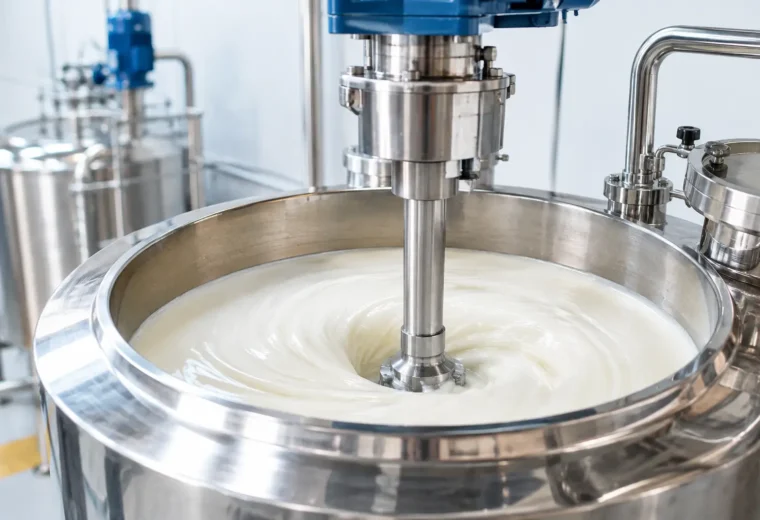
Mixing creates surface renewal, shear, folding, and particle movement. Those mechanisms are necessary for dispersion and uniformity, but they can also pull air into the product. Powders added to liquids commonly trap air in agglomerates. High-viscosity pastes may retain air pockets for long periods because bubbles cannot rise and escape. Even carefully loaded materials can contain dissolved gases that emerge later during heating, coating, filling, or curing.
Applying vacuum lowers the pressure above the product. Gas bubbles expand, migrate, and break at the surface more readily. Dissolved gases can also come out of solution when process conditions allow. In a properly designed vacuum mixer, agitation continually exposes new material to the low-pressure environment instead of allowing a static surface crust or stagnant zone to limit deaeration.
The result is not simply a smoother-looking batch. Reduced entrained air can improve bulk density, coating continuity, pumping consistency, package fill accuracy, and the mechanical properties of the cured or finished product. In formulations such as sealants, battery slurries, composites, silicone compounds, resins, inks, cosmetics, and pharmaceutical pastes, those outcomes can directly affect yield and product acceptance.
Why Mixers Need Vacuum for Moisture and Volatile Control
Vacuum changes evaporation behavior. As pressure falls, the boiling point of water and many solvents falls as well. That allows manufacturers to remove moisture or volatile components at lower product temperatures than would be required at atmospheric pressure.
This matters when heat can damage the formulation. Temperature-sensitive food ingredients, specialty chemicals, polymers, active compounds, and heat-reactive materials may degrade, discolor, lose functionality, or change viscosity when exposed to excessive thermal input. Vacuum enables evaporation at a more controlled temperature, especially when paired with a jacket, internal heating surfaces, or a heated mixing tool.
The objective is not always maximum drying. Some applications require a narrow final moisture range to achieve the required flowability, compressibility, texture, or reaction performance. Others need solvent reduction before packaging or before a subsequent process step. Vacuum gives the operator another controllable variable alongside temperature, mixing speed, and time.
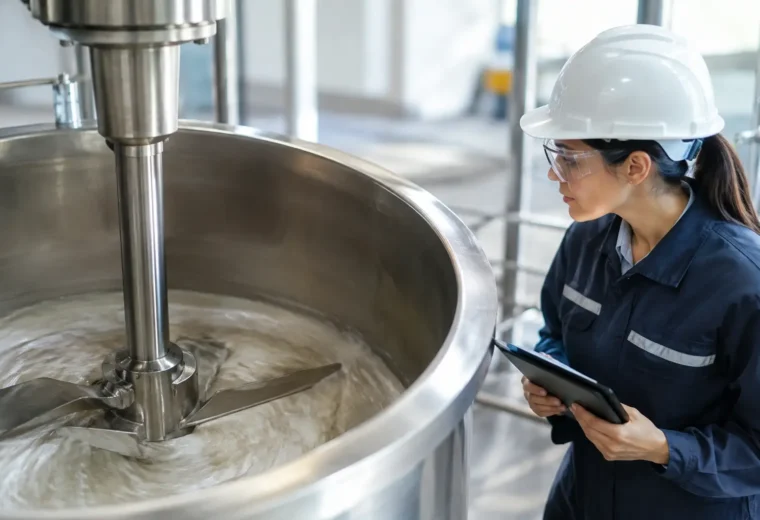
For high-viscosity materials, the mixer design is particularly important. A vessel may be under vacuum and still dry slowly if the agitator does not continually renew the material at heated surfaces and expose it to the vapor space. Multi-shaft, double planetary, sigma, and specialized vacuum drying systems are selected based on rheology, heat-transfer requirements, batch size, and the degree of evaporation required.
Vacuum Is Not a Substitute for Heat Transfer
A common specification mistake is treating vacuum as the entire drying solution. Vacuum lowers the energy required for evaporation, but the energy still must come from somewhere. If the process requires significant moisture or solvent removal, jacket area, heating medium temperature, product turnover, and vapor handling capacity must be evaluated together.
Poor heat transfer can create an extended cycle even with a deep vacuum. Excessive heat can create local overheating even when the average batch temperature appears acceptable. The most effective system balances vacuum level, mixing action, thermal surface area, and residence time around the actual material behavior.
Better Product Quality Begins With Controlled Deaeration
The quality benefits of vacuum vary by product, but the failure mechanisms are familiar across industries. Air changes how a material behaves during processing and after it leaves the mixer.
In coatings and inks, bubbles can cause craters, pinholes, foam, poor gloss, and inconsistent film thickness. In adhesives and sealants, entrained air can reduce bond integrity, create cosmetic defects, and interfere with accurate dispensing. In food products, vacuum mixing may support a denser, more uniform texture while reducing oxidation exposure. For chemical and polymer products, gas removal can improve density consistency and reduce the risk of defects during molding, casting, or curing.
Vacuum can also reduce oxidative exposure when processing materials that are sensitive to oxygen. However, vacuum alone is not always sufficient for oxidation control. Some applications require an inert gas purge, controlled nitrogen blanketing, or a sequence of evacuation and backfilling. The correct approach depends on material sensitivity, safety requirements, reaction chemistry, and acceptable residual oxygen levels.
The Mixer Must Be Engineered for Vacuum Duty
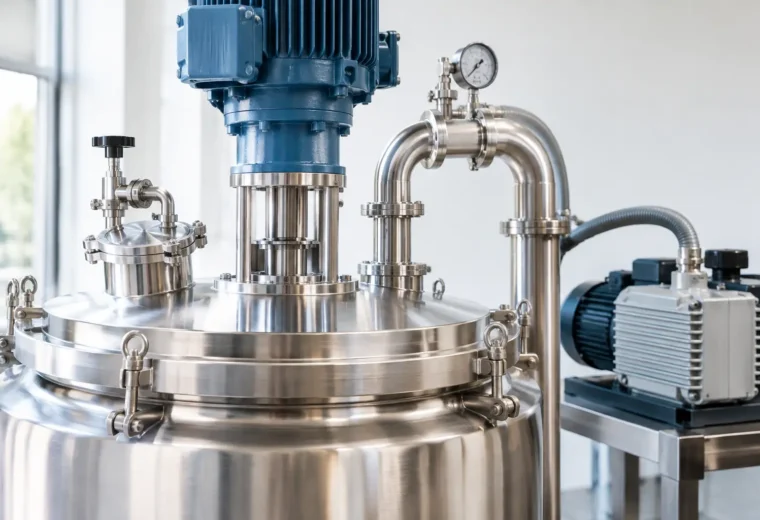
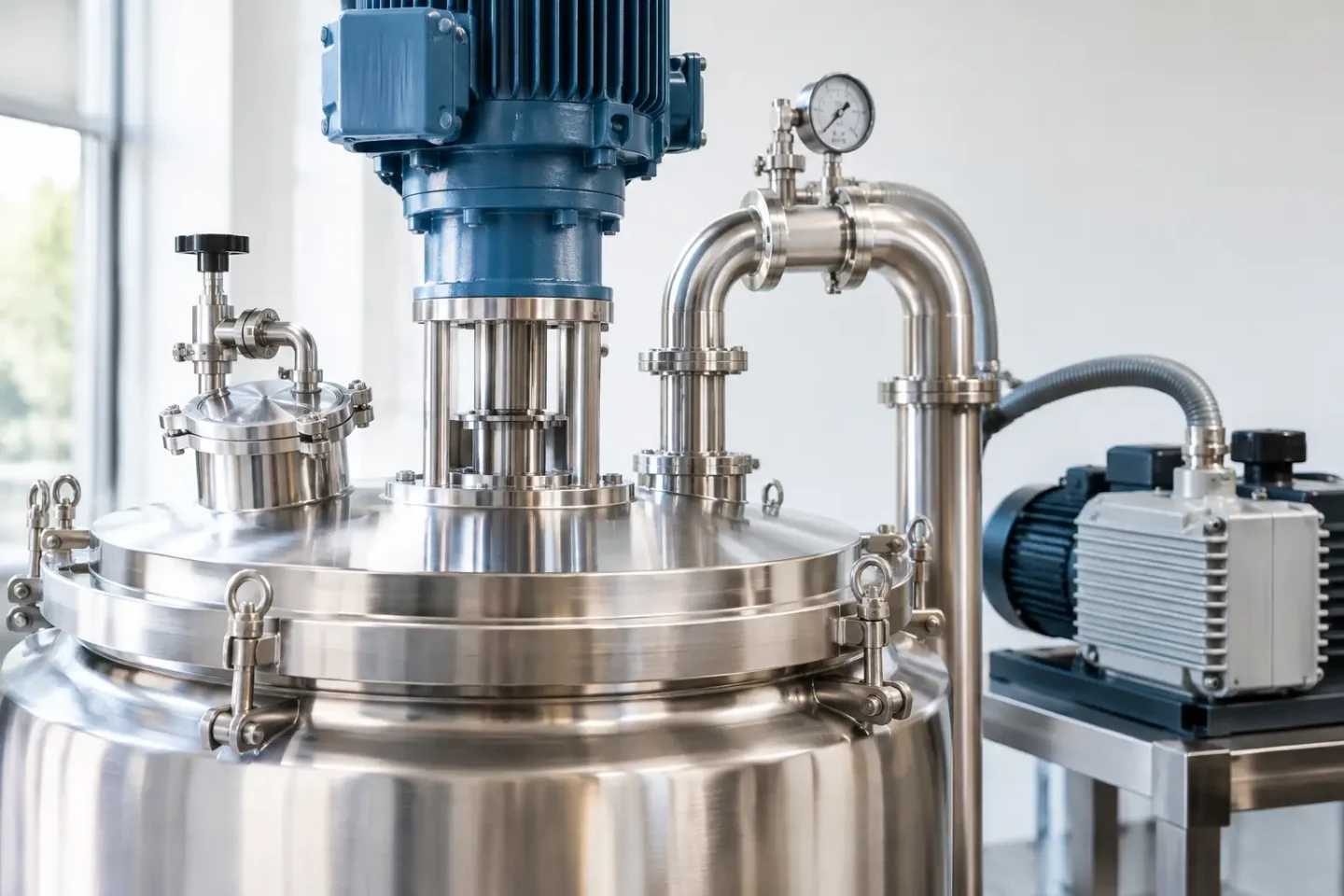
Not every mixer can safely or effectively operate under vacuum. A vacuum-capable system requires more than a sealed lid and a pump connection. The vessel, cover, agitator seals, shaft design, sight glass, instruments, discharge valve, and ancillary piping must be designed for the intended pressure differential and operating temperature.
Mechanical seals deserve close attention. Agitator shafts must maintain seal integrity while handling torque, product pressure, temperature changes, and potentially abrasive or sticky materials. A small air leak can slow deaeration, increase pump run time, and make endpoint control inconsistent. A product leak can create sanitation, maintenance, and safety concerns.
The discharge arrangement matters as well. Products processed under vacuum may be highly viscous, thixotropic, or prone to setting as they cool. The mixer must provide enough discharge force and a practical valve geometry to empty the vessel without excessive manual intervention or unacceptable hold-up. For sanitary applications, cleanability and validation requirements should be addressed before the equipment configuration is finalized.
Selecting the Right Vacuum Mixing Approach
There is no universal vacuum mixer because there is no universal product. The correct equipment begins with a process review rather than a generic horsepower or vessel-volume comparison.
A low-viscosity liquid that needs gentle degassing may be well served by a vacuum-rated agitator vessel with an appropriately sized deaeration headspace. A powder-liquid dispersion may require high shear to break agglomerates before or during vacuum processing. A heavy paste may need the high-torque, full-vessel turnover of a double planetary or sigma mixer. A product requiring substantial solvent removal may need a vacuum dryer or reactor configuration with greater heat-transfer capability.
Several application facts determine the best design:
- Product viscosity across the full batch and temperature range
- Air or gas content, bubble size, and required residual density or void level
- Moisture or solvent removal target and required cycle time
- Heat sensitivity, oxidation sensitivity, and any reaction hazards
- Batch volume, fill level, ingredient addition sequence, and discharge method
- Cleaning method, containment needs, automation requirements, and regulatory standards
These factors also drive vacuum pump selection. A pump must provide suitable ultimate pressure and pumping speed, but it must also tolerate or be protected from vapors, condensables, powders, and carryover. Condensers, cold traps, filters, receivers, and control valves may be necessary to protect the vacuum system and recover valuable solvent where applicable.
When Vacuum May Not Be Necessary
Vacuum adds capital cost, mechanical complexity, and maintenance requirements. If a low-viscosity, non-foaming material has no meaningful air, moisture, or volatile-control requirement, atmospheric mixing may be the more economical choice. In some cases, slow agitation, controlled ingredient addition, or a separate inline deaerator can solve the problem.
The decision should be based on measured product and process requirements, not on a presumption that deeper vacuum is always better. Excessive vacuum can cause violent foaming, loss of desired volatile ingredients, uncontrolled evaporation, or difficult temperature control. A well-engineered process defines the vacuum profile, not just the lowest possible pressure.
PerMix engineers vacuum mixing and processing systems around the material, the production target, and the operating realities of the plant. The most valuable question is not whether a mixer can pull vacuum. It is whether vacuum will produce a measurable improvement in quality, cycle time, yield, or process control for the specific batch.
Before specifying equipment, test the formulation under representative temperature, agitation, and pressure conditions. That work turns vacuum from a feature on a data sheet into a controlled manufacturing advantage.